Sunday, June 13, 2021
30th anniversary reprint
Today is my 30th anniversary in this little house, which has served loyally through snow and wind and insects, despite some long gaps in my attention. THANKS, house!
I'm too weary and disgusted this week to write anything positive, so I'll reprint this from 7 years ago.
= = = = = START REPRINT:
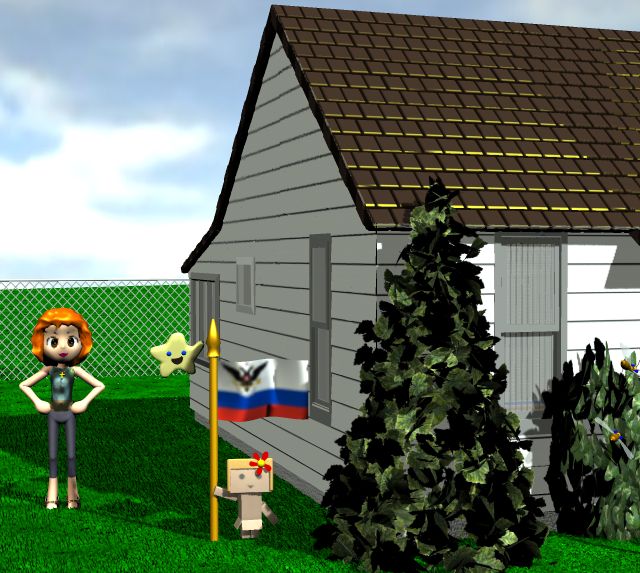 After making a picture of my house in the context of fixing wind damage, I looked back at an earlier entry here in which I traced the history of the house.
Bored without a new work assignment, I decided to look into the first owners, Jim and Bertha Willis. Found them in the 1940 Census, and found obits for both. Jim was born in Howell County, Mo, and Bertha was born in Hazelton, Kan, near Joplin. After Jim and Bertha moved to Spokane in 1909, they first bought (or built?) a house three blocks south of here. I'm guessing 'built' because that house was built in 1910 and has a distinctly Missoura look. It still exists and I see it every day on my walks. I've noticed it because it's next door to this slow construction project which still isn't finished.
Jim then bought or built this house in 1948. It's not clear why they wanted to 'downsize' out of a bigger and better house.
Jim's birthplace in Howell County struck a note, because that's where my father's folks lived before they wandered out to Okla.
Back to the Census. Grandpa and Jim wouldn't be there in 1940, but I hoped to find some indication of the names. Grandpa was born in West Plains, and Jim's obit listed Mountain View. Neither of those cities contained any of either name in 1940. But one township NE of West Plains contained a whole pile of Willises AND a whole pile of my father's folks. They were neighbors!
No wonder this house suits me.
= = = = =
Semi-related sidenotes: (1) It's unlikely that my father's folks ever lived inside the urbane cosmopolitan metropolis of West Plains. Once he told about visiting some of them in the late '40s. They ran a ramshackle semi-farm "way out in the sticks" and they had never gotten around to building an outhouse. Peeing off the porch and pooping in the bushes was good enough for them. (2) The Census for Howell County included a place called Shanty Town. Haven't yet figured out where it was. It consisted mainly of Alsups and DeBoards, both of whom clearly favored VERY large families. (3) Broadly, Howell County resembles the Okla counties I searched earlier. Single-person households were extremely rare, maybe 2% of all households. Income correlated negatively with number of children, and domestic servants were common in middle-class homes. (4) One pattern that I didn't see in Okla: A correlation between names and income. Occupants of the more expensive houses or farms had hard clattery Yankee names like Victor or Ted or Katy or Rebecca. Names you can punch a timeclock with. Everyone else had soft Missoura names like Earl or Wade or Eula or Pearline. Names you can spend some time with.
= = = = = END REPRINT.
Also about the neighborhood: here and here.
After making a picture of my house in the context of fixing wind damage, I looked back at an earlier entry here in which I traced the history of the house.
Bored without a new work assignment, I decided to look into the first owners, Jim and Bertha Willis. Found them in the 1940 Census, and found obits for both. Jim was born in Howell County, Mo, and Bertha was born in Hazelton, Kan, near Joplin. After Jim and Bertha moved to Spokane in 1909, they first bought (or built?) a house three blocks south of here. I'm guessing 'built' because that house was built in 1910 and has a distinctly Missoura look. It still exists and I see it every day on my walks. I've noticed it because it's next door to this slow construction project which still isn't finished.
Jim then bought or built this house in 1948. It's not clear why they wanted to 'downsize' out of a bigger and better house.
Jim's birthplace in Howell County struck a note, because that's where my father's folks lived before they wandered out to Okla.
Back to the Census. Grandpa and Jim wouldn't be there in 1940, but I hoped to find some indication of the names. Grandpa was born in West Plains, and Jim's obit listed Mountain View. Neither of those cities contained any of either name in 1940. But one township NE of West Plains contained a whole pile of Willises AND a whole pile of my father's folks. They were neighbors!
No wonder this house suits me.
= = = = =
Semi-related sidenotes: (1) It's unlikely that my father's folks ever lived inside the urbane cosmopolitan metropolis of West Plains. Once he told about visiting some of them in the late '40s. They ran a ramshackle semi-farm "way out in the sticks" and they had never gotten around to building an outhouse. Peeing off the porch and pooping in the bushes was good enough for them. (2) The Census for Howell County included a place called Shanty Town. Haven't yet figured out where it was. It consisted mainly of Alsups and DeBoards, both of whom clearly favored VERY large families. (3) Broadly, Howell County resembles the Okla counties I searched earlier. Single-person households were extremely rare, maybe 2% of all households. Income correlated negatively with number of children, and domestic servants were common in middle-class homes. (4) One pattern that I didn't see in Okla: A correlation between names and income. Occupants of the more expensive houses or farms had hard clattery Yankee names like Victor or Ted or Katy or Rebecca. Names you can punch a timeclock with. Everyone else had soft Missoura names like Earl or Wade or Eula or Pearline. Names you can spend some time with.
= = = = = END REPRINT.
Also about the neighborhood: here and here.


After making a picture of my house in the context of fixing wind damage, I looked back at an earlier entry here in which I traced the history of the house.
Bored without a new work assignment, I decided to look into the first owners, Jim and Bertha Willis. Found them in the 1940 Census, and found obits for both. Jim was born in Howell County, Mo, and Bertha was born in Hazelton, Kan, near Joplin. After Jim and Bertha moved to Spokane in 1909, they first bought (or built?) a house three blocks south of here. I'm guessing 'built' because that house was built in 1910 and has a distinctly Missoura look. It still exists and I see it every day on my walks. I've noticed it because it's next door to this slow construction project which still isn't finished.
Jim then bought or built this house in 1948. It's not clear why they wanted to 'downsize' out of a bigger and better house.
Jim's birthplace in Howell County struck a note, because that's where my father's folks lived before they wandered out to Okla.
Back to the Census. Grandpa and Jim wouldn't be there in 1940, but I hoped to find some indication of the names. Grandpa was born in West Plains, and Jim's obit listed Mountain View. Neither of those cities contained any of either name in 1940. But one township NE of West Plains contained a whole pile of Willises AND a whole pile of my father's folks. They were neighbors!
No wonder this house suits me.
= = = = =
Semi-related sidenotes: (1) It's unlikely that my father's folks ever lived inside the urbane cosmopolitan metropolis of West Plains. Once he told about visiting some of them in the late '40s. They ran a ramshackle semi-farm "way out in the sticks" and they had never gotten around to building an outhouse. Peeing off the porch and pooping in the bushes was good enough for them. (2) The Census for Howell County included a place called Shanty Town. Haven't yet figured out where it was. It consisted mainly of Alsups and DeBoards, both of whom clearly favored VERY large families. (3) Broadly, Howell County resembles the Okla counties I searched earlier. Single-person households were extremely rare, maybe 2% of all households. Income correlated negatively with number of children, and domestic servants were common in middle-class homes. (4) One pattern that I didn't see in Okla: A correlation between names and income. Occupants of the more expensive houses or farms had hard clattery Yankee names like Victor or Ted or Katy or Rebecca. Names you can punch a timeclock with. Everyone else had soft Missoura names like Earl or Wade or Eula or Pearline. Names you can spend some time with.
= = = = = END REPRINT.
Also about the neighborhood: here and here.
Labels: Heimatkunde, Shack people - Cottage people
¶ 11:52 AM
Saturday, January 16, 2021
Storm note
Just for the record, we had a major windstorm here 1/13 morning. This neighborhood wasn't the main target; only a couple full trees down, lots of branches busted. Houses and roofs untouched. Previous windstorms ruined many roofs.
Power out for 3 days, managed with propane as usual. Thinking about getting a natural gas hookup to avoid the hassle.... also, cooking with propane always reminds me of the absolute superiority of gas over electric cooking.
Labels: Heimatkunde, TMI
¶ 3:26 PM
Monday, January 04, 2021
Lost and more lost
Previous item focused on technologies and skills that were lost and MUCH later rediscovered.
One technology that hasn't been rediscovered yet is education. USA lost it 100 years ago, and we continue to make it WORSE every year. Every 'reform' or 'wakeup call' leads to LESS experiential training and MORE insane bizarre delusional THEORIES.
In 2020 we deleted schools entirely, which is the first move that could conceivably open the way to restarting from the proper angle. Of course we won't.
I was reminded yet again of the pre-1910 sanity by the chance encounter with Geographical Spice, written in 1893 by Eliza Morton.
'Spice' was just a supplement to her main geography book. The main book is full of sanity, viewing life as PURPOSE. It's a textbook of Natural Law.
The intro laid out the experience-based approach, which was typical of the era:
First — The Teacher's Edition gives a complete General Outline of Oral Instruction for Primary Schools, also a Model Oral Lesson and subject matter with definite outlines for one hundred or more oral exercises, adapted to Intermediate Classes. Second — The teacher is not only advised to use material objects, pictures, and blackboard sketches for illustrations, but is told just what to employ in connection with each lesson. The Supplement contains a fund of valuable information for the teacher's use. Third — The pupil is not required to deal with printed words until they have been vitalized by the voice of the living teacher and made suggestive of ideas. Fourth — The subject matter has been selected with reference to the principle that the earth is an organism governed by laws which children may be led to discover one by one; hence the physical side of Geography is made prominent, and the most interesting facts are linked together in a way to impress the mind by the power of association and to lay a firm foundation for the study of the political features of the world.Printed words are vitalized by the voice of the living teacher. A powerful word for a powerful concept. One more thing we've lost this year. LIVING teachers, even if not especially talented, are better than books. On animals:
Animals seem to be made for their homes and manner of life. Birds have hollow bones and boat-shaped bodies which enable them to float easily in the air. Their covering is such as to keep them warm and yet very light. Birds that swim have an oil about their feathers which keep them from being soaked with water. Birds that fly high in the air have eyes like telescopes and can see objects a mile or more away. Birds that wade in the water have long legs so that they can walk in swamps among the reeds and rushes. Fishes have long, slender, flat bodies which cut through the water easily. They are clothed with smooth scales which are kept oiled so that they can glide along swiftly. Their eyes are covered with a transparent skin to keep out the water. Animals have tools and weapons of defence, and seem to follow different trades. The woodpecker has a drill. The elephant has digging tools. The mole has a ploughing machine. The beaver is a carpenter and a mason. The silkworm and spider are spinners. The wasp is a papermaker. Some birds are fishermen. The tailor bird is a seamstress. One kind of fish is a hunter. Animals seem to think about what they see, hear, and feel, and some learn more than others, yet they have no new fashions and contrive no new ways of performing work as men do.On plants:
Plants are much like animals. They move, eat, drink, breathe, and sleep. Climbing plants twist themselves around any support at hand. Some flowers turn their faces always to the light. In parts of Brazil the ground is covered with sensitive plants, which when touched close their leaves. Plants take food through millions of little mouths in their roots, and suck water from the ground. They breathe through their leaves. Some plants, if chilled by the cold or kept where a light is left burning, will not go to sleep. When the cold weather comes, some plants go to sleep for the winter as do bears and a few other animals. Plants have sap which circulates up and down through their branches, as blood does through the veins and arteries of animals.On language:
All people do not speak the same language. The Bible tells us that there was a time when everybody talked alike, but the people were very wicked and gathered together on a great plain to make a Tower, the top of which should reach heaven, and God, being displeased, confused their language, so of course they could not build the tower.On human skills and Natural Law:
Hundreds of men have helped make and prepare the clothes we wear, the furniture we use, and the food we eat. We cannot get along without the help of others. Alone we could accomplish but very little. Since we are dependent upon others for many things we should not feel above them, but treat everyone kindly, doing all the good we can in the world .Modern "liberals" would burn this book for its constant references to God and PURPOSE. Modern "conservatives" would burn this book for its insistence that we should treat others kindly instead of slaughtering them, and the earth is an organism, and because the book never mentions the speeches of Cicero or the Peloponnesian War, which are the ONLY THINGS STUDENTS SHOULD EVER LEARN.
Labels: Experiential education, Heimatkunde, Natural law = Sharia law, skill-estate
¶ 2:46 AM
Saturday, June 27, 2020
Inancienation
I've used the above word once before, and the bots that "read" this blog seem to like it, since it provides a unique search term. So I'll satisfy their tastes again.
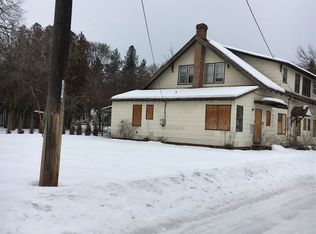
For the last ten years I've been tracking the decay and renovation of a vacant apt bldg in this neighborhood.
Here's how it looked for many years:
 Here's the fake start of renovation about two years ago:
 And the first demo about six months ago:
 Now they're FINALLY working steadily. They've closed off some windows and reshaped others, and reframed the inner walls.
This week they did something innovative, or rather inancienative.
Now they're FINALLY working steadily. They've closed off some windows and reshaped others, and reframed the inner walls.
This week they did something innovative, or rather inancienative.
 They tore off the rotten old porch cover on the left and replaced it with an EXACT REPLICA of the nicer porch on the right. Respecting the original designer. My crappy picture doesn't do it justice. All the dimensions and bevels are exact.
Good work!
Random stupid thought: If copyright laws applied to architecture, this form of respect and symmetry would be illegal. According to county records this apt was built in 1923, just after the Steamboat Willie line specified by the Disney-owned copyright "law". All additions would have to be mismatched.
They tore off the rotten old porch cover on the left and replaced it with an EXACT REPLICA of the nicer porch on the right. Respecting the original designer. My crappy picture doesn't do it justice. All the dimensions and bevels are exact.
Good work!
Random stupid thought: If copyright laws applied to architecture, this form of respect and symmetry would be illegal. According to county records this apt was built in 1923, just after the Steamboat Willie line specified by the Disney-owned copyright "law". All additions would have to be mismatched.
Here's the fake start of renovation about two years ago:
And the first demo about six months ago:
Now they're FINALLY working steadily. They've closed off some windows and reshaped others, and reframed the inner walls.
This week they did something innovative, or rather inancienative.
They tore off the rotten old porch cover on the left and replaced it with an EXACT REPLICA of the nicer porch on the right. Respecting the original designer. My crappy picture doesn't do it justice. All the dimensions and bevels are exact.
Good work!
Random stupid thought: If copyright laws applied to architecture, this form of respect and symmetry would be illegal. According to county records this apt was built in 1923, just after the Steamboat Willie line specified by the Disney-owned copyright "law". All additions would have to be mismatched.Labels: Heimatkunde, Patient things
¶ 7:32 AM
Friday, June 19, 2020
A note on masks and castes
Back on Feb 20 I noticed that this neighborhood was resisting the panic. This is a solid Deplorable zone. Four months of Hell later, nothing has changed here, and the caste link is more strongly visible every day.
As the bus goes toward downtown, humans get on in this neighborhood. Farther south, Mascoid Aliens start to show up. Most of the Mascoids are posing as "female" "humans" of the upwardly mobile type.
From the start, the humans have made a point of being extra friendly to other humans, as the Mascoids look down on us with grim contempt.
I'd always been jealous of smokers, who had a similar fraternity of underdogs for the last 20 years. Now I know how they felt.
= = = = =
Later afterthought: The total counted deaths from the Haute-Couture Branded Flu in Spokane County is 37, out of a population of 300k. This is much less than the number of suicides in the same four months. It hasn't moved lately, while the GENOCIDALLY STUPID "count" of "cases" continues to "climb", which motivates GENOCIDAL HOLOCAUSTAL BLOODTHIRSTY MONSTER BOB LUTZ to keep us in the current SubPhase of Holocauster Inslee's precisely enumerated and decimalized Hell. Needless to say, most of those 37 deaths were in two nursing homes. One of those nursing homes is in the VA complex at the west end of this neighborhood. So this area would count as a hot spot if the virus really mattered to anyone outside of a nursing home. The prevailing winds would have COATED this area with SPARKLING ORANGE WITCH POWDER, and all the horribly unmasked HUMANS would have been dead long ago.
Sarc off and real science on. Undoubtedly the virus has been floating around here longer than most other parts of town, exhaled from the vents and doors of the nursing home, and we HUMANS have been handling the virus as HUMANS always do, the way animals have been doing for A BILLION FUCKING YEARS. Our infinitely resourceful IMMUNE SYSTEMS have been reading the virus particles, checking their arsenal of ammo, modifying and reloading T-cells as needed, and quietly repelling the invaders. THIS IS HOW LIFE WORKS.
Labels: Heimatkunde
¶ 6:59 AM
Wednesday, April 01, 2020
Surfing a tsunami
In the last few years my vestibular system has been acting up, especially when I get overstressed or undersleeped. It's a useful negative feedback signal.
Last night around 5pm, just after I made the AVOIDABLE MISTAKE of paying attention to the panicators, I got a huge wobble.
 No, wait. This isn't normal. It's going on for 30 seconds, and it feels truly physical, not just perceptual. Sure enough, the hanging pot in the living room was swinging to beat the band. I checked SpokaneNews facebook, and again sure enough, lots of reports were coming in.
The pattern of the reports is interesting. The South Hill, mounted on granite, didn't feel much. Everyone who lives over the aquifer got rocked.
In other words, we were surfing a tsunami in the aquifer.
No, wait. This isn't normal. It's going on for 30 seconds, and it feels truly physical, not just perceptual. Sure enough, the hanging pot in the living room was swinging to beat the band. I checked SpokaneNews facebook, and again sure enough, lots of reports were coming in.
The pattern of the reports is interesting. The South Hill, mounted on granite, didn't feel much. Everyone who lives over the aquifer got rocked.
In other words, we were surfing a tsunami in the aquifer.
No, wait. This isn't normal. It's going on for 30 seconds, and it feels truly physical, not just perceptual. Sure enough, the hanging pot in the living room was swinging to beat the band. I checked SpokaneNews facebook, and again sure enough, lots of reports were coming in.
The pattern of the reports is interesting. The South Hill, mounted on granite, didn't feel much. Everyone who lives over the aquifer got rocked.
In other words, we were surfing a tsunami in the aquifer.Labels: Heimatkunde, Metrology
¶ 12:05 AM
Tuesday, March 17, 2020
Neighborhood notes
Meanwhile, here on the ground, we finally have a good stretch of decent weather after last week's surprise snow. The neighborhood kids are taking advantage of their early summer vacation to play basketball in the street. Healthy and sane.
Labels: Heimatkunde
¶ 3:50 PM
Sunday, March 08, 2020
AMLO again
Can you imagine any US politician doing this?
AMLO knows and loves every piece of his country and every year of its history, and knows and loves every one of his people.
[I often use the Heimatkunde tag loosely for 'stuff that pertains to this neighborhood', but in this case the word is exact.]
Labels: Heimatkunde
¶ 7:55 AM
Friday, March 06, 2020
Not especially interesting
Earlier I noted that this part of town is not panicking about the Branded Swine Flu. Still the same today. No masks, no signs of 'isolation', no discussion of the topic.
No empty shelves in Safeway, nothing out of stock, BUT one little piece of Security Theater. The checkers are wearing latex food-handling gloves. Today's checker spoiled the act by blowing his nose into a rag and stuffing the rag back under the register. No problem, it's just Theater.
Semi-related, one vaguely encouraging sign from elsewhere. All paid opinion-mongers in the world are working for Soros, running the usual Robust Debate on this topic. There is only one side. The "opponents" are not arguing about the premise, merely bidding up the panic and bidding up the kill count. But the unpaid folks, EVEN INSIDE THE WORLD OF STOCK DEMONS, are not fooled. This item at ZH tries to kill common sense along with Deplorables, but many of the commenters are knocking down the premise with proper uses of statistics.
Labels: Entertainment, Heimatkunde
¶ 9:07 AM
Wednesday, March 04, 2020
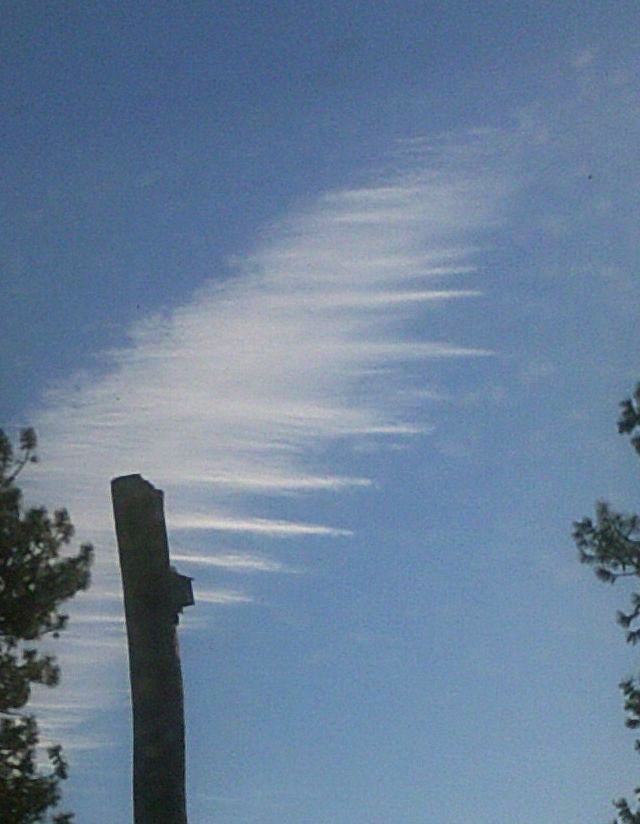
Comb-over cloud
I don't pay much attention to clouds, but this one caught my eye.
Labels: Heimatkunde
¶ 10:57 AM
Friday, February 28, 2020
Real membership
ZH headline: Walmart developing membership program to rival Amazon's Prime
Real membership has nothing to do with Big Data. I've never succumbed to the "loyalty card" shit at Safeway and always pay cash. Despite this, the checkers know me in a non-digital non-verbal Real Data way.
Yesterday I bought my usual Purina Bachelor Chow and slapped the $20 bill on the counter as usual. The checker lady, who had never conversed with me before, said: "Think you're going to make it under 20 today?" I said "Nope, the toothpaste will take it over." She said "Yup." And sure enough, the toothpaste took it from $18 to $23.
Real Data. She knows what I buy and what I'm thinking. If I depart from my habits drastically, the checkers will notice it. I'm a member.
Labels: Heimatkunde
¶ 11:46 PM
Thursday, February 20, 2020
Will be interesting
Apparently an "unknown number" of Swine Flu cases have been transported to Spokane via high-security military aircraft. They may be from one of the idiot cruise ships**. It's no big deal here; I didn't know about it until I read it in one of the NYC stock demon twits.
 Shorts and longs, all paid by the same master, working together to drive the "economy" ever upward.
It will be interesting to see if there's any response here, any masks or panic.
There won't be any response in this neighborhood. No snowflakes here. Hump up and take it types. Working-class whites, old vets, Russian emigres, Injuns, blacks. The snowflakes are in Browne's Addition and the new Kendall Yards 'urban haven'.
I'm more worried about the response by schizies. A certain type of schizy feels the need to participate in Official Terrorist Events. Sacred Heart has the isolation unit where the Swine Flu patients are arriving, and (I think) Sacred Heart also has a psych ward with occasionally troublesome schizies.
= = = = =
** Cruise ships are ALWAYS virus incubators. Many cruises are halted when a stomach virus takes over. I can't BEGIN to understand why anyone would want to spend thousands of dollars to mingle with thousands of idiots, all pretending to have fun, inviting all sorts of trouble. Hurricanes, diseases, pirates, capsizing. Nature takes revenge on such idiots. Unfortunately the rest of us end up paying for the revenge.
= = = = =
Later after the usual store trip: Yup. As predicted, no panic, no masks, no conversation about flu. People sneezing and coughing as usual without covering mouth, nobody worrying about it.
Equally predictably, the demon media are doing their genocidal job of creating panic and chaos and crime:
Shorts and longs, all paid by the same master, working together to drive the "economy" ever upward.
It will be interesting to see if there's any response here, any masks or panic.
There won't be any response in this neighborhood. No snowflakes here. Hump up and take it types. Working-class whites, old vets, Russian emigres, Injuns, blacks. The snowflakes are in Browne's Addition and the new Kendall Yards 'urban haven'.
I'm more worried about the response by schizies. A certain type of schizy feels the need to participate in Official Terrorist Events. Sacred Heart has the isolation unit where the Swine Flu patients are arriving, and (I think) Sacred Heart also has a psych ward with occasionally troublesome schizies.
= = = = =
** Cruise ships are ALWAYS virus incubators. Many cruises are halted when a stomach virus takes over. I can't BEGIN to understand why anyone would want to spend thousands of dollars to mingle with thousands of idiots, all pretending to have fun, inviting all sorts of trouble. Hurricanes, diseases, pirates, capsizing. Nature takes revenge on such idiots. Unfortunately the rest of us end up paying for the revenge.
= = = = =
Later after the usual store trip: Yup. As predicted, no panic, no masks, no conversation about flu. People sneezing and coughing as usual without covering mouth, nobody worrying about it.
Equally predictably, the demon media are doing their genocidal job of creating panic and chaos and crime:
 = = = = =
Next day: Yup, here we go with the schizies!
= = = = =
Next day: Yup, here we go with the schizies!
Shorts and longs, all paid by the same master, working together to drive the "economy" ever upward.
It will be interesting to see if there's any response here, any masks or panic.
There won't be any response in this neighborhood. No snowflakes here. Hump up and take it types. Working-class whites, old vets, Russian emigres, Injuns, blacks. The snowflakes are in Browne's Addition and the new Kendall Yards 'urban haven'.
I'm more worried about the response by schizies. A certain type of schizy feels the need to participate in Official Terrorist Events. Sacred Heart has the isolation unit where the Swine Flu patients are arriving, and (I think) Sacred Heart also has a psych ward with occasionally troublesome schizies.
= = = = =
** Cruise ships are ALWAYS virus incubators. Many cruises are halted when a stomach virus takes over. I can't BEGIN to understand why anyone would want to spend thousands of dollars to mingle with thousands of idiots, all pretending to have fun, inviting all sorts of trouble. Hurricanes, diseases, pirates, capsizing. Nature takes revenge on such idiots. Unfortunately the rest of us end up paying for the revenge.
= = = = =
Later after the usual store trip: Yup. As predicted, no panic, no masks, no conversation about flu. People sneezing and coughing as usual without covering mouth, nobody worrying about it.
Equally predictably, the demon media are doing their genocidal job of creating panic and chaos and crime:
= = = = =
Next day: Yup, here we go with the schizies!Labels: Heimatkunde, Shared Lie
¶ 4:47 PM
Tuesday, February 11, 2020
Full moon
From the last 24 hours on Spokane News:
3100 East 43rd, reported 21 year old is arguing with his mother about laundry and so he has called 911.
WSP trying to catch up to a speeding vehicle going 103 mph northbound on the NSC from Parksmith.
Monroe Street Bridge Police and Medical activity for a mental situation with a person on the bridge. Situation is under control on the bridge.
7500 North Division, Reported male taking off his clothes and laying down in the drive thru.
Barker and Broadway, Reported a Chicken in the roadway playing the chicken game with vehicles causing a traffic issue.
Division and Glass, Vehicle Collision Reported. #Update from WSP: Crash involving wrong way driver with stolen vehicle who failed to yield to trooper and hit a building.
And finally, since I seem to be focusing on power lines today,
10200 East Montgomery, Vehicle Collision Reported. #Update Semi vs Power lines and lines down. Montgomery is closed.
 The truck snagged a low-hanging line and towed a whole block of wires and poles.
The truck snagged a low-hanging line and towed a whole block of wires and poles.Labels: Heimatkunde
¶ 8:27 AM
Saturday, January 11, 2020
Just for my records
I've been keeping track of this for many years, so might as well continue the habit. Yesterday was the first SERIOUS snow of the season, about 7 inches. Today, first roof raking of the season. Much easier without the ladder. No big deal.
1/16 second raking of the season.
March: Looks like that's all. Thie was a nice non-rakey winter. Total snow was 41 inches, just a bit under average. The storms were more spread out than usual, with more warmish gaps between storms, so the snow didn't accumulate as much.
Labels: Heimatkunde, Metrology
¶ 12:56 PM
Tuesday, December 31, 2019
Snow scene
First real snow of the season today, about 5 inches. "Weather" bureau fucked up as usual, predicting less than one inch. Greta says we're BURNING, so we can't possibly have snow. "City" dysgovernment fucked up as usual, failing to plow.
Despite the fuckups, a proper family-style snow scene just passed by. A happy train: dog pulling dad, dad pulling kid on sled, everyone enjoying the run.
Labels: defensible times, Heimatkunde
¶ 9:49 AM
Saturday, December 21, 2019
Neighborhood note
For some reason the local homeowners aren't doing Xmas lights this year. Only a handful of lit houses. The usual annoying suspects are dark.
Can't think of a good reason. We haven't been hit by any disasters this year. The economy seems to be a bit better than usual by my measurements. Less vacant stores on NW Blvd, less parked RVs substituting for housing.
This winter is EASY so far. Only a few bite-size snowstorms, each melting quickly. Total around 12 inches. Normally we'd have 30 inches by now. Temp yesterday was 52, right now 50.
It's a puzzle.
Labels: Asked and unanswered, Heimatkunde
¶ 8:12 AM
Thursday, September 26, 2019
Where are the aphids?
Just putting down a reminder to self. Today appears to be the last warmish day of the year. The weather bureau sees nothing but 40s and 50s for the next few weeks, and downhill from there. I pulled out the air conditioner today.
Where are the aphids? Normally they mark the last warmish day, which varies from end of Sept to end of Oct. I haven't seen even one this fall.
The aphids haven't missed yet. If they're right, we still have a few warm days ahead.
10/16: They were right as always. Can't get ahead of Ma Nature.
Labels: Heimatkunde
¶ 9:36 AM
Friday, August 23, 2019
Fake "protection"
TAC still has some pretty good articles on urban planning along with the newer Sorosian crap. This article gives the history of college dormitories, which isn't really as surprising as the headline says.
Dorms were supposed to protect students from the corrupting influence of town life. They were especially meant to protect the girls.
Phillips in Enid was a small Christian college, advertising itself as a refuge from big-city iniquity. The campus was a perfect example of the alleged intention and the real-life failure.
Since I'm in blinkyGIF mode this week, here's another one.
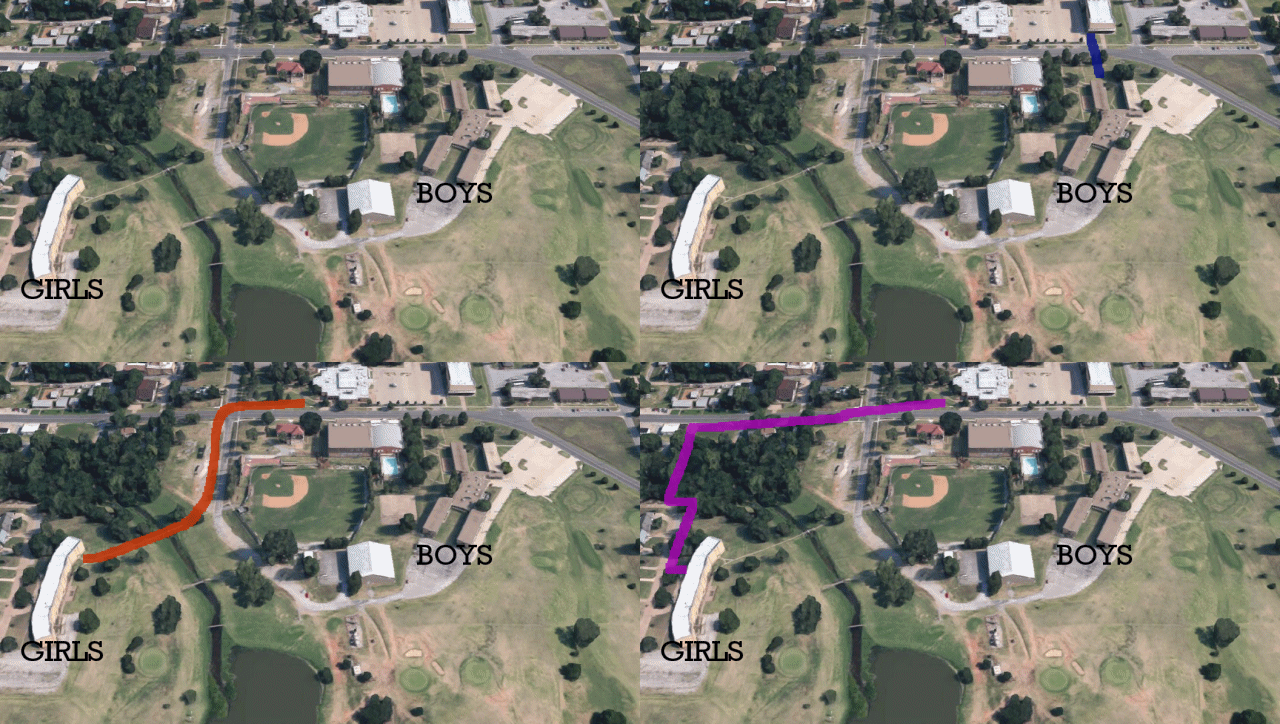 The classroom buildings are at the north of this view. Phillips was just four square blocks containing about six main buildings. Nice compact campus, not much walking needed.
The boys dorm (lower right) was right across the street from campus (blue path), and it was a typical one-story '50s school building. From the nearest classroom to a dorm room was about one block of flat walking.
The girls dorm (lower left) was an old three-story brick building without an elevator. It was "protected" from the boys by the valley, which is a lot deeper than this view shows. The main route (orange path) went south on a rutted gravel road past the college maintenance department, then down a steep unlighted hill to the narrow bridge across the creek, then up the same hill to the dorm. The alternate path (purple) was better lit but equally hilly. You walked two blocks west DOWNhill along Maine, passed a car repair shop and a sleazy no-tell mo-tell, then turned steeply UPhill on 19th, east on Cherokee, south on Lakeview, and finally into the dorm.
Distance wasn't the problem; big campuses require all students to walk vastly longer distances. The fake "protection" was the problem. Boys could get to campus without ever leaving lighted and safe areas. Girls had to pass through an unsafe area day or night.
= = = = =
City planners always believe that public parks and greenbelts are good for safety and health. Lethally false. In Spokane the planners gave us the long Centennial Trail, allegedly ideal for walkers. It's also ideal for muggers and rapists, who can hide in the bushes and watch the steady flow of traffic for a likely victim.
Walking on ordinary streets is safer for the walker, and ALSO helps to keep the neighborhood safe. Walkers who are IN THEIR OWN TERRITORY are quick to detect suspicious situations, and muggers can't find a secure hiding place on private property next to an occupied house.
The classroom buildings are at the north of this view. Phillips was just four square blocks containing about six main buildings. Nice compact campus, not much walking needed.
The boys dorm (lower right) was right across the street from campus (blue path), and it was a typical one-story '50s school building. From the nearest classroom to a dorm room was about one block of flat walking.
The girls dorm (lower left) was an old three-story brick building without an elevator. It was "protected" from the boys by the valley, which is a lot deeper than this view shows. The main route (orange path) went south on a rutted gravel road past the college maintenance department, then down a steep unlighted hill to the narrow bridge across the creek, then up the same hill to the dorm. The alternate path (purple) was better lit but equally hilly. You walked two blocks west DOWNhill along Maine, passed a car repair shop and a sleazy no-tell mo-tell, then turned steeply UPhill on 19th, east on Cherokee, south on Lakeview, and finally into the dorm.
Distance wasn't the problem; big campuses require all students to walk vastly longer distances. The fake "protection" was the problem. Boys could get to campus without ever leaving lighted and safe areas. Girls had to pass through an unsafe area day or night.
= = = = =
City planners always believe that public parks and greenbelts are good for safety and health. Lethally false. In Spokane the planners gave us the long Centennial Trail, allegedly ideal for walkers. It's also ideal for muggers and rapists, who can hide in the bushes and watch the steady flow of traffic for a likely victim.
Walking on ordinary streets is safer for the walker, and ALSO helps to keep the neighborhood safe. Walkers who are IN THEIR OWN TERRITORY are quick to detect suspicious situations, and muggers can't find a secure hiding place on private property next to an occupied house.
The classroom buildings are at the north of this view. Phillips was just four square blocks containing about six main buildings. Nice compact campus, not much walking needed.
The boys dorm (lower right) was right across the street from campus (blue path), and it was a typical one-story '50s school building. From the nearest classroom to a dorm room was about one block of flat walking.
The girls dorm (lower left) was an old three-story brick building without an elevator. It was "protected" from the boys by the valley, which is a lot deeper than this view shows. The main route (orange path) went south on a rutted gravel road past the college maintenance department, then down a steep unlighted hill to the narrow bridge across the creek, then up the same hill to the dorm. The alternate path (purple) was better lit but equally hilly. You walked two blocks west DOWNhill along Maine, passed a car repair shop and a sleazy no-tell mo-tell, then turned steeply UPhill on 19th, east on Cherokee, south on Lakeview, and finally into the dorm.
Distance wasn't the problem; big campuses require all students to walk vastly longer distances. The fake "protection" was the problem. Boys could get to campus without ever leaving lighted and safe areas. Girls had to pass through an unsafe area day or night.
= = = = =
City planners always believe that public parks and greenbelts are good for safety and health. Lethally false. In Spokane the planners gave us the long Centennial Trail, allegedly ideal for walkers. It's also ideal for muggers and rapists, who can hide in the bushes and watch the steady flow of traffic for a likely victim.
Walking on ordinary streets is safer for the walker, and ALSO helps to keep the neighborhood safe. Walkers who are IN THEIR OWN TERRITORY are quick to detect suspicious situations, and muggers can't find a secure hiding place on private property next to an occupied house.Labels: defensible spaces, Heimatkunde
¶ 5:36 AM
Sunday, August 18, 2019
Amazing!
Every year Spokane Transit makes major adjustments to its routes. Until this year, those adjustments always made life harder for this part of town. This year's change was proposed to be the worst of all, removing a route entirely from this neighborhood. Apparently I wasn't the only one who complained, and AMAZINGLY they listened to the complaints! They left the routes in place!
Thanks, STA, for staying your hand and letting some Deplorables live for a while longer.
Labels: Heimatkunde
¶ 12:21 AM
Thursday, August 08, 2019
Plums
Noticed while taking out the trash... The small trees on the west side of my lot have produced exactly three plums. I don't see any others, just one branch with a cluster of three neat little plums.
In the 1990s these trees were active producers, but gave up at some point. Fruit trees do that as part of aging. This spring and summer have been strictly average, resembling the 1990s. Lots of cool days in summer, until this week which is the strictly average few days of 100s. Not sure if that has any connection. It's not the fanatically sprinkling neighbor; he's on the opposite side of the lot.
Labels: Heimatkunde
¶ 11:41 AM

