What is $40 billion?
In a
wonderfully funny article about the idiots who fell for the DAO "constitution" scam, Vice says:
DAO governance tokens are themselves a $40 billion market.
What are governance tokens? Nothing. They say that you have paid money to the scammer. That's all. The scammer can let you "vote" on the subject of the "smart contract" or not, as he wishes.
In 1948, $40 billion was the entire fucking budget of the United Fucking States. Or more precisely it was Truman's proposed budget, and the Repooflicans were bitching that it would drive us into bankruptcy as fucking always.
Granted, inflation since then is about 10, so the figure is really $400 billion.
Even after adjustment, the DAO shit is genuinely equal to the
non-defense parts of the entire fucking government in 1948, and it does precisely nothing.
DAO is a super-complicated overload of the simplest scam in history. The simplest scam is a classified ad saying:
Send one dollar to PO Box 123 now! Beat the rush!
It's perfectly legal because it doesn't promise anything at all. It just invites you to send money.
Labels: Entertainment, Sucker Filter
Just sort of cute
An ad from Computers and Animation in 1965. Not relevant, just cute.
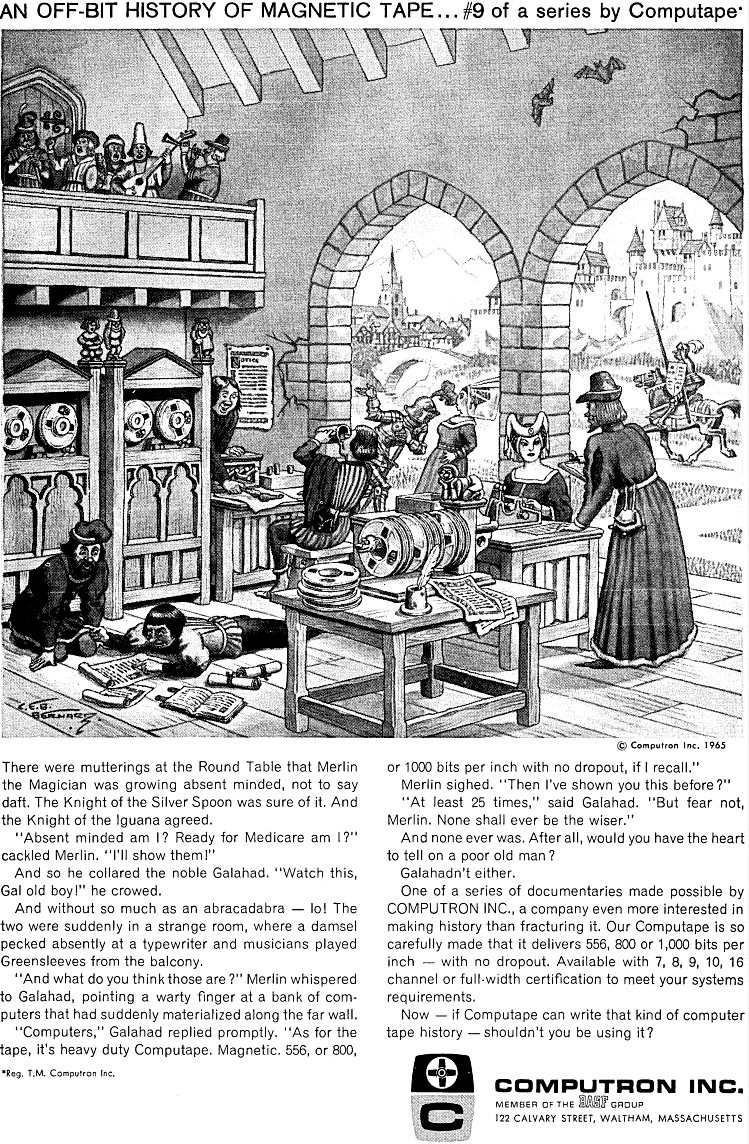
It nicely combines my latest two graphics projects,
Brahe's star castle and
IBM in 1957. Note also the
animistic tendencies.
The story is clever in deadpan British style. Unfortunately the company didn't last.
The guy talking to the secretary seems to be holding a medieval clipboard. Did such a device exist? Writers and artists have always needed a way to write or draw while standing or traveling. It couldn't include an inkwell, but it could include a patch of dry ink. ... Oh. Now I see. Yes, it existed. It's called a palette.
Labels: coot-proofing, Entertainment, TMI
A little Philco Phun
American Radio Library has added a
1931 Philco publication aimed at salesmen. Philco hadn't yet asserted its
unique style of circuitry and cabinets and corporate behavior. Still, these two pictures are sort of interesting.
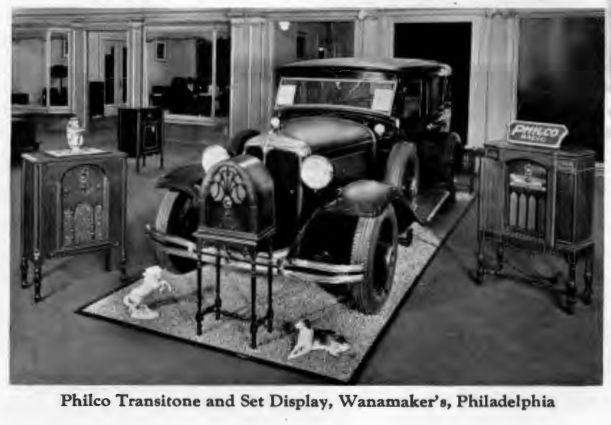
A display in Wanamaker's department store demonstrated car radios, a new idea. Philco later specialized in car radios and became a division of Ford. In '31 Philco receivers were mainly installed in Chrysler products. Note the common classical theme in the '31 Philco and the '31 Chrysler. The lights are on, so presumably the car's electrical accessories, including the radio, were powered by a transformer to provide a bit of drama.
Here's the control box in a Lincoln. In the early '30s the steering column was vacant and available for accessories. Earlier the hand throttle and spark control were usually on the column. Later the shift lever and turn signals. Philco took advantage of the vacant territory for the radio controls.
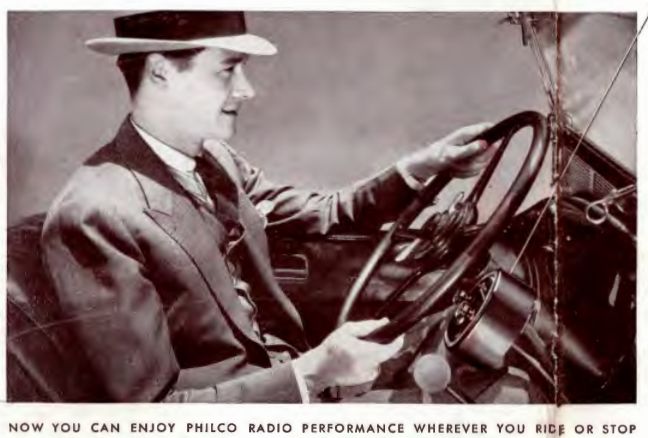
In other words, column selectors for receptions came before column selectors for transmissions.
Labels: Entertainment
Cars have genes.
Cars have DNA, or at least they did before they lost their souls to environmentalism and globalism.
I've been appreciating the
entertainment value of the American Bantam for a long time. When Polistra needs to drive, she drives a Bantam.
I'm reading Patrick Foster's book on the Nash Metropolitan. The Metro had the same genes as the Bantam. Basically an Austin Seven, rebodied and rerigged for American tastes.
And the Metro stirred exactly the same entertainment senses as the Bantam. It was used by businesses who wanted a small economical CUTE vehicle. Cuteness evokes pleasant feelings.
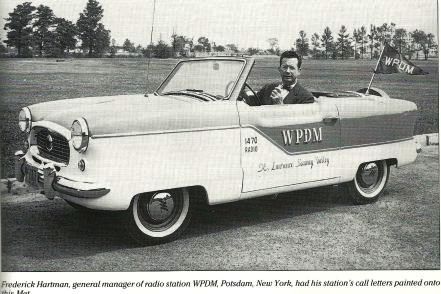
Radio stations had used the Bantam in the '30s, and used the Metro in the '50s:
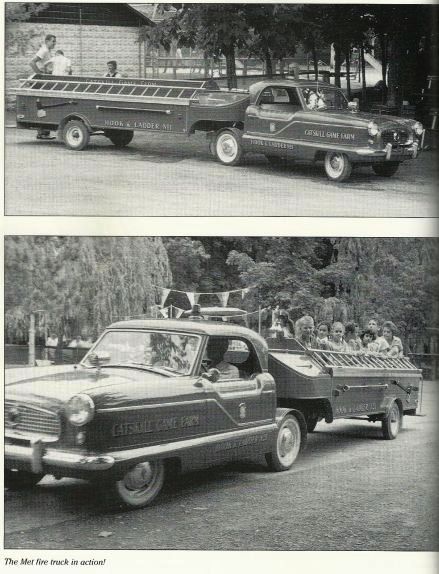
Circuses used Bantams as clown cars, and amusement parks turned Metros into rides:
Newspapers and other businesses also enjoyed Bantams and Metros for city delivery of small items. Businesses understood that the Metro was a
miniature business coupe. No back seat, trunk area lockable and accessible from inside. Its size made it an ideal replacement for motorcycles in dispatch and messenger service. Carry a reporter or a report. It couldn't quite fit in the same small space as a motorcycle, but it was much safer and comfier in rain and snow, and the storage area was secure.
Nash could have done more to attract the business coupe market. Austin made bucket seats for its domestic Austin and Morris cars, so the Metro could have offered a bucket option cheaply. The business user could remove the right seat for more storage area and access, similar to panel trucks and vans. Fans of "sporty Euro" cars would also appreciate the buckets.
Emphasizing business use would also enable a more appropriate name. Metropolitan was certainly a better name than Mason's original choice, NKI for Nash-Kelvinator International. But it didn't fit with Ambassador and Statesman.
Courier would suggest the business purpose and match the other names.
Nash also tried to appeal to police departments. The Metro had one unique advantage for parking patrol. Because it was built in England for sale in both countries, RHD editions were available at no extra cost.
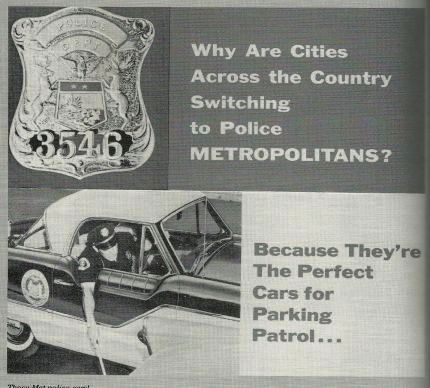
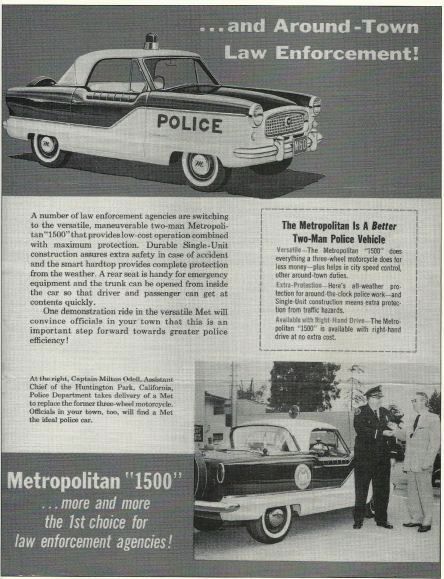
Very few cities responded, and surprisingly Kenosha WASN'T among them. Normally the police would only buy an offbeat car to support local industries.
Cops preferred Fords for good reasons.
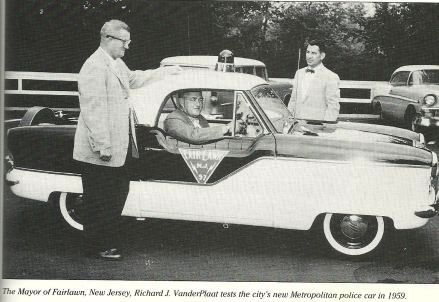
Hmm. Is that the same '56 Chevy in both pictures?
Labels: Entertainment
Wood works
In previous item I mentioned that the BLESSED return to benign weather after 8 months of wind and storms and heat has loosened up my mind to think about solutions to daily problems. Here's what I meant.
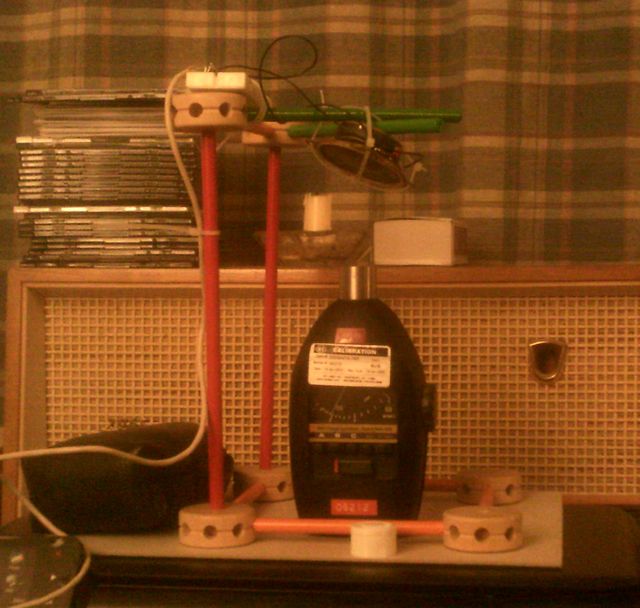
A few years ago I bought an old Tinkertoy set from Ebay, and used it first to build a
record player.

Then last year I dug into the set again and
built an acoustical test rig:
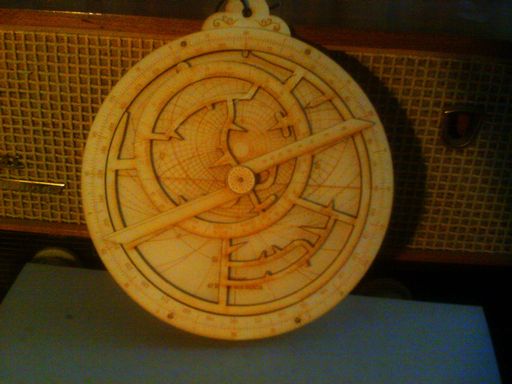
Wood is JUST RIGHT for some purposes. I was reminded of this in June when I bought and built
this wooden astrolabe kit:
Now that I've got a brief creative interval again, another use of wood suggested itself. There are several cleaning tasks in the kitchen that simply can't be done by brushes or sponges or fingernails. I've tried repeatedly, and nothing works.
1. The slots in a coffeemaker basket.
2. The narrow 'well' in the dish drainer that holds silverware.
3. The inside of a thermos.
It occurred to me that splitting off one side of a long slotted Tinkertoy rod might fit in those spaces. I reached into the bag and found one long rod with a handle already stuck on it. I used pliers to split off one side, and sure enough it's JUST RIGHT for all three tight spots.
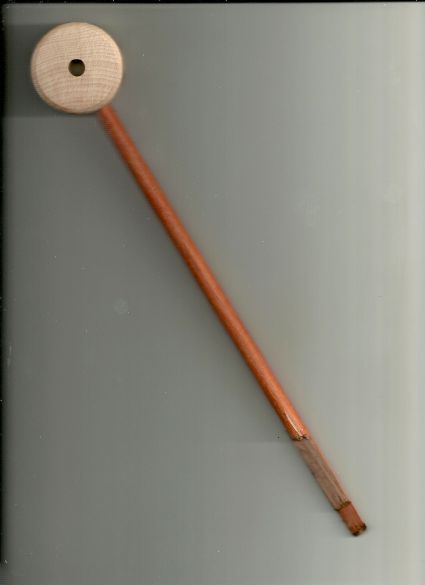
Wood is an ideal scrubber. It's hard enough to break through biofilms, but not hard enough to scratch metal or plastic surfaces.
= = = = =
Random wood-related sidenote, observed on this morning's walk.
The creeping thyme that lives in the pavement cracks is also appreciating the return to benign weather and last week's rain. After staying underground for 8 months, barely surviving, it's creating wildly this week, overflowing and spreading across the pavement. I've never seen it growing so enthusiastically before.
Labels: coot-proofing, defensible thymes, defensible times, Entertainment
Astrometeorology 8, Brahe's Star Castle interior
This is simply an expansion and revision of
part 7. At that point I couldn't see how the various instruments were fitted into the domes, and I was wildly underestimating the
size of the instruments. So we'll try it again, with a more complete underground structure and more appropriately sized instruments.
First the entire property from front, side, and top, as before.
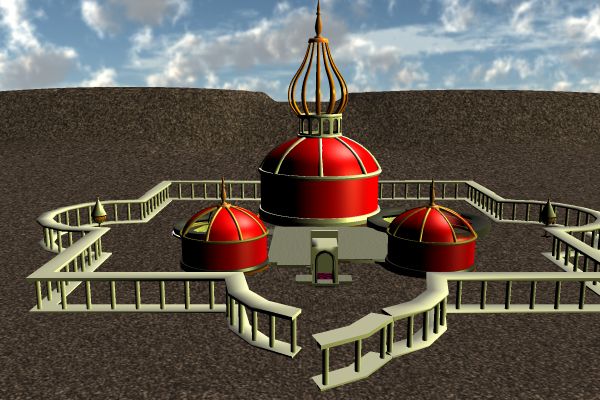

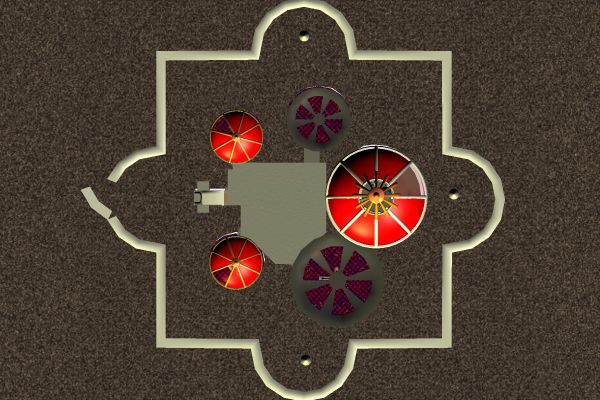
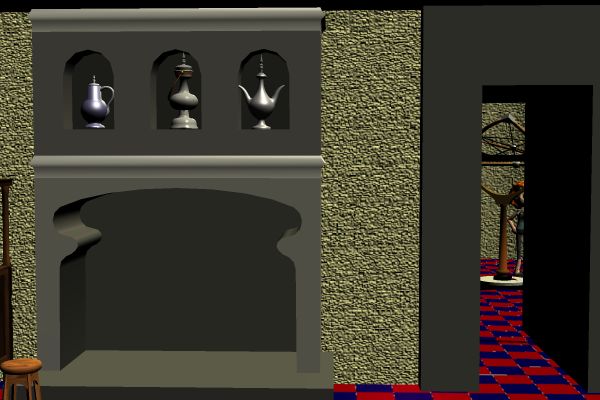
The square central part was the workroom and residence for Brahe's technician. Fortunately the existing floor plans show a worktable and a fireplace. So I've given Polistra those two items, plus other stuff found in unrelated pictures but appropriate to the place and time. The jugs over the fireplace nicely match Brahe's Persianish architecture.
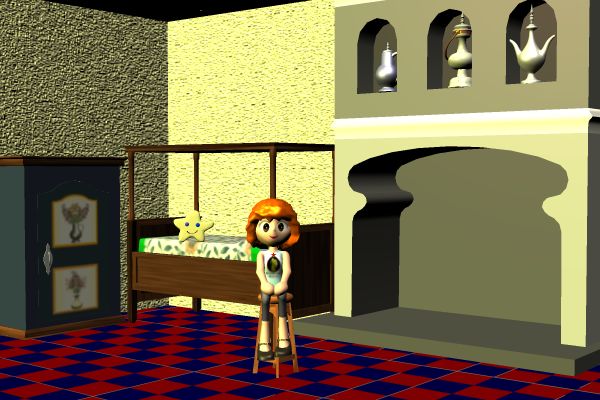
Another view, showing the worktable. You can also see the stairs up to the adit at the left side of the property.
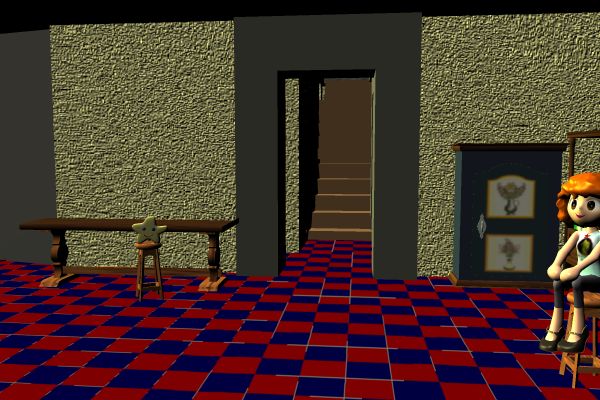
From the central room, halls branched off into the circular observation rooms. First we'll walk into the Sextant room, which is covered by one of the flat 'sewer grating' domes.
Looking down into the grating toward the sextant:
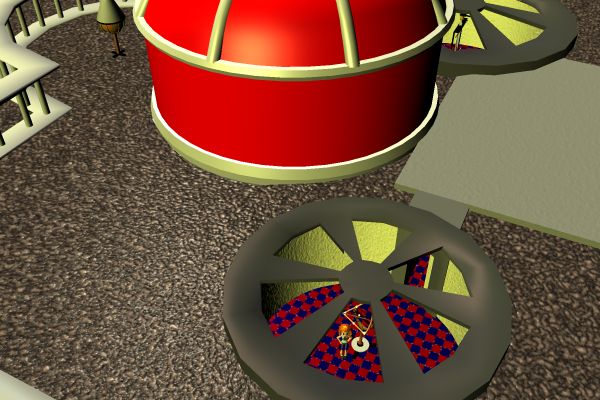
And here Polistra is sighting down the alidade toward a target star.
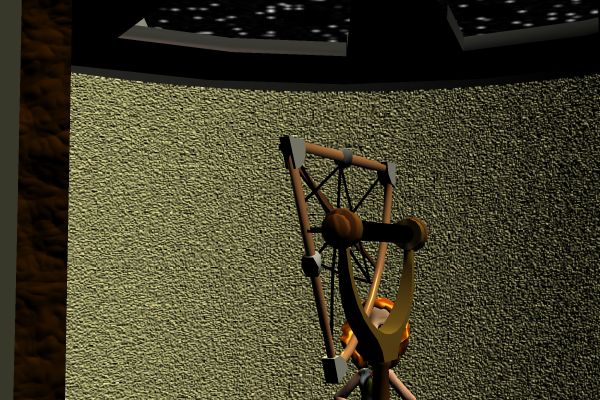
Next we return to the central workroom and walk toward the Equatorial instrument in the big dome.
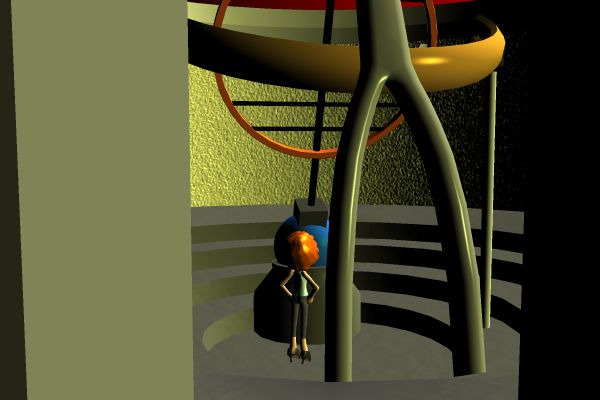
Looking at it from above. The descriptions are unclear, so I've arbitrarily made one pie-slice of the domes transparent. This wouldn't have worked in 1600. Did Brahe have hinged panels, or did he have a crew who lifted each entire dome off when it was time to observe? Most likely hinged.
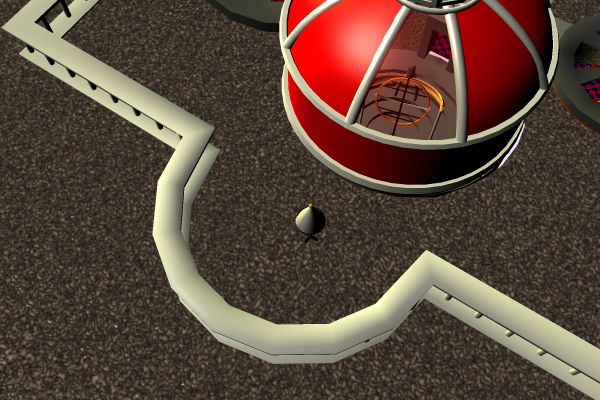
Here's a closeup of the equatorial in its arena. I had to 'remove' some of the walls to get this angle.
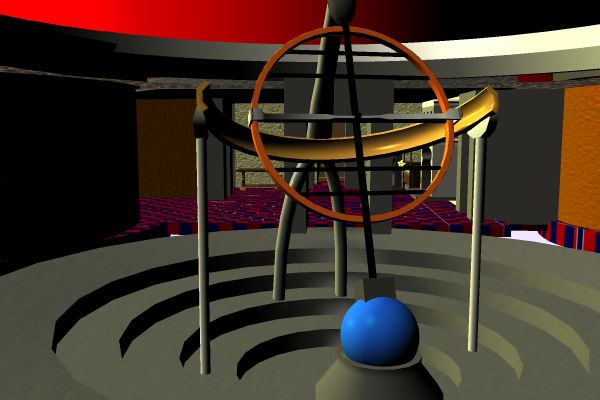
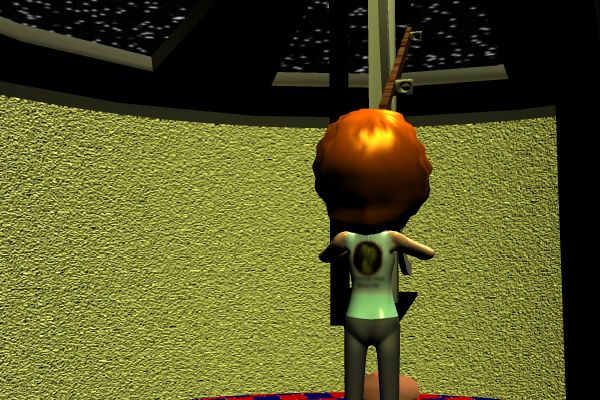
Now you're looking along the alidade toward the pie-slice in the roof.
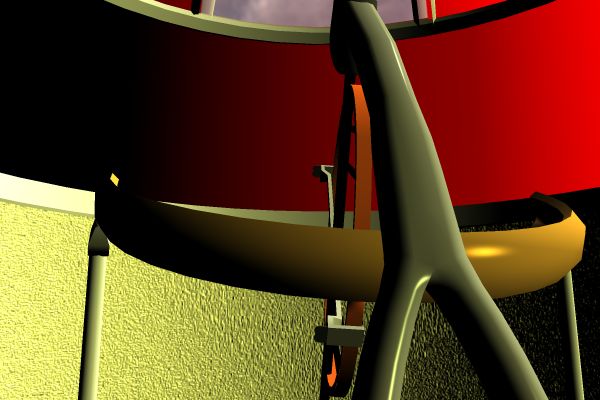
The Quadrant Magnus occupied the other 'sewer grating', here seen from the top.
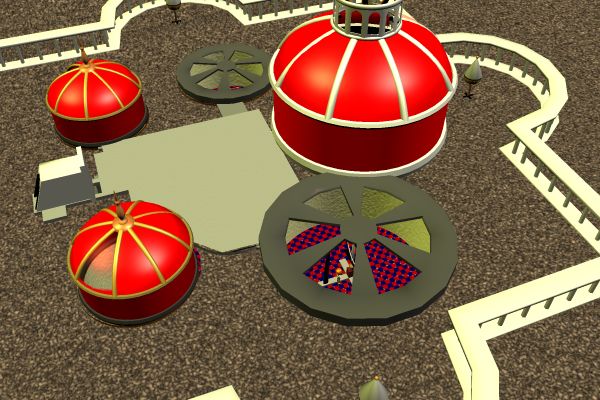
And again Polistra is measuring the azimuth and altitude of a chosen star.
= = = = =
Keeping track of the links so far:
Intro: Opening the doors again
2: James Ferguson
3: From Ferguson to Kepler
4: Maragha and astrolabes
5: Qibla
6: Back to Europe
7: Brahe's star castle (first try)
8: Brahe's star castle, revised. (this item)
= = = = =
10/6:
Now released as Poser scene on ShareCG.
Labels: Entertainment, Equipoise, Metrology
Paid vs unpaid interactivity
Interactive learning can be active or passive, paid or unpaid.
I've been trying to think of a way to slip payment into courseware, mixing entertainment and reward into the learning experience, but I haven't found it yet.
Most textbooks don't even offer
intrinsic pleasure. "Proof left as exercise for reader" doesn't get there at all.
Schools reward learning only with status (grades), which grows up into the tenure system that also runs mainly on status (rank).
Apprenticeships and business-based training schools are closer to the learn-to-earn setup, with guaranteed JOBS on graduation.
= = = = =
I've been noticing and enjoying both types of interactivity in old radio, which led me to think about the same distinction in education.
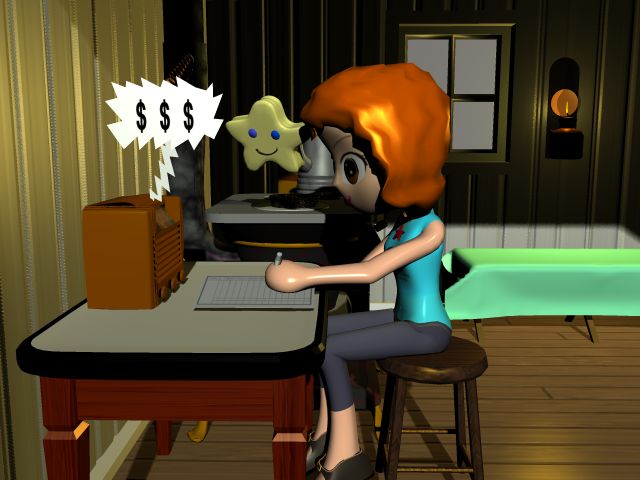
Four examples of unpaid interactivity:
MacHarrie's Guess What and Mel Blanc's Are you a genius were formatted as self-scoring tests, with no payment beyond the intrinsic satisfaction of thinking and learning.
Blackstone's magic show was on the line between paid and unpaid. Each episode featured instructions for a parlor trick. If you listened carefully and practiced the trick, you'd be rewarded with enjoyment at parties and the chance to win real bets with friends.
Dick Tracy had an elaborate scheme of clubs and codes. You were supposed to decode a message in each episode to 'help' Tracy escape the clutches of fiendish villains. I didn't see any direct payment, but you could send for badges and insignia to reward your club members for superior performance. Using status, as in school.
= = = = =
Two contrasting examples of paid interactivity:
The big national quiz Truth or Consequences was too much like Powerball. The prizes were astronomical** and the odds were astronomical. The questions were NOT educational.
The Chicago-based Calling All Detectives was a far more practical and winnable lottery. Much more like actual work, pay for value. Each local station called a listener every day, asking a question about a detail of today's episode. Especially in smaller markets, your odds of winning were 'imaginable'. The prize was also realistic. On WGN, the originating station, Sealy Mattresses offered a new mattress. Everyone can use a new mattress, and it's a prize worth EARNING.
= = = = =
I went in search of a trade journal with templates for such lotteries. I started by looking at
Broadcast magazine from the same month as the best Detectives episodes.
Immediately I found the opposite! At that exact moment the FCC was making a big push to HALT such lotteries, which explains why I hadn't heard them in more recent shows.
Broadcast Magazine said:
The FCC is embarrassed because it stubbed its bureaucratic toe on its proposed giveaway ban. It has made a hasty and strategic retreat. But the war isn't over. There appears to be no question now that the FCC lacks jurisdiction over lotteries and gift enterprises, per se. Congress, without fanfare last June, repealed the lottery section of the Communications Act, along with the section dealing with obscene, profane and indecent language. It transferred jurisdiction to the Department of Justice, under the revised Criminal Code, which becomes operative Sept. 1. Why the FCC's highly-placed lawyers muffed this one becomes a matter of administrative concern for the FCC itself.
But broadcasters shouldn't delude themselves. What the FCC cannot do directly it probably can achieve in other ways. The FCC is the licensing body. It can take judicial notice of violations of any statutes. It determines the qualifications of licensees. It may be a longer, more tortuous course, but it's there.
Any broadcasting designed to "buy" the radio audience, by requiring it to listen in hope of reward rather than for the quality of entertainment should be avoided. Voluntary adherence to that precept will do it. In one fell swoop, it will achieve everything the reputable broadcaster has sought for a quarter century. It will make good programming the yardstick. It will disarm the Government's crusade toward greater program controls. It will quell the Congressional clamor for tightening up of the law. It will end the free rides of manufacturers who give things away like mad for the air credits. It will create new business for radio.
Note the realistic grasp of Parkinson. Bureaucracies don't use laws. They do what they want to do. The response is also realistic. Lobbying is pointless. Just obey and hope to bore the demons.
We aren't allowed to think realistically now. We are required to blame The Horrible Other Party for the permanent laws of power. If only we can elect more of My Wonderful Party, all problems will magically disappear.
But the magazine was STUPIDLY WRONG when it called giveaways disreputable. These PAID LEARNING EXPERIENCES were deeply educational. Each of these surviving programs contained serious and accurate representations of geography and history and science. Even if the subject matter was typical soap opera, the MENTAL EXERCISE of strategic listening would be good for your brain. Blanc and MacHarrie urged you to listen with paper and pencil in hand, invoking MUSCLE MEMORY.
Whether you earned the mattress or not, you were
earning learning. And that's a vastly better prize than a mattress.
= = = = =
** Astronomical: At one point the Truth or Consequences prize was: A new house, new furniture and appliances, a complete wardrobe every year for life, a complete set of jewelry, a new Buick convertible, a yacht, and an AIRPLANE. For most listeners, the Buick and the clothing would be a net gain, but the rest would throw you into bankruptcy. (New house = maintenance, insurance and property taxes every year, not covered by the prize.)
Labels: Entertainment, Experiential education, Parkinson
Couldn't do it now
This 1948 episode of 'Calling All Detectives' is unique at two levels. At the character level it portrays the conflict between real science versus the highly competitive team sport of academic science. At the plot level, the detective USES real science to find the culprit.
A geologist who runs a seismology research station has been killed. The prime suspect is a real scientist who dislikes the team sport. Our detective clears him by narrowing down the time when the murder occurred, and showing that the prime suspect wasn't there at the time.
How did he narrow down the time? After hanging around the facility and observing the
delicately balanced seismographs, he realizes that the falling body would have made a blip on the graphs, which wouldn't be seen in other seismograph stations. Sure enough, they find a twitch during the relevant interval, which isn't matched by other stations.
Granted, a stabbed body wouldn't necessarily fall ... but the writers couldn't get overcomplicated in an 8-minute drama. Still, it's an accurate use of Constants And Variables, and an accurate representation of how real science works.
Modern TV and movies couldn't handle either level. All "scientists" must now be represented as pure altruists, even though the team sport is now UNIVERSAL. In reality, any scientist who puts the purity of measurement before the advancement of his career wouldn't get past the tenure committee.
And modern writers couldn't do real Constants And Variables even if they understood the concept, because it might feed the trolls. Heretics might start thinking in proper scientific terms about Holy Sacraments like lockdowns and distancing and ballgags. CRIMETHINK!
Those 1948 writers didn't realize they were the
last of a breed. In 1946 Deepstate began its multi-front war of total destruction, founding CIA and NSF and WHO and CDC to obliterate science and civilization.
Labels: Constants and Variables, Entertainment, Equipoise, Metrology
Astrometeorology 7, Brahe's Star Castle
In the 1500s Europeans were starting to pull away from Rome's monopoly on power and thought. Tycho Brahe was a rich aristocrat who became fascinated by Arab and Persian astronomy. He shared the Islamic motive of learning how the universe ticks (literally) so we could predict and align our activities better with the universe. His aristocratic rank enabled him to get a commission from King Frederick of Denmark to build an official observatory, initially to improve timekeeping.
From David King's history:
He became interested in astronomy after observing a conjunction of Jupiter and Saturn, the cause, he thought, of the great plague in 1563. He found that planetary tables were in error by several days, and there and then decided to make their improvement his prime concern.
In 1576 Tycho started building his Star Castle, following Islamic architecture and Islamic instruments
as seen at Maragha, but with improved and enlarged instruments for better accuracy.
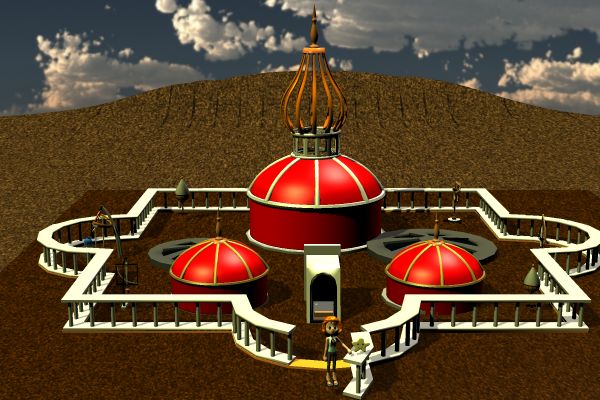

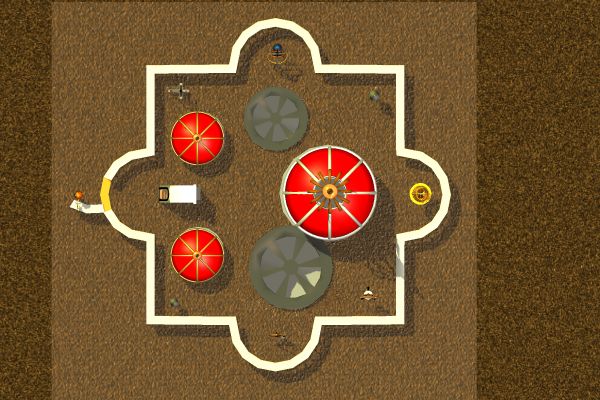
The function of the domes is unclear. King says they housed some of the instruments, guarding against wind and weather.... but the drawings from Tycho's book seem to show solid roofs, not retractable or glass roofs. Two of the circles have semi-open 'gratings' over them, which would probably be sufficient. The big dome has a semi-open chamber at the top, but the ribs would block practical use.
The floor plan of the underground part is clear. An adit on the left led downstairs to the rectangular middle part, which served as a residence for the technician. Passages from the middle led to the observation chambers, which might have housed instruments.
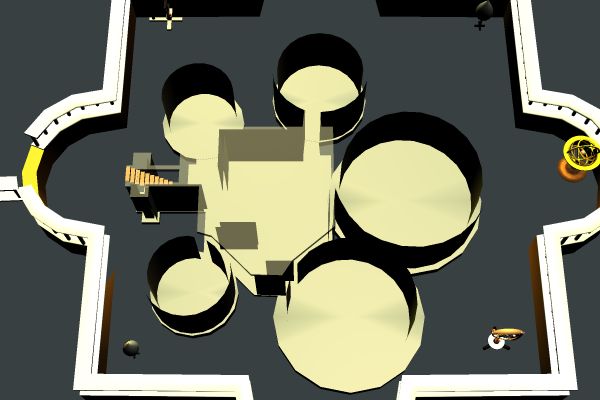
I've included several of the instruments aboveground for visibility.
First, the default structure was just a rotatable globe with some kind of mounting on top. The globe was protected by a cone when not in use. Experimental instruments could be mounted on the globe and rotated to various angles. An astronomical breadboard.

There were several armillary spheres, mainly for calculation and visualization, not for sighting.
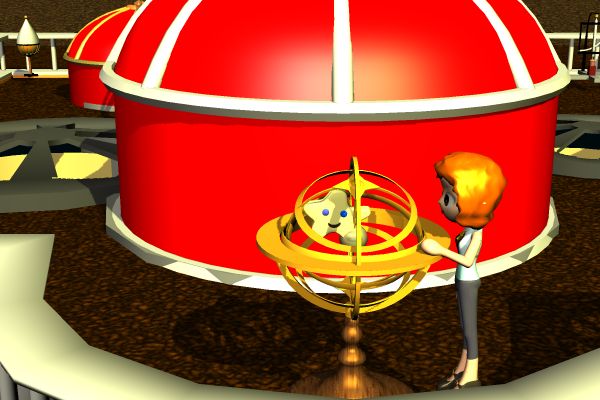
The Islamic instruments had alidades instead of lenses. Tycho continued the practice, and improved the accuracy with a vernier marking on top, anticipating the
tick marks in later sidereal time instruments.
One of the Maragha instruments:
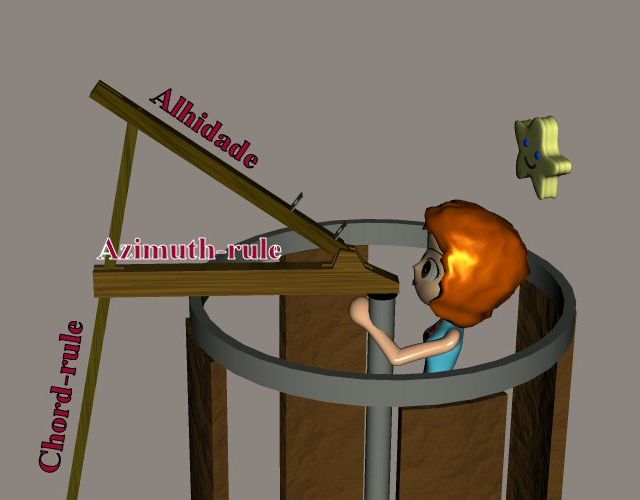
Tycho's version of a simple altitude sight:
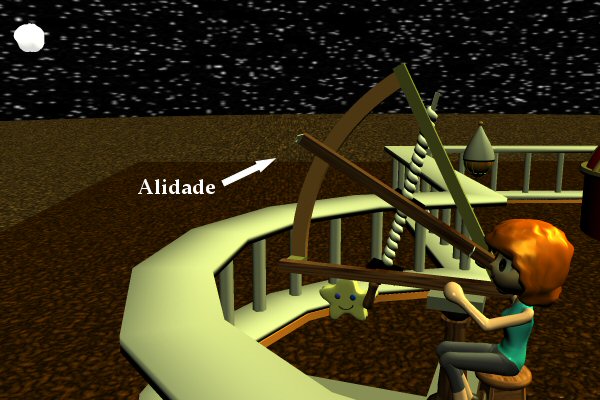
This machine had a fine worm-gear crank to adjust with greater precision:
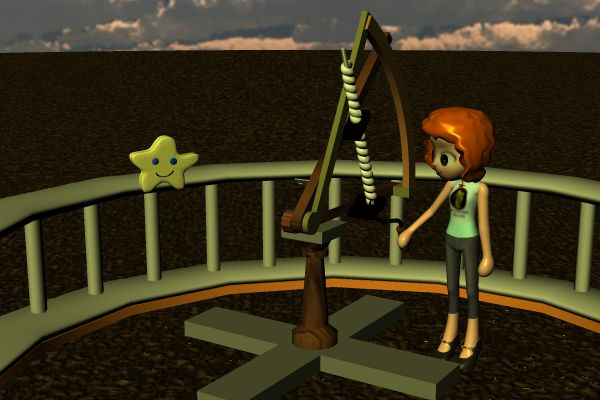
The Quadrant Magnus, with both altitude and azimuth adjustments:

Quadrant in use, sighting a star through the alidade:

The Sextant had three axes of adjustment, altitude and azimuth and a separate rotation of the alidade.
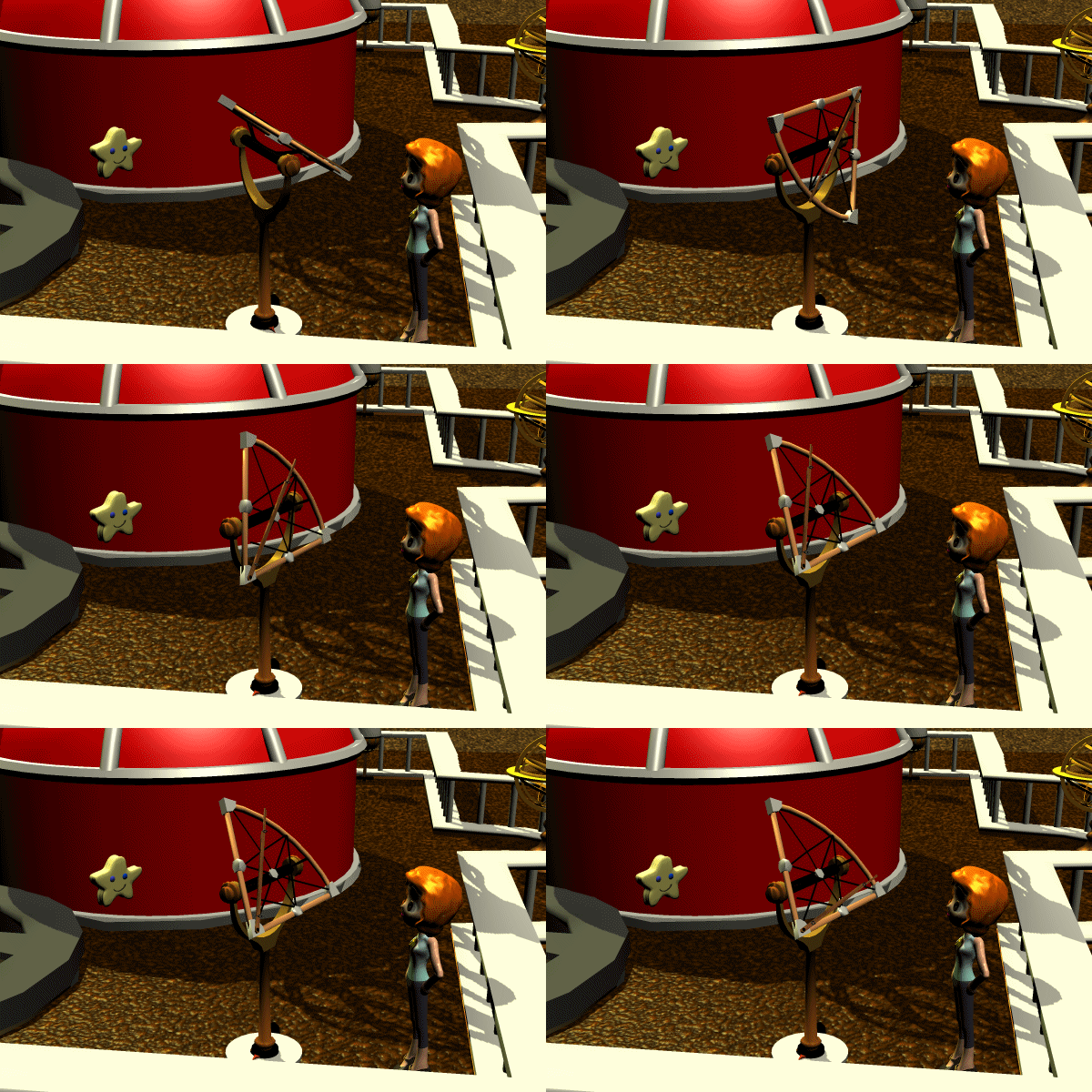
The Sextant in use:
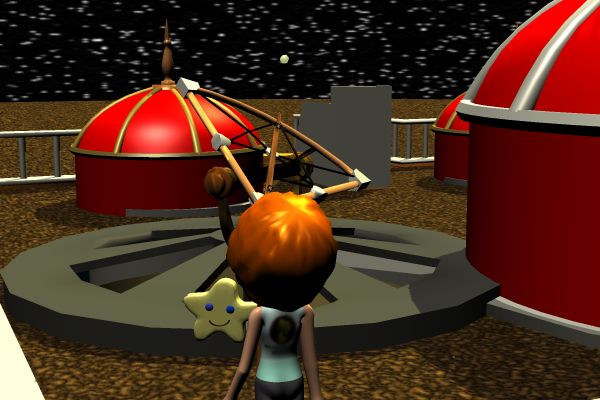
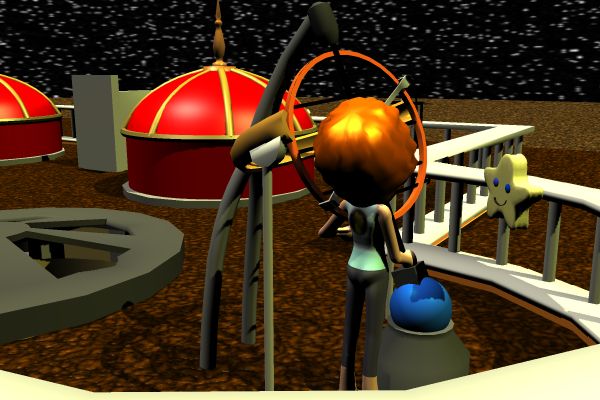
An equatorial instrument pivoted on a 23 degree axis, anticipating the more complex
equatorials of the 1800s. It had two independent alidades, for use in opposite directions.
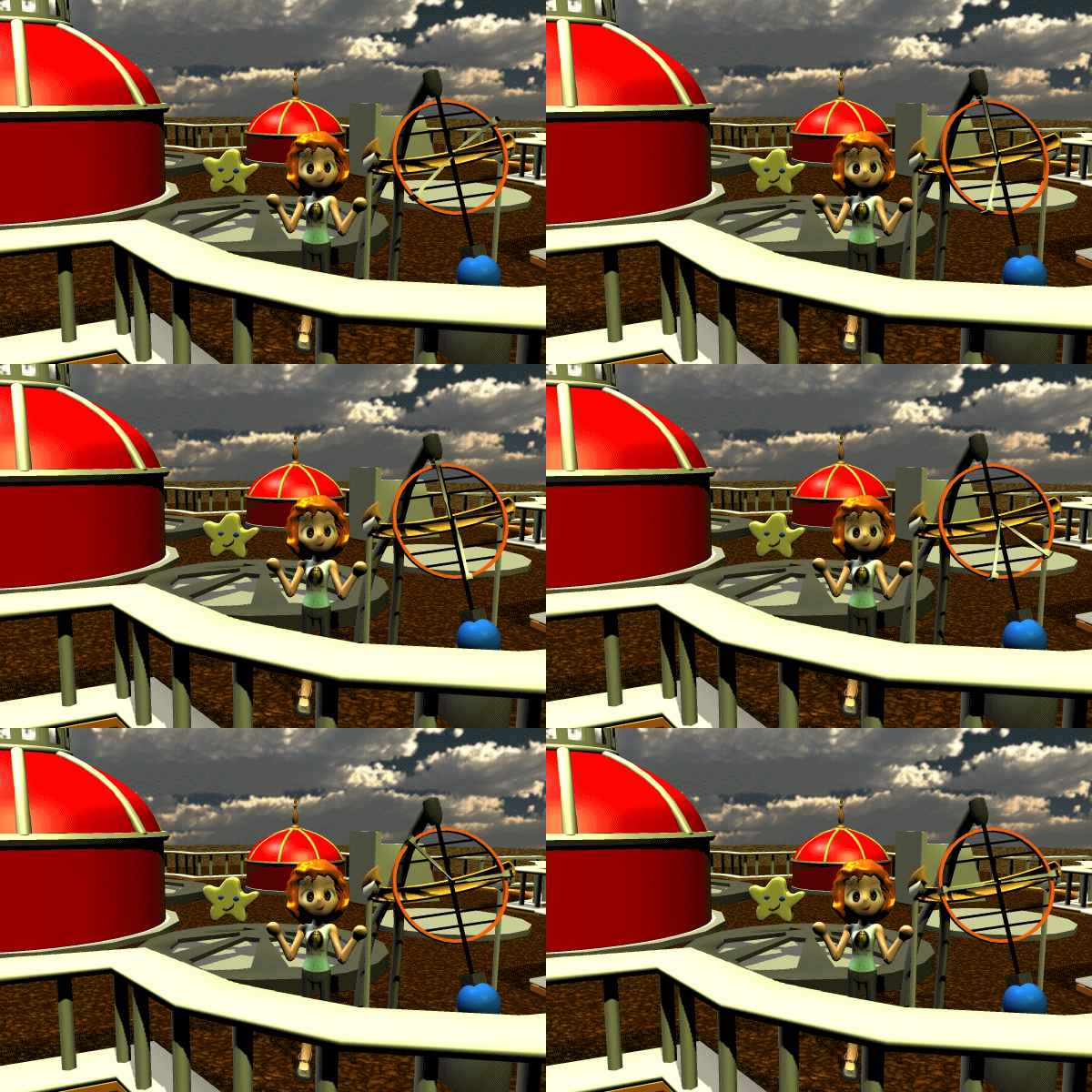
Polistra thinks this instrument would have been hard to use!
What happened to the Star Castle?
Again from David King:
Tycho had an imperious and fiery disposition which made him many enemies among the nobles of Denmark, especially those who envied him his large estate and high salary. After his benefactor's death, these individuals naturally counselled the young King Christian against his father's astronomer, already in some disfavour for having ill-treated one of his tenants.** After the coronation of King Christian in 1596, Tycho found his allowances gradually curtailed, even to the pension, so that he felt, as never before, that both he and his work were unwanted.
Eventually, his troubles became so acute that he was happy to leave Hveen, taking
with him servants, students, instruments, and printing-press. After a short stay in
Copenhagen, he left Denmark for ever, seeking safe domicile in Rostock, Wandsbeck, and Wittenburg until, worn out in body and spirit, he settled in Prague.
The castle's decay was hastened by his successors, who appear to have pulled down some parts in order to provide building material for new dwelling-houses. By 1652, there was scarcely any trace of the original buildings.
Tycho thus fits firmly into the tradition of
Follies that serve science. Follies fade quickly after the rich owner dies, but the
contributions to the work of other scholars remain and grow.
An institution that fades can't undergo the Parkinson process. Unlike bureaucracies and foundations, it can't turn to crime and corruption. The
product grows without interference from the now-corrupt
institution.
= = = = =
** Footnote: Can you imagine a modern aristocrat receiving disfavor for ill-treating one of his tenants? Now it's the other way around. Aristocrats lose Share Value when they accidentally treat their tenants and employees decently. Only ill-treatment is allowed.
= = = = =
Keeping track of the links so far:
Intro: Opening the doors again
2: James Ferguson
3: From Ferguson to Kepler
4: Maragha and astrolabes
5: Qibla
6: Back to Europe
7: Brahe's star castle (this item)
Labels: 2000=1000, Entertainment, Equipoise, Metrology, Parkinson
More accuracy
I'm encouraged when I see hints of a trend away from holocaustal orthodoxy. Last week I noted
this James Hankins essay on the decadence of philosophy.
Nathan Smith writes on the decadence of economics as an academic field. He slams the mind-destroying effects of tenure:
Moreover, it remains hard to open people’s eyes to the stupidity of much empirical economics, because the econometrics treadmill is useful as a make-work and credentialing program for tenure seekers.
“Publishing” is really the wrong word for what journals do in the age of SSRN. They certify work, for a fee, the return on which may consist in a “peer-reviewed” publication leading to tenure.
If journals are sometimes as boring to read as a stack of resumes, that’s because they largely serve the same function. Job applications masquerade as science because perverse customs make original scholarship—however trivial, wrong, and/or unread that scholarship may be. That’s the price of admission to a career explaining demand, supply, and market equilibrium to undergraduates.
Job applications masquerading as science. On the fucking dot.
Concluding, Smith approaches my theme of
science as entertainment, attempting to rebuild science as a hobby outside of the OFFICIAL TEMPLE OF WAR AND GENOCIDE.
What do you do when the emperor has no clothes? Other people need to step up and provide leadership. In the seventeenth and eighteenth centuries, the Enlightenment sprang not from established universities, but from gentleman soldiers and courtiers and statesmen, popular writers and clergymen, bohemians and sponges, who boldly called themselves philosophers and lived up to the name. Today, similarly, economics’ best hopes lie in uncredentialed economists from business, journalism, and government, abetted by academic mavericks.
Now that we see where the Enlightenment led, it's time for a counter-enlightenment. The enlightenment bred the myth of
Free Will and Meritocracy, which allowed psychopathic monsters to justify their holocausts. It began immediately with the French Terror in 1789, and continued seamlessly through the "Virus" Terror of 2020.
The pre-1700 idea of reality was accurate.
The universe has unchanging resonances. Our job is not to defy the universe and create chaos. Our job is to find and measure the real resonances and try to swing with them, joyfully and loosely.
LOOK ABOUT YOU.
TAKE HOLD OF THE THINGS THAT ARE HERE.
TALK TO THEM.
LET THEM TALK TO YOU.
Labels: Carver, Entertainment, Equipoise
Return of old humor?
For many years I've taken refuge from modern media's SCREECHING MURDER, living inside the
empathetic and gentle humor of the '30s.
Lately I
saluted the 1933 program Mirth Parade, one of many low-budget offerings that lightened the mood with low-quality humor and high-quality music.
Mirth Parade featured a satirical swami, a Hindu Swede called Yogi Yorgesson. His Swedish dialect was accurate, but his Hindu views weren't. He closed each segment with a punning prayer to the Hindu god Allah.
(This was a common conflation for some reason.)
Yogi Yorgesson specialized in contrived puns:
Q: My husband is Norwegian and he drinks a lot. Should I expect him to be waiting for me when I return from vacation?
A: No, he won't be waiting for you. Norse is Norse and souse is souse, and never the train shall meet.
He also delved into the edges of politics at times, with a pun about the Ku Klux Klan being Dumb Klux. (Partisan politics was
illegal on radio in the '30s, so jokes against one party were impossible.)
= = = = =
Kevin Barrett interviewed a modern comic who seems to be echoing Yogi Yorgesson intentionally or not.
He's a Jew posing as Swami Beyondananda. He calls one of his channels
OM Times Radio, an explicit echo. He also specializes in contrived puns, a little too densely for my taste. Every sentence includes a contrivance like "Notsee America: spelled N-O-T-S-E-E."
If you have to explain it, taint funny, McGee.
Despite the contrivance, I solidly support his purpose. For the last 30 years all entertainment has simply been FUCK TRUMP. "Comedians" no longer try for anything remotely resembling humor. They've become pure
court jesters, reinforcing the aristocratic need to KILL ALL PEASANTS.
Incidentally, one of the Swami's blogs redirects to a Chinese site that AVG halts for malware. Makes me wonder if he's paying attention to his productions.
Labels: Entertainment
Lost genre of songs?
A couple months ago I
saluted Mirth Parade, a 1933 low-budget syndicated show.
= = = = = START REPRINT:
When you treat everything as entertainment, you can live longer and MOST IMPORTANTLY you can
learn more.
When everything is EMERGENCY PANIC DEADLY SERIOUS you're
not allowed to learn anything.
Learning includes 'science', as I've been
pushing lately, and learning also includes the basics of human behavior.
= = = = =
Why was Jordan Peterson unnecessary in the 1930s? Because HARDASS human nature was part of entertainment. There were romantic songs for sure, but there was also a constant theme that marriage is more trouble than it's worth.
The unattached life had its own romance. If you weren't MEANT to be married, you had more freedom.
These views were already extinct when I grew up in the '50s and '60s. Marriage was automatically assumed to be necessary and wonderful. If you weren't MEANT to be married, you weren't qualified to live. Take one for the team NOW.
= = = = =
Recently my bedtime playlist has included a 1933 series called Mirth Parade. (It doesn't seem to be available free online.) The verbal part of Mirth Parade was low-quality humor by any standards, mainly contrived puns that reached 10 feet beyond funny to cram in a combination of words. Like many of the
syndicated shows, the musical part was brilliant.
An episode about sailing and boats includes two HARDASS representations of romantic reality. Neither song would be singable today. Reality is CRIMETHINK, in 'science' and human behavior.
First a version of the familiar Barnacle Bill, not quite legally obscene but HARDASS real.
This is how the world works.
Barnacle Bill.
Second, a totally forgotten lively number about a sailor with a dame in every port.
Two-buck Tim from Timbuktu.
Choral version of the same song.
= = = = = END REPRINT.
Several episodes featured songs similar to 'Two-Buck Tim'. They all have the same pattern and probably the same author. Simple tunes and
fast complex wordplay. All were performed by the same singer in the same Singsprache form. The singer was identified as Andy Andrews**. Some of the songs are jokes with a clear punchline.
These songs somehow don't fit the usual 'novelty song' category. Most 'novelty songs' are cheerful nonsense, not tightly crafted verses. These are much closer to the British music hall tradition, as in Gilbert and Sullivan.
LIFE IS PURPOSE.
ENTERTAINMENT IS THE OPPOSITE OF GENOCIDE.
LAUGHTER IS THE OPPOSITE OF DEATH.
= = = = =
** Not much online info about Andrews.
Goldindex, the best OTR source, shows his appearances in Mirth Parade plus one National Barn Dance episode. Another source lists most of the Mirth Parade performers as Al Pearce's troupe. Two episodes of Pearce's own show are
on Archive.org. They're pretty much the same thing: outstanding music, pointless "comedy".
Again I need to thank those hard-working preservers and digitizers who have been restoring REAL SANE ENTERTAINMENT for the benefit of moderns stuck in a totally insane time. Their work is on the same scale as the Arabs and Persians who preserved and advanced Greek science while Europe was stuck in craziness.
Labels: Asked and not worth asking, Entertainment
Proofreaderoleth
A fairly old cartoon that popped up in some memes:
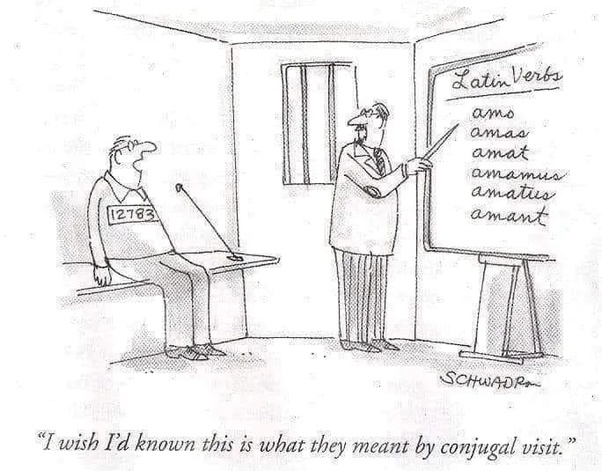
Funny. It also hits several resonant notes with me. Jail experience, teaching, grammar, and ABOVE ALL .... proofreading.
I was slow to get the joke because I was stuck on the incorrect 2nd plural form.
Labels: Entertainment, Jail mode, Language update, Leth
Theorigenic blindness
UncommonDescent notes the death of Weinberg, one of the major leaders of CERN. They give several quotes along these lines:
“With or without religion, you would have good people doing good things and evil people doing evil things. But for good people to do evil things, that takes religion.”
In fairness I don't know anything about Weinberg except his leadership of CERN. He might have said some sane things on other subjects. I'm really talking about CERN itself, and secondarily about Weinberg as a major spokesman for CERN.
Before the "virus" holocaust turned Public Health into the biggest threat, CERN was the biggest threat to the planet. CERN has been working intensively to create a black hole which will OBLITERATE THE PLANET.
You talk about war? That's a war to end all wars.
Weinberg shows what happens when science becomes the "life partner" of Deepstate, serving as the
God Of War And Genocide.
He sees COMPETING religions as subhuman neanderthals who must be EXTERMINATED.
He doesn't see his OWN religion, Science, as the most infinitely destructive of all religions.
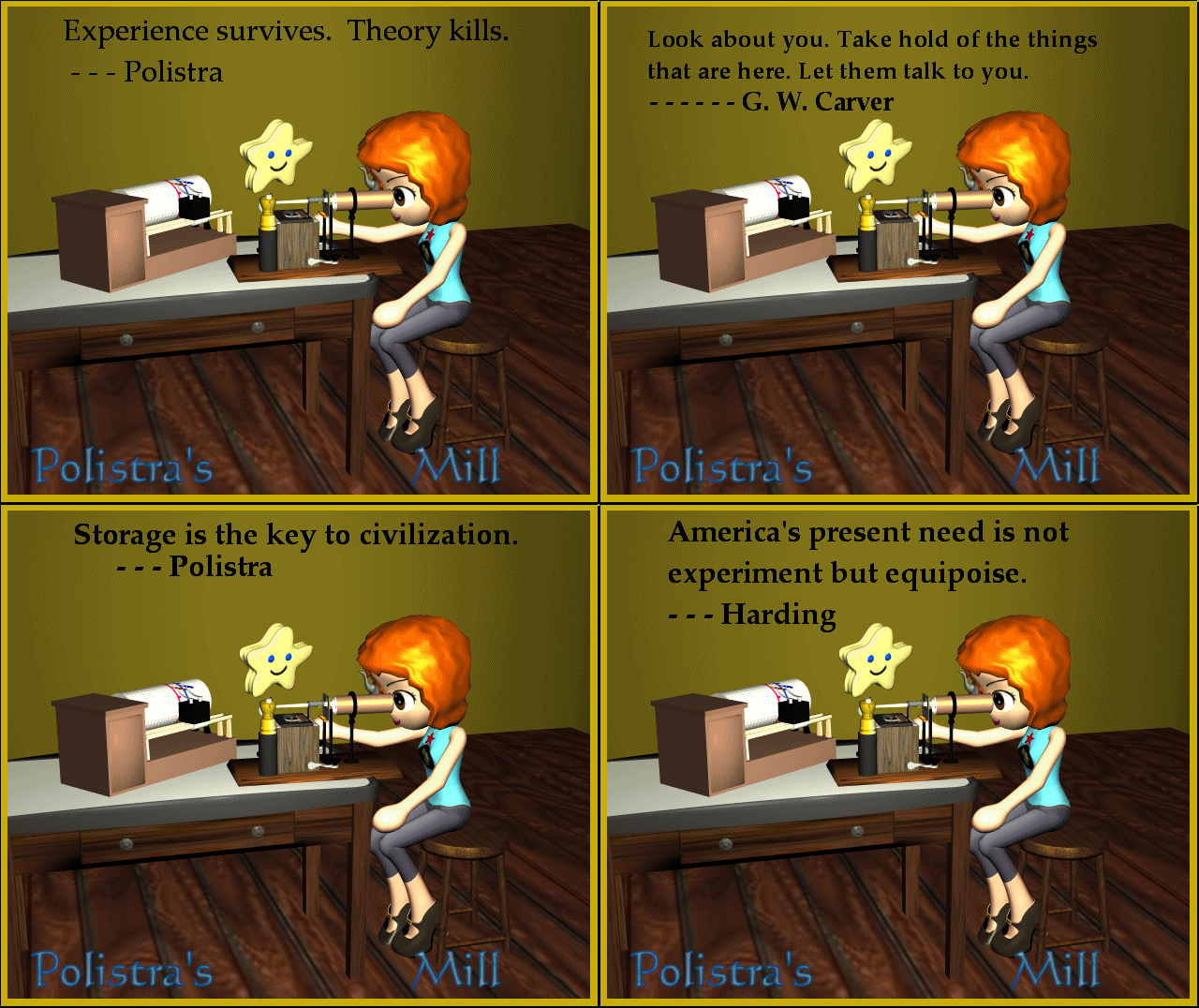
EXPERIENCE SURVIVES. THEORY KILLS.Labels: Entertainment, Metrology
Sabine's test
Hossenfelder offers a smart 'decision point' for fashionable nonsense in physics, like Dark Matter, Dark Energy, String Theory, and Multiverses.
She credits Lakatos for this rule:
Is this speculation clearly leading to results, or has it gone on for a long time without leading anywhere?
She then runs through the list and shows that all of them have been processed for
decades without any
progress. There's no map, no gradual development of better ideas and techniques. Just the same question tossed back and forth.
I'd use a more practical test:
Are you trying to SOLVE A REAL PROBLEM? Are you trying to help real people live better? If so, keep trying for as long as necessary. If not, stop**.
Some lines of invention and development can run for a long time with no progress. Easy example: Flying. For thousands of years we dreamed of flying like a bird, and hundreds of inventors tried and died.
Flight had to wait for two things: Chemical understanding of gases, and engines. After we understood buoyancy, balloons were possible. After engines, Wright Flight was possible.
Birds didn't give us the slightest hint of these two methods, though we realized
after using balloons that
birds have a controllable internal hot-air balloon.
Flight is a real problem with a determinate solution. We knew when it was solved because we were able to fly long distances consistently and regularly. Still, it took thousands of years and hundreds of
external prerequisites before we could see the path to solution. The solution was perfectly invisible until reciprocating steam engines started turning fans.
Theories do not solve problems. Theories provide mental exercise for theorists, and provide tenure and grants for academicians.
Relying on theories leads to GENOCIDE every fucking time.
EXPERIENCE SURVIVES. THEORY KILLS.
= = = = =
** Clarification from the
science as entertainment view. Tossing around theories is a form of entertainment for some hobbyists. When I say STOP, I really mean STOP USING GOVERNMENTAL FUNDS AND AUTHORITY TO PURSUE YOUR PRIVATE ENTERTAINMENT. If you want to discuss sci-fi on your own time, or make money writing
stories and videos for other hobbyists, that's wonderful. Entertainment is a good and necessary part of life. But GOVERNMENTAL FUNDS AND ARMIES AND AUTHORITY should never be involved in private entertainment.
Later, a perfect example
via RCS. Philosophers working for public universities are arguing about what would happen if an unusual human didn't have consciousness but appeared to have consciousness. The entire subject of consciousness fits firmly in the Lakatos category. No possibility of any progress, utterly and conclusively pointless and resultless by every possible standard. These TAX-PAID philosophers have managed to make the subject even more convolutedly hyperpointless than it was before.
Labels: Entertainment, Metrology
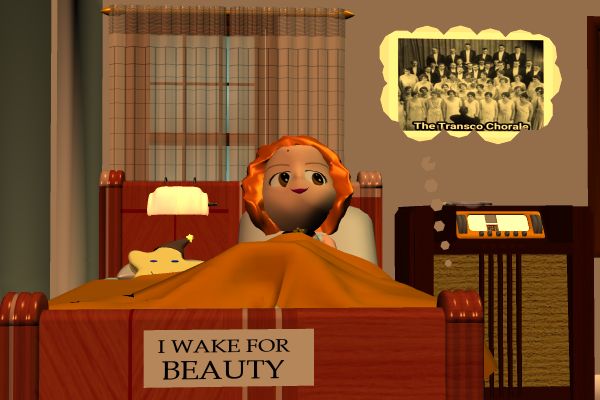
I wake for beauty
Since my computer failed last week (entirely my own damn fault!) I've been reconstructing my various workspaces in a 'newer' computer that I had in storage. Important stuff was well preserved on daily backups, but I never bothered to preserve my bedtime playlist. So I rebuilt it from CDs and from otrcat.com downloads. Clearing and rebuilding was probably a good thing. I was able to bring back some good episodes that I had forgotten.
One episode of 'Can you imagine that' includes a
perfectly beautiful rendition of the 1937 song Marquita by the Transcription Company Chorale.
This episode wakes me up
just before the song starts every time. There's nothing noisy in the rest of the episode, no gunshots or screams, just calm courteous
Lindsay MacHarrie narrating. Nevertheless, my mind catches something in the narration and wakes me up just in time to appreciate the perfection.
Labels: Entertainment, infinite GOOD
Thanks, Discovery Institute!
Occasionally I toss various amounts toward crowdfunds and kickstarts. I always toss enough to get the 'merch', whether it's a t-shirt or a mug or whatever. I've never actually received anything, and the projects never actually produced their video or book.
Finally an exception. I donated $300 toward
Discovery Institute's new ID video, and they immediately sent a nice fat packet of CDs and posters on design.
Reminds me of the packets I used to get back in the '50s when I sent a postage stamp or an
IRC for 'free literature'. Companies were happy to promote their products, sending posters and magazines and samples of new materials like Mylar. I always looked forward to 'literature', and this packet has the same pleasant feel.

I needed some pleasant feedback this week, and Discovery provided it. Thanks!
Labels: Entertainment, Grand Blueprint
Apologies to Jeffrey Tucker
The basic principle of science is
Don't trust. Verify.
Never take words as authority. Think in
Science As Entertainment mode. When you see a science article, treat it as an advertisement or attention grabber. "Hey! Look at this! I've found something really neat!" If you also think it's neat, verify it by your own experience, or your own observations, or your own experiments if possible.
Carver as always:
LOOK ABOUT YOU.
TAKE HOLD OF THE THINGS THAT ARE HERE.
TALK TO THEM.
LET THEM TALK TO YOU.
When Jeffrey Tucker called attention to the Michael Lewis book on the holocaust,
I was suspicious. Tucker cited one BIG FACT from the book, but seemed to dismiss the book as written from the wrong viewpoint. We need ALL THE FACTS, and if Lewis was bringing in a load of facts, his viewpoint shouldn't matter.
In 2020 I learned to follow Carver UNIVERSALLY, so I started with the hypothesis that Tucker was protecting his own turf.
Verify.
I bought the book (not from Amazon) and skimmed through it.
Tucker was exactly right, and I apologize for doubting him.
The book does have a few interesting facts, but it misses ALL the important points, totally ignores the inversion of science, and leaves out the 15 years of development between the 2005 initiative and the 2020 holocaust.
The book should have been titled
Why I am God
By Carter Mecher, as told to Michael Lewis.
Lewis doesn't know anything about science, so he didn't question or kick down any of the anti-science premises of the Mecher conspiracy.
Most notably, Mecher's plan was based on the notion that we fucked up the 1918 flu epidemic by NOT muzzling and NOT distancing and NOT lockdowning. We must get it right this time.
The facts instantly disprove this notion.
1. We tried all of those nasty tricks in 1918 and found that they didn't work. Our public health establishment was still operating IN science in 1918, and they were able to LEARN from experimental results.
2. The 1918 epidemic was a mix of virus and pneumococcus bacteria. Our scientists at the time didn't fully understand viruses, but they did fully understand bacteria, and they knew what they were seeing. MOST of the infections and deaths were from the bacteria. In 1918 WE DIDN'T HAVE ANTIBIOTICS against bacteria. Penicillin was discovered in 1928, and related antibiotics weren't really universal until WW2.
Fucking constants and fucking variables. The virus is a constant, but it wasn't the important factor in the 1918 deaths. The lockdown shit is a variable. It was tried AS A VARIABLE in 1918, and found to fail. After that, public health knew that lockdown shit didn't work. Bacteria, and defenses against bacteria, are two more variables. No bacteria in the 2020 illness, and even if the bacteria were present, we can handle them now.
Mecher deliberately skipped over those constants and variables and ASSERTED that lockdown shit would work this time, because Mecher said so.
Michelet as always:
Here lies Sprenger's real merit, which is beyond dispute. He is a fool, but an intrepid fool; boldly and unflinchingly he lays down the least acceptable doctrines. Another man would have tried to elude, attenuate, soften objections, —but this is not his way. Beginning on the first page, he sets down openly and displays one by one the natural, self-evident reasons there are for disbelieving the satanic miracles. This done, he adds coldly, "Merely so many heretic mistakes." And never pausing to refute the reasons given, he copies out the texts on the other side, St. Thomas Aquinas, the Bible, legends, canonists, and commentators. First he shows you what common sense has to say, then pulverises it by weight of authority.
The method is everywhere identical. Good common sense first of all, followed by a direct frontal attack, a downright, unhesitating negation of common sense. It would seem natural enough, for instance, to say that, love being in the soul already, it is hardly necessary to assume the mysterious intervention of the Evil One to be required. Is not this fairly self-evident? Not so, says Sprenger.
Labels: #WholeOfSociety, Constants and Variables, Entertainment
Rereading Percy
Walker Percy's
Love In The Ruins is the best prophetic dystopia for our age. The novel was written in 1971, much later than Orwell and Huxley, so some of the social prophecies aren't especially prophetic.
Percy includes a lot of 'woke' and 'cancel' shit, which would look prophetic if you weren't in academia in the '70s. In fact all of this shit has infected academia for
exactly 1000 years, and today's version isn't much worse than the '70s.
Oddly for a non-tech writer, his tech predictions are more prophetic than his social
observations. He shows Barack and Michelle Obama driving a Toyota electric car, and the apocalypse is induced by cellphones working for NSA. On the dot.
The plot pivots on the 'trial' of old Mr Ives, in the form of a Grand Rounds theater in a medical school. Mr Ives has been resisting 'care' and 'wellness' in a nursing home. Ives has been digging in the nursing home grounds, claiming to be looking for the Fountain of Youth. Obvious evidence of dementia.
The 'trial' is aimed at sending Ives off to the Happy Isle Separation Center, ie the gas chamber. The Percy character is trying to get Ives released from the nursing home entirely. He uses his brain-influencing cellphone to loosen up Ives's tacit stubbornness, and Ives starts telling his actual story. He is an amateur archeologist, studying old native artifacts and languages. After he was committed to the nursing home, he figured out that a certain relic was likely to be under the grounds of the nursing home. He dug it up and used it as a Rosetta stone to decipher a previously uncrackable ancient language. The Percy character wins the case, but the novel immediately rambles off into the apocalyptic chaos generated by the cellphones. So we don't find out what happens to Mr Ives.
My previous rereading of the book was 10 years ago. At that time the character of Mr Ives resonated strongly, but I didn't see the precise prediction of
eugenics aimed at oldsters. Now we're there. Goddess Greta ordered the world to Kill Granny, and the entire world obeyed in mechanical unison.
= = = = =
Last week's forced 'wellness' appointment in the medical torture chamber echoed Mr Ives. I was tacitly resistant, knowing full well that anything I said would be used against me. Afterward the clinic sent a brief note of the visit as standard procedure. Along with the weight and blood pressure and test results, the note said
Pt expressed dissatisfaction at being required to be here.
Well, that's accurate. Pt actually said "Just write the prescription and let me get out of here." But if Pt had been anywhere but the Star Chamber, Pt would have expressed considerably more than dissatisfaction. Pt has been expressing RAGE in this blog.
During 2020, Pt has been frantically engaged in amateur science, doing real experiments and animating old machines and places as a form of spiritual warfare. Pt has been sending out prayers to show the PROPER use of science as entertainment and improvement, trying to jam the overmodulated signals from
SCIENCE AS GOD OF WAR AND GENOCIDE.
Pt performed one real experiment a few years earlier that actually fits the novel. The Percy character invented a portable brain
analyzer. His satanic assistant Art Immelmann, who works for "considerably higher than FBI", modified the
analyzer into a brain
controller.
In 2018 Pt built a replica of Hubbard's original E-meter, which was billed as an
analyzer. Pt proved that it was actually a
controller, generating a panic response in Pt's body. Pt was SCARED SHITLESS and immediately disassembled the project.
Was Percy thinking of Hubbard? It's possible, considering that Hubbard's cult was at its peak in the '70s. MANY rich and famous fuckheads were Hubbard robots.
One reviewer mentions that Percy used Hubbardites as characters in other books.
Labels: #WholeOfSociety, Entertainment, Trinity House
Astrometeorology 6, back to Europe
Continuing from
previous, still slow and inadequate. Apologies to those ancient REAL SCIENTISTS who deserve vastly more credit than I can give here.
Proper astrology, using the stars and planets for scientific prediction of weather and human patterns, began with the Greeks in the era of Ptolemy and Pythagoras. When Greek and Roman civilization declined, Arabs and Persians picked up the subject and advanced it.
Around 1300 Europe started to resume the intellectual side of civilization, and grabbed the astrometeorology ball back from Persia.
I'll focus on three products of this early work, with an emphasis on
science as entertainment.
= = = = =
First the Torquetum. Copying
from one academic account:
The torquetum or turquet is a complex and sophisticated instrument characteristic of Medieval astronomy and the Ptolemaic tradition. It was a product of Christian Europe in the late 13th century. It could be used to make measurements in the three sets of astronomical coordinates: horizon (alt-azimuthal), equatorial, and ecliptic. It also provided a mechanical means to interconvert between these sets of coordinates without the use of calculations (it served as an analog computer), and to demonstrate the relationships of these coordinate sets. Modern scholars attribute the torquetum's use largely for demonstration purposes and "conspicuous intellectual consumption."
Nice phrase! In other words it was more entertainment than science.
The torquetum combined the motions of the
astrolabe and the
qibla-finder, and added even more motions.
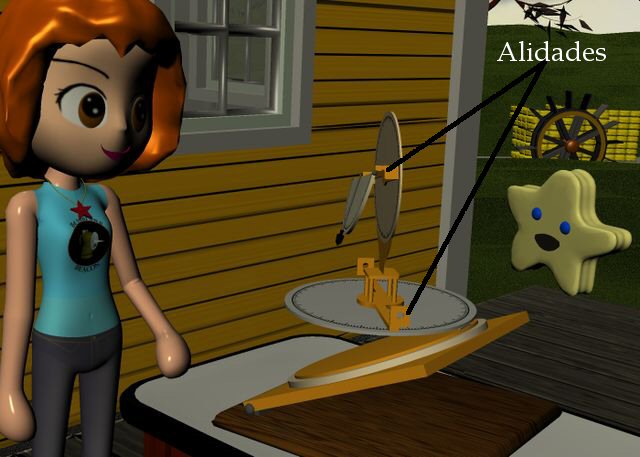
Note the vertical and horizontal alidades, for sighting sun and stars:
Here the torquetum runs through all of its possible motions:

It certainly would have been impressive! Maybe not educational.
= = = = =
A smaller and perhaps more useful tool was the Horary Dial:

This was made in Vienna around 1500. I can't find instructions for the usage of the triple-jointed arm or brachiolus, so Polistra will just wiggle it around.
= = = = =
The Navicula was more elegant and more useful. It was an artistic version of an astrolabe, designed to look like a ship. In other words it was both an analog computer and a
literal computer. Naviculas were made in several European countries, from Venice to Colchester. I'm animating the Colchester version.
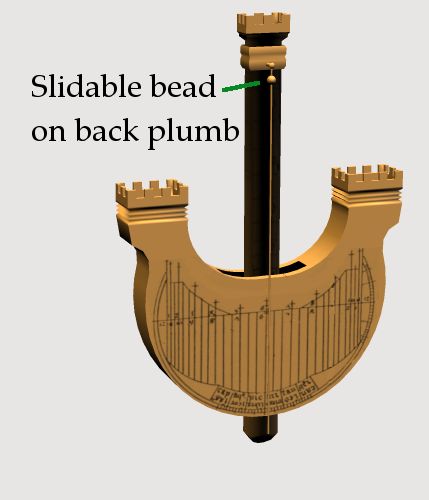
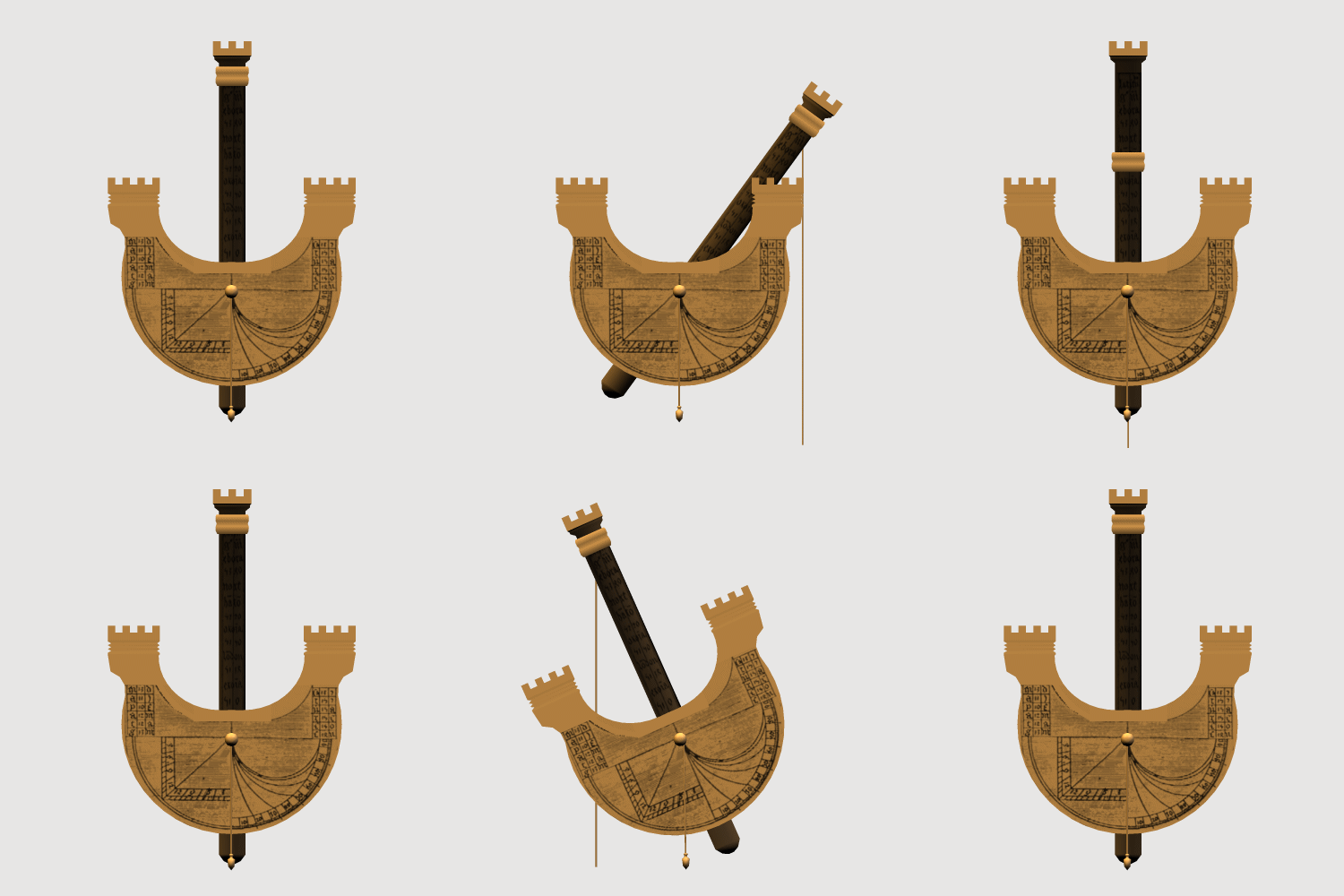
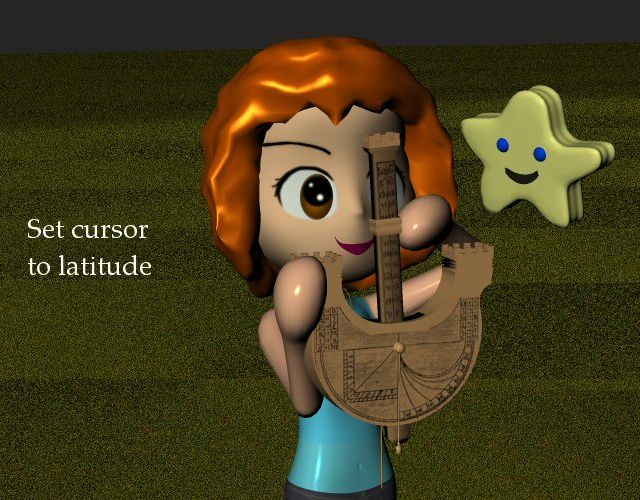
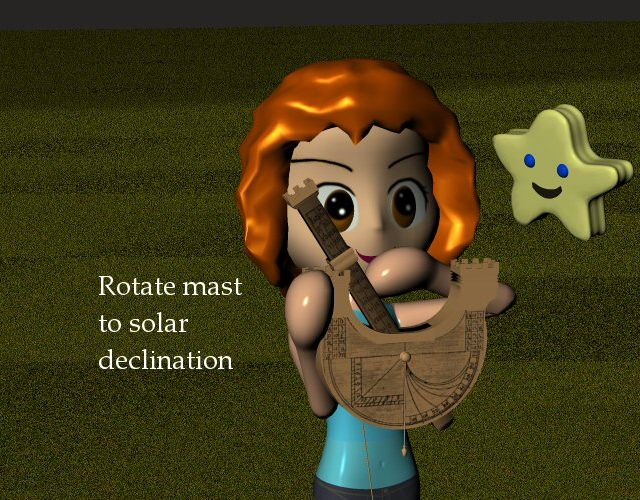
The mast rotated from side to side, and carried a cursor sliding down a scale of latitude. A plumb dropped from the middle of the instrument so you could determine the angle of the entire navicula.
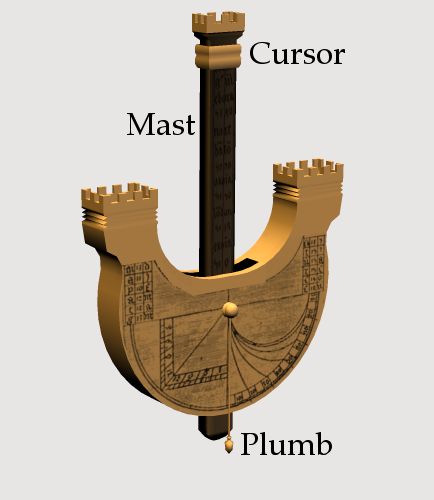
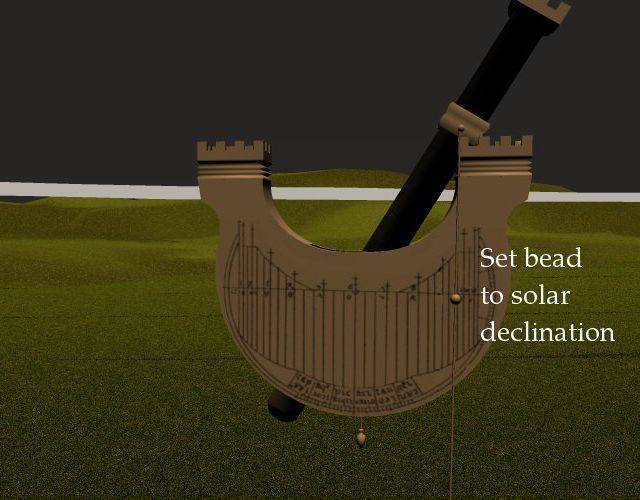
Back view: The cursor had its own plumb, with a sliding bead.
Here I'm simply rotating the entire instrument, pausing to show the alidade feature. You would sight between the slots in the end castles.
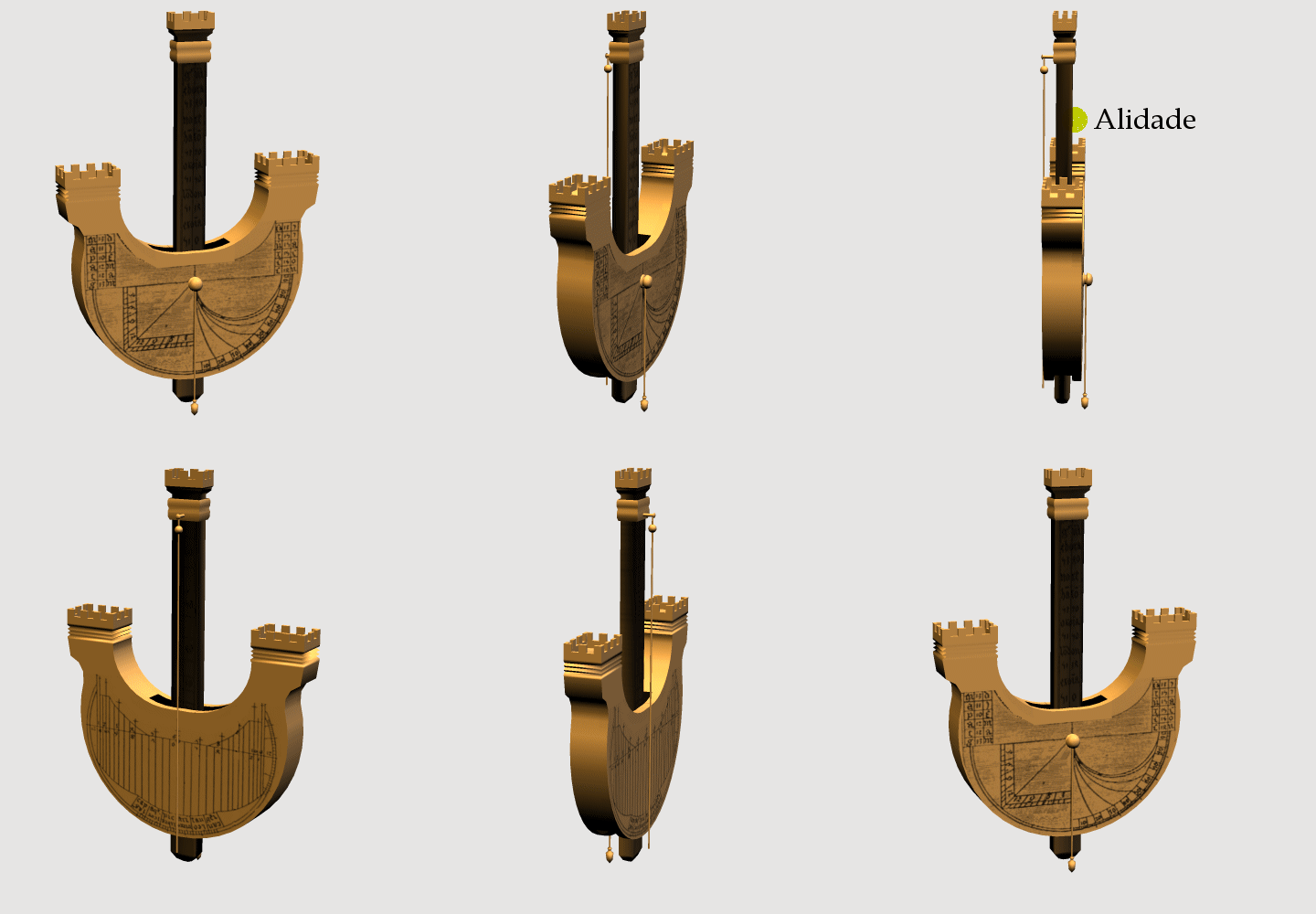
Putting it through its paces, from the front:
And from the back:

Plenty of action, plenty of scales and moving parts.
Now Polistra will follow
David King's instructions.
1. To use the instrument, we first set the cursor on the mast to the
latitude.
2 Then we rotate the mast to the solar declination on the lower
scale.
3 Next we set the bead on the thread at the solar declination on
the side scale.
4 When the instrument is tilted so that the rays of the sun pass through the hole on the upper sight and fall on the corresponding part of the lower sight,
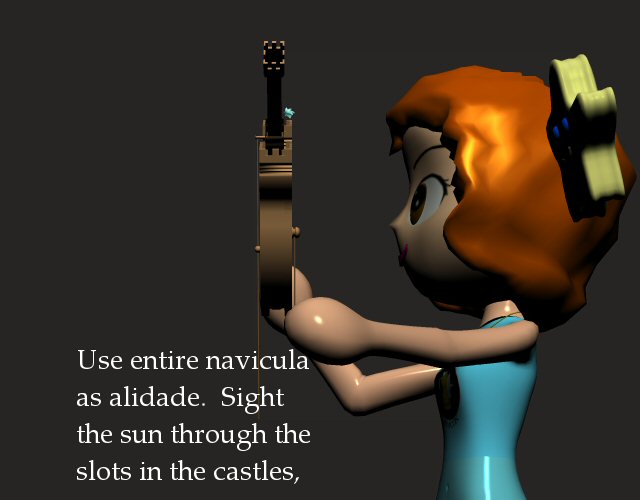
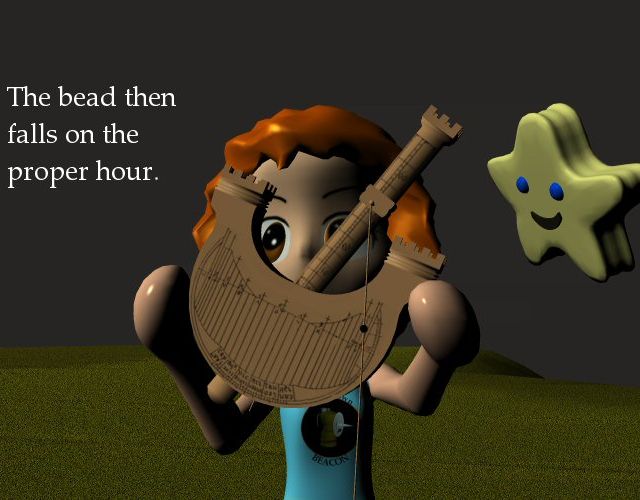
5 ... the inclination of the horizontal axis of the instrument measures the solar altitude. The bead then falls on the appropriate marking of the hour-scale.
Labels: Entertainment, Equipoise


