The eyes of the entertainment and media worlds are on the high-income city of Bartlesville, in northeastern Oklahoma, but hardly anyone in the city is aware that there is anything historic or unusual about the paid living-room movies that go into 545 homes.Note high-income. Bartlesville and Ponca were RICH towns before Share Value and offshoring. Now they're poor. Incidentally, Bartlesville was close enough to Tulsa that it didn't need 'community antenna TV'. All three Tulsa channels came in clearly. This service was solely for movies.
The 545 homes hooked up Nov. 1 will produce a box office take of $5,000 in November, plus any income from new subscribers joining early in the month, provided they all pay their $9.79 monthly bills. After two months Vumore is getting ready to do its first hard-selling of TeleMovies. Thus far the promotion has been designed to let Bartlesville and the nation know that TM was in operation. Now Vumore is getting ready for door-to-door selling and would like to see at least another 200 subscribers by Dec. 1.Ten bucks a month is about 100 bucks now. Current cable service is still about 100 bucks. In general, the paid movies seemed to be additive, not replacing either TV or theaters:
TV sets in TM homes are working overtime. Movie attendance doesn't seem to have suffered: any drop-off could easily be ascribed to such things as flu. Censoring of movies isn't an apparent problem and scarcely any complaints have been heard about the moral aspect of TM films.Notice the word that just slipped by? 1957 was a REAL EPIDEMIC but everything else in the world continued running.
Labels: Alternate universe, defensible times
¶ 3:50 PM

If the ingredients of a reward, a significant achievement, an interested audience, and at least one participant are taken as the criteria for a race, then there most certainly is a space race, since we have at least one highly demonstrative participant, the Russians, and we have ample evidence of the achievements, rewards, and interest to the audience. Let us then consider the race from the point of view of the Communist government and society of the USSR. The Russian Communists have certain over-all objectives. They want a strong Russian Communist society. They want to expand their sphere of influence. And they want an increasingly favorable economic situation for Russia; i.e., they wish a higher standard of living, greater productivity, and a favorable world market, which will permit them, in capitalistic terms, to make a profit.On the dot. As I've noted before, a few Americans understood the Soviet system correctly at that time. It was based on profit. The government profited when companies created value, so the government was motivated to help industries create real value. Since 1980 our system HATES profit and tries to OBLITERATE every aspect of profit. No creation or increase of real value is allowed. What prizes did Russia win by getting there first with Sputnik?
Some of the prizes can be valued in cold cash. The Russians probably spent on the order of 500 million dollars in order to launch the first several Sputniks. As a direct result of these launchings, Russian technical prestige took a large discrete jump upwards in the world market. Making a highly conservative guess of the cash value of this jump, based upon the size of the world market and the size of various governmental expenditures, the first several Sputniks meant a return on the world market on the order of five billion dollars. Therefore, by spending five hundred million dollars the Russians got back about ten times that amount.How does tech prestige translate into profit?
Suppose that you were a civil servant in South America or Asia and you were responsible for choosing a contractor to build a bridge. Because your own country has no bridge-building contractors, you must look to other countries of the world. Before Sputnik you would probably consider obtaining your bridge from the United States, the United Kingdom, or perhaps, West Germany. It is unlikely that you would consider a Russian contractor too seriously. After Sputnik, the countries that come to mind are now Russia and the United States.Now, of course, the countries that come to mind are China and Russia. USA no longer builds things. We only destroy and obliterate. Internal prestige is also a prize, and our Deepstate recognized the prize:
Such an achievement is an enormous boost to nationalism and patriotism, and the Russian Communists have succeeded in adding this asset of patriotism to support for Russian Communism. The Russian Communist government is now in far better standing with the Russian people: this is evidenced by at least two facts. The first fact is that the absolute dictator of Russia could afford to be out of his country for a period of three months. Secondly, we no longer hear the assertion that "if we could only reach the Russian people directly, they would overthrow the regime." Such talk no longer seems realistic.Scientific prestige? Not so important.
The real surprise is that the expected prize of all this space activity was supposed to be science and discovery and yet this prize seems to come last on the list. Until very recently, the Russians had not made any astonishing scientific discoveries and it almost appeared as if the United States held the monopoly. Unfortunately, that U.S. monopoly no longer exists and the Russians have made important scientific discoveries which are recognized as such throughout the world. The Russians have told us that the moon has no magnetic field nor does it have any Van Allen belt. It is unlikely that anyone will question this discovery. The Russians have taken a picture of the other side of the moon and have named the various topological features.Finally he hits us with HARDASS reality.
Based on this kind of evidence, I think it is fair to conclude that we are in a race. What we may not have realized is that the Russians are in it whether we are in it or not. In a sense, we are so far behind that the Russian competition does not even look back to find out where we are.
 Constant:
None of these considerations surfaced in our media, then or now. We "woke up". We switched our math and science teaching from horrible to totally useless, and that "solved" the problem.
Variable:
Our experts in 1959 were grounded in reality, and discussed reality openly. Now our experts know the reality and tell us the exact opposite.
Constant:
None of these considerations surfaced in our media, then or now. We "woke up". We switched our math and science teaching from horrible to totally useless, and that "solved" the problem.
Variable:
Our experts in 1959 were grounded in reality, and discussed reality openly. Now our experts know the reality and tell us the exact opposite.Labels: Constants and Variables, defensible times, Natural law = Soviet law
¶ 10:35 AM
I solemnly pledge myself to consecrate my life to the service of humanity. I will give to my teachers the respect and gratitude which is their due; I will be loyal to the profession of engineering and just and generous to its members; I will lead my life and practice my profession in uprightness and honor; whatever project I shall undertake, it shall be for the good of mankind to the utmost of my power; I will keep far aloof from wrong, from corruption, and from tempting others to vicious practice; I will exercise my profession solely for the benefit of humanity and perform no act for a criminal purpose, even if solicited, far less suggest it; I will speak out against evil and unjust practice wheresoever I encounter it; I will not permit considerations of religion, nationality, race, party politics, or social standing to intervene between my duty and my work; even under threat, I will not use my professional knowledge contrary to the laws of humanity; I will endeavor to avoid waste and the consumption of non-renewable resources. I make these promises solemnly, freely, and upon my honor.The good of humanity is the main problem. Euthanasia and eugenics are ALWAYS grounded on the greater good of humanity. Governments ALWAYS claim to be improving the breed of humanity by culling SUBHUMANS. Culling was quite open in Hitlerian language, and it's equally brazen in the language of both Gaians and Virans. "Science deniers" and "vax deniers" are subhuman vermin. Serving INDIVIDUAL CUSTOMERS is the best way to be moral. When you want to SELL MORE PRODUCTS, you want to have MORE LIVING AND PROSPEROUS CUSTOMERS who can buy your stuff. Share Value broke this connection, leaving tech solely tied to Deepstate and Epstein. And Epstein brings us to the other missing point, secrecy and blackmail. Engineers were NOT secret-keepers before 1946. They respected patents and trade secrets, but patents aren't killers. A trade secret protects an amortized skill. It doesn't induce blackmail. After the rebirth of Deepstate, the NSF and the nuclear program started bringing engineers into the fold. The sudden shift was visible in tech magazines between '45 and '46. The classic 'open source' attitude was still there in '45, spreading knowledge without breaking patents. In '46 everything was closed down to "protect against commie spies", who were of course really working for FBI. Secrecy was well underway in 1957. I remember talking with one of my engineer uncles who was working at Los Alamos. He said he was working on rockets, and that's all he would say. In '58 Ike lamented the fast shift of tech firms from PROFIT AND CUSTOMERS to government contracts and secrecy. By 1974 this shift was complete in electronics, but hadn't yet infected the newer software industry. Other writers in the same magazine were seeing it, but Suskind missed it. His first example, the county extension program, belongs to the open source world. Serving the customer with some help from the government. His second example, Hitler's euthanasia/eugenics, belongs to the secret-keeping world, slaughtering the customer with plenty of help from the government. Engineers were already in the secret-keeping world in '74, so no pledge could pull them back. Suskind also salutes Gaia at the end of his pledge, which would have helped to enable Greta's euthanasia/eugenics. I'll try to be charitable and assume he was just a poor prophet, but I'm not in a charitable mood this year. = = = = = Continued here.
Labels: AI point-missing, defensible times, endless hell
¶ 11:53 AM
 McBee cards could be punched and sorted by machine. The punching side was partly mechanized, but the sorting side was usually done by hand.
This has advantages and disadvantages. The most obvious advantage is cost. For McBee you need to order some cards, and you need a ticket-punch and an icepick and some boxes. The cards are the only real cost. For IBM you need to order some cards, and you also need to rent a keypunch and a sorter for about $150 a month (equals $1000 a month today). Individuals and small businesses could afford McBee.
When modeling and animating these processes I'm on halfway familiar ground. In the '50s I often helped my father with mechanical grading and categorizing for his college lecture classes. It was a job I truly enjoyed. I did a lot of sorting, and a little bit of hand-punching, but never encountered the punching machine illustrated below.
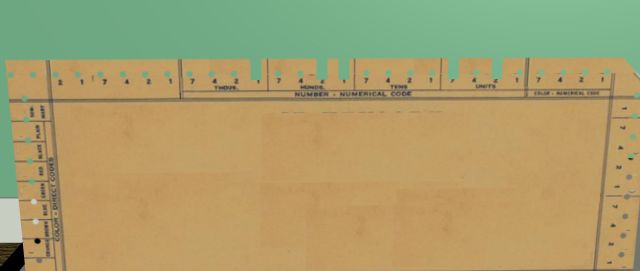
A typical McBee card had punchable fields all around the edge, and a writable area in the middle. The open central area was another advantage over Hollerith, which was solidly filled with punchable numbers. You could type or handwrite a considerable amount of info or diagrams in the center.
McBee cards could be punched and sorted by machine. The punching side was partly mechanized, but the sorting side was usually done by hand.
This has advantages and disadvantages. The most obvious advantage is cost. For McBee you need to order some cards, and you need a ticket-punch and an icepick and some boxes. The cards are the only real cost. For IBM you need to order some cards, and you also need to rent a keypunch and a sorter for about $150 a month (equals $1000 a month today). Individuals and small businesses could afford McBee.
When modeling and animating these processes I'm on halfway familiar ground. In the '50s I often helped my father with mechanical grading and categorizing for his college lecture classes. It was a job I truly enjoyed. I did a lot of sorting, and a little bit of hand-punching, but never encountered the punching machine illustrated below.
A typical McBee card had punchable fields all around the edge, and a writable area in the middle. The open central area was another advantage over Hollerith, which was solidly filled with punchable numbers. You could type or handwrite a considerable amount of info or diagrams in the center.
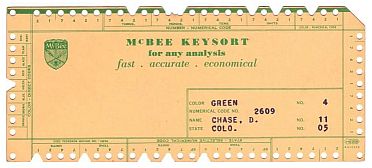 Cards were printed in a wide variety of individual styles for each business or purpose. Some had specialized non-numerical categories, some were all numerical, some were mixed alphanumeric.
McBee cards had a unique arithmetic system, based on 1 2 4 7. The system isn't a proper base-15, though it ranges from 0 to 14. The choice of these four digits was supposedly a compromise to minimize the number of punches needed. You could form all the digits from 0 to 9 with one or two punches. This was slightly more efficient than 4-bit binary.
Cards were printed in a wide variety of individual styles for each business or purpose. Some had specialized non-numerical categories, some were all numerical, some were mixed alphanumeric.
McBee cards had a unique arithmetic system, based on 1 2 4 7. The system isn't a proper base-15, though it ranges from 0 to 14. The choice of these four digits was supposedly a compromise to minimize the number of punches needed. You could form all the digits from 0 to 9 with one or two punches. This was slightly more efficient than 4-bit binary.
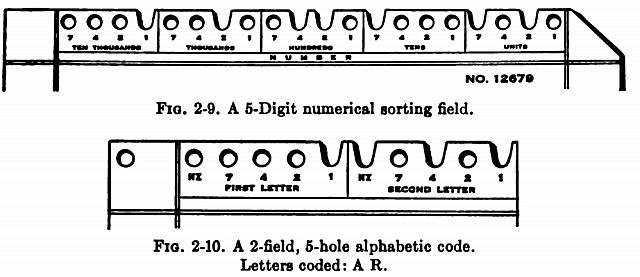 Letters were formed with 1 2 4 7 plus an extra, called NZ for nonzero. This was NOT more efficient than a 5-bit binary system, but the familiarity probably made it faster. Binary digits were totally foreign to most people until the 1980s, and it's always better to amortize an existing skill.
[Here's a comparison of efficiency in terms of total punches needed.]
One definite advantage of hand-sorted cards is flexibility of form. When the stack is going to be handled carefully and personally, you can include samples of material or photo images on or in each card. McBee cards with inset X-ray images were useful in medical records:
Letters were formed with 1 2 4 7 plus an extra, called NZ for nonzero. This was NOT more efficient than a 5-bit binary system, but the familiarity probably made it faster. Binary digits were totally foreign to most people until the 1980s, and it's always better to amortize an existing skill.
[Here's a comparison of efficiency in terms of total punches needed.]
One definite advantage of hand-sorted cards is flexibility of form. When the stack is going to be handled carefully and personally, you can include samples of material or photo images on or in each card. McBee cards with inset X-ray images were useful in medical records:
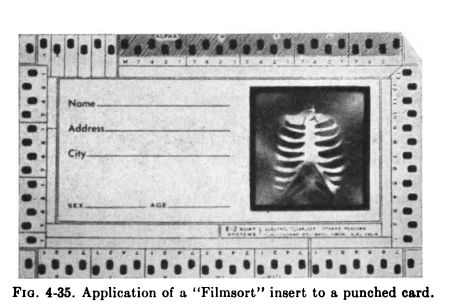 These inclusions couldn't pass through an IBM sorter or card-reader.
Hand punching was done with a special triangular hand punch that looked a lot like a ticket punch. My father didn't have the special, so we just used a ticket punch.
= = = = =
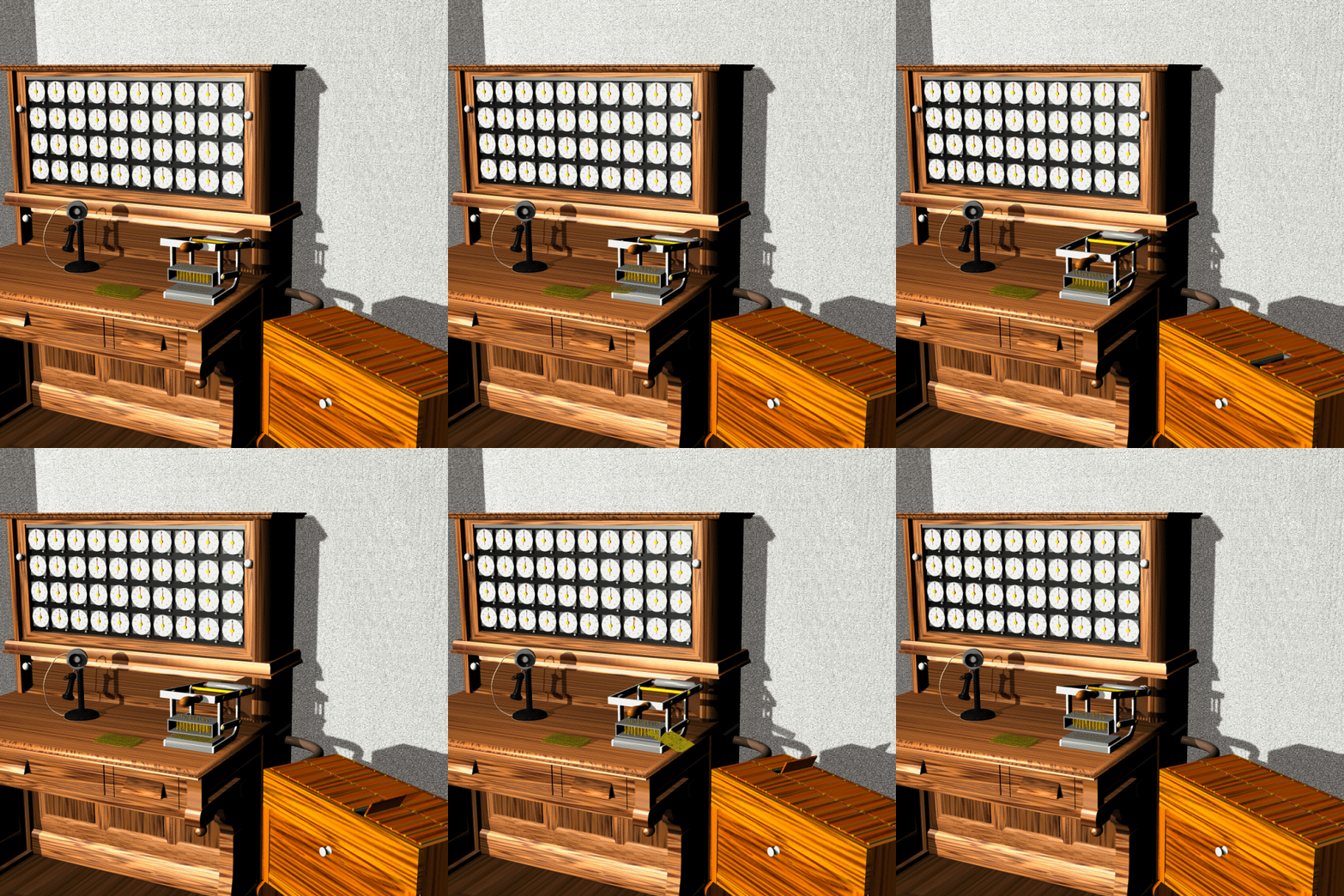
This punching machine was shown in one detailed description of McBee systems. No other information is available, so I'm semi-guessing the way it worked. I'm assuming that you would set up the patterns using the 8 columns of buttons for up to 8 numerical fields on one side of the card, then hit the big button on the right to punch these. The long side of a typical card contained 6 or 7 fields, so the 8 columns would usually handle one side of a card. I don't know what the 8 buttons on top were supposed to do. Maybe reset for each column? The process would have been like an adding machine except that you were consciously forming the 1247 pattern for each field.
These inclusions couldn't pass through an IBM sorter or card-reader.
Hand punching was done with a special triangular hand punch that looked a lot like a ticket punch. My father didn't have the special, so we just used a ticket punch.
= = = = =
This punching machine was shown in one detailed description of McBee systems. No other information is available, so I'm semi-guessing the way it worked. I'm assuming that you would set up the patterns using the 8 columns of buttons for up to 8 numerical fields on one side of the card, then hit the big button on the right to punch these. The long side of a typical card contained 6 or 7 fields, so the 8 columns would usually handle one side of a card. I don't know what the 8 buttons on top were supposed to do. Maybe reset for each column? The process would have been like an adding machine except that you were consciously forming the 1247 pattern for each field.
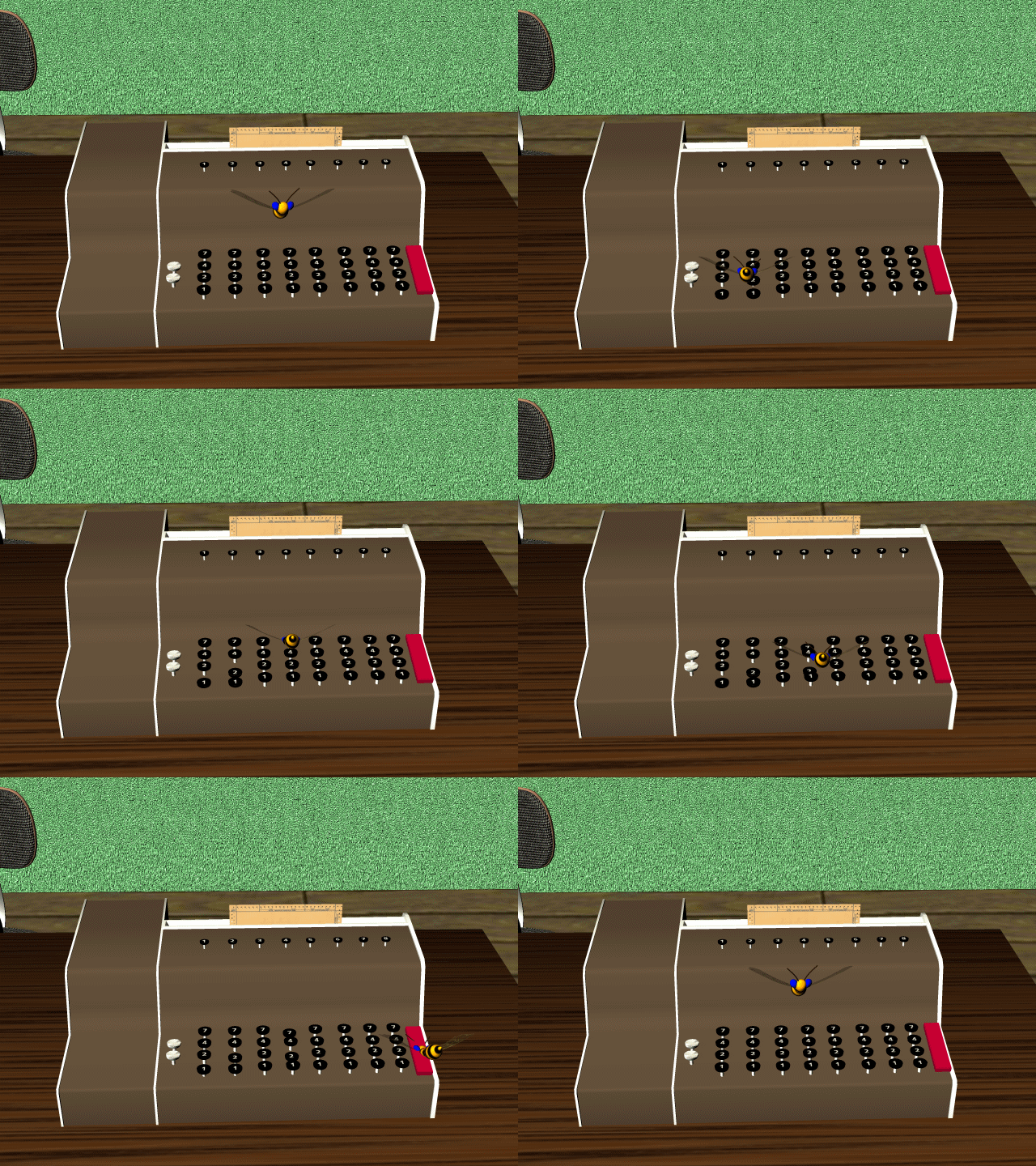 Mr McBee has just punched in 1309, so the card would look like this after turning it over:
 Now Polistra will demonstrate the first step of the selecting process. Assume she's looking for cards with 1309. She begins by finding cards with a 1 in the thousands place.
McBee selection is inverse to the usual way of thinking. It's more like the military volunteer method, where the soldiers who are NOT volunteering to check out the minefield are asked to step back, leaving the volunteers and the sleepers in the original row.
The poker was called a tumbler for some unknown reason. (It should have been a stinger.) Polistra inserts the tumbler into the 1 hole of the thousands field. Cards that were NOT punched in this slot can be pulled up, while the cards with a PUNCH in this digit stay down. She then places the UNWANTED cards in the red box, leaving only the few WANTED cards in the original blue box.
Now Polistra will demonstrate the first step of the selecting process. Assume she's looking for cards with 1309. She begins by finding cards with a 1 in the thousands place.
McBee selection is inverse to the usual way of thinking. It's more like the military volunteer method, where the soldiers who are NOT volunteering to check out the minefield are asked to step back, leaving the volunteers and the sleepers in the original row.
The poker was called a tumbler for some unknown reason. (It should have been a stinger.) Polistra inserts the tumbler into the 1 hole of the thousands field. Cards that were NOT punched in this slot can be pulled up, while the cards with a PUNCH in this digit stay down. She then places the UNWANTED cards in the red box, leaving only the few WANTED cards in the original blue box.
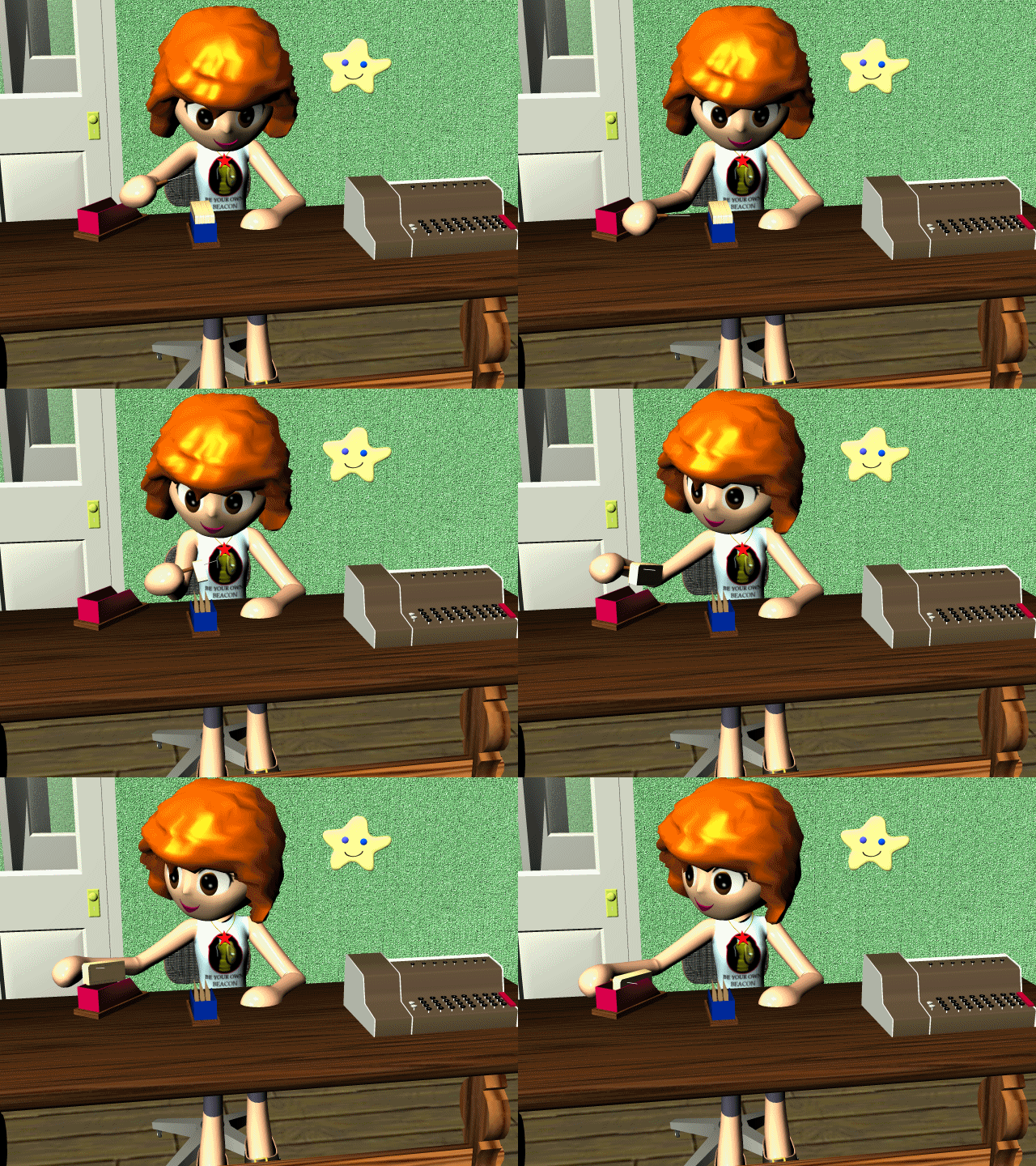 She would then tumble a 1 and a 2 in the hundreds field, to complete the 3; then do nothing for the zero in the tens field; then tumble the 2 and 7 in the ones field.
All remaining cards in the original blue box would then be 1309.
She would then tumble a 1 and a 2 in the hundreds field, to complete the 3; then do nothing for the zero in the tens field; then tumble the 2 and 7 in the ones field.
All remaining cards in the original blue box would then be 1309.
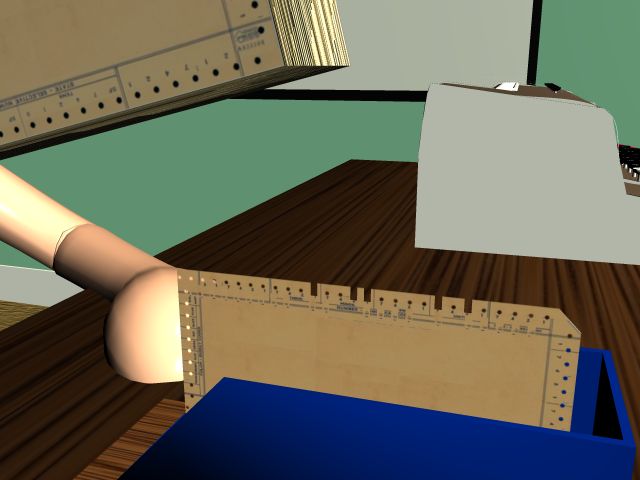 This may seem tiresomely slow, but the basic IBM sorter in that era also sorted one field at a time, with repeated sorts of the smaller remainders. The difference is that the IBM processed all digits in a numeric field at once. For cards with non-numerical fields, where each value in the field represented one value of a category (like M/F gender or Small/Medium/Large size) McBee and IBM would need the same number of passes.
McBee later made a more IBMish puncher and sorter, but no info is available online except this one picture:
This may seem tiresomely slow, but the basic IBM sorter in that era also sorted one field at a time, with repeated sorts of the smaller remainders. The difference is that the IBM processed all digits in a numeric field at once. For cards with non-numerical fields, where each value in the field represented one value of a category (like M/F gender or Small/Medium/Large size) McBee and IBM would need the same number of passes.
McBee later made a more IBMish puncher and sorter, but no info is available online except this one picture:
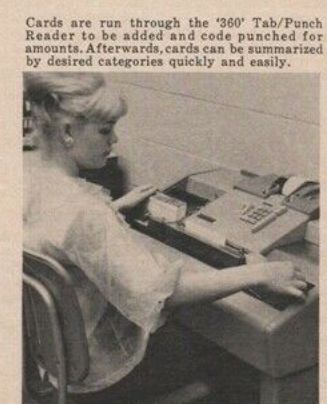 This machine didn't gain popularity for an obvious reason. When you OWN a niche, you need to claim and optimize the niche. Customers bought McBee BECAUSE it was naturally visual and lo-tech. McBee customers weren't buying McBee because they WISHED it was more like IBM.
Admittedly their marketers finally picked up the beehive theme!
This machine didn't gain popularity for an obvious reason. When you OWN a niche, you need to claim and optimize the niche. Customers bought McBee BECAUSE it was naturally visual and lo-tech. McBee customers weren't buying McBee because they WISHED it was more like IBM.
Admittedly their marketers finally picked up the beehive theme!Labels: defensible times, Equipoise
¶ 2:51 PM
Labels: 2000=1000, defensible times, From rights to duties, the broken circle
¶ 1:58 PM
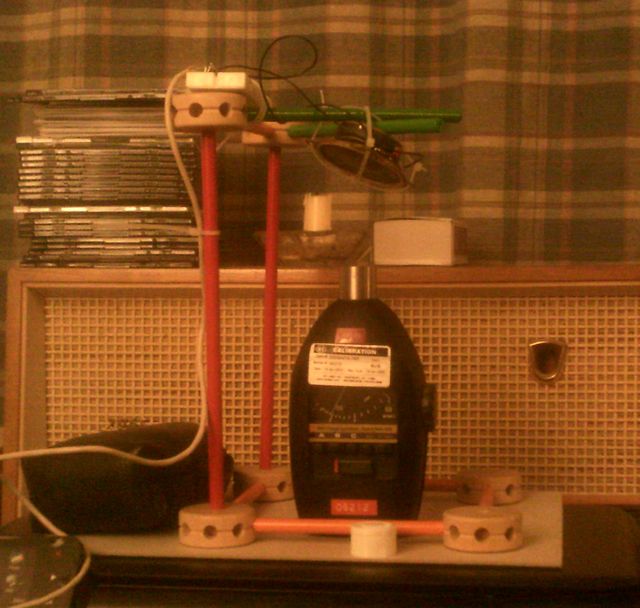
 Then last year I dug into the set again and built an acoustical test rig:
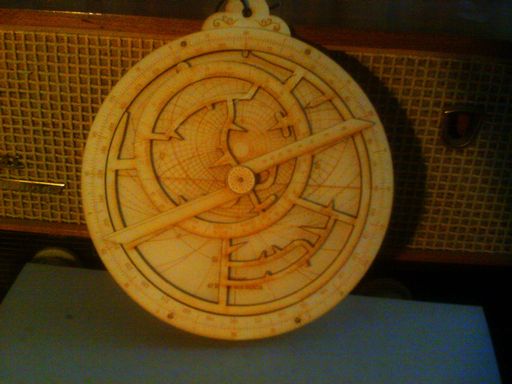
 Wood is JUST RIGHT for some purposes. I was reminded of this in June when I bought and built this wooden astrolabe kit:
 Now that I've got a brief creative interval again, another use of wood suggested itself. There are several cleaning tasks in the kitchen that simply can't be done by brushes or sponges or fingernails. I've tried repeatedly, and nothing works.
1. The slots in a coffeemaker basket.
2. The narrow 'well' in the dish drainer that holds silverware.
3. The inside of a thermos.
It occurred to me that splitting off one side of a long slotted Tinkertoy rod might fit in those spaces. I reached into the bag and found one long rod with a handle already stuck on it. I used pliers to split off one side, and sure enough it's JUST RIGHT for all three tight spots.
Now that I've got a brief creative interval again, another use of wood suggested itself. There are several cleaning tasks in the kitchen that simply can't be done by brushes or sponges or fingernails. I've tried repeatedly, and nothing works.
1. The slots in a coffeemaker basket.
2. The narrow 'well' in the dish drainer that holds silverware.
3. The inside of a thermos.
It occurred to me that splitting off one side of a long slotted Tinkertoy rod might fit in those spaces. I reached into the bag and found one long rod with a handle already stuck on it. I used pliers to split off one side, and sure enough it's JUST RIGHT for all three tight spots.
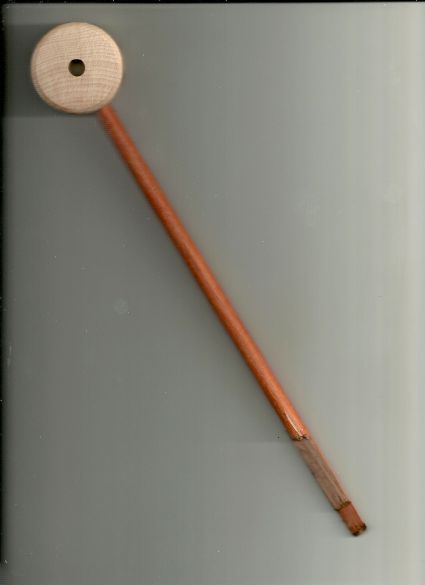 Wood is an ideal scrubber. It's hard enough to break through biofilms, but not hard enough to scratch metal or plastic surfaces.
= = = = =
Random wood-related sidenote, observed on this morning's walk. The creeping thyme that lives in the pavement cracks is also appreciating the return to benign weather and last week's rain. After staying underground for 8 months, barely surviving, it's creating wildly this week, overflowing and spreading across the pavement. I've never seen it growing so enthusiastically before.
Wood is an ideal scrubber. It's hard enough to break through biofilms, but not hard enough to scratch metal or plastic surfaces.
= = = = =
Random wood-related sidenote, observed on this morning's walk. The creeping thyme that lives in the pavement cracks is also appreciating the return to benign weather and last week's rain. After staying underground for 8 months, barely surviving, it's creating wildly this week, overflowing and spreading across the pavement. I've never seen it growing so enthusiastically before.Labels: coot-proofing, defensible thymes, defensible times, Entertainment
¶ 5:20 AM
Labels: Carver, defensible cases, defensible times, Grand Blueprint, storage
¶ 2:10 PM
Labels: Carbon Cult, defensible times
¶ 11:00 PM
Labels: defensible times, Jackboot stomping forever
¶ 10:38 PM
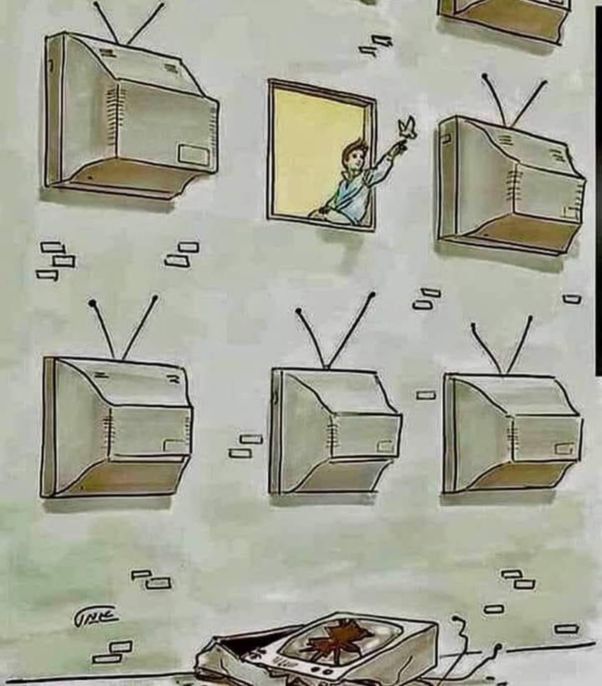 I tried to make the same point here, but didn't get anywhere near the same perfection.
 Labels: defensible cases, defensible times
¶ 2:40 PM
Labels: Deadthink, defensible times, Parkinson
¶ 1:34 AM
Ogni mezzo che serve alla comunicazione di un essere coll' altro, si comprenderebbe solto il nome di telegrafia, interpretando questa parola nel senso il più esteso. Tutti i membri della creazione animale hanno ricevuto dal loro Fattore qualche mezzo naturale di comunicazione che unisca e colleghi fra loro gli individui delle varie specie. Infiniti e mirabili sono i modi con cui si manifesta il divino linguaggio della natura, disposto con bella armonia. L'uccello gorgheggia, il quadrupede emelte gridi e voci inarticolate, e questi mezzi cosi poveri e ristretti bastano ai bruti limitati nella loro vita ai bisogni istintivi e materiali. L'uomo destinato ad una via L'uomo destinato ad una via di progresso morale e civile, ha mestieri di poter esprimere con segni sensibili le idee, i sentimenti che si agitano nell'anima sua, comunicarli ai propri simili, e stringersi con essi in amichevoli rapporti: E la divina Provvidenza lo dotò di favella che lo rende superiore agli altri esseri, e determina lo sviluppo di sue facoltà intellettuali e morali.The book starts out with the Chappe semaphore, which uniquely marked the destruction of this connection in France. Claude Chappe was a priest who thought he was advancing the poter esprimere con segni sensibili le idee, i sentimenti che si agitano nell'anima. When he saw that the Revolution was using his invention for the exact opposite purpose, he jumped down a well. Reviving the sense of entertainment and joy must also revive the connection to the gift by Divine Providence. Can't have one without the other.
Labels: defensible times, Entertainment
¶ 9:40 AM
Labels: 2000=1000, defensible cases, defensible spaces, defensible times
¶ 11:54 PM
Labels: 2000=1000, defensible times, endless hell, Patient people
¶ 11:46 PM
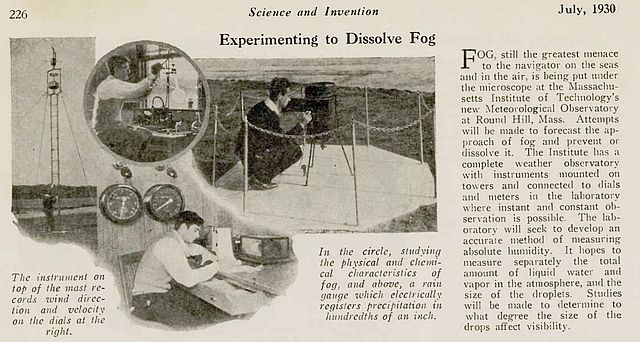 Nice combination of two subjects I've recently mentioned.
1. Lodge and his sons were attempting to use electrical charge to break up fog. They abandoned the effort after deciding that it would require WAY too much equipment and electricity to make a difference. Hail cannons and cloud seeding both require remarkably small amounts of energy and material. A few acetylene puffs, and a few pounds of silver iodide. By analogy, is there a similar solution for fog, using vortices?
2. The MIT facility at Round Hill was a gift from Colonel Green, the heir of the Hetty Green fortune. He was a dilettante but contributed tremendously to the progress and enjoyment of science through gifts of money and property.
Self-defense from weather has been prohibited since 1975. All the old research has been memoryholed, even though hail cannons are still protecting European vineyards.
In 2020 self-defense against disease joined weather. We no longer have immune systems, so we must do what we're told, no matter how crazy and holocaustal the tellers are. Ours not to reason why, ours but to die and die.
Immediate answer to the question: Yes, fog control worked.
Nice combination of two subjects I've recently mentioned.
1. Lodge and his sons were attempting to use electrical charge to break up fog. They abandoned the effort after deciding that it would require WAY too much equipment and electricity to make a difference. Hail cannons and cloud seeding both require remarkably small amounts of energy and material. A few acetylene puffs, and a few pounds of silver iodide. By analogy, is there a similar solution for fog, using vortices?
2. The MIT facility at Round Hill was a gift from Colonel Green, the heir of the Hetty Green fortune. He was a dilettante but contributed tremendously to the progress and enjoyment of science through gifts of money and property.
Self-defense from weather has been prohibited since 1975. All the old research has been memoryholed, even though hail cannons are still protecting European vineyards.
In 2020 self-defense against disease joined weather. We no longer have immune systems, so we must do what we're told, no matter how crazy and holocaustal the tellers are. Ours not to reason why, ours but to die and die.
Immediate answer to the question: Yes, fog control worked.Labels: defensible times, Jackboot stomping forever
¶ 3:30 PM
Labels: defensible cases, defensible spaces, defensible thymes, defensible times
¶ 5:39 AM
 Rayleigh and Tyndall and others built a variety of sirens and horns, and tested them under a variety of conditions.
 = = = = =
John Tyndall, in his 1880 textbook on acoustics, describes some of those experiments at both Foreland and Lizard Point.
The goal was to determine what kind of sound source penetrated various atmospheric formations best, in order to protect ships against reefs and grounding in fog. Tyndall discusses the peculiarities of air layers, especially inversions and interfaces between masses of different temperature or humidity. When the line from the sound to the listener is parallel to a boundary, the sound will be channeled to your ear. When the line is perpendicular, the sound is blocked.
Tyndall includes this letter from Professor RGH Kean in Virginia.
= = = = =
John Tyndall, in his 1880 textbook on acoustics, describes some of those experiments at both Foreland and Lizard Point.
The goal was to determine what kind of sound source penetrated various atmospheric formations best, in order to protect ships against reefs and grounding in fog. Tyndall discusses the peculiarities of air layers, especially inversions and interfaces between masses of different temperature or humidity. When the line from the sound to the listener is parallel to a boundary, the sound will be channeled to your ear. When the line is perpendicular, the sound is blocked.
Tyndall includes this letter from Professor RGH Kean in Virginia.
For the following account of the battle of Gain's Farm, I am indebted to the Rector of the University of Virginia: March 19, 1874. SIR, I have just read with great interest your lecture of January 16, on the acoustic transparency and opacity of the atmosphere. The remarkable observations you mention induce me to state to you a fact which I have occasionally mentioned, but always, where I am not well known, with the apprehension that my veracity would be questioned. It made a strong impression on me at the time, but was an insoluble mystery until your discourse gave me a possible solution. On the afternoon of June 28, 1862, I rode, in company with General Randolph, then Secretary of War of the Confederate States, to Price's house, about nine miles from Richmond. The evening before, General Lee had begun his attack on McClellan's army, by crossing the Chickahominy about four miles above Price's, and driving in McClellan's right wing. The battle of Gain's Farm was fought the afternoon to which I refer. The valley of Chickahominy is about one and a half miles wide from hilltop to hilltop. Price's is on one hilltop, that nearest to Richmond; Gain's Farm, just opposite, is on the other, reaching back in a plateau to Cold Harbour. Looking across the valley I saw a good deal of the battle, Lee's right resting in the valley, the Federal left wing the same. My line of vision was nearly in the line of the lines of battle. I saw the advanceof the Confederates, their repulse two or three times, and in the grey of the evening the final retreat of the Federal forces. I distinctly saw the musket fire of both lines, the smoke, individual discharges, the flash of the guns. I saw batteries of artillery on both sides come into action and fire rapidly. Several field-batteries on each side were plainly in sight. Many more were hid by the timber which bounded the range of vision. Yet looking for nearly two hours, from about 5 to 7 PM on a midsummer afternoon, at a battle in which at least 50,000 men were actually engaged, and doubtless at least 100 pieces of field-artillery, through an atmosphere optically as limpid as possible, not a single sound of the battle was audible to General Randolph and myself. I remarked it to him at the time as astonishing. Between me and the battle was the deep broad valley of the Chickahominy, partly a swamp shaded from the declining sun by the hills and forest in the west (my side). Part of the valley on each side of the swamp was cleared; some in cultivation, some not. Here were conditions capable of providing several belts of air, varying in the amount of watery vapour (and probably in temperature), arranged like laminae at right angles to the acoustic waves as they came from the battlefield to me.Several boundary layers of OBJECTIVITY were channeled in 1880 and blocked now. 1. Trinity House was basically a mutual insurance company, devoted to the safety of sailors and ships. It gained profit when ships sailed and landed safely. So it devoted huge resources to eliminating false beacons, and to developing the best ways of signaling danger to ships. Trinity supported optical research on lights, acoustical research on foghorns, and electronic research on ship-to-shore radio. Now insurers are no longer objective, even when partisanship ruins their own profits. They sacrifice all to serve DNC. 2. Kean was watching a battle where men were dying. The South won that particular battle, but by 1874 the NYC occupiers were fully engaged in pillaging and looting and raping the South, after burning it down and killing huge numbers of people. Nevertheless, he was able to separate science from genocide, carefully calibrating distances and swamps and forests. Now science IS genocide, and nothing can be published unless it advances NYC's pillaging and looting and raping. 3. Tyndall didn't mention the alleged "purposes" of Madman Lincoln's genocide and didn't automatically dismiss an entire section of the world as Unpersons. He simply found Kean's observations interesting enough to include. 4. Kean's letter must have come through the regular postal system. Transatlantic mail via steamship was efficient and fast in 1880, generally taking about one week. Unlike today's superfast and "free" web service, the postal system in 1880 didn't refuse to carry mail from Unplaces. At that time science had NOTHING to do with political partisanship or geographical partisanship. Madman Lincoln's genocide was still running full speed, but neither Kean nor Tyndall let their emotions interfere with OBSERVATION.
Labels: Carver, defensible times, Trinity House
¶ 11:00 PM
 These two shows were not ordinary quizzes. They were strictly between the host and the listener, a teaching and learning conversation with quantified self-scoring and self-evaluation.
Labels: defensible times, Experiential education
¶ 5:36 AM
Question: Are there any old programming languages that are still in use? Answer: FORTRAN (63 years), COBOL (60 years), BASIC (56 years), C (48 years), SQL (42 years), C++ (35 years), Objective-C (32 years), Python (29 years), and Java (25 years) are all fairly old and still used (though COBOL is pretty specialized legacy code today). The first three are older than I am.COBOL is specialized legacy code / Older than I am. Self-explanatory sentence. This is the Github view. Old shit is specialized legacy shit and you shouldn't be using it, and we will PROHIBIT YOU FROM USING IT. Any attempt to use tools or thinking from the filthy Neanderthal knuckle-dragging previous femtosecond will halt your life and crash your computer. In the Github world, the PURPOSE of programming is to spend 100% of your mental time relearning, and 100% of your computer's CPU time processing updates. Windows 10 implements this purpose perfectly. What is the original intended purpose of a TOOL like computers? The real purpose of any TOOL is to help you GET WORK DONE. Fortunately the GET WORK DONE side is also well represented in Quora, by older WORKERS and even some younger WORKERS in places like Brazil. Reality: In the world of computers that DO WORK, most of the WORK is done by COBOL. The part of the computing world that is truly needed, the part that would completely collapse the whole economy if it failed, is COBOL. = = = = = END PARTIAL REPRINT. Extension: Focus on WE WILL PROHIBIT YOU FROM USING IT. I ran into an especially annoying example in the graphics world this month. Since 2000 I've been using Poser for work (courseware animation) and play. I've bought most of the updates, skipping a couple that were specialized sidetracks. Last year's update (v11) added a Github "feature" for the first time. Poser contacts the central server to check for valid license every time you use it. This was annoying in a practical way along with the IMMORALITY of stealing the tool. When my Comcast web service is down, which happens once a week or so, I can't use Poser. With v12, released this month, they added a total deal breaker. Poser switched to using the latest version of Python, and LOCKED OUT all python programs using the TkInter GUI instead of the WXPython GUI. This may seem like a minor detail, but I've written about a thousand animation 'tools' using TkInter, and rewriting is NOT trivial. It takes about a day to rewrite from Tk to WX. At first I went ahead and paid the $129.95 for the update, figuring they would HAVE to change this lockout. Nope, they don't HAVE to change it, because they're fully infected by the Github worm. They are revising the scripts that come with the Poser package, but anything that isn't in-house is out of luck. After this became clear, I demanded a refund. They gave the refund and turned off the license for v12, which is appropriate. But they ALSO turned off the license for v11, which was using the same serial number. That's outright theft. Now I can't use the last semi-usable version. So I'm severing the connection with Bondware, rolling back to v9, which was the last non-Githubed version. = = = = This shouldn't be an especially emotional process. I've been following this curve with software for 30 years, even before the Github crimes. Every program and OS reaches an optimal point when it has all the necessary features. After the optimum, newer versions add unnecessary shit and start subtracting the good stuff. Now Poser joins the crowd of STOP WHERE IT AIN'T BROKE, like COBOL. There's an added emotional factor, along with the general exhaustion of surviving amid the worldwide takeover by psychopathic demons. Most of the Python stuff that Bondware is taking in-house was originally derived from my scripts, which I had actively provided to the community from 2003 to 2010 or so. This was only mildly annoying before; I considered it as a form of teaching. The students took my examples and expanded them. Now Bondware is forcing the teacher to spend all of his time revising his own tools instead of working. Well, this is where I get off the idiot train. This is where I stop subsidizing CRIME.
Labels: defensible times, Experiential education
¶ 11:01 PM
Question: Are there any old programming languages that are still in use? Answer: FORTRAN (63 years), COBOL (60 years), BASIC (56 years), C (48 years), SQL (42 years), C++ (35 years), Objective-C (32 years), Python (29 years), and Java (25 years) are all fairly old and still used (though COBOL is pretty specialized legacy code today). The first three are older than I am.COBOL is specialized legacy code / Older than I am. Self-explanatory sentence. This is the Github view. Old shit is specialized legacy shit and you shouldn't be using it, and we will PROHIBIT YOU FROM USING IT. Any attempt to use tools or thinking from the filthy Neanderthal knuckle-dragging previous femtosecond will halt your life and crash your computer. In the Github world, the PURPOSE of programming is to spend 100% of your mental time relearning, and 100% of your computer's CPU time processing updates. Windows 10 implements this purpose perfectly. What is the original intended purpose of a TOOL like computers? The real purpose of any TOOL is to help you GET WORK DONE. Fortunately the GET WORK DONE side is also well represented in Quora, by older WORKERS and even some younger WORKERS in places like Brazil. Reality: In the world of computers that DO WORK, most of the WORK is done by COBOL. The part of the computing world that is truly needed, the part that would completely collapse the whole economy if it failed, is COBOL. To a first approximation, computing = COBOL. And there's a simple reason, which I didn't understand until I started reading these discussions. I'm older than COBOL but I didn't start programming until 1983, and I didn't start in the world of commerce. I started in audio processing, first with 8086 and PDP-11 assembly, then Basic, then C. Simple reason: COBOL handles money naturally and intrinsically. The newer languages, including FORTRAN, all start from a theoretical math view of numbers where floating-point arithmetic is the base.
 Digital computers are counters and sorters, not slide rules or theoretical equations on blackboards. Our stupid official history starts with Babbage, who was actually a dead end. Nothing came from Ada except some modern rebuilt legends. The real history of computing starts with Hollerith's counter and sorter, and the real history of programming starts with IBM mainframes counting and sorting money, programmed first in machine codes then soon in COBOL. IBM is uncool, so we can't mention it in our official histories.
Money doesn't use floating point. Money is naturally columnar. I've discussed this in the context of ancient bookkeeping:
= = = = = START REPRINT:
A ledger from the store that was outfitting fur traders in the Louisiana Territory around 1812. It's in French, with some plain English. Deeply fascinating to an old bookkeeper. I'm sure real historians have answered all these questions, but I'm having fun trying to solve them.
Title on first page:
La Compagny des Fourures du Missoury dans son Avanture.
Here's the top few lines of an account for trader Brice Arnold, showing the ledger structure clearly.
Digital computers are counters and sorters, not slide rules or theoretical equations on blackboards. Our stupid official history starts with Babbage, who was actually a dead end. Nothing came from Ada except some modern rebuilt legends. The real history of computing starts with Hollerith's counter and sorter, and the real history of programming starts with IBM mainframes counting and sorting money, programmed first in machine codes then soon in COBOL. IBM is uncool, so we can't mention it in our official histories.
Money doesn't use floating point. Money is naturally columnar. I've discussed this in the context of ancient bookkeeping:
= = = = = START REPRINT:
A ledger from the store that was outfitting fur traders in the Louisiana Territory around 1812. It's in French, with some plain English. Deeply fascinating to an old bookkeeper. I'm sure real historians have answered all these questions, but I'm having fun trying to solve them.
Title on first page:
La Compagny des Fourures du Missoury dans son Avanture.
Here's the top few lines of an account for trader Brice Arnold, showing the ledger structure clearly.
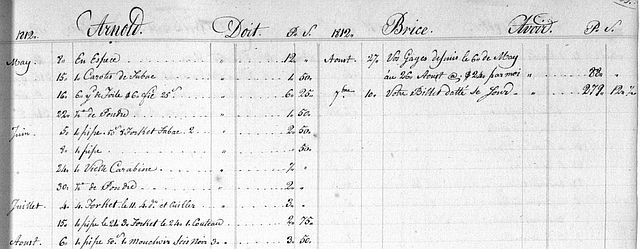 The debit column (Doit) is equipment sold to the fur traders, the credit column (Avoir) is furs bought from the traders. Note the Avoir column is closed out with "Your bill given this day."
The money units are puzzling. The two columns are P and S. My first thought was Poids et Shillings, but it appears that Pesos were the dominant currency in the territory at that time.
The S unit is 100ths of the P unit, not 8ths or 20ths. According to online sources, the peso would have been divided into 8 reales at this time, and centavos didn't start until 1863. No firm answer to this question. Was it just US dollars and cents, labeled P and S by tradition?
We have the $ sign on totals, which meant pesos before it meant dollars. One credible explanation of the symbol traces it to a habit of writing an abbreviation for Pesos as a big P with a little s as a diacritic on top. These clerks were precise with their pens, and their dollar sign always had a big belly and a little head. You can almost see a big P with a little s riding on it. They clearly weren't thinking of the whole symbol as an S with lines through it; their uppercase S is entirely different.
Note the marks after each number. Decimal points? Nope, ditto marks. The clerk meticulously repeated the ditto after each number in each column, indicating that all the left numbers were P and all the right numbers were S.
Columnar accounting belongs to the Roman era, not to the modern place-value era. Monetary units were mostly non-decimal, so the tradition of recording each unit in its own independent column made sense, and there was no reason for decimal points. Note that some of the S numbers are followed by fractions, which was still common in US pricing up till WW2 when inflation made fractional cents meaningless.
= = = = = END REPRINT.
Units are not floating point. Fractions are not floating point. Many fractions can't be represented uniquely and cleanly in floating point. A ledger with the proper set of columns corresponding to units can always represent the fractions that people actually use.
The human brain has separate processing systems for analog continua and countable units. We use both in business for different purposes.
The analog side judges the quality and status of different products with the help of senses and muscles. For products that are actually used, like the whiskey and gunpowder and furs in the example, we judge by using and working. We compare one whiskey with another in a totally analog way, leading to an analog decision. You prefer Jack Daniels, but you'll take Old Crow if Jack isn't around. There is no binary step anywhere.
The counting side works with units, which can be single coins or single banknotes or written columns in the ledger.
These units MUST BE DIGITAL. Paying or billing an analog amount is physically impossible and legally meaningless. Decimal currencies hide this fact by eliminating irrational fractions, but through history most currency systems included irrational fractions. In the LSD system, a bill for 5 pence would be 5/12 of 1/20 of a pound, expressed in floating as 0.02083333unending pounds. If we write the bill this way, there's no way to determine whether it was paid properly or not. But if we have a column for pence, we can bill or pay 5 pence and know precisely whether the debt is satisfied.
= = = = =
Later: I installed one of the COBOL compilers for Windows and started learning to use COBOL. This is fun! The more I see how COBOL works, the more I wish I'd tried it in college back in 1967. I'm a natural bookkeeper, not a natural theoretical mathematician. COBOL would have been instantly pleasing to my clerical genes. FORTRAN was always frustrating because I couldn't see the purpose of the examples.
The debit column (Doit) is equipment sold to the fur traders, the credit column (Avoir) is furs bought from the traders. Note the Avoir column is closed out with "Your bill given this day."
The money units are puzzling. The two columns are P and S. My first thought was Poids et Shillings, but it appears that Pesos were the dominant currency in the territory at that time.
The S unit is 100ths of the P unit, not 8ths or 20ths. According to online sources, the peso would have been divided into 8 reales at this time, and centavos didn't start until 1863. No firm answer to this question. Was it just US dollars and cents, labeled P and S by tradition?
We have the $ sign on totals, which meant pesos before it meant dollars. One credible explanation of the symbol traces it to a habit of writing an abbreviation for Pesos as a big P with a little s as a diacritic on top. These clerks were precise with their pens, and their dollar sign always had a big belly and a little head. You can almost see a big P with a little s riding on it. They clearly weren't thinking of the whole symbol as an S with lines through it; their uppercase S is entirely different.
Note the marks after each number. Decimal points? Nope, ditto marks. The clerk meticulously repeated the ditto after each number in each column, indicating that all the left numbers were P and all the right numbers were S.
Columnar accounting belongs to the Roman era, not to the modern place-value era. Monetary units were mostly non-decimal, so the tradition of recording each unit in its own independent column made sense, and there was no reason for decimal points. Note that some of the S numbers are followed by fractions, which was still common in US pricing up till WW2 when inflation made fractional cents meaningless.
= = = = = END REPRINT.
Units are not floating point. Fractions are not floating point. Many fractions can't be represented uniquely and cleanly in floating point. A ledger with the proper set of columns corresponding to units can always represent the fractions that people actually use.
The human brain has separate processing systems for analog continua and countable units. We use both in business for different purposes.
The analog side judges the quality and status of different products with the help of senses and muscles. For products that are actually used, like the whiskey and gunpowder and furs in the example, we judge by using and working. We compare one whiskey with another in a totally analog way, leading to an analog decision. You prefer Jack Daniels, but you'll take Old Crow if Jack isn't around. There is no binary step anywhere.
The counting side works with units, which can be single coins or single banknotes or written columns in the ledger.
These units MUST BE DIGITAL. Paying or billing an analog amount is physically impossible and legally meaningless. Decimal currencies hide this fact by eliminating irrational fractions, but through history most currency systems included irrational fractions. In the LSD system, a bill for 5 pence would be 5/12 of 1/20 of a pound, expressed in floating as 0.02083333unending pounds. If we write the bill this way, there's no way to determine whether it was paid properly or not. But if we have a column for pence, we can bill or pay 5 pence and know precisely whether the debt is satisfied.
= = = = =
Later: I installed one of the COBOL compilers for Windows and started learning to use COBOL. This is fun! The more I see how COBOL works, the more I wish I'd tried it in college back in 1967. I'm a natural bookkeeper, not a natural theoretical mathematician. COBOL would have been instantly pleasing to my clerical genes. FORTRAN was always frustrating because I couldn't see the purpose of the examples.Labels: defensible cases, defensible thymes, defensible times, Real World Math, SES
¶ 11:28 PM

