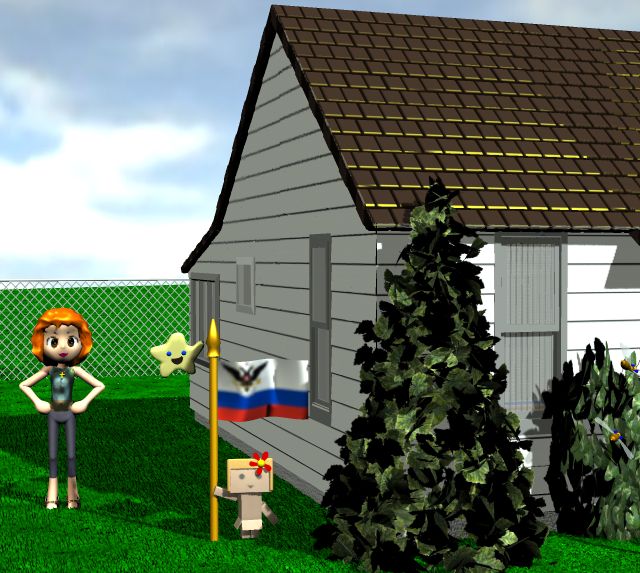
 After making a picture of my house in the context of fixing wind damage, I looked back at an earlier entry here in which I traced the history of the house.
Bored without a new work assignment, I decided to look into the first owners, Jim and Bertha Willis. Found them in the 1940 Census, and found obits for both. Jim was born in Howell County, Mo, and Bertha was born in Hazelton, Kan, near Joplin. After Jim and Bertha moved to Spokane in 1909, they first bought (or built?) a house three blocks south of here. I'm guessing 'built' because that house was built in 1910 and has a distinctly Missoura look. It still exists and I see it every day on my walks. I've noticed it because it's next door to this slow construction project which still isn't finished.
Jim then bought or built this house in 1948. It's not clear why they wanted to 'downsize' out of a bigger and better house.
Jim's birthplace in Howell County struck a note, because that's where my father's folks lived before they wandered out to Okla.
Back to the Census. Grandpa and Jim wouldn't be there in 1940, but I hoped to find some indication of the names. Grandpa was born in West Plains, and Jim's obit listed Mountain View. Neither of those cities contained any of either name in 1940. But one township NE of West Plains contained a whole pile of Willises AND a whole pile of my father's folks. They were neighbors!
No wonder this house suits me.
= = = = =
Semi-related sidenotes: (1) It's unlikely that my father's folks ever lived inside the urbane cosmopolitan metropolis of West Plains. Once he told about visiting some of them in the late '40s. They ran a ramshackle semi-farm "way out in the sticks" and they had never gotten around to building an outhouse. Peeing off the porch and pooping in the bushes was good enough for them. (2) The Census for Howell County included a place called Shanty Town. Haven't yet figured out where it was. It consisted mainly of Alsups and DeBoards, both of whom clearly favored VERY large families. (3) Broadly, Howell County resembles the Okla counties I searched earlier. Single-person households were extremely rare, maybe 2% of all households. Income correlated negatively with number of children, and domestic servants were common in middle-class homes. (4) One pattern that I didn't see in Okla: A correlation between names and income. Occupants of the more expensive houses or farms had hard clattery Yankee names like Victor or Ted or Katy or Rebecca. Names you can punch a timeclock with. Everyone else had soft Missoura names like Earl or Wade or Eula or Pearline. Names you can spend some time with.
= = = = = END REPRINT.
Also about the neighborhood: here and here.
Labels: Heimatkunde, Shack people - Cottage people
¶ 11:52 AM

 Above is 2007, below is Aug 2014. This is typical (though not universal) of the whole neighborhood around Byers and SE14. The houses aren't any bigger, but they're smartly renovated. Presumably some of the occupants are new, but I doubt that everyone was forced to evacuate. So the old occupants are pulling up to fit the new standard.
OKC has broken the boom-bust ratchet! Instead of ripping out the smallest shacks, transform the shacks into cottages ... Then the cottage people will come ... Note the little hipster car! ... And the shack people will either leave or rediscover how to be cottage people ... Which most of them were at one time.
THIS IS THE CORRECT ALTERNATIVE TO EMPTIED-OUT NEIGHBORHOODS.
Double Bravo to OKC for doing it RIGHT!
= = = = =
Later: Presumably most of the work was done by individual contractors and flippers, but the results have a coordinated 'look'. This implies city planning or urging. Those brick mailboxes were starting to appear in the 2007 googleview, and they're all over the neighborhood in the newer picture. They must have been a city effort to give the neighborhood an instinctive and distinctive identity. OKC has been running a clever and productive neighborhood-identity program for quite a while, but I don't see any references to this well-defined little area in online discussions of the program.
When I lived there, the 'perceived boundaries' were the river on the north, SE17 on the south, High on the east, and Central on the west. I did most of my shopping along Central and only occasionally went over to Capitol Hill.
Aha. Here's the only specific description online. The document is a 1994 survey for historic landmarks, which looks down its haughty nose and sniffs:
Shidler-Wheeler #1 district is primarily residential, consisting of bungalows, Folk Victorian, and shotgun houses. Included is a row of brick-veneer shotgun houses on SE15. The area is approximately from SE10 to SE15 and S Byers to S Laird, comprising most of the Central Addition platted in 1908. Many of the houses were built prior to the 1920's; however, many have been drastically altered, some demolished, and a number of inappropriate infill buildings constructed. The survey determined that the area no longer meets the criteria for National Register listing.
Drastically altered? Inappropriate infill? Hmph to you too, assholes.
Infill is a city's salvation.
= = = = = END REPRINT FROM 2014
Now the video made by the organization responsible for the recovery:
Nice to see LOCAL people trying to restore a place they love.
Labels: Asked and answered, infill, Shack people - Cottage people
¶ 3:14 PM
 The old screen door opened from the bottom; new opens from the top. Doesn't matter in winter when it stays closed anyway, but it turns out to be a poor source of 55 air in the summer. The top opening lets out warm air but doesn't let in cool air.
I can tell the difference by opening the entire door. With the screen open the room doesn't cool much. When the entire door is open even a few inches, the room cools IMMEDIATELY.
The double-hung sash is nearly obsolete now, and its purpose is forgotten.
 Forgot or not, the purpose is still valid. Cool comes in below, hot goes out above.
Labels: Shack people - Cottage people
¶ 3:49 AM
Labels: Shack people - Cottage people
¶ 10:47 AM
Labels: Shack people - Cottage people
¶ 7:12 AM
 Note the rightmost column, income in 1932 as a percent of 1929. One of my grandpas worked for Detroit Edison (Electric light and power and gas) and the other was a school janitor (Government). They were in the least damaged parts of the economy.
The same book also answers the other half of the question, though not in simple tabular form. Oklahoma depended mainly on cattle and oil. Cattle production didn't drop at all from '29 to '32. Petroleum lost 22%, but the industries typical of the Northeast lost around 70%. So Okla wasn't hurt as badly as the states where media and historians live.
Incidentally, the href'd book is valuable for an odd reason. It's a 10-year collection of newsletters from the National Bureau of Economic Research from 1922 to 1933. Packed with useful and readable info about those years. But how did a book published in 1933 make it past the grasping claws of Steamboat Willie? Because it wasn't exactly published. It appears to have been assembled by a librarian, without a title page to show copyright or publication date. The first page is simply the first newsletter, dated 1922. Just outside Steamboat's well-guarded border.
Labels: Asked and answered, Shack people - Cottage people
¶ 4:54 AM
 This is the American experimental record, and it WORKS if built with proper attention to sun and orientation. [ie Porch faces south.] Overhang keeps the walls cool in summer, high ceilings keep the heat above your head. Bungalows last a long time, partly because the same overhang also protects the foundation from water and termites.
Presumably Mister Maccchuuu couldn't say the word BUNGALOW because Bungalows were largely built and occupied by unspeakable unthinkable unnameable
 He can think of the grass bridge because it was built by those delicate vulnerable endangered nonviolent zenlike Aztecs when they weren't busy tossing virgins in the volcano. That's COOOL. Killing innocents is always COOOOOL. Death wins the MacArthur Prize.
= = = = =
Addendum: Bungalows are optimal for hot places with little snow. For snowy places, a hip roof with deep overhangs on all sides is preferable.
 Lots of soffits around the bottom, lots of vents on top. Result: Roof stays as cool as possible, and has a UNIFORM temperature from top to bottom. Very low chance of ice dams. The exposed overhang on bungalows pretty much guarantees ice dams. In all seasons hip is better than gable because hip causes water to spread out while it flows downward. Flow distributes evenly on all sides. About 40% of the houses in this neighborhood have wide hips like this. I don't know if they were intended to be platonic houses, but that's exactly what they are! (Wish I could afford one. Maybe later.)
= = = = =
Addendum next day: Now HERE is a combination of both subjects above. A single wonderfully explanatory picture that covers the development of American vernacular architecture. NEAT! I love it!
= = = = =
Much later update about the hip-roof theory: I WAS DEAD WRONG. It sounds good, but houses built on that design are ACTUALLY the worst ice-dammers. More here. Thus proving yet again that you should go with EXPERIENCE, NOT THEORY.
Labels: Experiential education, Grand Blueprint, Heimatkunde, infill, Shack people - Cottage people
¶ 4:03 PM
Labels: Shack people - Cottage people, TMI
¶ 12:57 PM
 That's the BIG question.
Labels: Shack people - Cottage people
¶ 3:28 AM
 Expensive at $400, but worth it.
Maintainable-ness has two sides. Parts should be replaceable, and adjustments should be reachable. This old house doesn't score well on either side. Everything is non-standard and hard to reach. Every step to improve maintainable-ness helps both me and the house to age better.
Labels: coot-proofing, Shack people - Cottage people
¶ 3:14 AM
 First snow of the winter. Unimpressive. Weather bureau was predicting 4 inches, and we got about 1.5 inches. Not enough to properly shovel. Too bad; I was actually looking forward to shoveling the paths and raking the roof. Good exercise and sense of accomplishment.
Not too surprising. This is a Nino year, which means the storm track is mainly heading for Calif. They need it and we don't. Nature always reverts to the mean.
If this snow wanted to get some respect, it should have jetted over to England where it would be seen as a DEADLY LETHAL UNPRECEDENTED WEATHER BOMB!!!!!
Next morning after walk: This snow didn't amount to much, but it turned into a formidable obstacle to walking and driving. It got clumpy toward the end then froze HARD. Result is like walking on lava. Good traction but throws your ankles in all directions at once. Amazingly noisy. CRUNCH! CRACK! POP! I suspect we'll see a lot of flat tires this morning.
Labels: Carbon Cult, Shack people - Cottage people
¶ 4:21 PM
 Left page is too poor = too many kids per household. Right page is too rich = too few kids. Middle page contains one of my folks.
Somewhat puzzled, though. In this case I had a point of reference: my great-grandfather who I met once when I was 4 and he was 94. I thought he had stayed in Mo. The Census showed 25 households with the correct last name in Osage and Maries, but nobody with the correct first name. Maybe he did move to Okla after all. This is my third incorrect assumption about addresses of ancestors in 1940! [Sidenote: I could look up these facts directly. Most of my ancestors have been thoroughly genealogized. But I'm not doing genealogy; I'm just exercising my creaky old mind and drawing some broader conclusions about history.]
Osage County had one peculiarity that made it stand out from the general run of Census pages. It was mainly German Catholic, which meant a lot of LONG names (Aufderheide, Kochenberger) and a lot of Catholic schools scattered through the farmland. Because the Census was only for residents, it didn't show schools or businesses as such. But each Catholic school had a dozen resident Sisters, who were easily visible as a block of similarly shaped names that overflowed the blanks. There was one parochial school for every hundred households or so. Bear in mind that this was 1940, still nominally in the Depression... but these farmers remained prosperous enough to support a mini-convent while they were paying taxes for the public schools they weren't using. Yet another data point opposing the common notion that "only WW2 broke the Depression".
Labels: Shack people - Cottage people
¶ 8:17 AM
After making a picture of my house in the context of fixing wind damage, I looked back at an earlier entry here in which I traced the history of the house.
Bored without a new work assignment, I decided to look into the first owners, Jim and Bertha Willis. Found them in the 1940 Census, and found obits for both. Jim was born in Howell County, Mo, and Bertha was born in Hazelton, Kan, near Joplin. After Jim and Bertha moved to Spokane in 1909, they first bought (or built?) a house three blocks south of here. I'm guessing 'built' because that house was built in 1910 and has a distinctly Missoura look. It still exists and I see it every day on my walks. I've noticed it because it's next door to this slow construction project which still isn't finished.
Jim then bought or built this house in 1948. It's not clear why they wanted to 'downsize' out of a bigger and better house.
Jim's birthplace in Howell County struck a note, because that's where my father's folks lived before they wandered out to Okla.
Back to the Census. Grandpa and Jim wouldn't be there in 1940, but I hoped to find some indication of the names. Grandpa was born in West Plains, and Jim's obit listed Mountain View. Neither of those cities contained any of either name in 1940. But one township NE of West Plains contained a whole pile of Willises AND a whole pile of my father's folks. They were neighbors!
No wonder this house suits me.
= = = = =
Semi-related sidenotes: (1) It's unlikely that my father's folks ever lived inside the urbane cosmopolitan metropolis of West Plains. Once he told about visiting some of them in the late '40s. They ran a ramshackle semi-farm "way out in the sticks" and they had never gotten around to building an outhouse. Peeing off the porch and pooping in the bushes was good enough for them. (2) The Census for Howell County included a place called Shanty Town. Haven't yet figured out where it was. It consisted mainly of Alsups and DeBoards, both of whom clearly favored VERY large families. (3) Broadly, Howell County resembles the Okla counties I searched earlier. Single-person households were extremely rare, maybe 2% of all households. Income correlated negatively with number of children, and domestic servants were common in middle-class homes. (4) One pattern that I didn't see in Okla: A correlation between names and income. Occupants of the more expensive houses or farms had hard clattery Yankee names like Victor or Ted or Katy or Rebecca. Names you can punch a timeclock with. Everyone else had soft Missoura names like Earl or Wade or Eula or Pearline. Names you can spend some time with. Labels: Shack people - Cottage people
¶ 2:33 AM
 (2) Learned that the publisher of my courseware has suddenly sold off the whole division including my stuff, as part of their JPMorgan hostile-takeover-bankruptcy process. The new publisher might or might not continue with this project. So I've just put in a year of 50-hour weeks, brought the project close to completion, and may never get paid for it.
Which event matters to me? (1) Pride of property. The publisher shit doesn't bother me a bit.
This is exactly why I set up my life this way, starting with a plan in 1985. I can take or leave idiot New York Goldmanite assholes. Independently poor. DECOUPLED.
= = = = =
Oddly enough, I was thinking about writing a piece on the destruction of human capital by feral Goldmanism. I was going to extend recent thoughts about soil conservation into the notion of conserving human capital. When you run a business for pure share value, you have no regard for training, no regard for developing a labor force. Everything is outsourced, everything is temped, everyone is disposable.
Now the publisher has given me a nice personalized example.
Labels: Shack people - Cottage people, the broken circle, Zero Problems
¶ 3:48 PM
Labels: Grand Blueprint, Natural law = Sharia law, Shack people - Cottage people
¶ 3:44 AM
Above is 2007, below is Aug 2014. This is typical (though not universal) of the whole neighborhood around Byers and SE14. The houses aren't any bigger, but they're smartly renovated. Presumably some of the occupants are new, but I doubt that everyone was forced to evacuate. So the old occupants are pulling up to fit the new standard.
OKC has broken the boom-bust ratchet! Instead of ripping out the smallest shacks, transform the shacks into cottages ... Then the cottage people will come ... Note the little hipster car! ... And the shack people will either leave or rediscover how to be cottage people ... Which most of them were at one time.
THIS IS THE CORRECT ALTERNATIVE TO EMPTIED-OUT NEIGHBORHOODS.
Double Bravo to OKC for doing it RIGHT!
= = = = =
Later: Presumably most of the work was done by individual contractors and flippers, but the results have a coordinated 'look'. This implies city planning or urging. Those brick mailboxes were starting to appear in the 2007 googleview, and they're all over the neighborhood in the newer picture. They must have been a city effort to give the neighborhood an instinctive and distinctive identity. OKC has been running a clever and productive neighborhood-identity program for quite a while, but I don't see any references to this well-defined little area in online discussions of the program.
When I lived there, the 'perceived boundaries' were the river on the north, SE17 on the south, High on the east, and Central on the west. I did most of my shopping along Central and only occasionally went over to Capitol Hill.
Aha. Here's the only specific description online. The document is a 1994 survey for historic landmarks, which looks down its haughty nose and sniffs:
Shidler-Wheeler #1 district is primarily residential, consisting of bungalows, Folk Victorian, and shotgun houses. Included is a row of brick-veneer shotgun houses on SE15. The area is approximately from SE10 to SE15 and S Byers to S Laird, comprising most of the Central Addition platted in 1908. Many of the houses were built prior to the 1920's; however, many have been drastically altered, some demolished, and a number of inappropriate infill buildings constructed. The survey determined that the area no longer meets the criteria for National Register listing.
Drastically altered? Inappropriate infill? Hmph to you too, assholes.
Infill is a city's salvation.
= = = = =
**Footnote for non-Okies: Shidler rhymes with Idler, not with Midler or something else.
Labels: infill, Shack people - Cottage people
¶ 8:09 AM
Labels: Heimatkunde, Shack people - Cottage people
¶ 10:37 AM
Author touches an important point but doesn't quite hit it:
I know I'm not alone in finding tiny homes so weirdly compelling. People have lived in very small spaces since the dawn of civilisation, of course, whether out of necessity or monkish self-denial. ... The rural wing of the tiny homes movement, meanwhile, is motivated primarily by environmental concerns. How much more lightly can you tread on the planet than by having only one room to heat, and no space to accumulate the detritus of the modern consumer economy?
As usual the Greenies are backwards. When you own enough land for a farm but don't use it for farming or livestock, you're not Green. You're just another rich man engaging in Conspicuous Consumption. When you live far from town, unless you're strictly self-sufficient, you're using vastly more gasoline and other materials than you would in town. Number of rooms isn't the main variable when the energy has to be transported 30 miles to reach your house. The fuel and labor for the propane tank truck, the maintenance and resistance of the long single-user electric wire, and the electricity needed to pump and purify your well water, more than compensate for the rooms you're not heating.
The best way to use minimal resources is to live in a closely-built 'walkable' city with good mass transit. Apartment, semi-detached, or small house, equally good when you're not operating a car.
Some Greenies do appreciate that point, but not the Tiny-housers described above.
Another thought: Trailer-park living is pure Tiny-house, but the Tiny-housers refuse to recognize it. An 8 x 32 travel trailer is beautifully designed to make the best use of available space, and the trailer park uses land and utilities efficiently. Nope, doesn't count because it's incurably unfashionable. Associated with poor white Christians, thus unthinkable. In short, the Tiny-housers are reinventing the 5th-wheel, and doing a shitty job of it.
Labels: Shack people - Cottage people
¶ 4:43 AM
These infill walks required fighting two old internal rules made by my Kraut chromosomes.
Rule 1: «Achtung! Valk must haff Purpose! No Valk mitout Utility!»
This rule never made any sense. In younger years I felt free to drive or bike without a destination, but walking has always needed a firm reason. No idea why. Breaking this rule was easy; just one pleasant random walk deconditioned it.
Rule 2: «Achtung! All Valking Routes must be Maximally Efficient! Cut all Corners, never go around Unnecessary Block!»
This rule does make sense for a lifetime pedestrian, and I've learned quite a few tricks to find the shortest possible path. But it's completely wrong for a random walk, where the only destination is Back Home, and the purpose is to maximize distance without getting overly tired. Because it's logical, this rule is harder to break, and still requires some Strangelovian internal slapdowns.
= = = = =
Useful walks always head south and east from my house, because that's where the stores and bus stops are. So the random walks have headed north and west, to explore unfamiliar territory. And there's a surprising amount of unfamiliar stuff within a one-mile radius, because I simply never looked in those directions before!
Earlier I noted a 'locus of new growth' that seems to be propagating from the city's beautiful repaving of Wellesley. Flips, sales, existing remodels, and new construction. Infill as usual in Spokane, the Infill Capital of the West. Nevertheless, an indication of positive economic activity in this part of town. The new construction is on lots that have been vacant for a hundred years!
Now I'm noticing a 'locus of decay' in the other direction, propagating from the only apartment building in the neighborhood. This apt is a two-story wood structure, possibly a WW2 barracks extensively remodeled. It's been decaying for a long time and fully abandoned for a couple years. The apt seems to be infecting nearby houses with Who-Gives-A-Fuck-Itis. Near the apt are several collapsing failed remodels, mixed as usual in Spokane with beautiful and elegant 1930's cottages.....

Labels: infill, Shack people - Cottage people
¶ 1:58 PM


