I solemnly pledge myself to consecrate my life to the service of humanity. I will give to my teachers the respect and gratitude which is their due; I will be loyal to the profession of engineering and just and generous to its members; I will lead my life and practice my profession in uprightness and honor; whatever project I shall undertake, it shall be for the good of mankind to the utmost of my power; I will keep far aloof from wrong, from corruption, and from tempting others to vicious practice; I will exercise my profession solely for the benefit of humanity and perform no act for a criminal purpose, even if solicited, far less suggest it; I will speak out against evil and unjust practice wheresoever I encounter it; I will not permit considerations of religion, nationality, race, party politics, or social standing to intervene between my duty and my work; even under threat, I will not use my professional knowledge contrary to the laws of humanity; I will endeavor to avoid waste and the consumption of non-renewable resources. I make these promises solemnly, freely, and upon my honor.The good of humanity is the main problem. Euthanasia and eugenics are ALWAYS grounded on the greater good of humanity. Governments ALWAYS claim to be improving the breed of humanity by culling SUBHUMANS. Culling was quite open in Hitlerian language, and it's equally brazen in the language of both Gaians and Virans. "Science deniers" and "vax deniers" are subhuman vermin. Serving INDIVIDUAL CUSTOMERS is the best way to be moral. When you want to SELL MORE PRODUCTS, you want to have MORE LIVING AND PROSPEROUS CUSTOMERS who can buy your stuff. Share Value broke this connection, leaving tech solely tied to Deepstate and Epstein. And Epstein brings us to the other missing point, secrecy and blackmail. Engineers were NOT secret-keepers before 1946. They respected patents and trade secrets, but patents aren't killers. A trade secret protects an amortized skill. It doesn't induce blackmail. After the rebirth of Deepstate, the NSF and the nuclear program started bringing engineers into the fold. The sudden shift was visible in tech magazines between '45 and '46. The classic 'open source' attitude was still there in '45, spreading knowledge without breaking patents. In '46 everything was closed down to "protect against commie spies", who were of course really working for FBI. Secrecy was well underway in 1957. I remember talking with one of my engineer uncles who was working at Los Alamos. He said he was working on rockets, and that's all he would say. In '58 Ike lamented the fast shift of tech firms from PROFIT AND CUSTOMERS to government contracts and secrecy. By 1974 this shift was complete in electronics, but hadn't yet infected the newer software industry. Other writers in the same magazine were seeing it, but Suskind missed it. His first example, the county extension program, belongs to the open source world. Serving the customer with some help from the government. His second example, Hitler's euthanasia/eugenics, belongs to the secret-keeping world, slaughtering the customer with plenty of help from the government. Engineers were already in the secret-keeping world in '74, so no pledge could pull them back. Suskind also salutes Gaia at the end of his pledge, which would have helped to enable Greta's euthanasia/eugenics. I'll try to be charitable and assume he was just a poor prophet, but I'm not in a charitable mood this year. = = = = = Continued here.
Labels: AI point-missing, defensible times, endless hell
¶ 11:53 AM

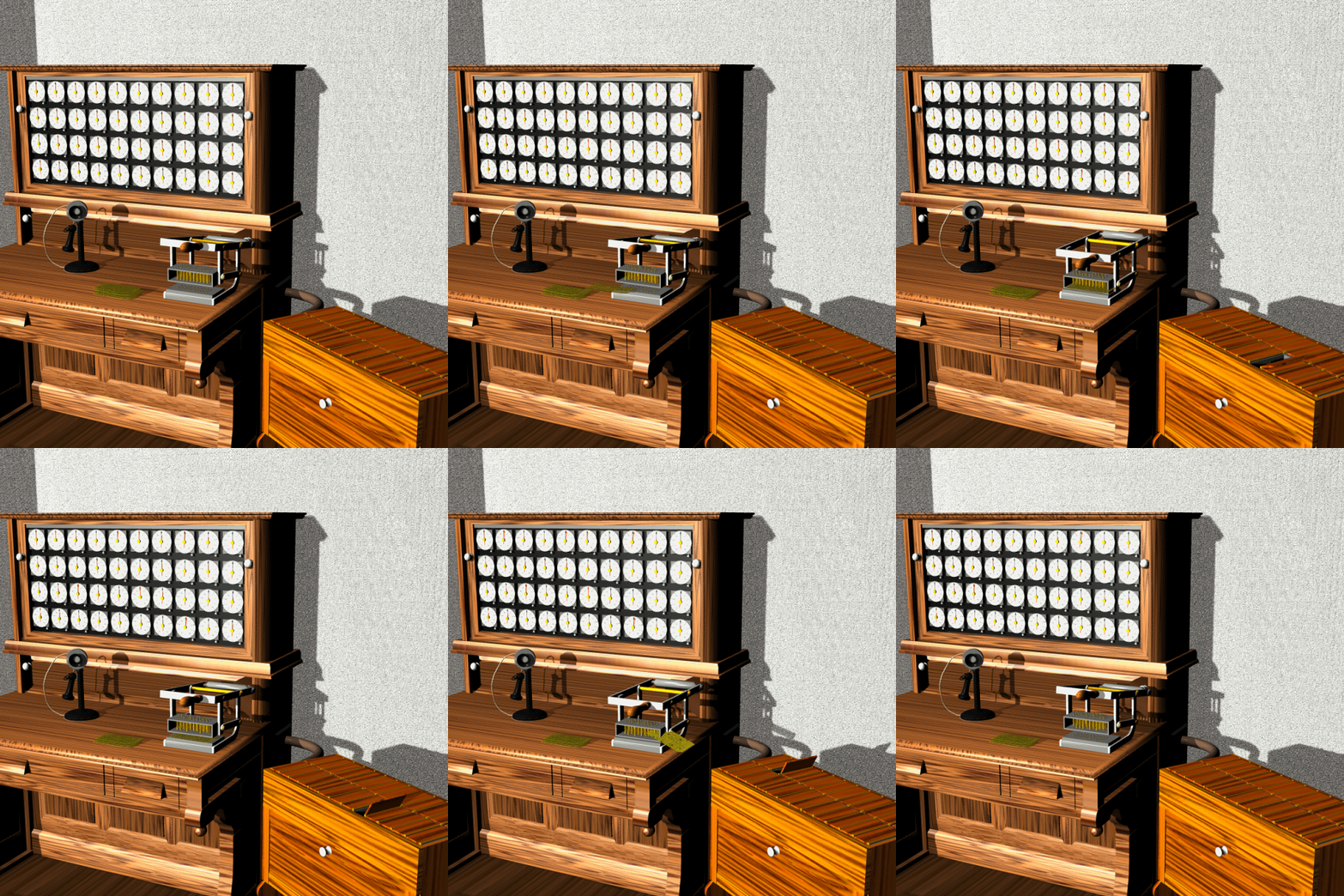 McBee cards could be punched and sorted by machine. The punching side was partly mechanized, but the sorting side was usually done by hand.
This has advantages and disadvantages. The most obvious advantage is cost. For McBee you need to order some cards, and you need a ticket-punch and an icepick and some boxes. The cards are the only real cost. For IBM you need to order some cards, and you also need to rent a keypunch and a sorter for about $150 a month (equals $1000 a month today). Individuals and small businesses could afford McBee.
When modeling and animating these processes I'm on halfway familiar ground. In the '50s I often helped my father with mechanical grading and categorizing for his college lecture classes. It was a job I truly enjoyed. I did a lot of sorting, and a little bit of hand-punching, but never encountered the punching machine illustrated below.
A typical McBee card had punchable fields all around the edge, and a writable area in the middle. The open central area was another advantage over Hollerith, which was solidly filled with punchable numbers. You could type or handwrite a considerable amount of info or diagrams in the center.
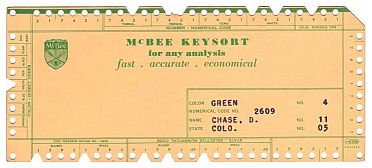 Cards were printed in a wide variety of individual styles for each business or purpose. Some had specialized non-numerical categories, some were all numerical, some were mixed alphanumeric.
McBee cards had a unique arithmetic system, based on 1 2 4 7. The system isn't a proper base-15, though it ranges from 0 to 14. The choice of these four digits was supposedly a compromise to minimize the number of punches needed. You could form all the digits from 0 to 9 with one or two punches. This was slightly more efficient than 4-bit binary.
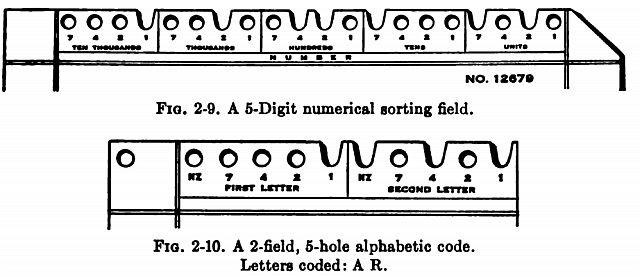 Letters were formed with 1 2 4 7 plus an extra, called NZ for nonzero. This was NOT more efficient than a 5-bit binary system, but the familiarity probably made it faster. Binary digits were totally foreign to most people until the 1980s, and it's always better to amortize an existing skill.
[Here's a comparison of efficiency in terms of total punches needed.]
One definite advantage of hand-sorted cards is flexibility of form. When the stack is going to be handled carefully and personally, you can include samples of material or photo images on or in each card. McBee cards with inset X-ray images were useful in medical records:
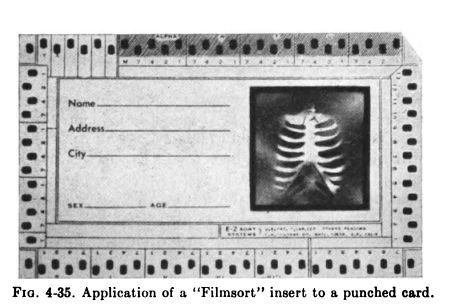 These inclusions couldn't pass through an IBM sorter or card-reader.
Hand punching was done with a special triangular hand punch that looked a lot like a ticket punch. My father didn't have the special, so we just used a ticket punch.
= = = = =
This punching machine was shown in one detailed description of McBee systems. No other information is available, so I'm semi-guessing the way it worked. I'm assuming that you would set up the patterns using the 8 columns of buttons for up to 8 numerical fields on one side of the card, then hit the big button on the right to punch these. The long side of a typical card contained 6 or 7 fields, so the 8 columns would usually handle one side of a card. I don't know what the 8 buttons on top were supposed to do. Maybe reset for each column? The process would have been like an adding machine except that you were consciously forming the 1247 pattern for each field.
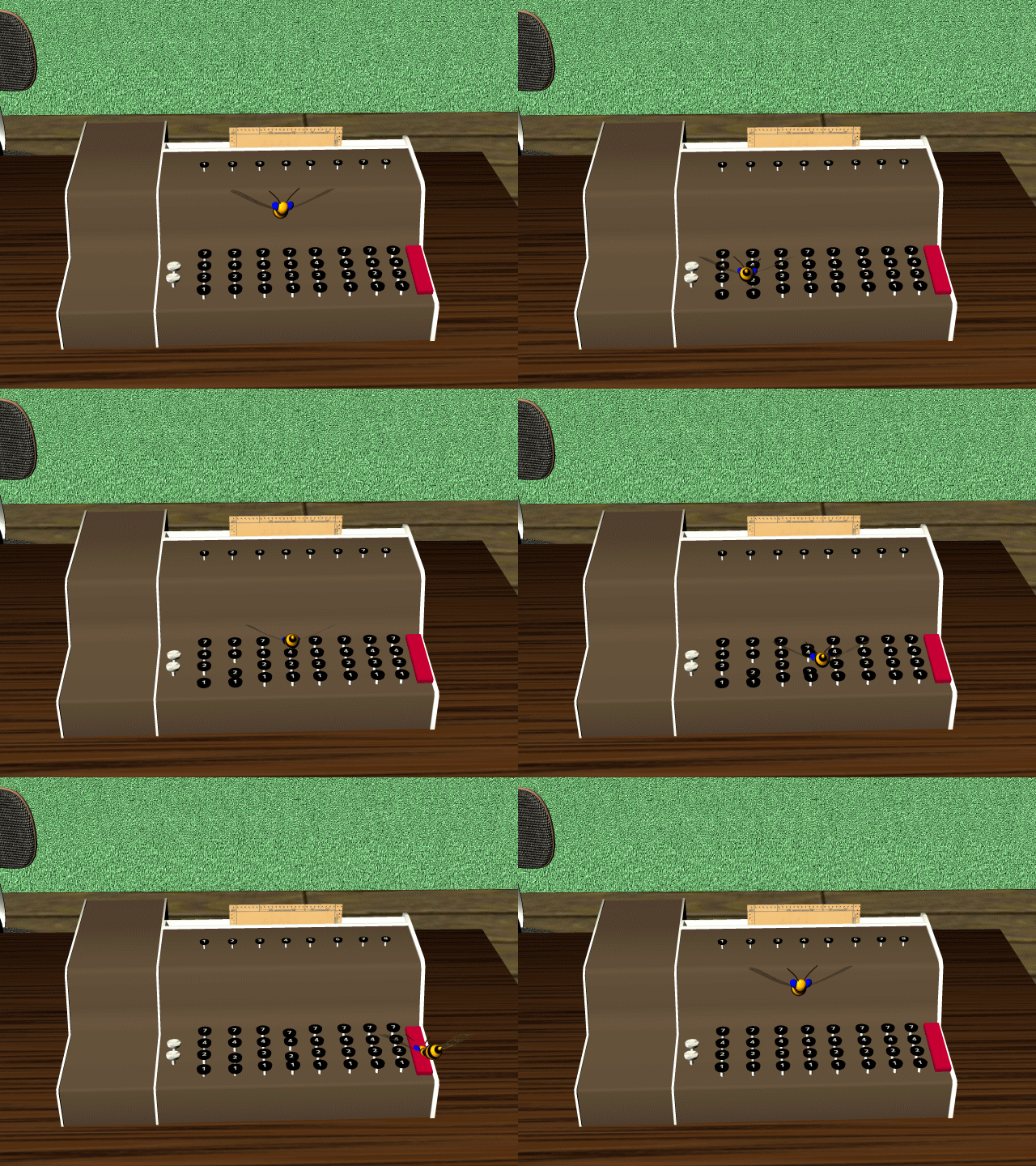 Mr McBee has just punched in 1309, so the card would look like this after turning it over:
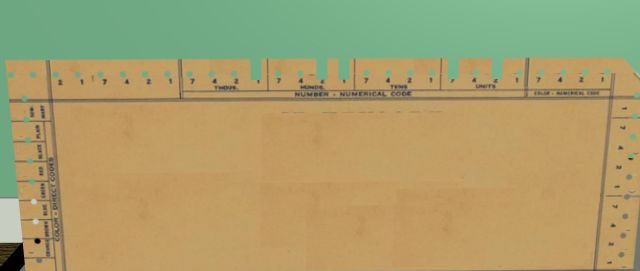 Now Polistra will demonstrate the first step of the selecting process. Assume she's looking for cards with 1309. She begins by finding cards with a 1 in the thousands place.
McBee selection is inverse to the usual way of thinking. It's more like the military volunteer method, where the soldiers who are NOT volunteering to check out the minefield are asked to step back, leaving the volunteers and the sleepers in the original row.
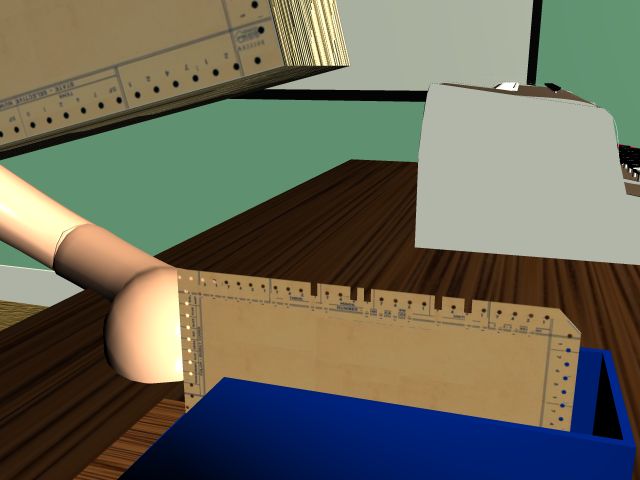
The poker was called a tumbler for some unknown reason. (It should have been a stinger.) Polistra inserts the tumbler into the 1 hole of the thousands field. Cards that were NOT punched in this slot can be pulled up, while the cards with a PUNCH in this digit stay down. She then places the UNWANTED cards in the red box, leaving only the few WANTED cards in the original blue box.
 She would then tumble a 1 and a 2 in the hundreds field, to complete the 3; then do nothing for the zero in the tens field; then tumble the 2 and 7 in the ones field.
All remaining cards in the original blue box would then be 1309.
 This may seem tiresomely slow, but the basic IBM sorter in that era also sorted one field at a time, with repeated sorts of the smaller remainders. The difference is that the IBM processed all digits in a numeric field at once. For cards with non-numerical fields, where each value in the field represented one value of a category (like M/F gender or Small/Medium/Large size) McBee and IBM would need the same number of passes.
McBee later made a more IBMish puncher and sorter, but no info is available online except this one picture:
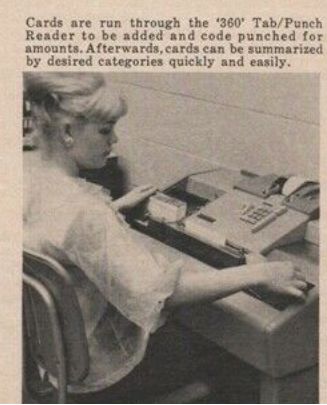 This machine didn't gain popularity for an obvious reason. When you OWN a niche, you need to claim and optimize the niche. Customers bought McBee BECAUSE it was naturally visual and lo-tech. McBee customers weren't buying McBee because they WISHED it was more like IBM.
Admittedly their marketers finally picked up the beehive theme!
Labels: defensible times, Equipoise
¶ 2:51 PM
From my study of and experience with establishments, I believe the following natural laws apply: • Because an establishment develops to perform a function, usually at the outset it performs the function very well, and so it derives a great deal of its strength from its belief in the "obvious" importance and worthwhileness of its function. • As an establishment ages over the years, it tends to become more and more blind and bureaucratic in its behavior. • An establishment develops fashions, fads, and mythology such as the "national security" blanket; the "peace with honor" hoax; etc. • An establishment will not willingly tolerate truth that puts it in an unfavorable light. • An establishment is a kind of system, and therefore should be made subject to all the laws for the proper functioning of systems, INCLUDING FEEDBACK CONTROL. In other words, for nearly all the years that an establishment is in existence, the correction and modification of that establishment by applying truth to it is vitally necessary. Here is another reason why those persons who are now ca!led "computer professionals" need to concern themselves with truth, in great variety and on many levels. Information processing is really important only if you are dealing with the truth.Unfortunately it didn't happen. The total transition from analog to digital removed feedback from the technical understanding of the profession. Share Value removed feedback from the economic side of the business. Epstein removed facts and truth. The economic end would probably be easiest to fix, by restoring profit to business and restoring the profit MOTIVE to establishments and governments. Ideally an establishment should gain money by SOLVING problems, not by UNSOLVING problems. I've been discussing this fix in the Trinity House theme.
Labels: Parkinson, Trinity House
¶ 11:43 PM
Labels: 2000=1000, Constants and Variables, endless hell, Parkinson
¶ 12:27 PM
Labels: Bemusement
¶ 5:41 AM
 Note that the input and output were IBM's default cards. The system included at least one memory drum, which was an established machine at the time, and several magnetic memory matrices. Those weren't the New and Improved part. Reynold Johnson's multiple disk was the iconic part of RAMAC.
= = = = =
Trend 2:
Recording and storing sound and data have mostly taken separate paths, occasionally converging and then diverging again.
Recording and storing DATA has gone through three stages.
Tape, cylinder, disk.
Cards are a subset of tape. Jacquard stored programs on a chained set of metal cards, essentially a jointed tape. Early telegraph systems used punched tape, and computers continued the form well into the 1970s.
Hollerith established free-standing cards as the default physical data holder for computers in 1890.
Magnetic recording began with Valdemar Poulsen, primarily responsible for the wire recorder. Poulsen also tried a magnetic disk, similar in size and shape to the RAMAC disks.
 Wire started widening into tape around 1940, as plastic manufacturing matured. Wire was never used for data, but magnetic tape quickly became the standard for internal storage of data, with cards as the human-readable inputs and outputs.
= = = = =
Trend 3:
Reynold Johnson joined IBM in the '30s and brought the world of analog thinking and sense transducing into the mechanistic and digital world of sorters and collators. Johnson's team was responsible for the multiple hard disk that formed the unique center of RAMAC.
= = = = =
IBM threw a nationwide party to introduce RAMAC, with showings in major cities, following GM's
Motorama trend.
 Again the name had to be slightly offbase. Ramarama wouldn't do.
Later, RAMAC served to keep score at the 1960 winter Olympics, with more hoopla.

 Note the lack of OCD. Smoking and eating around the computer were EXPECTED. Machines and humans were both designed to tolerate normal life.
= = = = =
As an Equipment, RAMAC was meant to be set up in exactly one configuration, and IBM provided all necessary cabling to set it up.
Proper setup:
 The floor plan with exact measurements:
 = = = = =
Now my version, demonstrated as usual by Polistra and Happystar.

 Unlike the other memory devices, the 350 hard disk had a glass front. Ramarama again.
 It was sometimes called the Jukebox Memory for obvious reasons. Each disk was coated on both sides, and the arm traveled radially in and out to reach any point on any of the 50 disks in a few milliseconds. The up/down and in/out movements were both driven by servomotors. Up/down was on a pulley, and in/out was a rack and pinion. The base of the 305 box included an air compressor, with hoses to each head to maintain spacing from the surface.
 Other parts of the system were older technologies, mainly using cards.
Each machine had at least one internal plugboard, continuing the programming technique that began with Hollerith's first 1880 census tabulator:
 A fast printer was available:
 The console at right had a card reader:
 And a conventional typewriter for output in more readable form:
 Only a few thousand RAMACs were installed, but they changed the landscape of computing.
= = = = =
Footnote: Credit to Ed Thelen's RAMAC site for most of the necessary information.
Labels: Alternate universe, Equipoise
¶ 9:16 AM
 Blackmail plus Big Data, 1938 style. Now it's much easier, but we're not allowed to see how it works.
¶ 8:52 PM
Labels: #WholeOfSociety, endless hell, MMT, skill-estate
¶ 8:35 PM
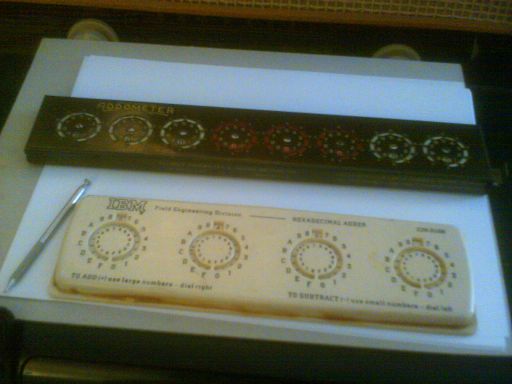 I saw this on Ebay and had to buy it. Closeup view:
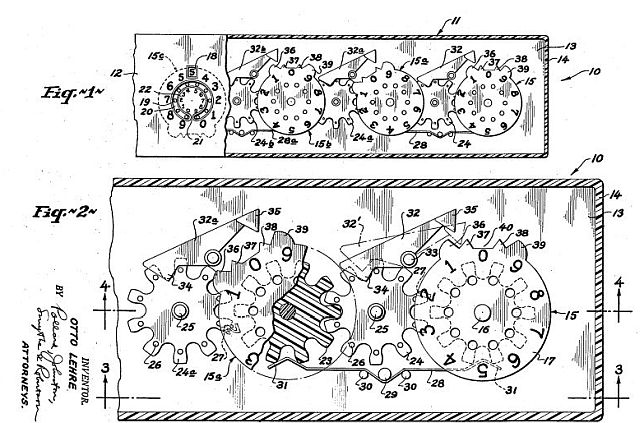
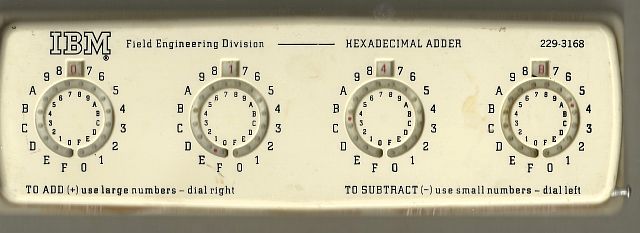 On the back it says MADE IN USA, and lists Patent number 2797047. The patent (for decimal, not hex) was granted to Sterling Plastics in New Jersey in 1957.
 Somebody had scratched 'Bad Carry' on the back, but the carry action works fine. It just needed to be loosened up. The only problem is that it doesn't have a convenient way to reset to zero. The older Addometer pictured above it had a reset lever.
Sterling sounded familiar but I couldn't place it at first. I have several slide rules made by Sterling.
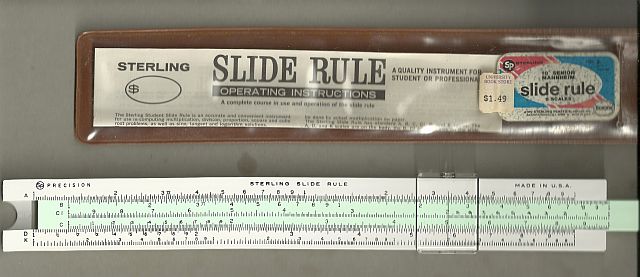 The Slide Rule Museum gives a history of Sterling and shows its decimal adders, which were sold commercially. Presumably the hex version was a special 'fleet order' for IBM.
Labels: Happy Ending, new toy
¶ 1:50 PM
 Swift and SWIFT would be proud.
= = = = =
1987 was an interesting date. Roy Cohn, who operated the old-fashioned way, stopped blackmailing in 1986. Epstein started his blackmail business in 1981, and took over Cohn's government contracts after 1986. But Epstein didn't take over the tech world until the mid 90s. Of course the government itself had been using computerized data for its own blackmail operations since 1890. The older tech firms had been part of Deepstate since the '50s. Epstein's contribution to the extortion industry was flipping those Silicon Valley outsiders, not bringing in tech as such.
Labels: Jackboot stomping forever, NOT alternate universe
¶ 8:46 AM
In this new learning environment, the student need not be restricted to verbal or symbolic information. Since the cathode-ray tube on his terminal is designed to project visual images, he can call up all kinds of pictures, and the treasures of the world's art collections will be his to command. He can have performed on a tape recorder whatever music he is interested in hearing, while on his screen he watches the notes that represent it. He can hear great poetry spoken, he can watch a surgical operation performed, he can have a geometrical theorem demonstrated, he can watch the re-enactment of a historical event. And no nervous human teacher, anxious about distractions to himself and to the other students in the class, will have to concern himself over whether that student is chewing gum, doodling, or in any other way relieving the tensions of his own concentration. We give adult workers in our factories soft music to ease their efforts; when can we begin to show equal sympathy for the strains we impose on hyperactive kids when we compel them to sit for hours and listen to us talk at them?He misses the main purpose of apprenticeship. Job training doesn't just individualize the passive experience of a classroom. Training engages the student in a PRODUCTIVE task. Making things, serving customers. In '82, just a few years after the '75 inflection point, many programmers (including me) were starting to use the interactive potential of the computer for job training. Visual graphics had been around since the '20s on analog computers, and since 1950 on specialized digital terminals. Audio was much slower to develop, as always; but it was expensively available on PCs in '81. (A professional-level ADC/DAC accessory board was $1500.) = = = = = Second: On p 36, Richard Sprague goes deep into Deepstate's nefarious activities, which had just been fakely "exposed" by the Watergate crap. Watergate was meant to attach the evil to Nixon, then kick out Nixon to "remove the evil", like an anti-rust anode on a ship. Sprague wasn't fooled. He had been organizing computer professionals to analyze aspects of the JFK assassination, and had seen Deepstate's stings and controlled opposition up close.
An organization I belong to, called "The Organizing Committee for the Fifth Estate," has decided to concentrate on the issue. It is the growing, illegal, immoral, and clandestine use of various methods and policies by the intelligence "community" in the U.S. This ·development could lead us toward what we may call "technofascism," a dictatorship in the U.S. by technologists in the Interests of the military-industrial complex. The methods involved include the use of computer technology and information systems. The Fifth Estate defines the clandestine intelligence "community" as including secret divisions or departments or contractors or subcontractors of agencies and groups at four levels of government; federal, state, regional, and local. Evidence is mounting that all four levels are currently increasing (and not decreasing) the amount of illegal, unethical, immoral, and unconstitutional activity, aimed at reducing or limiting the rights of citizens and increasing the power of the clandestine groups.On the fucking dot.
To sum up, I recommend again, as three controversial issues for discussion: 1. Who is assassinating our political leaders and why? 2. What activities are leading us toward "technofascism," how can they be exposed and stopped? 3. Where and how is the American establishment using technology in other countries around the world to help suppress people and murder them?On all the fucking dots. 50 years later his grim prophecies have come true, and the genuine opposition never got any traction. The metaquestions are: 4. What happened to those three questions? 5. What happened to the people who were asking them? A question that DOESN'T need to be asked is: 0. How did the entire tech establishment join Deepstate? We know the answer to this one. Epstein. And those dissidents WERE aware of the power of an Epstein.
Labels: Answered better than asked, Experiential education, Jackboot stomping forever
¶ 7:10 AM
In a post here (“The First ‘Simple’ Self-Replicator?”), I tried to explain why self-replicating machines are so far beyond current human technology, by imagining trying to design something as “simple” as a self-replicating cardboard box. Take an empty cardboard box, I said, and build a completely automated factory inside which can produce empty cardboard boxes. The factory would, I presume, at least need to have some metal parts to cut and fold the cardboard and a motor with a battery to power these parts. But since the box now only builds empty boxes, it is not a self-replicator. So we would need to add another factory that could automatically produce a box with an empty box-building factory inside, and that factory would be enormously more complicated. But this box is still not a self-replicator because the box it builds can only build empty boxes, so now we need to add more technology to build a factory that builds the empty box-building factory, and then…. All of this ignores, of course, the very difficult question of where the box gets the cardboard and metals and other raw materials needed to supply its factories.In fact we've had fully automatic box-making machines for at least 100 years, long before computers. What we don't have, and absolutely CAN'T have, is an infinite regress of box-making machine-making machine-making machine-making machine-making .... The resource problem is outside of the infinite regress, and thus not PERFECTLY unsolvable. We have never developed a machine that seeks and extracts water and minerals and sunlight, and assembles a new machine with the full capacity to assemble more machines. Plants do it all the time. This resource extraction mechanism is at least conceivable, not perfectly logically impossible.
Labels: Not AI point-missing
¶ 12:03 PM
Vakoch is planning on sending messages containing references to the periodic table. The idea being that certain elements, such as hydrogen, are abundant across the Universe so any receiving civilisation is likely to recognise a reference to the chemical signature of those elements. Another important requirement is making sure that whoever is on the receiving end of the message knows what they’re tuning into, says Jacob Haqq-Misra, a researcher at the Blue Marble Space Institute of Science. “The basic idea is to define some sort of mathematical language,” he says. Initial messages might establish some basics. One is not equal to zero, but one is equal to one, for example. “And now we've established a common language, we can talk about physics with each other.”No, no, no. Your "basics" are NOT the basics of math. Axioms and definitions are the fake "foundation" stuffed under the REAL structure of math by Peano and Hilbert and Godel. Why should we talk about physics? Real humans don't talk about physics.
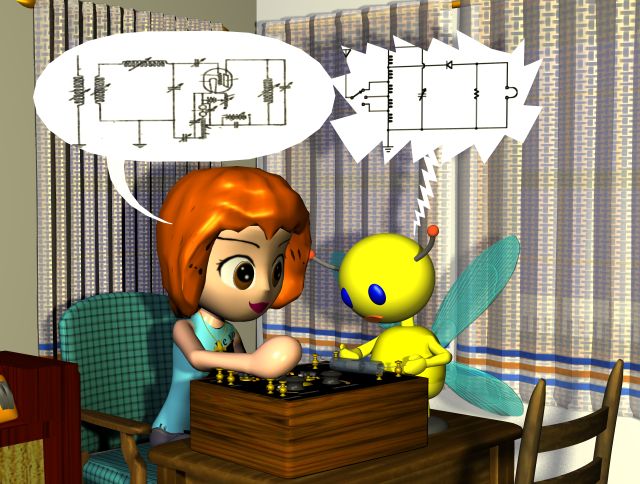 One good idea: Do what hams do. Talk about antennas and transmitters and receivers and propagation. In other words, talk about the process of communicating.
A better idea: Talk in parallel instead of serial. Talk the way we talk. Send harmonies on many frequencies at once, so the receiving party could build a 3d object from the spectrogram.
The best idea: Shut up. First listen to the universe itself, instead of searching for a cult leader who is Just Like Me But Cooler. Figure out what the universe has in mind for us and for me.
This was the purpose of astronomy from Plato through the Arabs and Persians to Brahe and Kepler. After Kepler we stopped listening to the universe and started listening to cult leaders who spoke in the name of Science.
= = = = =
Later and more random thoughts:
Discussion of aliens is packed full of CASTE. The trite old cartoons featured an alien who looks like a vacuum cleaner approaching an Earthly vacuum cleaner and saying "Take me to your leader." He wasn't saying "Tell me about your life and your place."
The people who wish for aliens are high-caste Courtiers, the same type who wish to be leaders. Courtiers dress like leaders (including ballgags), drive the right cars and eat the right foods and medicines as recommended by leaders. They don't realize the leaders don't actually wear or eat or drive or inject any of those recommendations. It's a cargo cult.
BUT: The people who report actual contacts with aliens are pure 100% Deplorables. White Christians in Dixie, the lowest caste of all, the caste every leader and influencer wants to EXTERMINATE, but only Lincoln actually accomplished the task.
Conclusion: If the aliens are really landing and contacting us, they're good scientists following Carver's rules. They realize that Deplorables are sane. They want to interrogate sane realistic people instead of wacked-out cargo cultists. A vacuum cleaner can tell you more about the house than the owner can.
Labels: AI point-missing, Carver, Real World Math
¶ 12:35 AM
 The cost to compile 100 COBOL statements varied unpredictably from twenty cents to twenty dollars! No correlation with monthly rental. Note that IBM 70xx series computers were at both ends of the scale.
Unsurprisingly, the same issue of Datamation had a long article on the pros and cons of timesharing.
Labels: Constants and Variables, Metrology
¶ 3:21 PM
Labels: AI point-missing, Carver, storage
¶ 11:31 PM
Labels: Sorosia
¶ 5:33 AM
 Side view:
 His prototype used the same principle as the Hollerith punch. Remove material to create a conductive spot. The test paper would be conductive, and coated with a set of pasted-on non-conductive squares. The student would peel off a square for each desired answer, and a matrix of pins would make contact with the conductive paper. A key sheet with the correct answers would occupy a second pin-press, and lights would indicate where the student paper's conductivity disagreed with the key sheet's conductivity. The paper would be expensive to make, and the process would be too delicate for most students.
This first concept was purely digital, with a glowing lamp for each peeled square that disagreed with the peeled square on the key sheet. The teacher would be able to see which of the peeled spots disagreed with the key sheet, which she could have seen easily enough without the whole mechanism!
Johnson's second concept, like many Big Ideas, inverted the original. Instead of removing an insulator to create a conductive point, add a conductive point to create a conductive point. Replace punches with pencils. Wireless experimenters were familiar with the semiconductor properties of graphite. Johnson placed a pair of contacts close together on each standardized square of ordinary paper. If there was a smear of graphite in this narrow rectangle, there would be a current between the contacts.
Now the analog and balancy part takes over. Instead of lighting a single light for each disagreeing contact, the machine would sense the graphite conduction of each individual answer, and compare it against the correct answers on a key sheet. This comparison or subtraction would provide a delta of current in one direction.
 The total of the deltas would then be summed up in an analog way and indicated on a meter.
= = = = =
After IBM hired Johnson, he was able to work with their vast array of electronic and mechanical resources. Their workshop turned the concept into a first machine, somewhat rough-looking but fully usable.
 The correct key sheet was kept inside the upper right box. Each student paper was inserted in the middle hopper, then the teacher would turn the crank to run the paper into the comparison press, where the rights and wrongs balanced into the meter reading. The paper then flowed down onto the stack.
The knobs on the left were complicated and I suspect they were rarely used. It was possible to section off the key sheet into groups with different weightings. Each knob set the weights for the sections, and the master knob normalized the result to 100 with a calibration sheet.
A later and more convenient version, the 805, motorized and automated the paper action.
Here teacher Polistra is assisted by TA Happystar. The answer key (red here) stays in the front hopper. Happystar inserts one student sheet into the back hopper. Polistra notes the name of the student and pushes the button to process the sheet. The total correct shows on the meter, and she writes the total in her gradebook. (The gradebook would be on the 'wing' of the grading machine.)
 Top view to show the multiplier knobs and meter action:
 = = = = =
There are only a few pictures of the 805 online. None of the usual computer museums or collectors own one, so there are no new pix or videos. The old pictures disagree on the combination of knobs and the mode of operation. Some seem to show the teacher writing grades on the student answer sheet after running it through the comparison. The sheet appears to be on a roller, and a later patent shows rollers. This action is entirely unclear, so I've stuck with the fairly clear action seen in the earlier patent. Insert, measure, write grade in gradebook, drop into stack at bottom.
= = = = =
Reynold Johnson stayed at IBM. His team developed a huge variety of inventions, focused on analog transducers serving as sensors for digital machines. The 805 graphite grader evolved into the 1230 optical grader, providing detailed digital counts and records. His biggest breakthrough was the 350 hard disk drive in 1957, which I'll feature in the next item.
Labels: Equipoise
¶ 3:15 PM
Labels: #WholeOfSociety, Jackboot stomping forever, UNENDING HELL
¶ 9:15 AM
Labels: Bemusement
¶ 8:50 AM
Labels: endless hell, infinite evil, infinite STUPID, Jackboot stomping forever
¶ 5:51 AM
The ICBM with a hydrogen warhead takes less than half an hour to reach its target. This means, that within a few years every city on the globe will be living with a threat of sudden death - its life dependent on one man's action. And that man is not the ruler of an enemy country, but the soldier on guard in an isolated ICBM launching site. The least we can hope is that he is not one of those young hotheads who frequently exchange rifle shots across a frontier. But no matter who he is, his decision is the death sentence of the target city. With this situation rapidly becoming an accepted fact, military strategists have concluded that the only answer is the threat of immediate and total retaliation. Conceptually, the enemy's missiles are detected on route and the retaliatory missiles are launched even before the enemy missiles have reached their targets. Thus, even if the launching sites do not survive the targets, destruction of the enemy is achieved. Even after the anti-missile-missile has been perfected, this basic strategy would be maintained.In other words, MAD was meant to guard against Deplorables in the military. Computers and MAD were meant to protect the elite world from Deplorables. What really happened is the EXACT FUCKING OPPOSITE. The computers were the hotheads, and a Russian Deplorable saved the world by making a HUMAN decision. = = = = = START 2015 REPRINT: The newly publicized story of Stanislav Petrov slaps us with a couple of big lessons. Petrov is the sanest man in the world, and thus the grumpiest man in the world. Petrov saved the world from nuclear destruction in 1983. He was manning the controls for part of Russia's nuclear arsenal, watching his radar and computer screens. Suddenly a blip appeared to be coming across the Arctic from North America. Then it was joined by four more blips in the same direction, but no more. Just five blips. He had to think fast. There were four possibilities, formed into a truth table. False indication, don't respond: End of his career. No other harm. False indication, respond: Instant end of America, eventual end of humanity. True indication, don't respond: Instant end of Russia, eventual end of humanity. True indication, respond: Instant end of humanity. His decision was based on a knowledge of all these possibilities, plus an understanding of his instruments and the meaning of their readings. He decided that five blips could not be a real USA STRONG attack, because USA STRONG understood the End Of Humanity logic as well as he did. If USA STRONG was going to attack, it would be sending hundreds of missiles all at once because there wouldn't be a chance to send the rest after Russia's response. He chose not to push the button, and we're all alive because he did. Thanks, Petrov! It didn't exactly end his career, but he didn't get any rewards either. Now he's barely surviving on a pension, but he's fiercely loyal to Russia. Lesson #1: Trust technicians. Trust metrology. A technician who understands his instruments will make the right decision far more often than a Professional who understands theories. The Professional will ignore obvious indications of bad readings, and will often intentionally falsify the readings, to keep his theory and his grants running. Lesson #2: Especially for the beyond-evil hypermonsters who have been misruling USA STRONG since 1989. Don't underestimate Russians. Don't assume that they will surrender because you impose some economic hardships. They are accustomed to self-sufficiency and they are good at improvising. Above all, Russians are unconditionally Russian. = = = = = END 2015 REPRINT. THEORIES KILL. EXPERIENCE SURVIVES.
Labels: #DeplorableLivesMatter, AI point-missing, Metrology
¶ 3:29 PM
Negotiations are in progress with the Post Office Department, and with other departments and bureaus of the Government which are engaged to any considerable extent in statistical work, for the purpose of introducing the tabulating machinery which has been invented, developed, and manufactured in the bureau's mechanical laboratory. The representatives of the Post Office Department have arranged for a practical test of the tabulating machine. This machine can also be used advantageously on cost accounting, and the bureau is already making such use of it, with highly satisfactory results. It makes possible the preparation, with a minimum of time, labor, and expense, of either general or detailed cost statements, in accordance with the “classification of objects of expenditure" adopted by the General Accounting Office. I feel very strongly that a material saving can be effected by the introduction of the bureau's tabulating machinery in other branches of the Government.But those other departments were already using Hollerith machines and Hollerith cards. They didn't WANT to switch, and they didn't even want to start using GPO cards in the Hollerith machines, based on experience. The GPO cards didn't fit right. GPO tried to assert conflict of interest:
In a letter of August 19, 1925, the Postmaster General wrote as follows: Under the terms of the Hollerith contract with the Government, their machines are leased with the express stipulation that they be used only for the tabulation and assorting of cards of Hollerith manufacture. The Federal Trade Commission also stated in its reply of August 4, 1925, that it had entered into a similar contract with one of the tabulating machine companies. Admission of this exclusive and tying contract, which appears to be a violation of the Clayton Act...But it didn't work in the end. Hollerith had perfected the SKILL of making tabulating machinery AND the cards to match. This was the unique American advantage, before we threw it away in the '70s. We knew how to turn an invention into a SYSTEM, with all of its pieces and connectors working together. Using machines that don't work as well, with no service available, and with cards that don't fit, is NOT the way to save costs. The most important cost is downtime, not initial expenditure. SKILL is always the most important variable. The SKILL of the various departments would be wasted by forcing them to use inadequate and unserviceable machinery. Human capital matters infinitely more than money capital. IBM made huge profits BECAUSE it understood this point. Now, of course, we aim for Share Value instead of profit, so 100% downtime is the sole purpose and goal of the economy. No work, no skills, no production, no employees, no products, no customers, no humans. Just Bezos and machines.
Labels: skill-estate
¶ 11:03 PM
Labels: From rights to duties, Parkinson
¶ 12:00 PM
 Totals from the big names:
Burroughs 1400
Control Data 2100
DEC 2600
GE 1800
Honeywell 2100
IBM 40000
NCR 3300
RCA 1300
UNIVAC 5500
The total number of mainframes in the country was 63k, and IBM owned 40k of them.
How many do we have now? One. All computing depends on AWS.
All of those 1968 computers were entirely built in America from parts that were entirely built in America. The entire supply chain and service chain was under American control. No hostile country could cut off the supply or turn off the call centers.
Some of them were networked in a VARIETY of privately controlled ways. The Western Union teletype system and the Bell telephone system carried a lot of data between computers. Both of these networks were entirely under national control, and strictly regulated to maintain QUALITY of service.
What's the moral of the story? Libertarians are globalists. The purpose of deregulation is total centralization.
Incidentally, the oft-quoted 'misprediction' by Watson wouldn't have made sense. At the time when he supposedly said that the world couldn't possibly use more than a dozen computers, IBM already had several thousand electronic computers in service. As far back as 1920, IBM had several hundred electromechanical computers under its supervision. Watson must have been talking about one specific type of system, not computers in general.
¶ 11:00 PM
Labels: Bemusement, infinite STUPID
¶ 10:51 AM
On Friday October 4, scientists of the USSR opened a new era in the history of the world. Close to midnight, from a rocket launcher north of the Caspian Sea, they fired a three-stage rocket which ejected an instrumented globe named Sputnik into space above the earth's atmosphere. It weighed 184 pounds, was 23 inches in diameter, and had four extendible radio transmitting antennas, through which signals have been coming continually. This of course is a magnificent, epoch-making achievement. The Soviet people and all human beings everywhere can take great pride in it. Certainly it is on a par with the Italian sailor Columbus's discovery of America.I'm not entirely surprised by this approach; as a shortwave listener and reader of electronics mags, I knew at the time that the world of science was more united and less warlike than the world of politics. Berkeley knows the difference between systems from personal experience:
The scientists who launched the rocket had enough resources to make very certain that it would be launched in exactly the way they desired. They oriented the whole third stage rocket to the position, direction, and velocity that they desired, and then separated the parts of it. There was evidently no stinting in the supply of all that was needed - and this time for a basically scientific achievement and not a military one. I am reminded of something I was told on a short visit in Russia in 1934, about planning in a socialist society: a man might need a great ship to accomplish something worth while, but he would never need 50 pairs of shoes or a house with 50 rooms.On the fucking dot.
It seems apparent from various accounts that the rocket energy, productive capacity, and skills at the command of the Russians are almost certainly greater than what is at the command of Americans. In the first place, the space satellite planned to be launched by the United States is only about 10 inches in diameter and is to weigh about 30 pounds. Compare this with the 23-inch diameter Sputnik weighing 184 pounds. In addition, the Russians have stated that they have successfully tested an intercontinental ballistic missile. At least some American authorities say they believe this statement. The Russians have added that they can place such a missile on any spot on the earth. Almost all of us in the United States have no access to information which enables us to judge whether this statement is likely to be true or not. In comparison, however, the Americans have only partially tested an intermediate range ballistic missile, and there have been a number of tests that failed. These facts imply however that the Russians have essentially escaped from the confinement of the ring of American bases surrounding the Soviet Union.Sound familiar? In this case the FACTS are familiar, but our propaganda, then and now, was the exact opposite of the FACTS. Berkeley stated the FACTS correctly. We were ready to attack Russia from all angles, and Russia broke our ring. Putin did the same thing two years ago with his hypersonic missiles. We are always trying to invade and destroy Russia, and Russia is always trying to break out of our ring and survive.
Why has a Russian moon happened? There are several reasons of great importance, which do not require the elaborate reasoning of automatic computers and data processing to demonstrate them. First, the Soviet Union has been putting forth a massive effort in good, sound education, especially education in science and technical fields. It is currently graduating something like twice as many scientists and technicians as the United States. And there is good evidence that they are educated much better.ON THE FUCKING DOT A TRILLION TIMES. As I've hammered a hundred times, we responded to this FACT by making our education even worse than before.
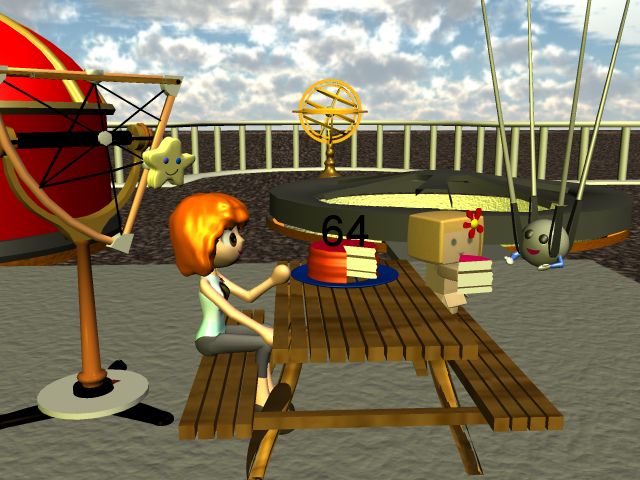
Fourth, professors, scientists, and intellectually able people are highly regarded in the Soviet Union as they are in most of Europe. In the Soviet Union they are well rewarded for good work, with a very high standard of living. They are not ridiculed in a stereotyped way as highbrows, eggheads, queers, and eccentrics. It is not considered that their careers should be secondary to those of good mixers, star football players, and organization men. It is no doubt true that they may be looked on with suspicion and investigated as likely to be subversive, in the Soviet Union as well as in the United States. Exceedingly few Soviet scientists are permitted to travel outside of the Soviet Union into the Western world; we are sure that they have less freedom than Western scientists. But this fact does not seem to affect very much the quality and quantity of scientific work being done.Note the remarkably even-handed objectivity about "freedom". Freedom to work means having the resources and training to do good work. Russia valued freedom to work in all fields, not just science. SKILL was valued and cultivated and appreciated in every possible way. At the end of the article Berkeley converges to standard Cold War alarmism, probably in an attempt to keep his credentials. The facts are easier to digest when coated by normal branding. = = = = = Here's a repeat of my usual Sputnik anniversary scene, this time placed in Brahe's Star Castle.
Labels: Alternate universe, Natural law = Soviet law, skill-estate
¶ 11:29 PM
Insects don't waste much time in adulthood; lots of bugs live several years as larvae and only a few days as adults.
These flies take it to an extreme. Adults are minimally equipped to get in the air and reproduce. They don't have as much brain power as other flies, nor do they have hard shells. Instead of flying purposefully, they drift with the wind like seeds, and die as soon as they bump into anything even at near-zero drifting speed. Result: for a couple of days, your face and clothes are covered with semi-liquid insects.
Despite their lack of navigation, they must have some kind of superior instinct or 'community intelligence', because picking the last warm day is much harder than picking the first warm day of spring. Termites and ants don't need to calculate their swarming day; they only need a simple neuron to detect when temperature rises past a certain threshold, plus an emitted pheromone to trigger the avalanche.
But how do these flies determine that today is not just warm, but the last warmth for their generation? They must be sensing something besides temperature.
At any rate, they serve as a reliable sign for us, even if our supercomputers can't match their calculations.

Polistra has put it into folk-wisdom format:
White flies swarming, no more warming.
= = = = =
[Artistic note: the swarm in the animation turned out nicely, but Polistra's head looks steroid-swollen and South-Park-ish for unknown reasons. Maybe she's allergic to the bugs.]
[Technical note: According to some sources, these bugs are smoky-winged ash aphids, Prociphilus americanus.] = = = = = END REPRINT. ¶ 2:19 PM
Labels: Sucker Filter
¶ 8:24 AM

