Monday, October 11, 2021
Sewell hits a huge point
I need to interrupt my ceaseless point-missing-finding expedition to note an extremely sharp BULLSEYE by Granville Sewell.
He demolishes a common AI myth with a perfectly simple bit of logic that SHOULD be obvious. But it's not obvious to anyone else. It wasn't obvious to me. I never noticed the problem.


In a post here (“The First ‘Simple’ Self-Replicator?”), I tried to explain why self-replicating machines are so far beyond current human technology, by imagining trying to design something as “simple” as a self-replicating cardboard box. Take an empty cardboard box, I said, and build a completely automated factory inside which can produce empty cardboard boxes. The factory would, I presume, at least need to have some metal parts to cut and fold the cardboard and a motor with a battery to power these parts. But since the box now only builds empty boxes, it is not a self-replicator. So we would need to add another factory that could automatically produce a box with an empty box-building factory inside, and that factory would be enormously more complicated. But this box is still not a self-replicator because the box it builds can only build empty boxes, so now we need to add more technology to build a factory that builds the empty box-building factory, and then…. All of this ignores, of course, the very difficult question of where the box gets the cardboard and metals and other raw materials needed to supply its factories.In fact we've had fully automatic box-making machines for at least 100 years, long before computers. What we don't have, and absolutely CAN'T have, is an infinite regress of box-making machine-making machine-making machine-making machine-making .... The resource problem is outside of the infinite regress, and thus not PERFECTLY unsolvable. We have never developed a machine that seeks and extracts water and minerals and sunlight, and assembles a new machine with the full capacity to assemble more machines. Plants do it all the time. This resource extraction mechanism is at least conceivable, not perfectly logically impossible.
Labels: Not AI point-missing
¶ 12:03 PM
Saturday, October 02, 2021
More non-pointmissing
Again from 'Computers and Automation', published by ACM. On p 11 of the May 56 issue, Elizabeth Thomas gives us a delightful parody of AI writing poetry.
Perfectly prophetic, hitting all the bases.
The 'inventor' is an internationally celebrated scientist with nearly half the letters of the alphabet following his name.
His lab is a typical multidisciplinary Centre For, composed of members of the Engineering, Applied Science, Mathematical, and English Departments; technicians; and clerical help.
His mechanical poet derives its data from
a special group of readers called "Prospectors", whose job it is to read all of the poetic output of the country and report on all significant trends in word usage. At present, for instance, it is practically obligatory for the poet to employ such words as nubile and incandescent at least once in each poem.Now, of course, the Prospectors have also been automated, but they still pick up current trends, which are often unwanted by the real controllers of the machine and censored for 'racism' or a hundred other isms. The good Austrian Doctor is lecturing to a tour group:
"It ees not true," said Dr. Yaffee at the conclusion of his short lecture, as severely as if one of us had suggested that it was true, "that the Yaffee Electronic Relay Poem-Writer vill eventually supersede or obsolete the poet. What it vill do ees to free the poet from the mechanical trammels that have hitherto shackled him, increase his output, and enhance his leisure.Sound familiar? One of the tour group bravely volunteers to provide a subject and name for a sonnet. The machine labors for several minutes and then prints out: THE HOUR IS TWICE A CAT ON VELVET ROSE WHO MELTS THE MOON UNTIL THE WILLOW SINGS UNFOUND DELIGHT STANDS WHERE THE LANTERN GROWS AND MEETS THE GLASSY SHORE ON DOWNCAST WINGS. THE WEARY NOMAD FRAMES HIS ROAD APART REPELLED BY CAUTION ON THE SHATTERED BRINK TO HER HE FLINGS HIS INCANDESCENT HEART UNCERTAIN OF THE SNOW HE LONGS TO SINK FORGOTTEN FEARS CREEP DOWN THE BROKEN WALL DIM SHADOWS TWIST THE CONTOURS OF THE SEA THE WIND REPEATS THE EARNEST SEAGULLS CALL AND GIVES LIKE DREAMING RAIN THE MORNINGS KEY Sound familiar? Incidentally, the obligatory words for today's poetry machines are gay and odor. One is expected, the other isn't. Or maybe it is. Credit footnote: I've been trying to find more info on the remarkably prophetic Elizabeth W Thomas, but Google doesn't get there. Elizabeth Marshall Thomas started writing in the '50s and is still alive and still writing, so she fills the references. Possibly the same, but seems unlikely. The latter specializes in archeology and Egyptian stuff, with no obvious connections to computers or data processing in the '50s. Many of the ACM opinion pieces were by well-known sci-fi authors, so Elizabeth might have worked in those circles.
Labels: Not AI point-missing
¶ 11:50 PM
AI non-pointmissing from 1954
The Bitsavers archive includes some old magazines like ACM.
In April 1954, Elliott Gruenberg wrote about thinking, creativity, and artificial intelligence. Page 6 of the PDF.
He got EVERYTHING right.
At that point digital was struggling to compete with analog. 1/3 of the material in the magazine was about new uses of analog computers, or analog controlled and recorded by digital. After digital defeated analog, we lost our ability to think properly about thinking and creativity. All of our metaphors are based on discrete time segments and discrete instructions, with NO FEEDBACK. From this mindset we can't begin to understand how life works. Gruenberg did understand how life works. Or rather he understood THAT life works. Living things are primarily meant to make, not think.
Human personality is characterized by a drive to preserve a self or ego; by an awareness of self, as related to a world; by an urge to survive. In addition, there is a capacity to plan action, to talk about it, to himself and others, and thus to reason. But beyond this, the human being has feeling, emotions. Activities make him feel good or bad. Certain sights also give rise to such feelings, and certain sounds. There is a feeling of good health hard to describe. A human being has a positive feeling when he has created something: a new book; a musical composition, a report, a new machine, a new room for the house. The struggle of creation may not be pleasant, but the results, if well done, give rise to happy emotions.I see only one point where recent knowledge has gone beyond what Gruenberg knew in 1954:
Most anti-mechanists emphasize the importance of creativeness as a distinguishing mark of human personality. But before we get carried away with the uniqueness of human personality, let us examine creativity a little more closely. Mothers who bear babies feel a sense of creative power, and justifiably so. Yet, in what sense does a mother create her child? Her control over the process once it starts is no better than the control of an attendant monitoring the gauges in a chemical plant.Epigenetics now shows that the emotions and actions of mothers create lasting changes in the baby. Grandma's "superstitions" were right. The anti-mechanists are right.
Labels: Not AI point-missing, skill-estate
¶ 9:05 AM
Sunday, September 26, 2021
Circling
Some rare NON-pointmissing, via MindMatters as usual....
Does that mean that there is no difference between science and pseudoscience? No, it does not. Although there is no definite dividing line between day and night, we can all agree that clear examples of each are easy to find. In the same way, we can all agree that, say, physics and chemistry are clear examples of true sciences and astrology and homeopathy are excellent examples of pseudoscience. So how are we doing this? The best approach appears to be one that does not attempt to apply a definitive list of strict criteria but instead accepts that there are certain ‘benchmarks’ that characterise what we think of as good science. First and foremost, science is a set of methods for attempting to gain veridical knowledge. It is not an established body of ‘facts’ that must never be questioned. Personally, I no longer believe in paranormal phenomena such as precognition, telepathy, clairvoyance, and precognition. I could be wrong, of course, and maybe one day new evidence of a robust and replicable paranormal phenomenon will be presented that will lead me to change my mind. After almost a century and a half of systematic research, I’m not holding my breath.Getting there. Telepathy and precognition DEFINITELY happen SOMETIMES. They can't be turned on and off like an engine or a flashlight, so they can't be examined in a standard controlled experiment. A more profitable examination would treat the SOMETIMES as a skill, not a theory. What conditions are conducive to telepathy and precognition? Who seems to be most sensitive? How can we increase our sensitivity? As fucking usual, Russians were working on this SKILL for quite a while, and we were dismissing it just as we dismissed Lamarck. Russian science has a record of being right, and we have a record of being wrong. = = = = = When you start from absolute determinism, ESP and precognition aren't a problem. The old Arabs and Persians started there, and the Euros who picked up science from them (Brahe, Kepler, etc) were thinking in the same mold. The universe is a massive clock, with an infinite pattern of interfering waveforms from its parts. An observer who is sensitive to those waveforms should be able to predict the future pattern of the waveforms. Real astrology, as I've been pointing out, was an attempt to systematize those patterns, or at least the part of the patterns formed by our nearby planets. I've been circling around this question for several months. and still haven't managed to pull it together. Apparently I'm not predestined to cinch up the topic yet.
Labels: Equipoise, Not AI point-missing, skill-estate
¶ 8:32 AM
Monday, September 06, 2021
Reprint again on aliens
For once an author DOESN'T miss the point:
 Polistra begs to differ. The supposed "universality" of math is a myth.
Our new Facebook Friends on Alpha Centauri could have the technology to text us, while knowing very little math. Let's look at the start of electrical communication on Earth. Sam Morse was an artist, not a mathematician, and his telegraph was built by trial and error. Alex Bell was a speech teacher with a deep visual comprehension of wave action. Early radio sets (spark-gap transmitters, cat-whisker detectors) were also built without fancy math, though a certain amount of measurement was important for meaningful testing.
You need a way of remembering size and comparing this size with that size. When testing antennas, you'd need to see that a longer antenna worked better than a shorter antenna, and you'd need to know when the lengthening stopped improving the performance and started making it worse. In other words, you need GRAPHS, or the mental equivalent of GRAPHS.
Even without trying to imagine an alien mind, it's easy to see how we Earthlings could have developed a communication system able to reach distant planets, all without any math beyond measurement.
Polistra begs to differ. The supposed "universality" of math is a myth.
Our new Facebook Friends on Alpha Centauri could have the technology to text us, while knowing very little math. Let's look at the start of electrical communication on Earth. Sam Morse was an artist, not a mathematician, and his telegraph was built by trial and error. Alex Bell was a speech teacher with a deep visual comprehension of wave action. Early radio sets (spark-gap transmitters, cat-whisker detectors) were also built without fancy math, though a certain amount of measurement was important for meaningful testing.
You need a way of remembering size and comparing this size with that size. When testing antennas, you'd need to see that a longer antenna worked better than a shorter antenna, and you'd need to know when the lengthening stopped improving the performance and started making it worse. In other words, you need GRAPHS, or the mental equivalent of GRAPHS.
Even without trying to imagine an alien mind, it's easy to see how we Earthlings could have developed a communication system able to reach distant planets, all without any math beyond measurement.
 If we look at human history, societies that developed PROBLEM-SOLVING technologies like dams and aqueducts and plows didn't die suddenly. They weren't killed BY the dams and aqueducts and plows. Sometimes they were conquered by enemies (eg Mayans), sometimes they lost their technological edge but continued functioning (eg Persia).
Societies that focused on THEORY were killed directly by the THEORY.
We can see the distinction RIGHT FUCKING NOW in the realm of medicine.
Vaccination was developed WITHOUT THEORY 500 years ago by the Circassians. It was brought to England and "reinvented" 200 years ago. Since then, vaccines for many different diseases have been developed by continual refinement of techniques and constant endless TRIAL AND ERROR. NEGATIVE FEEDBACK. The ERROR part is crucial. Before 2020, clinical trials were HALTED when too much ERROR appeared. None of this development used or needed any theories, except the OBSERVATION that the immune system can be trained to reject a disease by seeing a preview of the disease.
In 2020 we explicitly DELETED the entire concept of immunity. Public Death Officers still understand that it exists, but they use their understanding to ELIMINATE immunity, not to BOOST it. Now clinical trials are conducted to improve genocide, not to improve health.
Now we're operating on a magnificently maniacal THEORY that disease is caused by heretical beliefs. We still use the word "virus", but what we mean by "virus" is witch powder, not a microscopic package of RNA.
We are committing FAST suicide. Or more precisely, Deepstate and its branches are MURDERING us faster than ever before.
EXPERIENCE SURVIVES. THEORY KILLS.
= = = = = END REPRINT.
If we look at human history, societies that developed PROBLEM-SOLVING technologies like dams and aqueducts and plows didn't die suddenly. They weren't killed BY the dams and aqueducts and plows. Sometimes they were conquered by enemies (eg Mayans), sometimes they lost their technological edge but continued functioning (eg Persia).
Societies that focused on THEORY were killed directly by the THEORY.
We can see the distinction RIGHT FUCKING NOW in the realm of medicine.
Vaccination was developed WITHOUT THEORY 500 years ago by the Circassians. It was brought to England and "reinvented" 200 years ago. Since then, vaccines for many different diseases have been developed by continual refinement of techniques and constant endless TRIAL AND ERROR. NEGATIVE FEEDBACK. The ERROR part is crucial. Before 2020, clinical trials were HALTED when too much ERROR appeared. None of this development used or needed any theories, except the OBSERVATION that the immune system can be trained to reject a disease by seeing a preview of the disease.
In 2020 we explicitly DELETED the entire concept of immunity. Public Death Officers still understand that it exists, but they use their understanding to ELIMINATE immunity, not to BOOST it. Now clinical trials are conducted to improve genocide, not to improve health.
Now we're operating on a magnificently maniacal THEORY that disease is caused by heretical beliefs. We still use the word "virus", but what we mean by "virus" is witch powder, not a microscopic package of RNA.
We are committing FAST suicide. Or more precisely, Deepstate and its branches are MURDERING us faster than ever before.
EXPERIENCE SURVIVES. THEORY KILLS.
= = = = = END REPRINT.
Victorians of the late 19th century, living in the era of ambitious engineering, looked at Mars and saw globe-spanning canals – evidence, they believed, of a grand industrial civilisation mirroring their own. In the Cold War 1960s, as millions lived under the shadow of potential nuclear annihilation, ‘neocatastrophism’ – the theory that extraterrestrial civilisations are inevitably wiped out by violent events – emerged as an explanation for our apparent cosmic solitude. The Argentinian Trotskyist J Posadas was convinced that advanced aliens would be socialists; more recently, the Vatican’s then-chief astronomer José Gabriel Funes suggested in 2008 that extraterrestrials might share a close relationship with God. We scientists tend to believe that intelligent extraterrestrials will be builders of technology, fluent in the universal language of mathematics. In Contact, the aliens announce their presence by beaming prime numbers at us, and many of our messages broadcast to the stars consist of physics and mathematics wrapped up in binary code. This perspective on aliens as scientific rationalists underlies most of modern SETI. It’s a viewpoint that I happen to agree with. Then again, I’m a scientist: of course I do.Good candor at the end. I'm more of a technician than a scientist, so I've been arguing that the aliens wouldn't need math at all, because WE DIDN'T NEED MATH. Reprinting from January, still valid. = = = = = START REPRINT: .... The article goes on to discuss which formulas and theories would be good candidates for interplanetary chit-chat.
Polistra begs to differ. The supposed "universality" of math is a myth.
Our new Facebook Friends on Alpha Centauri could have the technology to text us, while knowing very little math. Let's look at the start of electrical communication on Earth. Sam Morse was an artist, not a mathematician, and his telegraph was built by trial and error. Alex Bell was a speech teacher with a deep visual comprehension of wave action. Early radio sets (spark-gap transmitters, cat-whisker detectors) were also built without fancy math, though a certain amount of measurement was important for meaningful testing.
You need a way of remembering size and comparing this size with that size. When testing antennas, you'd need to see that a longer antenna worked better than a shorter antenna, and you'd need to know when the lengthening stopped improving the performance and started making it worse. In other words, you need GRAPHS, or the mental equivalent of GRAPHS.
Even without trying to imagine an alien mind, it's easy to see how we Earthlings could have developed a communication system able to reach distant planets, all without any math beyond measurement.
If we look at human history, societies that developed PROBLEM-SOLVING technologies like dams and aqueducts and plows didn't die suddenly. They weren't killed BY the dams and aqueducts and plows. Sometimes they were conquered by enemies (eg Mayans), sometimes they lost their technological edge but continued functioning (eg Persia).
Societies that focused on THEORY were killed directly by the THEORY.
We can see the distinction RIGHT FUCKING NOW in the realm of medicine.
Vaccination was developed WITHOUT THEORY 500 years ago by the Circassians. It was brought to England and "reinvented" 200 years ago. Since then, vaccines for many different diseases have been developed by continual refinement of techniques and constant endless TRIAL AND ERROR. NEGATIVE FEEDBACK. The ERROR part is crucial. Before 2020, clinical trials were HALTED when too much ERROR appeared. None of this development used or needed any theories, except the OBSERVATION that the immune system can be trained to reject a disease by seeing a preview of the disease.
In 2020 we explicitly DELETED the entire concept of immunity. Public Death Officers still understand that it exists, but they use their understanding to ELIMINATE immunity, not to BOOST it. Now clinical trials are conducted to improve genocide, not to improve health.
Now we're operating on a magnificently maniacal THEORY that disease is caused by heretical beliefs. We still use the word "virus", but what we mean by "virus" is witch powder, not a microscopic package of RNA.
We are committing FAST suicide. Or more precisely, Deepstate and its branches are MURDERING us faster than ever before.
EXPERIENCE SURVIVES. THEORY KILLS.
= = = = = END REPRINT.
Labels: endless hell, Jackboot stomping forever, Not AI point-missing
¶ 12:14 AM
Saturday, May 29, 2021
Surprisingly perfect article
This article was linked by RealClearScience, normally a pillar of genocidal orthodoxy. I started reading it with my eyes halfway averted as usual, ready to shut down the page before I needed to smash the computer.
Amazingly, everything in the article is correct and wise. No gotchas, no poke-throughs. The author is discussing the latest NSF appropriation, separating out the useful and useless parts.
Core of the article:
There is deep and ongoing disagreement within the scientific community about the nature and extent of the crisis — including whether it is a genuine problem and what, if anything, can be done about it. Nevertheless, the NAS report points to a growing consensus that the replication crisis is symptomatic of deeper flaws with the way scientific research is currently organized and conducted. These include obstacles to sharing scientific data, inadequate statistical training among researchers, problems with the peer-review system and grant culture, misaligned financial and professional incentives, and the corrosive effects of publish-or-perish.The last sentence covers everything, conclusively and comprehensively. None of this is new. My father saw it in 1959 and warned me about it. Ike saw it at the same time and warned the nation about it. I listened, the nation didn't. The author then suggests a path toward solution:
New Zealand, for example, has been experimenting since 2015 with a lottery system for scientific grants. Lottery systems set aside some portion of well-qualified government grant seekers to be selected at random, rather than through the traditional merit system. The underlying idea is that scientific discoveries often come from unexpected places and require breaking out of existing consensuses.Putting it another way: Big Science is uniformly Darwinian. So let's apply Darwin to science itself, instead of constantly using a grotesque parody of Darwin as a weapon against heresy. Create random mutations and let nature select them.
Labels: Not AI point-missing
¶ 8:19 AM
Monday, May 17, 2021
When copywriters open up
This article by Tamara Wilhite is far more valuable than any technical discussion of AI.
Wilhite is a copywriter who has written some of the scripts used by AI bots and also some of the scripts used by human call centers. She gives a long set of REAL Turing tests, based on speed, variability, and language.
Her point is that the dividing line isn't digital talkers versus human talkers. The dividing line is programmed talkers (both silicon and wetware) versus unprogrammed talkers, who are only wetware. You can't really distinguish a programmed silicon writer from a programmed wetware writer. They are both on the mechanistic side of the line.
Reminds me of the 1944 book by Marynelle Williams, another copywriter telling us how copywriters work.
Labels: Not AI point-missing
¶ 10:01 PM
Wednesday, February 24, 2021
Rare common sense about common sense
Via ScienceDaily, a study that separates FACT knowledge from SKILL knowledge properly.
"Current machine text-generation models can write an article that may be convincing to many humans, but they're basically mimicking what they have seen in the training phase," said Lin. "Our goal in this paper is to study the problem of whether current state-of-the-art text-generation models can write sentences to describe natural scenarios in our everyday lives." Specifically, Ren and Lin tested the models' ability to reason and showed there is a large gap between current text generation models and human performance. Given a set of common nouns and verbs, state-of-the-art NLP computer models were tasked with creating believable sentences describing an everyday scenario. While the models generated grammatically correct sentences, they were often logically incoherent. For instance, here's one example sentence generated by a state-of-the-art model using the words "dog, frisbee, throw, catch": "Two dogs are throwing frisbees at each other." The test is based on the assumption that coherent ideas (in this case: "a person throws a frisbee and a dog catches it,") can't be generated without a deeper awareness of common-sense concepts. In other words, common sense is more than just the correct understanding of language -- it means you don't have to explain everything in a conversation. This is a fundamental challenge in the goal of developing generalizable AI -- but beyond academia, it's relevant for consumers, too.This also applies to the deification of theory among "human" scientists. As every branch of science departs from PHYSICAL experience, theories become weirder and crazier and more murderous. 100 years ago, theorists like Lodge and Faraday and Ayrton worked constantly with REAL PHYSICAL EQUIPMENT, and depended on close teamwork with mechanics who could build and maintain the REAL PHYSICAL EQUIPMENT. When every idea is applied directly to Nature, Nature will TELL you which ideas are sensible. ... but you need to LISTEN as well, and you need to break out of Parkinson. You need to use negative feedback, not positive feedback. With negative feedback, constant failure tells you to stop and try something different. With positive feedback, constant failure tells you to try the same shit EVEN HARDER AND BIGGER. The omnicidal "physicists" at LHC are using positive feedback. Their attempts to obliterate the universe just go on and on and on. They never find the mythical unicorns they're supposedly looking for. Every failure becomes an urgent requirement for more speed, more energy, more staff, more funding. Common sense and physical reality should tell you when to stop. If the unicorn is a real part of Nature, you should be able to find it at ordinary scales and ordinary energies. If you have to use energies trillions of times beyond anything in Nature, you're not going to find a unicorn that occurs in Nature. NEGATIVE FEEDBACK IS LIFE. POSITIVE FEEDBACK IS DEATH.
Labels: Not AI point-missing, Parkinson
¶ 11:22 PM
Tuesday, January 26, 2021
Rare productive piece
A rare piece of PRODUCTIVE writing about economics.
Most discussions of regression to the mean treat it as an unbreakable "mathematical" law, without noticing WHY it happens so often. When you're stuck in meritocracy you can't afford to notice reality.
Gary Smith breaks out of meritocracy by acknowledging the power of LUCK.
Regression happens whenever we make comparisons that involve an element of luck. The most highly rated generally have had more good luck than bad and are not as far above-average as they seem. Nor are the lowest rated as far below-average as they seem. Our lives and the world around us are not slogging to a depressing mediocrity with all companies equally profitable and all people equally tall, intelligent, healthy, and athletic. Our lives are much more interesting than that. We are constantly buffeted by temporary bursts of good luck or misfortune. Our challenge is to recognize the important role of luck in our lives and not overreact. Life is a bumpy highway, but we should enjoy the ride.Focusing on the power of luck immediately creates one blazing clarification. Why does the stock market always lead to maximum evil and criminality? Because it's a system based solely on betting. And not just simple betting; infinitely piled layers of side-side-side-side-side-bets on increasingly trivial aspects of the previous layer. In a truly unbiased luck system, an ideal unrigged roulette wheel or dice throw, each player will come out even after a while. The only way to win consistently is CHEATING. Basing the entire economy on a bet system guarantees that the worst and most evil cheaters will rule the economy. Normal humans doing normal jobs will be dead. The correct solution, as described by God and Mohammed and Marx, is to base the economy on SKILL. Labor is value, and more specifically the skills and styles of labor are value. Every single piece of every single living thing is designed to be USEFUL. Humans desperately need to be USEFUL, need to SERVE A PURPOSE. When the economic system favors gradual steady improvement of SKILL and USEFULNESS, everyone wins. The Soviet system was the best approximation of a skill-improving economy. America was moving in this direction, with ups and downs, from 1920 to 1970. Since 1970 we've been breaking away from labor and skill, first slowly, then accelerating, then all at once in 2020. = = = = = Later thought also produced by Smith's productive insight: Luck is mainly permanent, only partly temporary. Luck has different time factors for individuals and organizations. For each person, luck is permanent and innate. If you're attractive or impressive or likable or aggressive, you will win far more often than the permanent opposites of those qualities. No way around it. For a business or a small government, luck is much more fleeting and external. A business or farm can win or lose regardless of its innate tendencies, if weather or national governments turn the wrong way. A city can win if railroads decide to run a track here, or governments decide to run a new highway here. Before Bloomberg turned all cities into holocaust gas chambers, city governments competed and CHEATED to gain those railroads or highways or courthouses or colleges. There is only one semi-guarantee of permanent luck for a business or government: Save MONEY and SKILL. When you have lots of MONEY savings, you can survive bad weather or consumer fads or highway decisions. You can pause production and use your intelligence and SKILL to find new products or new ways to bring in money. When you preserve your SKILL capital, you'll have the intelligence to use those pauses productively. If you always live in debt and always repel your most experienced workers, you can't even survive normal conditions. You may be fooled by a temporary period of good external luck, but your permanent tendency to go the wrong way will use the good times to incur even more debt and fire even more experienced workers. Functional civilizations smooth out the extremes in both spatial and temporal directions. They try to smooth out the extremes of permanent human luck. They make room for unpopular people, and constrain the evil tendencies of aggressive demons. Functional civilizations make it easy to save money and hard to get in debt. They pay high interest on savings and charge higher interest on loans. They strictly forbid casinos of all types, especially the NYC type.
Labels: Natural law = Soviet law, Not AI point-missing, skill-estate
¶ 12:05 AM
Friday, December 18, 2020
One point hit, one missed
MindMatters has an excellent podcast on the top 12 AI Hypes. Lively discussion and clear info.
Most of the hypes are well-known, basically extensions of the old chess-playing robot that used mirrors to conceal a smart dwarf. The newer chess players like Facebook's robot moderators are less obvious, but there's always some human guidance and editing concealed inside a "completely artificial" process.
One big point that I hadn't thought about before:
Models are necessarily based on the existing players in a system. A predictive model for stock prices will analyze existing patterns to predict future changes in specific prices. What the model DOESN'T include is the effects of the model. When large numbers of people are using a simulation to guide their trading, the model becomes part of the feedback loop, and the assumption of existing factors is no longer valid.
In reality, of course, stock prices are not a natural system. Stock prices are operated by Deepstate to enrich the rich and kill the poor. Therefore the predictive models AREN'T failing to account for their own presence. The trading programs are designed by Deepstate to guide traders toward enriching the rich and killing the poor. Otherwise they wouldn't be allowed.
Labels: AI point-missing, Not AI point-missing
¶ 7:09 AM
Wednesday, March 04, 2020
Foreign meddling!
This time AI writer Dixon gets everything right, countermanding another writer who was getting it wrong.
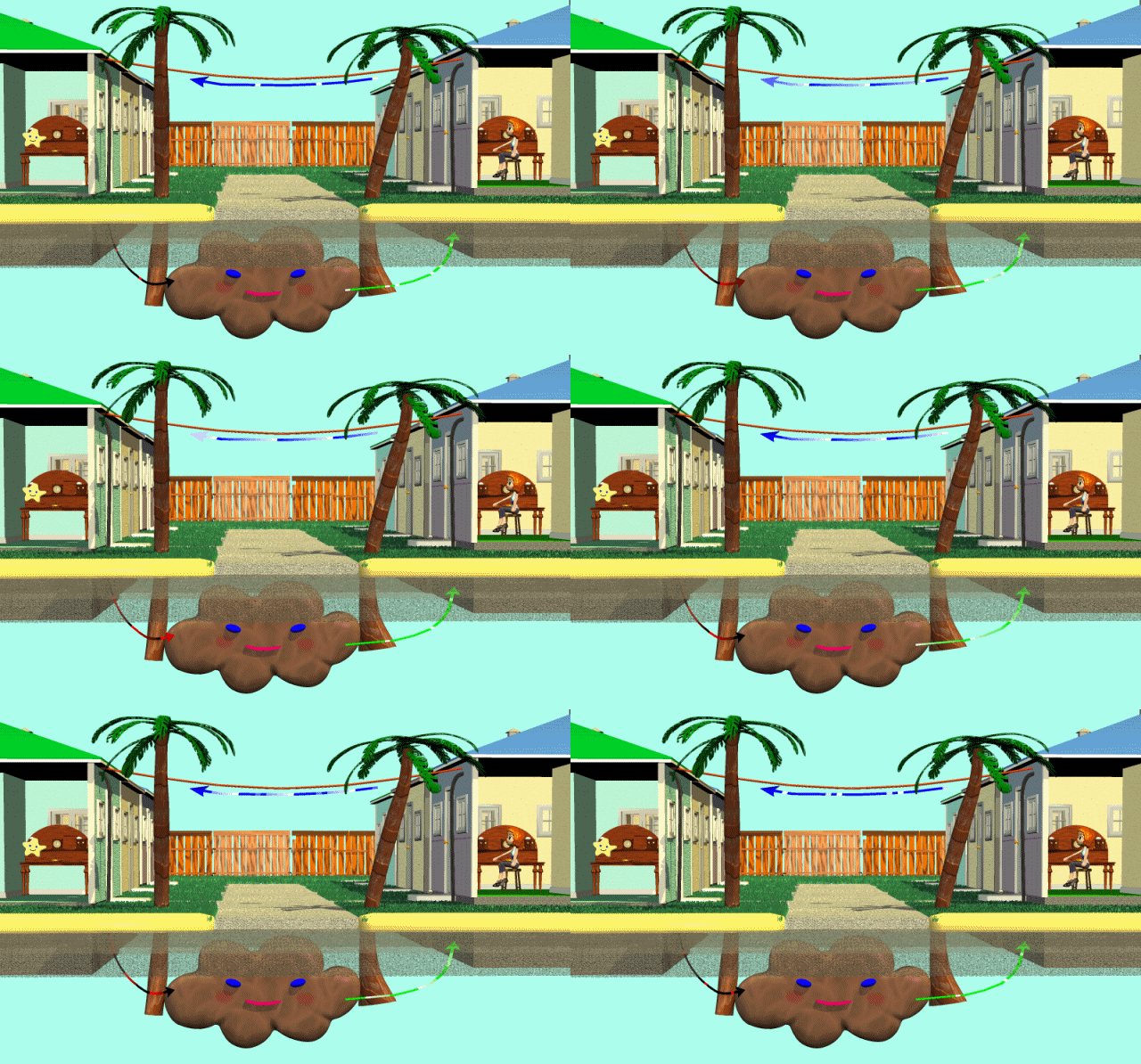 [Introducing a new character: HappyTruffle.]
In modern HV power lines, spike discharges often arc to nearby trees, causing acoustic 'pings' and occasional distortion of the power. Pine trees eat ions. When the trees grow toward the power lines to eat more ions, the trees are using natural intelligence to MEDDLE with the signal.
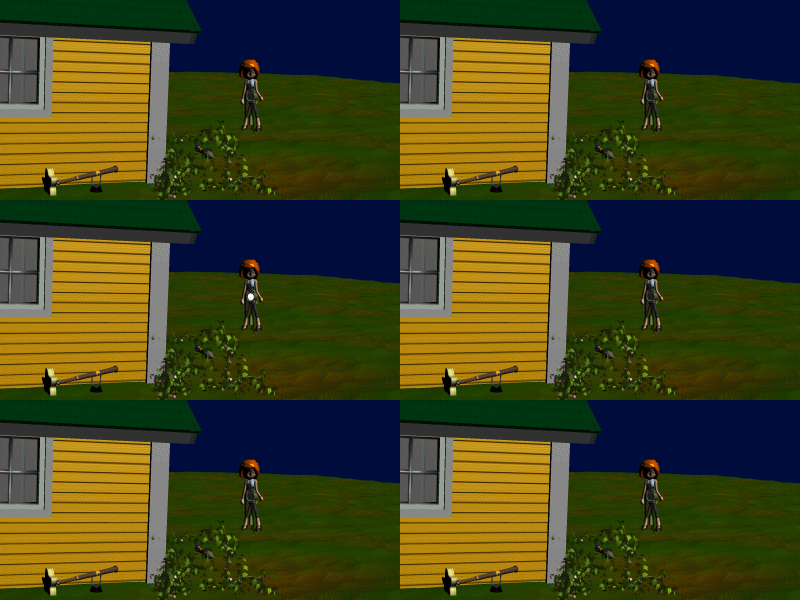
Here's a contrived example of a live bug in the system. Polistra is using the signal lantern to tell Happystar to RETREAT! The lightning bug thinks Polistra is a girl bug twerking at him, and flashes his assets in response. Happystar only sees the non-Morse repetitive flashing and figures Polistra is just keeping the lantern warm between messages.
[Introducing a new character: HappyTruffle.]
In modern HV power lines, spike discharges often arc to nearby trees, causing acoustic 'pings' and occasional distortion of the power. Pine trees eat ions. When the trees grow toward the power lines to eat more ions, the trees are using natural intelligence to MEDDLE with the signal.
Here's a contrived example of a live bug in the system. Polistra is using the signal lantern to tell Happystar to RETREAT! The lightning bug thinks Polistra is a girl bug twerking at him, and flashes his assets in response. Happystar only sees the non-Morse repetitive flashing and figures Polistra is just keeping the lantern warm between messages.
 = = = = =
Breaking news: Paleontologists have just discovered a network of communication wires among a population of pre-Cambrian rangeomorph fossils, which were somewhere between plants and animals in structure. The filaments are too narrow to be stolons carrying water and nutrition; they look more like ion-carrying signal wires.
= = = = =
Breaking news: Paleontologists have just discovered a network of communication wires among a population of pre-Cambrian rangeomorph fossils, which were somewhere between plants and animals in structure. The filaments are too narrow to be stolons carrying water and nutrition; they look more like ion-carrying signal wires.
In most software — and by “most” I mean nearly all — we call failures “bugs.” Bugs are things developers are expected to fix. If software has a bug, it’s broken and needs repair. Unless, of course, it is artificially intelligent software. Then, we may be told, it’s not broken. It’s “being deceptive.” Deception requires intention, purpose,…a mind. There is no mind present in the machine with the power to deceive. So when AI delivers a wrong, or unexpected, result, it is a bug.Yes. This is simple. Dixon gets it exactly right. Still, it raises a separate question. What if part of the system is genuinely alive and you don't realize it? In earlier telegraph systems, the earth was the return wire. Lots of living things are interpolated between sender and receiver, including some very BIG and very SIGNAL-INTENSIVE living things like the fungus networks that tie forests together. A mycorrhiza network could "eat" our signals and "poop" them out as altered signals to suit its own purposes. If it learned to eat at certain times of day when the most important signals (stock market closing reports) were coming through, the result would be genuinely intelligent.
[Introducing a new character: HappyTruffle.]
In modern HV power lines, spike discharges often arc to nearby trees, causing acoustic 'pings' and occasional distortion of the power. Pine trees eat ions. When the trees grow toward the power lines to eat more ions, the trees are using natural intelligence to MEDDLE with the signal.
Here's a contrived example of a live bug in the system. Polistra is using the signal lantern to tell Happystar to RETREAT! The lightning bug thinks Polistra is a girl bug twerking at him, and flashes his assets in response. Happystar only sees the non-Morse repetitive flashing and figures Polistra is just keeping the lantern warm between messages.
= = = = =
Breaking news: Paleontologists have just discovered a network of communication wires among a population of pre-Cambrian rangeomorph fossils, which were somewhere between plants and animals in structure. The filaments are too narrow to be stolons carrying water and nutrition; they look more like ion-carrying signal wires.Labels: Morsenet of Things, Not AI point-missing
¶ 3:48 PM

