Tuesday, October 12, 2021
IBM had Pascal in 1957!
No, not Turbo Pascal. Pascal's adder.
Continuing my 1957 IBM theme:
IBM's field engineers sometimes needed to figure in hexadecimal. IBM made sure its engineers were equipped with superdeluxe pocket-size hex calculators.
But they weren't electronic. IBM's engineers were using the original mechanical adding machines while servicing the most advanced electronic sorting machines.
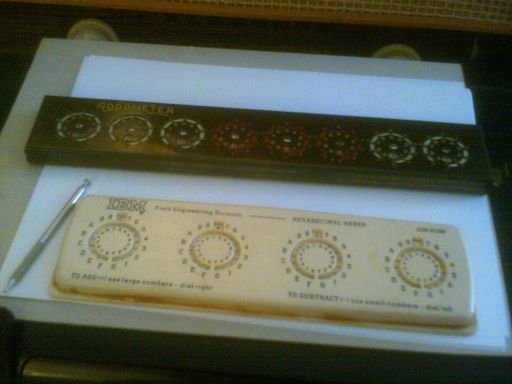 I saw this on Ebay and had to buy it. Closeup view:
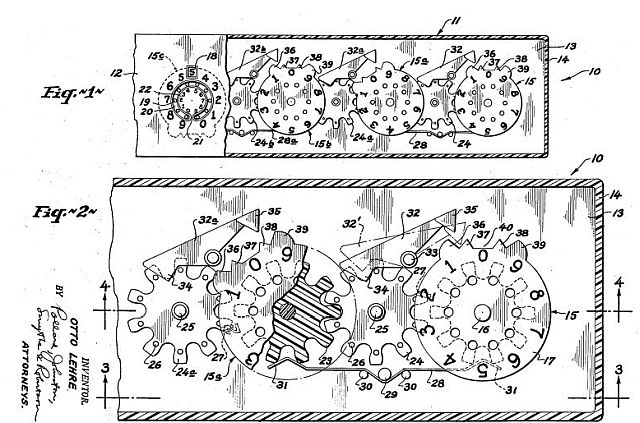
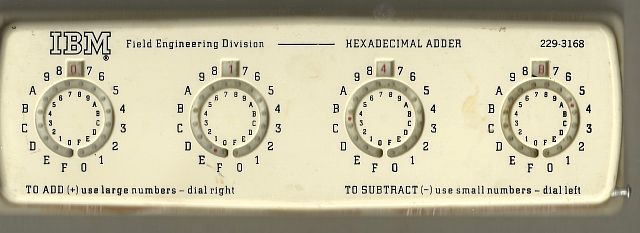 On the back it says MADE IN USA, and lists Patent number 2797047. The patent (for decimal, not hex) was granted to Sterling Plastics in New Jersey in 1957.
 Somebody had scratched 'Bad Carry' on the back, but the carry action works fine. It just needed to be loosened up. The only problem is that it doesn't have a convenient way to reset to zero. The older Addometer pictured above it had a reset lever.
Sterling sounded familiar but I couldn't place it at first. I have several slide rules made by Sterling.
Somebody had scratched 'Bad Carry' on the back, but the carry action works fine. It just needed to be loosened up. The only problem is that it doesn't have a convenient way to reset to zero. The older Addometer pictured above it had a reset lever.
Sterling sounded familiar but I couldn't place it at first. I have several slide rules made by Sterling.
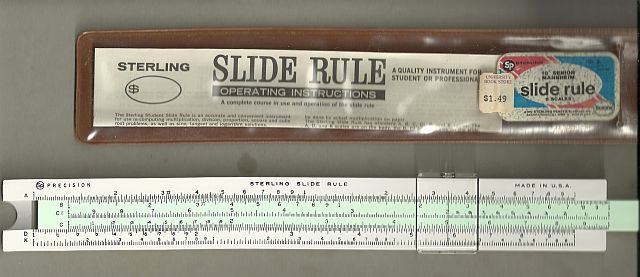 The Slide Rule Museum gives a history of Sterling and shows its decimal adders, which were sold commercially. Presumably the hex version was a special 'fleet order' for IBM.

I saw this on Ebay and had to buy it. Closeup view:
On the back it says MADE IN USA, and lists Patent number 2797047. The patent (for decimal, not hex) was granted to Sterling Plastics in New Jersey in 1957.
Somebody had scratched 'Bad Carry' on the back, but the carry action works fine. It just needed to be loosened up. The only problem is that it doesn't have a convenient way to reset to zero. The older Addometer pictured above it had a reset lever.
Sterling sounded familiar but I couldn't place it at first. I have several slide rules made by Sterling.
The Slide Rule Museum gives a history of Sterling and shows its decimal adders, which were sold commercially. Presumably the hex version was a special 'fleet order' for IBM.Labels: Happy Ending, new toy
¶ 1:50 PM
Saturday, May 22, 2021
Price != status
The latest issue of Collectible Auto has a long and satisfying article on the Ford small V8/60, produced from '37 to '40 in US, failed to sell here, then enjoyed a happy Second Life in many other countries until '67. Ended up as a fast OHV Hemi in Brazilian Simcas.
BEST ARTICLE EVER. Shows how history can include all other subjects. Math, economics, politics, personality, engineering. Every aspect is comprehensive and neatly linked into a solid narrative. Author Karl Ludvigsen deserves an award, if there are awards for this type of writing.
A shorter feature on Chrysler's last custom Imperials is less satisfying and more puzzling:
The Ghia Crown Imperial offers a window into something intangible, the power of glamour. With just 132 produced over a nine-year span, only a very select clientele, the rich, famous, and powerful, could enjoy such a car. That, of course, was the program's purpose. A Who's Who of users included presidents Eisenhower, Kennedy and Johnson; RCA chief Sarnoff, novelist Pearl Buck, heads of several Middle Eastern royal houses, Dominican dictator Trujillo, and Yugoslav president Tito.What's puzzling? The Crown cost $18,500. That wasn't a "presidential" price in 1965. It was the price of a basic two-bedroom house. My parents could have bought one if they were savers instead of borrowers. Any upper-middle earner could afford 18k. Inflated to today, it would be $150k. I could buy one if I wanted to use up all my savings. So price wasn't the constraint. Chrysler must have been selecting the buyers carefully by status, with official standards for the permissible Crown Imperial buyer. Or else they were taking LARGE off-the-books payments. The writer didn't seem to catch this point.
Labels: Asked and partly answered, Happy Ending
¶ 5:03 PM
Saturday, March 27, 2021
Salute to Benjn Pike Jr part 2: Electrotherapy
Continuing from the intro.
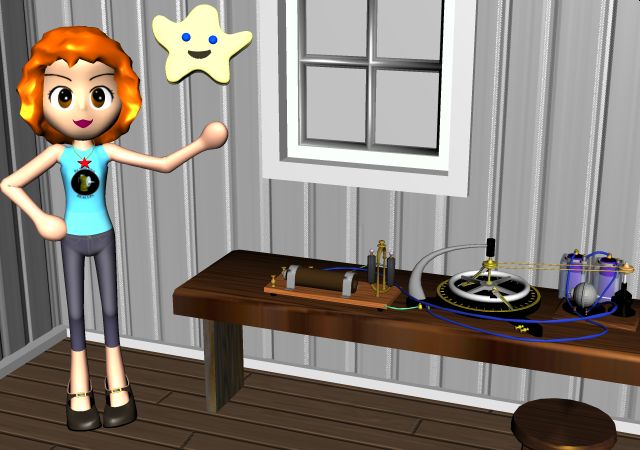
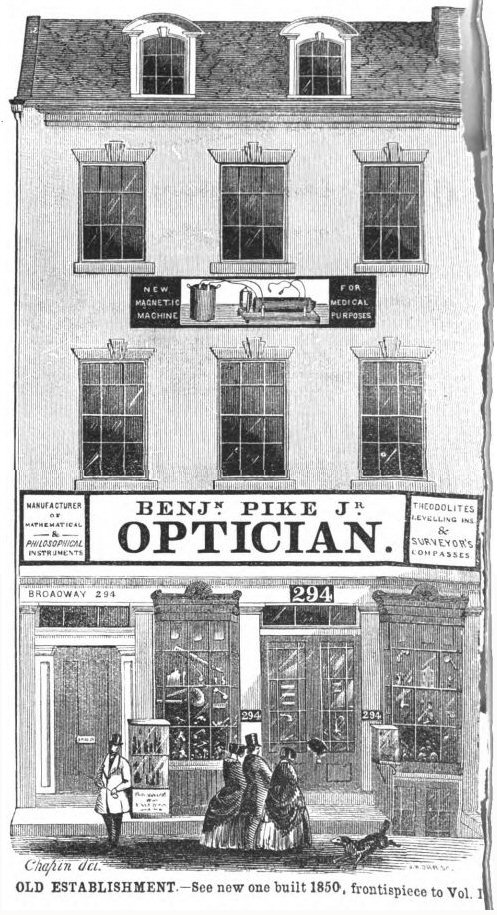 The 1856 Pike catalog featured a Magnetic Machine For Medical Purposes on its cover. I've animated it, and added another unique item from the period. Both of these have a medical/magical flavor.
Here's the magnetic machine in use for electrotherapy. You can see that Happystar is getting a pulse once in each revolution of the big wheel:
The 1856 Pike catalog featured a Magnetic Machine For Medical Purposes on its cover. I've animated it, and added another unique item from the period. Both of these have a medical/magical flavor.
Here's the magnetic machine in use for electrotherapy. You can see that Happystar is getting a pulse once in each revolution of the big wheel:
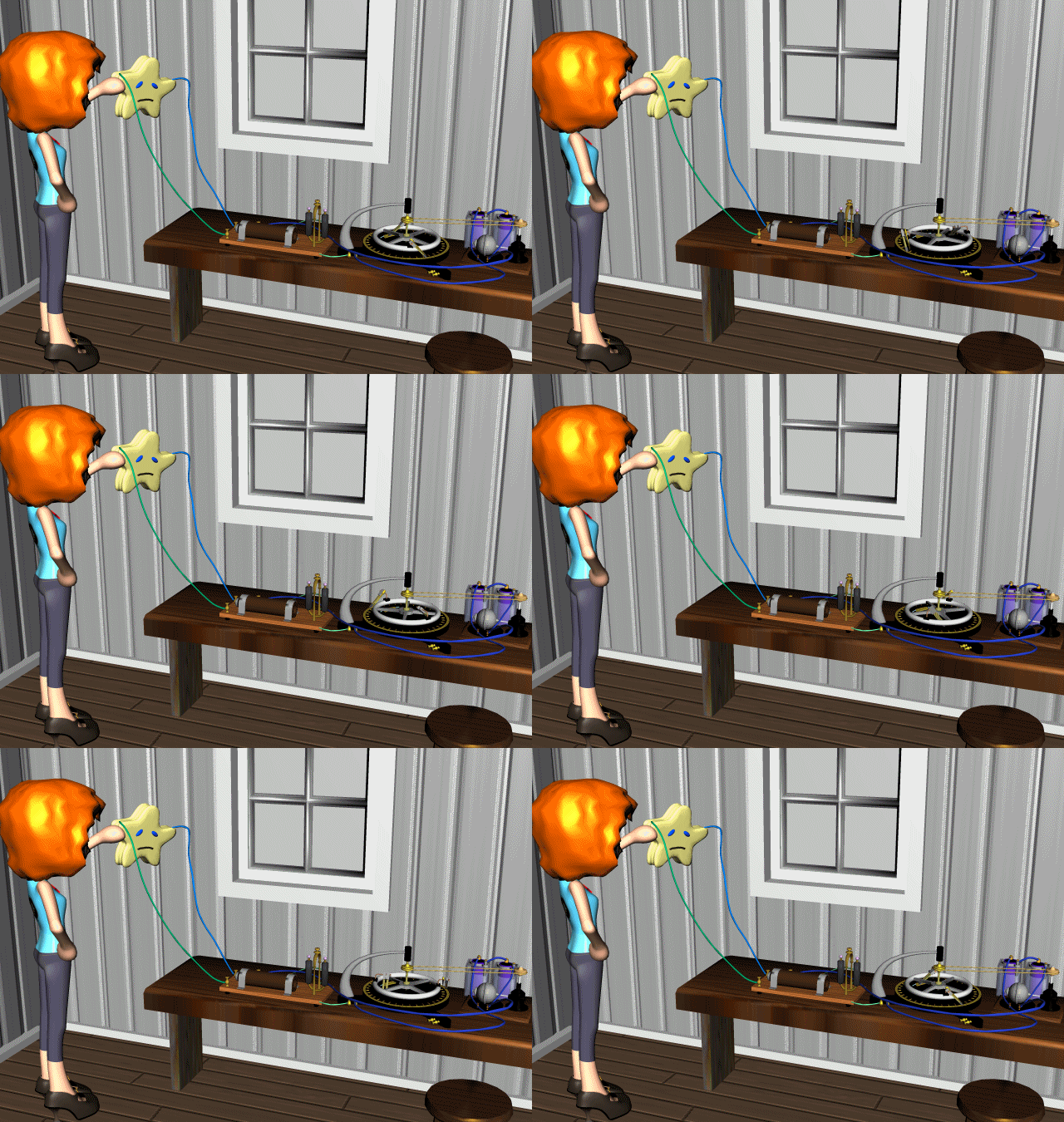 The Magnetic Machine (left) is just an induction coil with a buzzer, the most common source of high voltage from Wheatstone to Marconi to the Ford T. The coil has a primary with less turns and a secondary with more turns, and the iron core (protruding on left) can be slid in and out for more or less coupling.
The Pike catalog gives $10 as the price of the machine itself, which is about $400 now.
This early version has a uniquely shaped buzzer:
The Magnetic Machine (left) is just an induction coil with a buzzer, the most common source of high voltage from Wheatstone to Marconi to the Ford T. The coil has a primary with less turns and a secondary with more turns, and the iron core (protruding on left) can be slid in and out for more or less coupling.
The Pike catalog gives $10 as the price of the machine itself, which is about $400 now.
This early version has a uniquely shaped buzzer:
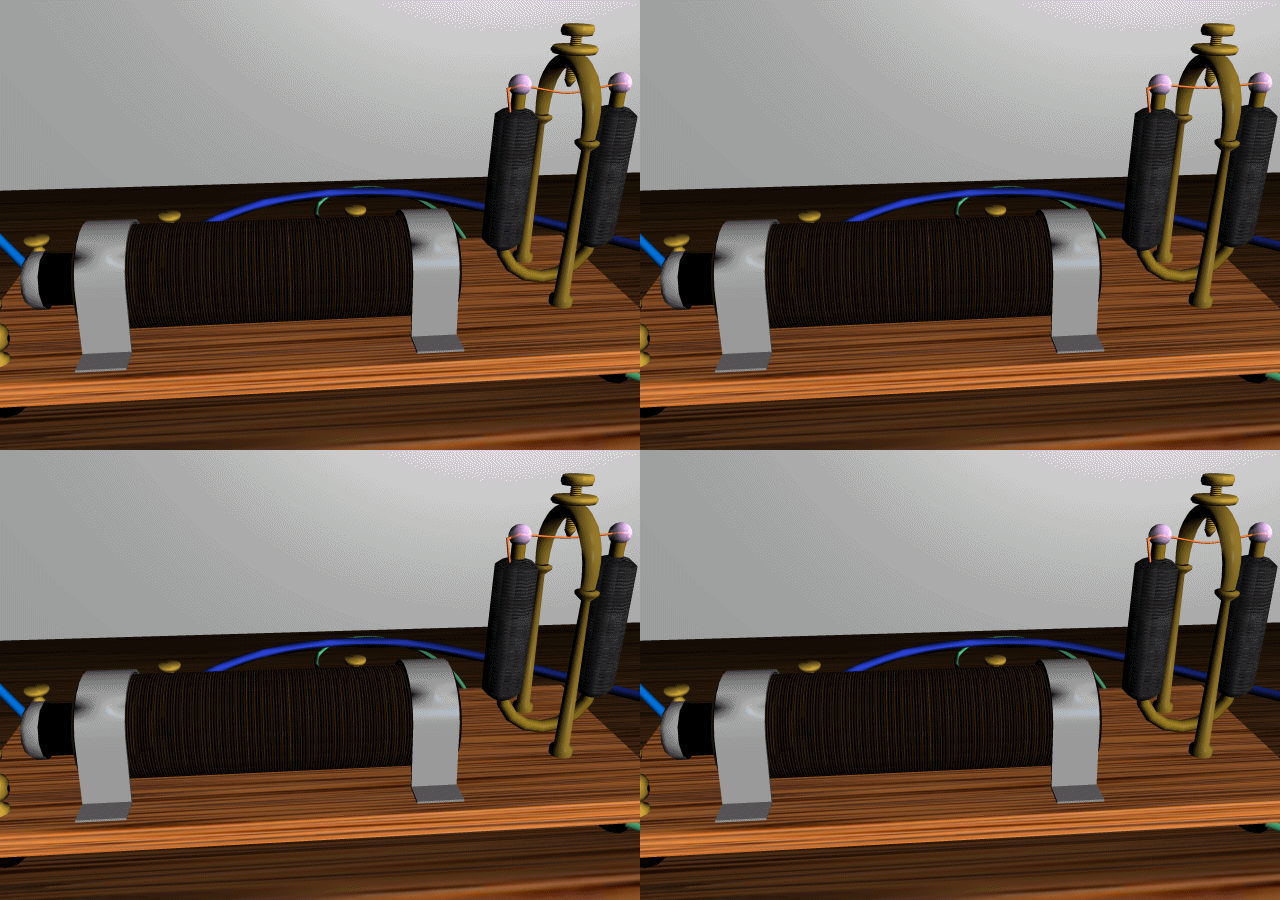 A fine iron wire is pulled down when the magnets are energized, breaking the circuit to the magnets. When it springs back up, it closes the circuit again. This seems overly delicate, and most later buzzers had a more massive spring element, looking and acting more like a pendulum.
= = = = =
The big wheel in the middle is a Rheotome (flow-cutter), a long-forgotten source of timed pulses with controllable width. It was often used in electrotherapy to provide brief pulses that could be sync'd with the heart or other rhythms. It's driven via pulleys by the electric motor on the right. Speed varied with usage; apparently 10 RPM was typical.
This particular rheotome has two entirely separate timers, for different purposes. Each timer consists of a pair of sliding brushes mounted on the wheel. The wheel itself doesn't carry any electricity, and there's no connection between the two pairs of brushes. Each pair skates on the insulated turntable below the wheel, and each pair connects two sets of contacts mounted on or in the turntable, but only when it skates onto the contacts.
A fine iron wire is pulled down when the magnets are energized, breaking the circuit to the magnets. When it springs back up, it closes the circuit again. This seems overly delicate, and most later buzzers had a more massive spring element, looking and acting more like a pendulum.
= = = = =
The big wheel in the middle is a Rheotome (flow-cutter), a long-forgotten source of timed pulses with controllable width. It was often used in electrotherapy to provide brief pulses that could be sync'd with the heart or other rhythms. It's driven via pulleys by the electric motor on the right. Speed varied with usage; apparently 10 RPM was typical.
This particular rheotome has two entirely separate timers, for different purposes. Each timer consists of a pair of sliding brushes mounted on the wheel. The wheel itself doesn't carry any electricity, and there's no connection between the two pairs of brushes. Each pair skates on the insulated turntable below the wheel, and each pair connects two sets of contacts mounted on or in the turntable, but only when it skates onto the contacts.
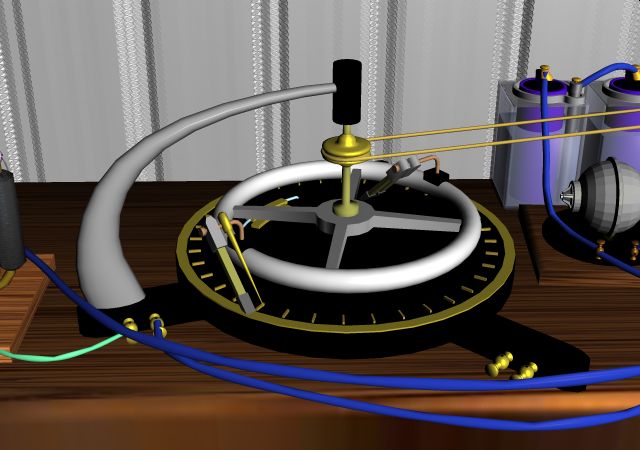 The outer pair of brushes has one needle and one brush for more precision. The needle is running over a 'compass rose' of precisely spaced metal contacts protruding from the insulating turntable. The outer brush is running over a continuous circle. When the needle passes over one of the precise compass points, current flows from the outer circle to the compass rose. These are tied internally to the binding posts on the right leg.
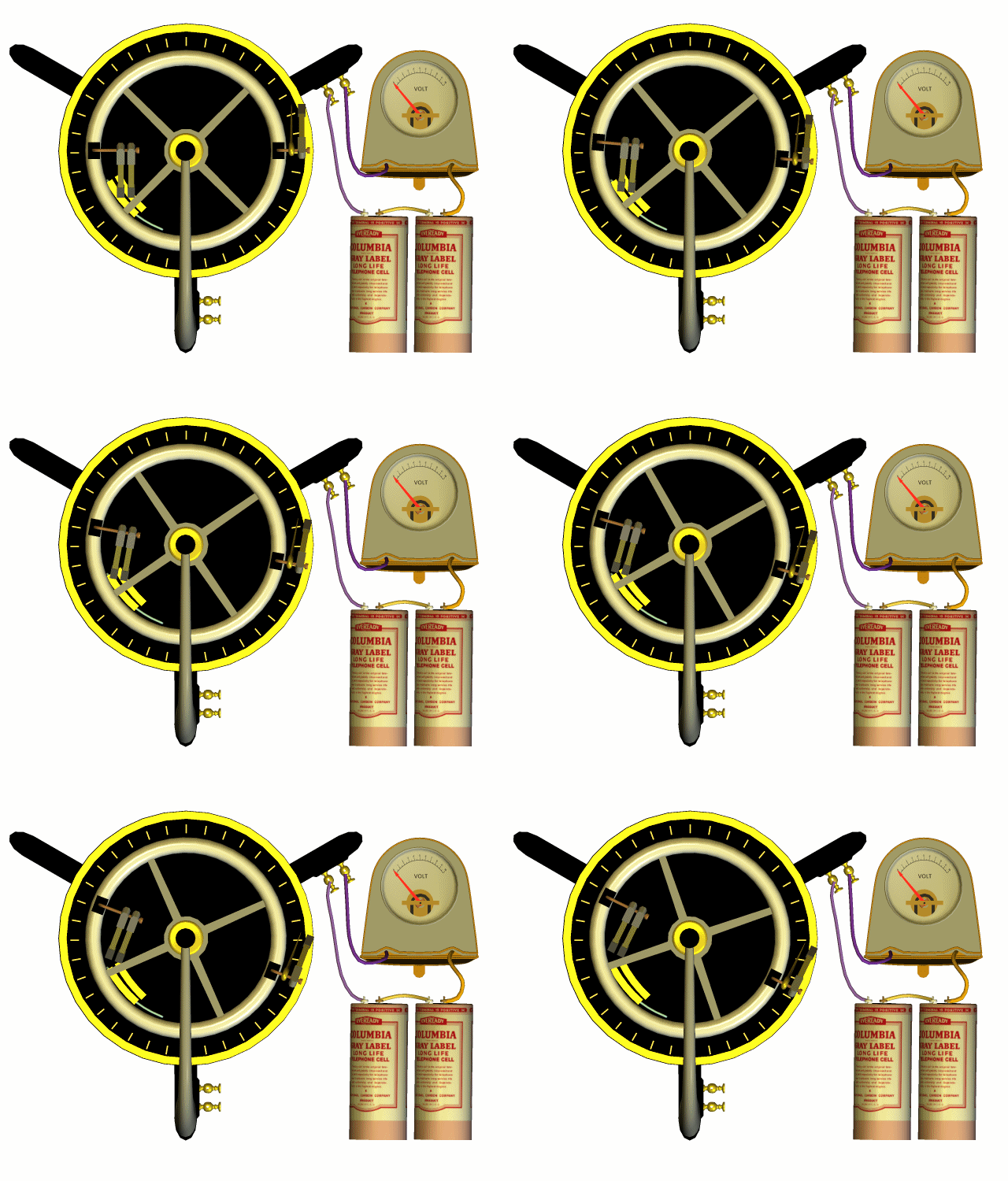 I've connected a simple series circuit with two drycells and a voltmeter, showing when the needle makes contact. (Not running the full circle here, because the rest would be repetitive.) These ticks could be used to activate a buzzer, but they would be more suitable as drivers for a time-marker pen on a chronograph.
= = = = =
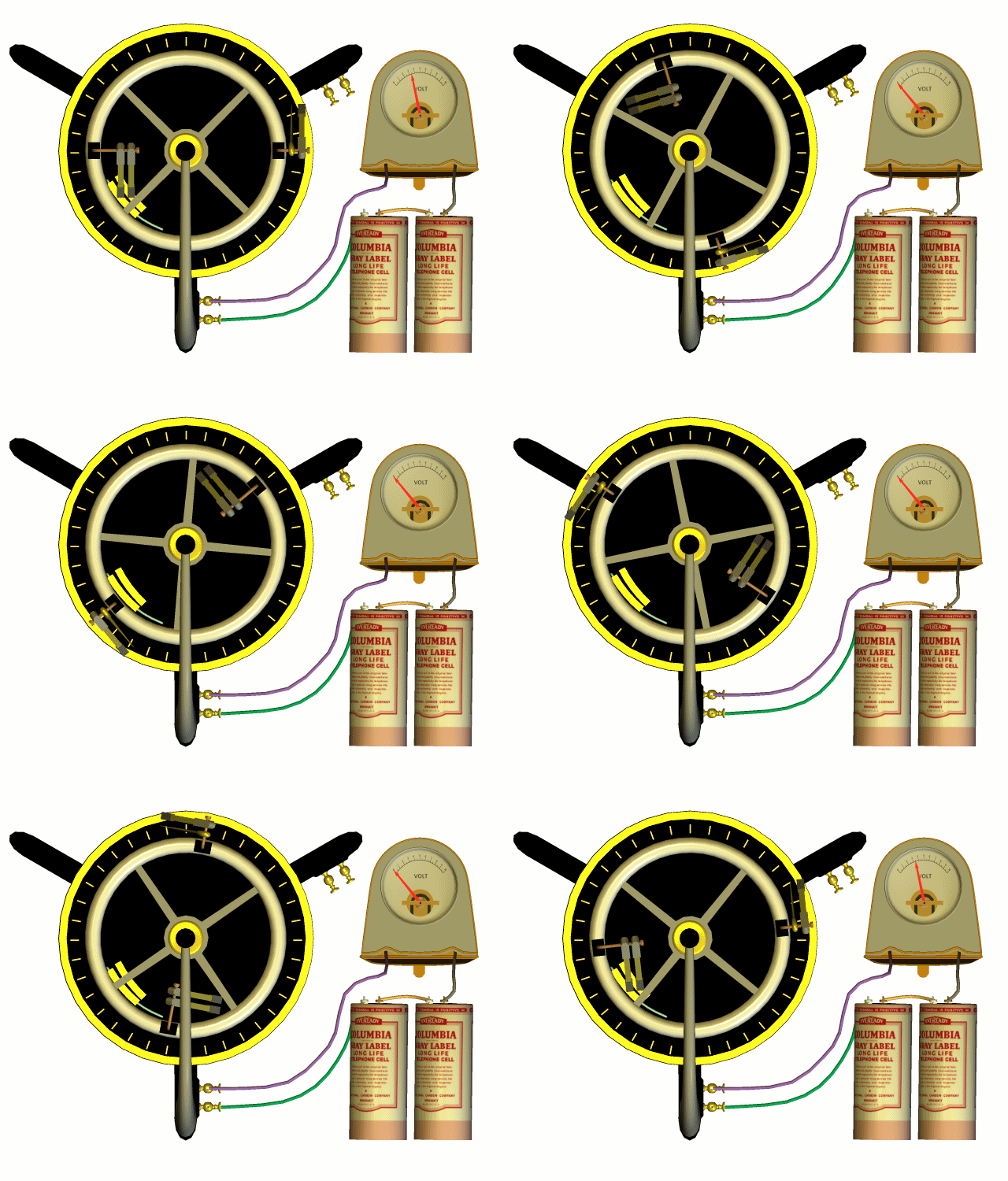
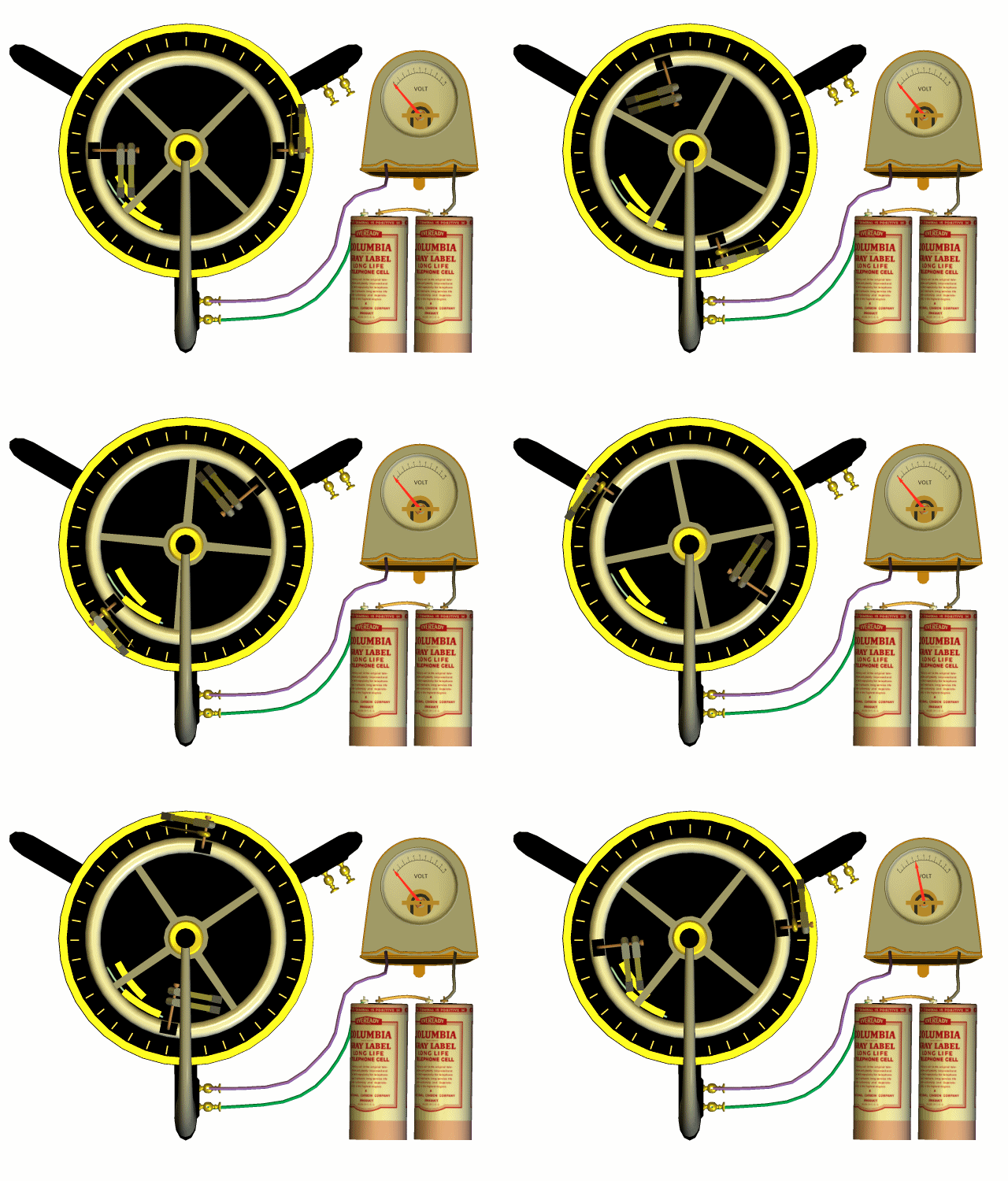
The more interesting pair is the inner pair. Two brushes pass over a short pair of 'mesas' on the insulated turntable. The outer mesa (which is adjustable) leads to the outer binding post on the south leg, and the inner mesa to the inner binding post. When BOTH brushes are contacting BOTH mesas, current passes between the binding posts. Again I'm using a simple series arrangement so the voltmeter shows when the pulse is on.
The outer mesa can slide both ways to vary the pulse length. When it's more southward, the area of overlap is narrower, so the pulses are narrower. The difference isn't impressive, but this seems to be a realistic representation of the difference in the real rheotome.
I've connected a simple series circuit with two drycells and a voltmeter, showing when the needle makes contact. (Not running the full circle here, because the rest would be repetitive.) These ticks could be used to activate a buzzer, but they would be more suitable as drivers for a time-marker pen on a chronograph.
= = = = =
The more interesting pair is the inner pair. Two brushes pass over a short pair of 'mesas' on the insulated turntable. The outer mesa (which is adjustable) leads to the outer binding post on the south leg, and the inner mesa to the inner binding post. When BOTH brushes are contacting BOTH mesas, current passes between the binding posts. Again I'm using a simple series arrangement so the voltmeter shows when the pulse is on.
The outer mesa can slide both ways to vary the pulse length. When it's more southward, the area of overlap is narrower, so the pulses are narrower. The difference isn't impressive, but this seems to be a realistic representation of the difference in the real rheotome.
 The 1848 Pike catalog describes the use of the Magnetic Machine thusly:
 And the machine was used with confidence! Happystar's waves are resync'd, back in resonance with the universe.
Sounds like the main effect was pulsed static charge, not current through the body. The hand of the healer has always been important in real healing. Modern "medicine" has forgotten it, and in 2020 prohibited all healing entirely.
And the machine was used with confidence! Happystar's waves are resync'd, back in resonance with the universe.
Sounds like the main effect was pulsed static charge, not current through the body. The hand of the healer has always been important in real healing. Modern "medicine" has forgotten it, and in 2020 prohibited all healing entirely.
The 1856 Pike catalog featured a Magnetic Machine For Medical Purposes on its cover. I've animated it, and added another unique item from the period. Both of these have a medical/magical flavor.
Here's the magnetic machine in use for electrotherapy. You can see that Happystar is getting a pulse once in each revolution of the big wheel:
The Magnetic Machine (left) is just an induction coil with a buzzer, the most common source of high voltage from Wheatstone to Marconi to the Ford T. The coil has a primary with less turns and a secondary with more turns, and the iron core (protruding on left) can be slid in and out for more or less coupling.
The Pike catalog gives $10 as the price of the machine itself, which is about $400 now.
This early version has a uniquely shaped buzzer:
A fine iron wire is pulled down when the magnets are energized, breaking the circuit to the magnets. When it springs back up, it closes the circuit again. This seems overly delicate, and most later buzzers had a more massive spring element, looking and acting more like a pendulum.
= = = = =
The big wheel in the middle is a Rheotome (flow-cutter), a long-forgotten source of timed pulses with controllable width. It was often used in electrotherapy to provide brief pulses that could be sync'd with the heart or other rhythms. It's driven via pulleys by the electric motor on the right. Speed varied with usage; apparently 10 RPM was typical.
This particular rheotome has two entirely separate timers, for different purposes. Each timer consists of a pair of sliding brushes mounted on the wheel. The wheel itself doesn't carry any electricity, and there's no connection between the two pairs of brushes. Each pair skates on the insulated turntable below the wheel, and each pair connects two sets of contacts mounted on or in the turntable, but only when it skates onto the contacts.
The outer pair of brushes has one needle and one brush for more precision. The needle is running over a 'compass rose' of precisely spaced metal contacts protruding from the insulating turntable. The outer brush is running over a continuous circle. When the needle passes over one of the precise compass points, current flows from the outer circle to the compass rose. These are tied internally to the binding posts on the right leg.
I've connected a simple series circuit with two drycells and a voltmeter, showing when the needle makes contact. (Not running the full circle here, because the rest would be repetitive.) These ticks could be used to activate a buzzer, but they would be more suitable as drivers for a time-marker pen on a chronograph.
= = = = =
The more interesting pair is the inner pair. Two brushes pass over a short pair of 'mesas' on the insulated turntable. The outer mesa (which is adjustable) leads to the outer binding post on the south leg, and the inner mesa to the inner binding post. When BOTH brushes are contacting BOTH mesas, current passes between the binding posts. Again I'm using a simple series arrangement so the voltmeter shows when the pulse is on.
The outer mesa can slide both ways to vary the pulse length. When it's more southward, the area of overlap is narrower, so the pulses are narrower. The difference isn't impressive, but this seems to be a realistic representation of the difference in the real rheotome.
The 1848 Pike catalog describes the use of the Magnetic Machine thusly:
It may be used agreeably, and with much effect, by the patient holding one of the conductors, and another person the other conductor, and with the other hand making passes over or around the diseased part. This is particularly useful about the head, and where the pain is under the hair it should be thoroughly wet, to have the effect pass through it. The best effects have followed from regular applications of a mild power, from five to fifteen minutes, twice or more a day. The machine may be used with confidence, no injury being known to result from its use.
And the machine was used with confidence! Happystar's waves are resync'd, back in resonance with the universe.
Sounds like the main effect was pulsed static charge, not current through the body. The hand of the healer has always been important in real healing. Modern "medicine" has forgotten it, and in 2020 prohibited all healing entirely.Labels: Entertainment, Equipoise, Happy Ending
¶ 3:37 PM
Sunday, March 14, 2021
Flagellum equo
Pointed by Zuhlsdorf, an interesting proposal to restore Latin as the official language of Europe.
It's not clear if the reformers are aiming for classical or Vulgate. Sounds like the latter.
Obviously it can't and won't happen because English owns the digital world. But contrapuntally, the digital world would make the switchover much easier than ever before.
Latin is trivially central to the Latinate languages in the western half of Europe. It's also central to English vocabulary if not English grammar. Slavic is more distant, but Russians would have the partial advantage of familiarity with noun cases, which have vanished from the Latinates and English. Krauts would get the short end, with no vocabulary or grammar parallels. German has always refused to adopt Latin words as its own.
The author commits the modern Creative Destruction error here:
Another reason Latin went extinct was because of how difficult and complex it is. The language is by design, highly affected by vocal inflexion. That means nearly every spoken word can be modified based on context, voice, mood, person, number, gender, tense, and delivery. With no central authority governing what was authentic Latin, it quickly fell out of everyday usage.As with buggy whips and dinosaurs and Neanderthals, LATIN DIDN'T GO EXTINCT. It smoothly morphed into Italian and other Latinates, and it became a major part of English by interbreeding and HGT. The Latinates kept most of the verb forms and lost the noun forms, so complexity itself wasn't the problem. = = = = = Later and sharper thought: Among animals and plants, AND among products and skills and languages, EXTINCTION NEVER HAPPENS NATURALLY. A successful item in all of those categories may seem to disappear if you're classifying it narrowly. But in reality a successful item always adapts, always finds a way to reuse its genes or skills. Dinosaurs become birds, carriage builders become automobile builders, Latin becomes Italian. In all of those categories, true extinction requires intentional mass murder. When you shoot all of the passenger pigeons, they are extinct. When you offshore all of the steel and electronics and textile industries, or when you lock down the barbers and restaurants, those skills become extinct. The people who owned those skills, now deprived of purpose and income, die out just as surely as the pigeons. The "endangered species" fraud focuses our attention on purported natural extinction caused by change in habitat. The "endangered" laws remove land from successful human use, causing REAL extinction of human skills and communities and cultures. LIFE IS PURPOSE. TECH IS DEATH.
Labels: Carbon Cult, Happy Ending, Language update, skill-estate
¶ 12:18 AM
Wednesday, November 04, 2020
Silly sci-fi
Speaking of IS vs COULD in science...
The IDers at Evolution News are arguing with a Darwinian named Helen Hansma.
Hansma is proposing the silliest and couldiest idea I've ever heard. It builds on several favorite axioms of the modern Darwinians and adds a completely impossible physical supposition.
She proposes that life developed from non-life in mica sheets underwater. Apparently there's a way to use layers of mica to 'pump up' energy, and the modern Darwinians always base everything on energy consumption.
 This doesn't capture the unique reflection/refraction of mica, but at least it shows how the mica was used in tubes.
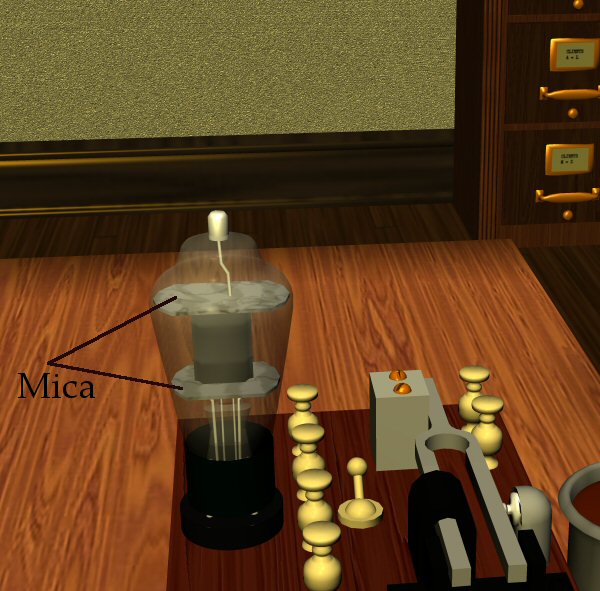 Unlike gems, mica is fragile. It crumbles easily. You don't want to bend it much. In stoves and tubes and capacitors the mica was mounted to avoid bending.
Fourth, there are several ways of 'pumping up' energy that involve capacitance. Mica is an excellent dielectric, but it doesn't naturally 'pump up' energy unless it has been formed into the dielectric of a capacitor, and even then the mica isn't the pumper. The entire complex circuit is the pumper. What's worse, these pumps don't give you extra energy. They just trade amps for volts, like a lever trading force for distance, and there's inevitably some loss in the process.
Mechanical energy between the sliding sheets? This is wordsalad. If there's enough wave action to slide the sheets around, they will crumble in a few minutes and won't be sheets any longer.
Even if this pumping could raise the energy of chemical reactions (how????), it wouldn't last long enough in one piece to evolve and naturally select.
This idea belongs with perpetual motion. It sounds plausible if you've never dealt with the real thing, but anyone who has worked with actual mica knows it's impossible.
= = = = =
Small Happy Ending: Mica is still used and sold for windows in various kinds of heaters.
Unlike gems, mica is fragile. It crumbles easily. You don't want to bend it much. In stoves and tubes and capacitors the mica was mounted to avoid bending.
Fourth, there are several ways of 'pumping up' energy that involve capacitance. Mica is an excellent dielectric, but it doesn't naturally 'pump up' energy unless it has been formed into the dielectric of a capacitor, and even then the mica isn't the pumper. The entire complex circuit is the pumper. What's worse, these pumps don't give you extra energy. They just trade amps for volts, like a lever trading force for distance, and there's inevitably some loss in the process.
Mechanical energy between the sliding sheets? This is wordsalad. If there's enough wave action to slide the sheets around, they will crumble in a few minutes and won't be sheets any longer.
Even if this pumping could raise the energy of chemical reactions (how????), it wouldn't last long enough in one piece to evolve and naturally select.
This idea belongs with perpetual motion. It sounds plausible if you've never dealt with the real thing, but anyone who has worked with actual mica knows it's impossible.
= = = = =
Small Happy Ending: Mica is still used and sold for windows in various kinds of heaters.
Professor Hansma pioneered the origins model postulating that the motion of mica sheets along the ocean floor could have driven chemical reactions energetically uphill, resulting in higher-energy molecules. In her letter, she challenges my evaluation of the power limitations on “natural engines” by asserting that the mechanical energy of the mica sheets could have provided sufficient energy to sustain some pathway to the first cell.In the obvious first fucking place, life is the exact opposite of energy efficiency. Life is the most extravagantly ANTIefficient process of all, when measured simply as energy input vs energy output. Second, the boundary between life and non-life is a boundary between ORDER and CHAOS, not a border between higher and lower energy. Organization is a completely distinct variable that can't be measured. (Entropy and information are narrowly defined 'examples' of organization, not basic measures.) Third, mica sheets don't float around in the ocean. Mica is formed as part of igneous rock under extreme pressure, something like diamonds. There's no natural process that would separate it, and it's not found in the oceans now. Mica is a wonderful material. It's beautiful in a gem-like way, with translucent depths and pearlescent reflections. It was widely familiar 80 years ago. Stoves and furnaces used mica for windows to see whether the flame is lit, and it was a major part of vacuum tubes and capacitors before 1970. It's a nearly perfect insulator for both heat and electricity, so it was the ideal material for 'framing' in vacuum tubes and for dielectrics in capacitors. I couldn't find any decent pics online so I made one.
This doesn't capture the unique reflection/refraction of mica, but at least it shows how the mica was used in tubes.
Unlike gems, mica is fragile. It crumbles easily. You don't want to bend it much. In stoves and tubes and capacitors the mica was mounted to avoid bending.
Fourth, there are several ways of 'pumping up' energy that involve capacitance. Mica is an excellent dielectric, but it doesn't naturally 'pump up' energy unless it has been formed into the dielectric of a capacitor, and even then the mica isn't the pumper. The entire complex circuit is the pumper. What's worse, these pumps don't give you extra energy. They just trade amps for volts, like a lever trading force for distance, and there's inevitably some loss in the process.
Mechanical energy between the sliding sheets? This is wordsalad. If there's enough wave action to slide the sheets around, they will crumble in a few minutes and won't be sheets any longer.
Even if this pumping could raise the energy of chemical reactions (how????), it wouldn't last long enough in one piece to evolve and naturally select.
This idea belongs with perpetual motion. It sounds plausible if you've never dealt with the real thing, but anyone who has worked with actual mica knows it's impossible.
= = = = =
Small Happy Ending: Mica is still used and sold for windows in various kinds of heaters.Labels: AI point-missing, Happy Ending
¶ 5:21 AM
Saturday, October 31, 2020
Tool rule
Previous item about a Soviet navy manual with USEFUL math reminded me of the basic point.
Russian math and science teaching was EXPERIENTIAL and SKILL-BASED. Our STEM was based on theory and memorization. Sputnik should have told us to start imitating Russia, but instead we made our own education even worse with Set Theory.
Here's a pretty good rule:
When a part of math is used in real life, the users develop real tools to make it easy.
Abacuses and ledgers have been used in commerce for thousands of years. Tables of log and trig values have been printed for hundreds of years. Babbage designed and used his computer to print tables, not to solve individual problems.
Specific trades developed highly specialized slide rules or 'wheel charts', usually circular, to figure often-used formulas in one turn. HVAC contractors had slide rules for fan capacity and Freon quantity. Radio repairmen had slide rules for Ohm's law and resonant frequency. Carpenters had slide rules for lumber size and bevel angles. Insurance salesmen had slide rules for annuity values and life premiums.
Later those slide rules turned into specialized calculators, then specialized computer apps.
Conversely, how can you tell if a part of math is useless? No tables or slide rules.
There was NEVER a pocket manual or a slide rule or a calculator or an app for set theory.
You can't even write a computer program to do set theory! It's completely ephemeral and useless.
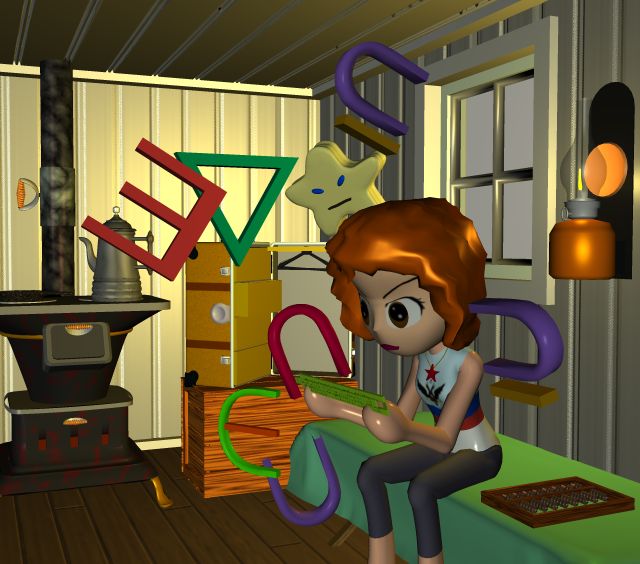 Happy Ending: Searching Ebay for wheel charts showed surprisingly that wheel charts are still alive. They seem to be most active in graphic situations like color matching or image matching, where computers can't beat human perception. Turn the outer wheel to match the color on the object, and the inner windows show which color name or product is closest to the color.
Happy Ending: Searching Ebay for wheel charts showed surprisingly that wheel charts are still alive. They seem to be most active in graphic situations like color matching or image matching, where computers can't beat human perception. Turn the outer wheel to match the color on the object, and the inner windows show which color name or product is closest to the color.Labels: Experiential education, Happy Ending, Patient things
¶ 1:55 PM
Friday, September 11, 2020
Grandinifughi
Last week I ran across these strange devices while looking for something else, as usual.
 On further reading, it turns out that hail cannons were a big business for about 20 years. French and Italian farmers were convinced that the cannons made a difference. Like cloud seeding, they didn't halt the weather every time, but they dissipated hail often enough to save massive amounts of money and trouble. Unlike cloud seeding, there was no downside. Seeding is a zero-sum procedure, depriving one location of rain to favor another location. Deicing the hail doesn't move the precip, it just avoids the damage.
Major agricultural implement companies made hail cannons along with plows and seeders and cream separators. Genuine scientific conferences were held annually, showing off the latest experiments and inventions.
The French called them canons contre grèle or grelifuges, and the Italians called them Grandinifughi. A word you can chew on!
Here's part of a wonderfully lyrical account from a 1901 cultural magazine (p 662 of the PDF):
On further reading, it turns out that hail cannons were a big business for about 20 years. French and Italian farmers were convinced that the cannons made a difference. Like cloud seeding, they didn't halt the weather every time, but they dissipated hail often enough to save massive amounts of money and trouble. Unlike cloud seeding, there was no downside. Seeding is a zero-sum procedure, depriving one location of rain to favor another location. Deicing the hail doesn't move the precip, it just avoids the damage.
Major agricultural implement companies made hail cannons along with plows and seeders and cream separators. Genuine scientific conferences were held annually, showing off the latest experiments and inventions.
The French called them canons contre grèle or grelifuges, and the Italians called them Grandinifughi. A word you can chew on!
Here's part of a wonderfully lyrical account from a 1901 cultural magazine (p 662 of the PDF):
 Polistra is at the controls of CANNONE FORMIDABILE, a full-fledged artillery piece with azimuth and altitude adjustments:
 Happystar is supervising a cannon built into its own cozy shed, with a separate inner room where the tireur could sit and wait for the storm while sipping the products of the vineyard he was protecting.
 An automatic acetylene cannon is in the background, developed by Maghiora and Blanchi.
 Did the cannons make sense? We know from wind-tunnel studies of streamlining that a vortex breaks up smooth airflow. The purpose of streamlining is twofold: First avoid flat surfaces directly pushing the air; second, avoid vortices. You want the air to split smoothly around the car or plane, and rejoin smoothly afterward.
The end of the Grandinifughi era isn't clear. Did the farmers decide that the Grandinifughi weren't worth the effort? Or did insurance companies make damage more profitable than prevention? Flood insurance works that way.
= = = = =
Happy ending! Grelifuges are STILL USED in France and Italy, and STILL MADE in Spain, and they look about the same as the 1902 versions! The new cannons use acetylene, continuing the tech invented by Maghiora and Blanchi. Video of a modern grelifuge. Live action with a visible and audible whirlwind-ring at 4:14. The old description wasn't lyrical, it was accurate!
= = = = =
Etymological footnote: The French and Italian words for hail are opposite. Grèle comes from Latin gracilis, and means slim or small when used as an adjective. Grandini comes from a root meaning 'coarse-grained', thus by extension grinding and grain and grand and things that grind, including hail. My initial impression of 'chewiness' was spot on.
Did the cannons make sense? We know from wind-tunnel studies of streamlining that a vortex breaks up smooth airflow. The purpose of streamlining is twofold: First avoid flat surfaces directly pushing the air; second, avoid vortices. You want the air to split smoothly around the car or plane, and rejoin smoothly afterward.
The end of the Grandinifughi era isn't clear. Did the farmers decide that the Grandinifughi weren't worth the effort? Or did insurance companies make damage more profitable than prevention? Flood insurance works that way.
= = = = =
Happy ending! Grelifuges are STILL USED in France and Italy, and STILL MADE in Spain, and they look about the same as the 1902 versions! The new cannons use acetylene, continuing the tech invented by Maghiora and Blanchi. Video of a modern grelifuge. Live action with a visible and audible whirlwind-ring at 4:14. The old description wasn't lyrical, it was accurate!
= = = = =
Etymological footnote: The French and Italian words for hail are opposite. Grèle comes from Latin gracilis, and means slim or small when used as an adjective. Grandini comes from a root meaning 'coarse-grained', thus by extension grinding and grain and grand and things that grind, including hail. My initial impression of 'chewiness' was spot on.
On further reading, it turns out that hail cannons were a big business for about 20 years. French and Italian farmers were convinced that the cannons made a difference. Like cloud seeding, they didn't halt the weather every time, but they dissipated hail often enough to save massive amounts of money and trouble. Unlike cloud seeding, there was no downside. Seeding is a zero-sum procedure, depriving one location of rain to favor another location. Deicing the hail doesn't move the precip, it just avoids the damage.
Major agricultural implement companies made hail cannons along with plows and seeders and cream separators. Genuine scientific conferences were held annually, showing off the latest experiments and inventions.
The French called them canons contre grèle or grelifuges, and the Italians called them Grandinifughi. A word you can chew on!
Here's part of a wonderfully lyrical account from a 1901 cultural magazine (p 662 of the PDF):
The terror of hail is as old as Adam's first planting season, and the hysterical efforts of man to do away with it date from that same springtime. It is just another phase of man's striving to climb back into Eden, where it does not hail. So he rang bells and made other noises, at first in religious appeal, and then with a vague notion of turning the storm by deafening detonations. Neither is the more scientific idea of shooting against clouds a new one. In 1760 the Chevalier de Jancourt, a physicist, noted that it never hailed on besieged towns, and urged wise men to get to work against what he called the most costly form of divine wrath. But the wise men were not wise enough, and the peasants rang their bells as before, and then declared that it would have hailed harder if they had not rung them.The author visited actual farms and watched the Grelifuges in action. He talked to the farmers and grape-growers and scientists. Conclusion:
Cannons have been fired against hailstorms, and hail did not fall. You might say that hail would not have fallen anyhow. But it did fall anyhow - that is, all around except on the spot covered by cannon. Again there remains the other possible coincidence: namely, that the hail had no designs against that particular exempted spot in the first place. But there is still an answering fact; for when the shooting ceased, the rain changed to hail, and when the shooting recommenced the hail as quickly changed back to rain. This is not an isolated instance, but the general case. ....... A veteran artilleur who had lost a leg in the service demonstrated how simply and safely this particular gun can be handled. He first produced one of the empty cartridges. This was of specially forged steel, about eight inches long. He adjusted a percussion cap, rammed in eighty grammes of mining powder, and ended with a wad of soft wood... The artilleryman advised us to watch for the whirlwind-ring, and then he pulled the string. The explosion sounded like the heavy boom of rock-blasting. You knew vaguely that the tripod was hidden in smoke, and that a white cloud had puffed from the mouth of the funnel. Then, as though growing out of the shock of the explosion, there came the sound of a long, shrill whistling. It was like the fierce metallic singing of some monster tuning-fork, mounting to a more angry pitch as it hurled higher in air. There, away up in the sky, was a gauzy ring as of smoke, still ascending and still buzzing on that shrill crescendo note. The ring was outlined against the deep blue like a soft, silky wreath, in the rays of the sun it was brilliant and changing, and then again shaded. One second later, and it had vanished in space. That, briefly, is the tore, or whirlwind-ring, which bursts from the cannon.And what happened after the vortex penetrated the cloud?
But even as the spectator on the hill was losing hope for the much-vaunted cannon, he looked up again. There was a disturbance going on in the darkest cloud, just over the vineyards. It looked like billows of rolling, tossing smoke up there. Then all at once the cloud opened, and through the rift was the glorious gold of the afternoon sun. At last, here was a breach in the enemy's flank. A gunner below shouted involuntarily, and all of them worked faster and faster yet. Each cannon was counting two, three, shots to the minute. Other breaks showed in the clouds. There was a moment of wavering, and then panic. The dark-browed invader broke and fled. He scattered towards the hills, and in his retreat he sent down a discouraged volley of raindrops.Or in more prosaic form, the cannons broke the updrafts that encouraged hail, and left a heavy rain. Here's my attempt to capture the scene.
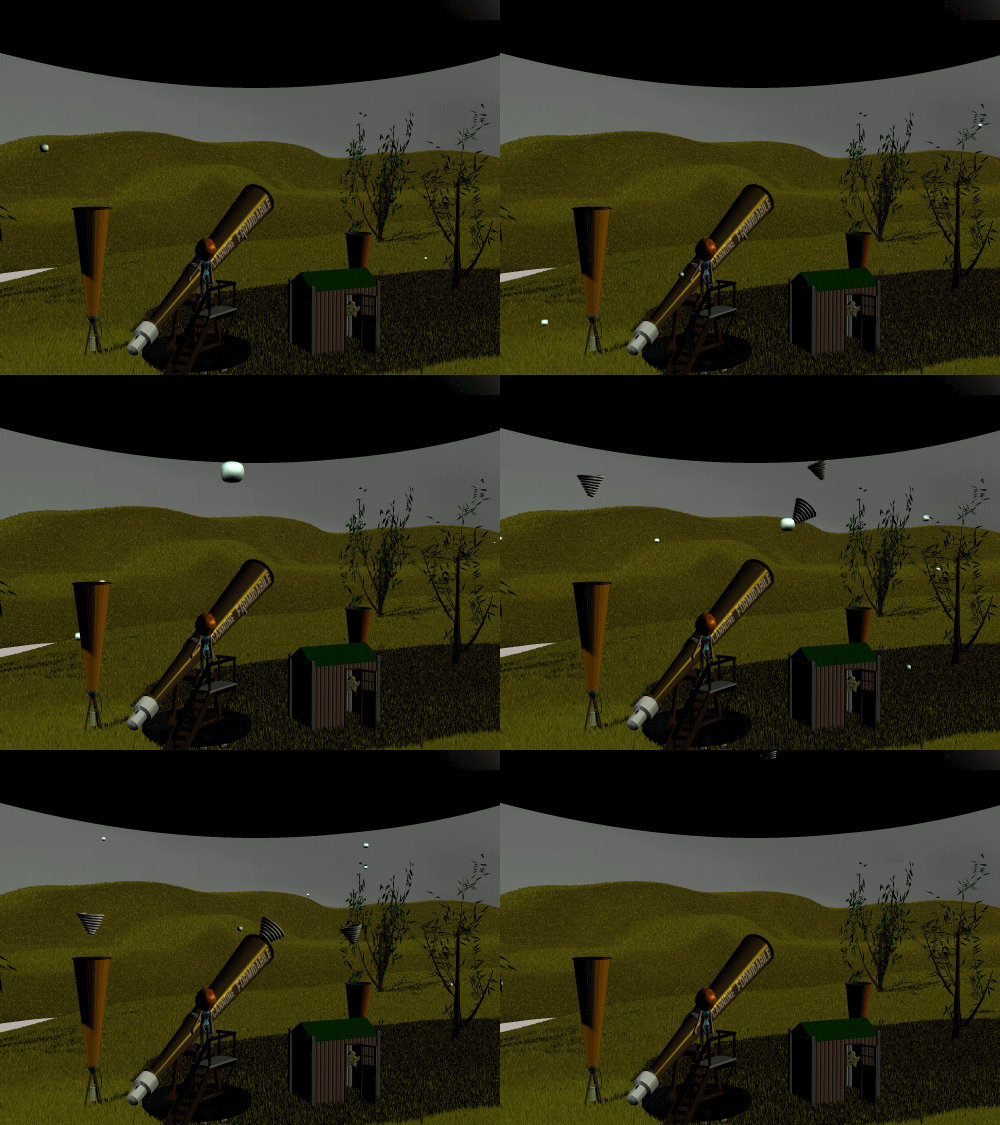
Polistra is at the controls of CANNONE FORMIDABILE, a full-fledged artillery piece with azimuth and altitude adjustments:
Happystar is supervising a cannon built into its own cozy shed, with a separate inner room where the tireur could sit and wait for the storm while sipping the products of the vineyard he was protecting.
An automatic acetylene cannon is in the background, developed by Maghiora and Blanchi.
Did the cannons make sense? We know from wind-tunnel studies of streamlining that a vortex breaks up smooth airflow. The purpose of streamlining is twofold: First avoid flat surfaces directly pushing the air; second, avoid vortices. You want the air to split smoothly around the car or plane, and rejoin smoothly afterward.
The end of the Grandinifughi era isn't clear. Did the farmers decide that the Grandinifughi weren't worth the effort? Or did insurance companies make damage more profitable than prevention? Flood insurance works that way.
= = = = =
Happy ending! Grelifuges are STILL USED in France and Italy, and STILL MADE in Spain, and they look about the same as the 1902 versions! The new cannons use acetylene, continuing the tech invented by Maghiora and Blanchi. Video of a modern grelifuge. Live action with a visible and audible whirlwind-ring at 4:14. The old description wasn't lyrical, it was accurate!
= = = = =
Etymological footnote: The French and Italian words for hail are opposite. Grèle comes from Latin gracilis, and means slim or small when used as an adjective. Grandini comes from a root meaning 'coarse-grained', thus by extension grinding and grain and grand and things that grind, including hail. My initial impression of 'chewiness' was spot on.
Labels: 1901, Asked and partly answered, Happy Ending, Morsenet of Things
¶ 5:11 PM
Saturday, August 22, 2020
National Coherer Day
August 20 was National Radio Day, arbitrarily created in the '70s to celebrate WWJ in Detroit. This year is the centennial of WWJ's first broadcast, which wasn't exactly the first commercial broadcast but close.
I'll arbitrarily call today National Coherer Day because I feel like it.
Coherers were an odd sidetrack in the history of radio. They were developed by experiment and accident, not by theory. Coherers flourished in a very specific environment, and helped to maintain the environment. Spark gap transmitters favored coherer receivers, and coherer receivers favored spark gap transmitters.
Most of all, coherers were strictly for Morse, and strictly for driving a tape-writer or plotter. They didn't belong in a system that relied on human hearing, whether via Morse sounder or earphones. Printers were part of the early transatlantic cable systems, and printers were mature and reliable at the time when wireless experimentation started. Marconi saw wireless as a replacement for the transatlantic cable, with essentially one sender and one receiver; so his system was surrounded and constrained by the analogy and the existing equipment.
= = = = =
Let's start with a complete Lodge-Muirhead station, operated by Polistra with the help of Happystar.
Lodge designed a resonant antenna, with two conical capacitive elements tied by an inductive element.
 The station included, from right to left, the Morse key (hidden by Polistra); the Lodge Buzzer; an induction coil; a spark gap tuned by Leyden jar capacitors and an inductor; the transmit-receive switch leading out to the antenna; a Lodge Coherer; and finally a printer or tape-writer.
 The Lodge Buzzer was an overly complex way of providing AC to the primary of the induction coil. Most systems used a simple hammerbreak. The Buzzer was a three-stage relay, allowing the Morse key to handle low voltage and current. The fast switching of high current for the primary was done by a mercury dip.
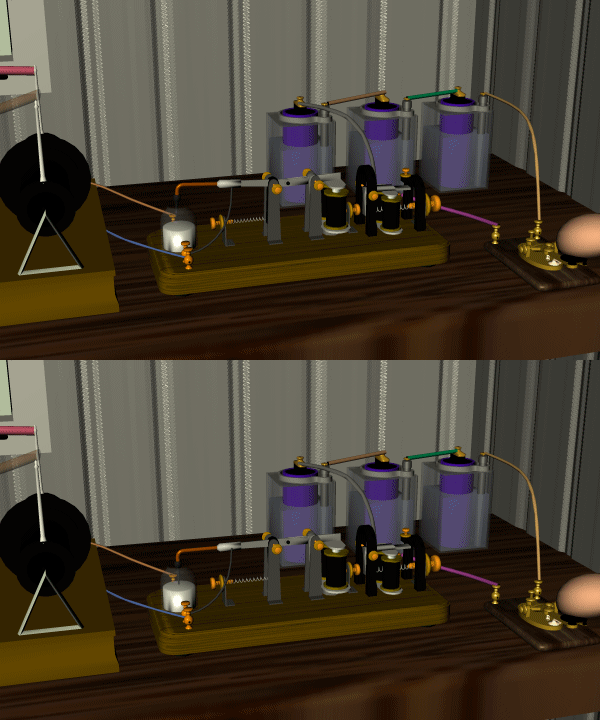 Now we see the whole thing ticking and tapping away, while Polistra sends a meaningful message through the antenna.
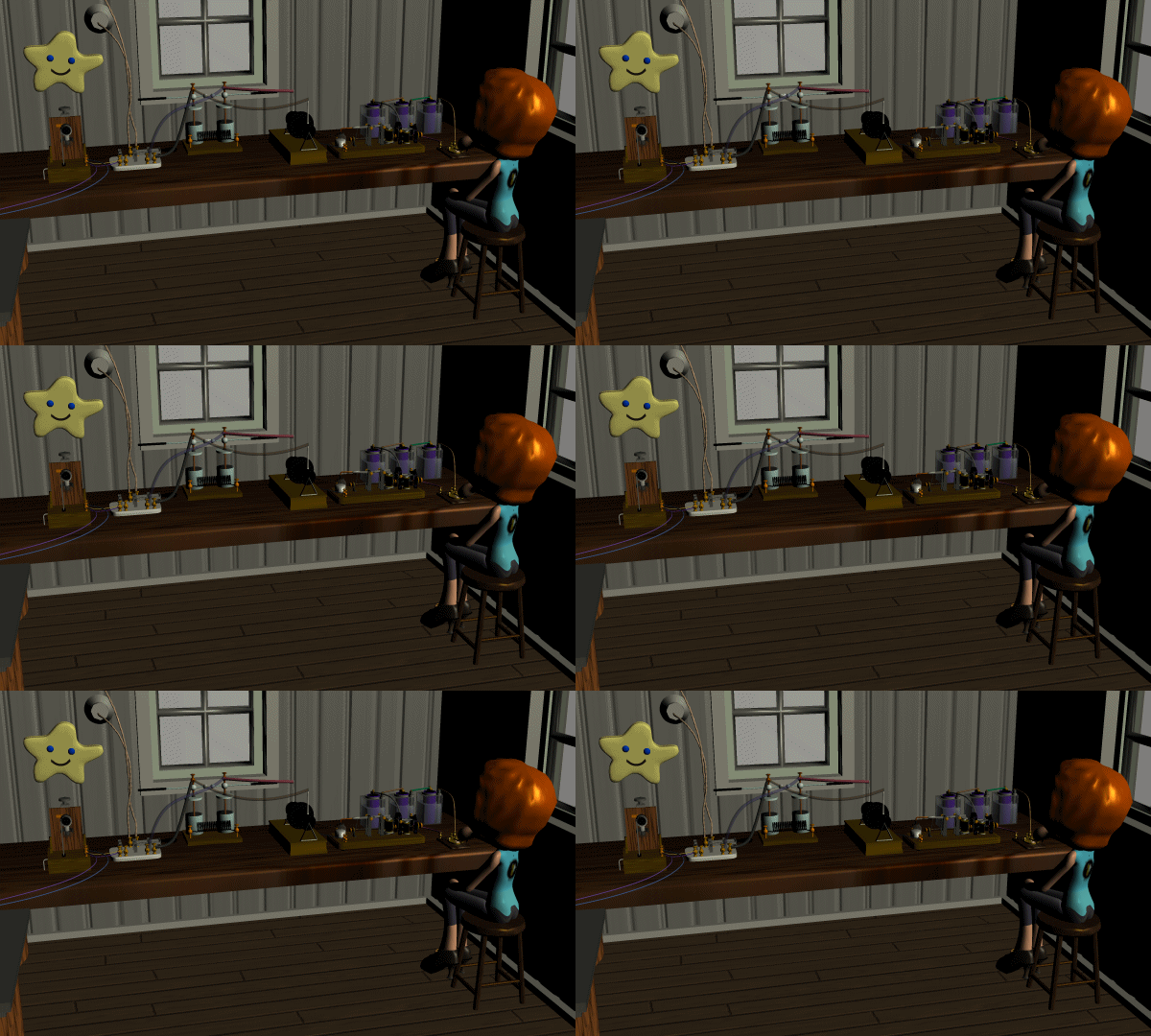 Early telegraph rigs were extremely clocky, with all sorts of mechanical pendulums and escapements, and electrically switched pendulums.
Before looking at the Lodge Disc Coherer, we'll show the most common coherer.
Early telegraph rigs were extremely clocky, with all sorts of mechanical pendulums and escapements, and electrically switched pendulums.
Before looking at the Lodge Disc Coherer, we'll show the most common coherer.
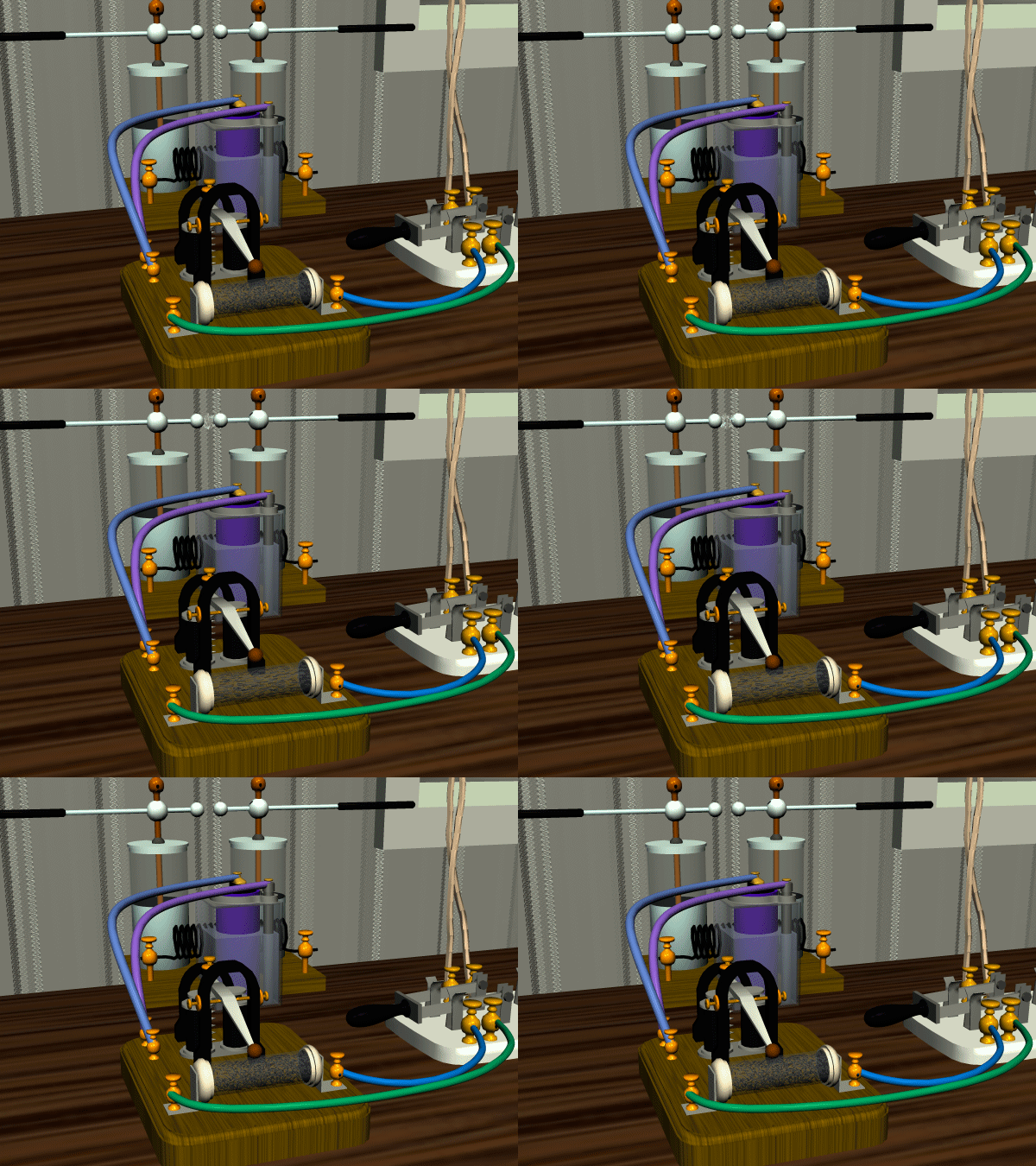 A glass tube with loose metal powder or filings inside. The tube was placed in series with a battery and the printer or tape-writer. Normally the filings had a high resistance, essentially non-conducting. When an RF signal came through the ether near the coherer, or a high-frequency signal was imposed on the DC, the filings lined up and cohered, closing the circuit and effectively acting like a relay. The filings wanted to remain lined up, so a mechanical tapper was needed to break them apart between dots and dashes. This tapper is run by a buzzer, but it could also be pure mechanical clockwork.
The Lodge Disc was entirely different.
A glass tube with loose metal powder or filings inside. The tube was placed in series with a battery and the printer or tape-writer. Normally the filings had a high resistance, essentially non-conducting. When an RF signal came through the ether near the coherer, or a high-frequency signal was imposed on the DC, the filings lined up and cohered, closing the circuit and effectively acting like a relay. The filings wanted to remain lined up, so a mechanical tapper was needed to break them apart between dots and dashes. This tapper is run by a buzzer, but it could also be pure mechanical clockwork.
The Lodge Disc was entirely different.
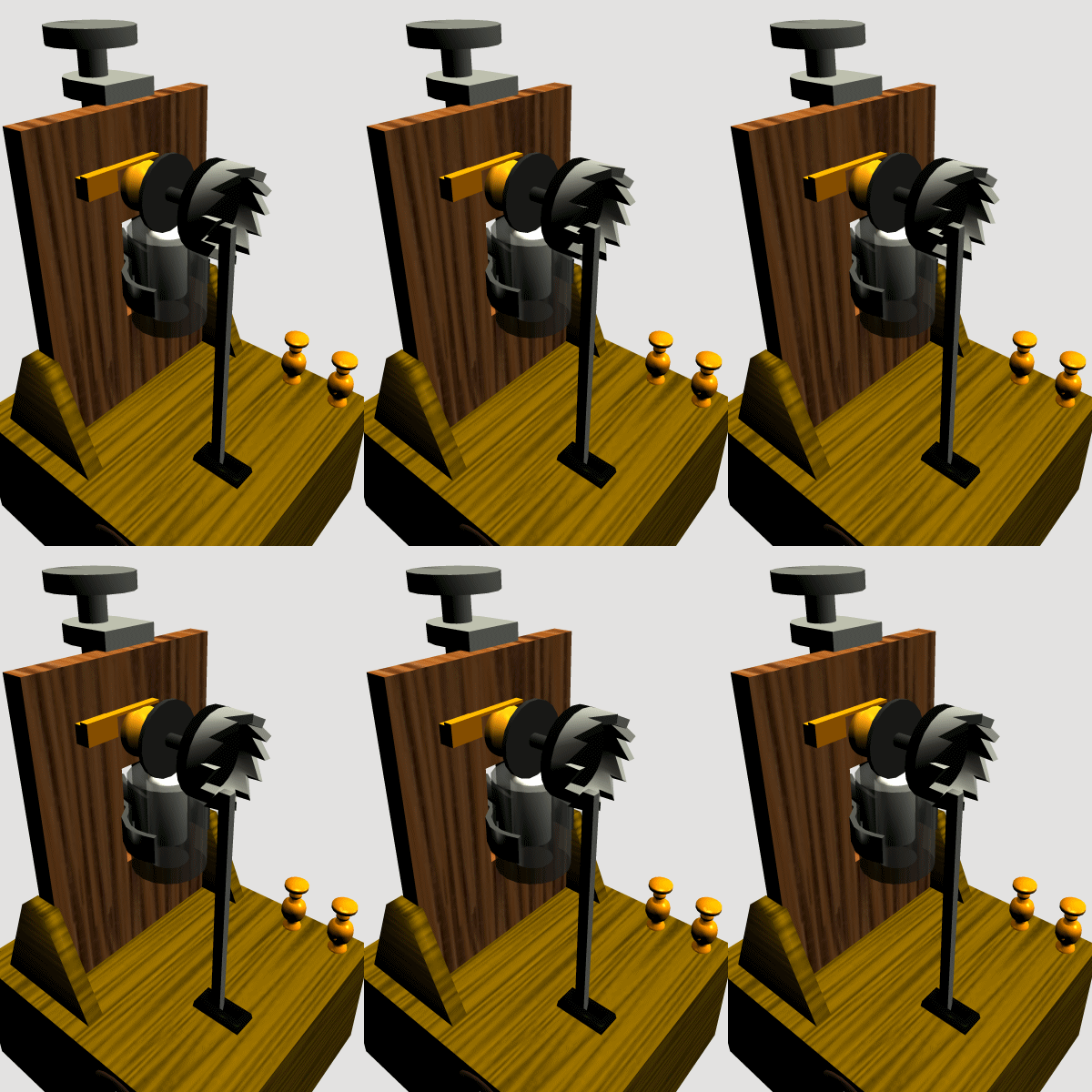 Here's a description of its action:
This is done by causing a small steel disc to revolve continuously in contact with a column of mercury, between which is interposed a thin film of oil. In action the coherer operates as follows: When the impinging waves set up oscillations in the resonator circuit the potential difference due to their cumulative effect disrupts the film of oil and at that instant cohesion takes place between the molecules of the solid and the fluid metals, only to be instantly restored by a partial revolution of the disc.
The thin layer of oil between dissimilar metals was probably acting like a semiconductor, similar to a catwhisker or even a bijunction transistor. "Cumulative" implies that some degree of rectifying was going on.
Marconi tried another variation on the constantly moving surface:
Here's a description of its action:
This is done by causing a small steel disc to revolve continuously in contact with a column of mercury, between which is interposed a thin film of oil. In action the coherer operates as follows: When the impinging waves set up oscillations in the resonator circuit the potential difference due to their cumulative effect disrupts the film of oil and at that instant cohesion takes place between the molecules of the solid and the fluid metals, only to be instantly restored by a partial revolution of the disc.
The thin layer of oil between dissimilar metals was probably acting like a semiconductor, similar to a catwhisker or even a bijunction transistor. "Cumulative" implies that some degree of rectifying was going on.
Marconi tried another variation on the constantly moving surface:
 Looks like a tape recorder or wire recorder. The large-diameter coil around the moving wire carried the DC, and the antenna was connected to the small-diameter coil inside it. When RF was present, the magnetic particles in the wire cohered, strengthening the core effect, raising the inductance of the large coil momentarily, and thus providing a pulse of added current in the larger coil. The moving loop gave this section of wire a chance to relax its coherence before it was used again.
Another inventor went full biological, reverting to Galvani.
Looks like a tape recorder or wire recorder. The large-diameter coil around the moving wire carried the DC, and the antenna was connected to the small-diameter coil inside it. When RF was present, the magnetic particles in the wire cohered, strengthening the core effect, raising the inductance of the large coil momentarily, and thus providing a pulse of added current in the larger coil. The moving loop gave this section of wire a chance to relax its coherence before it was used again.
Another inventor went full biological, reverting to Galvani.
 A frog leg carried a pen in its foot, and the RF was enough to trigger muscular contractions.
= = = = =
An early realization of the need for tuning came close to understanding the principle of rectifiers:
To excite the coherer under the conditions presumed to be necessary for
long distances, the impulses due to these waves must syntonize with the natural period of oscillation of the receiving circuit, and therefore these successive waves must pass by that circuit (wherever it may be), with the second following in the same phase as the first, or nearly so, otherwise the tendency of the second one will be to weaken or annul the effect of the first one.
Again emphasizing the cumulative effect. Almost got the point of rectifying, but not quite. Fleming finally realized that it was necessary to eliminate or invert the negative side of the sine wave. A symmetrical wave adds and subtracts equally, so the sum is zero. Removing one side made it possible to accumulate the RF power, which could then be filtered to sort out the modulation. But the realization was hard to grasp while the sparks and coherers were working together nicely.
= = = = =
Earlier I mentioned an attempt to see coherer-like activity in the brain. The experiments were interesting, and I noted that the connection was actually better than the 1906 researcher could see.
There's a separate coherer-like response in nearly all neurons, which didn't occur to me at that point. A spark-gap signal received by a coherer, complete with the buzzing and tapping and ticking at both ends, was a pulse train of varying length. A longer series of pulses for a dash, shorter series for a dot. This is how MOST neurons communicate and accumulate their signals. Pulse trains of varying lengths.
= = = = =
Happy ending:
Surprisingly, coherers are enjoying a second life in the new digital world.
A frog leg carried a pen in its foot, and the RF was enough to trigger muscular contractions.
= = = = =
An early realization of the need for tuning came close to understanding the principle of rectifiers:
To excite the coherer under the conditions presumed to be necessary for
long distances, the impulses due to these waves must syntonize with the natural period of oscillation of the receiving circuit, and therefore these successive waves must pass by that circuit (wherever it may be), with the second following in the same phase as the first, or nearly so, otherwise the tendency of the second one will be to weaken or annul the effect of the first one.
Again emphasizing the cumulative effect. Almost got the point of rectifying, but not quite. Fleming finally realized that it was necessary to eliminate or invert the negative side of the sine wave. A symmetrical wave adds and subtracts equally, so the sum is zero. Removing one side made it possible to accumulate the RF power, which could then be filtered to sort out the modulation. But the realization was hard to grasp while the sparks and coherers were working together nicely.
= = = = =
Earlier I mentioned an attempt to see coherer-like activity in the brain. The experiments were interesting, and I noted that the connection was actually better than the 1906 researcher could see.
There's a separate coherer-like response in nearly all neurons, which didn't occur to me at that point. A spark-gap signal received by a coherer, complete with the buzzing and tapping and ticking at both ends, was a pulse train of varying length. A longer series of pulses for a dash, shorter series for a dot. This is how MOST neurons communicate and accumulate their signals. Pulse trains of varying lengths.
= = = = =
Happy ending:
Surprisingly, coherers are enjoying a second life in the new digital world.
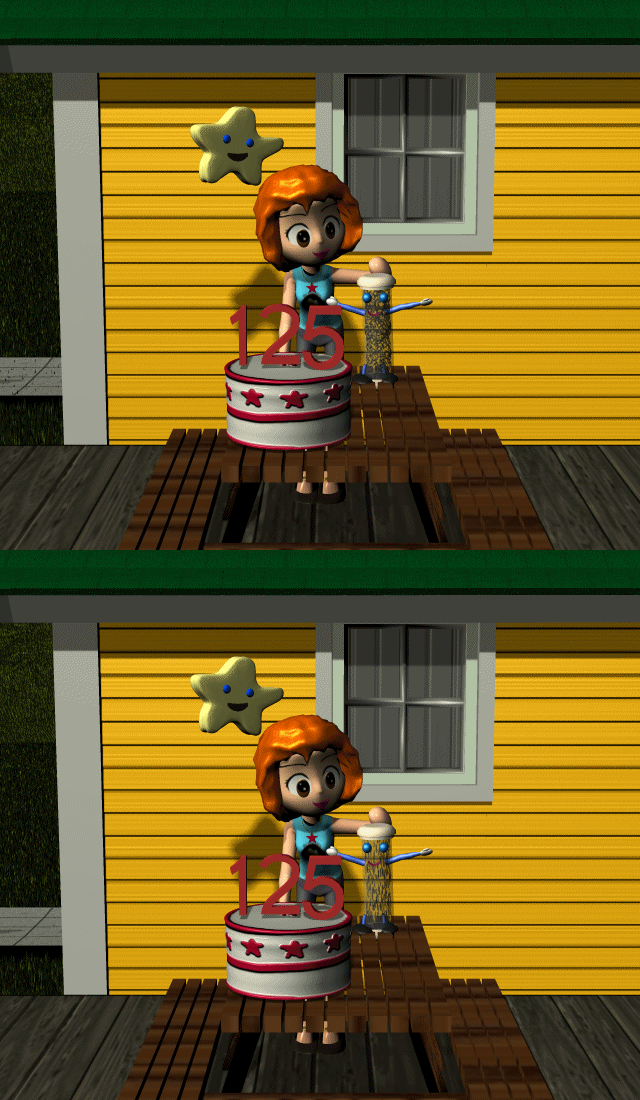 In the '50s, US and Soviet researchers were using coherers as computer memory elements, taking advantage of the natural hold time to create a 'short-term' memory.
Several recent Japanese patents use old-style powder coherers for the original purpose, giving a sensitive relay-like response to small added AC. The patents use coherers in touch-sensitive pens, or to detect nearby lightning.
Convective question: Wouldn't it be nice if our wetware memory had a tapper to break up unwanted coherences? Instant answer: We do have a tapper. Walking. Also, some biofeedbackish therapy techniques use finger tapping for this exact purpose.
= = = = =
Here's the set for Poser at ShareCG.
Followup, a real experiment with a real coherer!
In the '50s, US and Soviet researchers were using coherers as computer memory elements, taking advantage of the natural hold time to create a 'short-term' memory.
Several recent Japanese patents use old-style powder coherers for the original purpose, giving a sensitive relay-like response to small added AC. The patents use coherers in touch-sensitive pens, or to detect nearby lightning.
Convective question: Wouldn't it be nice if our wetware memory had a tapper to break up unwanted coherences? Instant answer: We do have a tapper. Walking. Also, some biofeedbackish therapy techniques use finger tapping for this exact purpose.
= = = = =
Here's the set for Poser at ShareCG.
Followup, a real experiment with a real coherer!
The station included, from right to left, the Morse key (hidden by Polistra); the Lodge Buzzer; an induction coil; a spark gap tuned by Leyden jar capacitors and an inductor; the transmit-receive switch leading out to the antenna; a Lodge Coherer; and finally a printer or tape-writer.
The Lodge Buzzer was an overly complex way of providing AC to the primary of the induction coil. Most systems used a simple hammerbreak. The Buzzer was a three-stage relay, allowing the Morse key to handle low voltage and current. The fast switching of high current for the primary was done by a mercury dip.
Now we see the whole thing ticking and tapping away, while Polistra sends a meaningful message through the antenna.
Early telegraph rigs were extremely clocky, with all sorts of mechanical pendulums and escapements, and electrically switched pendulums.
Before looking at the Lodge Disc Coherer, we'll show the most common coherer.
A glass tube with loose metal powder or filings inside. The tube was placed in series with a battery and the printer or tape-writer. Normally the filings had a high resistance, essentially non-conducting. When an RF signal came through the ether near the coherer, or a high-frequency signal was imposed on the DC, the filings lined up and cohered, closing the circuit and effectively acting like a relay. The filings wanted to remain lined up, so a mechanical tapper was needed to break them apart between dots and dashes. This tapper is run by a buzzer, but it could also be pure mechanical clockwork.
The Lodge Disc was entirely different.
Here's a description of its action:
This is done by causing a small steel disc to revolve continuously in contact with a column of mercury, between which is interposed a thin film of oil. In action the coherer operates as follows: When the impinging waves set up oscillations in the resonator circuit the potential difference due to their cumulative effect disrupts the film of oil and at that instant cohesion takes place between the molecules of the solid and the fluid metals, only to be instantly restored by a partial revolution of the disc.
The thin layer of oil between dissimilar metals was probably acting like a semiconductor, similar to a catwhisker or even a bijunction transistor. "Cumulative" implies that some degree of rectifying was going on.
Marconi tried another variation on the constantly moving surface:
Looks like a tape recorder or wire recorder. The large-diameter coil around the moving wire carried the DC, and the antenna was connected to the small-diameter coil inside it. When RF was present, the magnetic particles in the wire cohered, strengthening the core effect, raising the inductance of the large coil momentarily, and thus providing a pulse of added current in the larger coil. The moving loop gave this section of wire a chance to relax its coherence before it was used again.
Another inventor went full biological, reverting to Galvani.
A frog leg carried a pen in its foot, and the RF was enough to trigger muscular contractions.
= = = = =
An early realization of the need for tuning came close to understanding the principle of rectifiers:
To excite the coherer under the conditions presumed to be necessary for
long distances, the impulses due to these waves must syntonize with the natural period of oscillation of the receiving circuit, and therefore these successive waves must pass by that circuit (wherever it may be), with the second following in the same phase as the first, or nearly so, otherwise the tendency of the second one will be to weaken or annul the effect of the first one.
Again emphasizing the cumulative effect. Almost got the point of rectifying, but not quite. Fleming finally realized that it was necessary to eliminate or invert the negative side of the sine wave. A symmetrical wave adds and subtracts equally, so the sum is zero. Removing one side made it possible to accumulate the RF power, which could then be filtered to sort out the modulation. But the realization was hard to grasp while the sparks and coherers were working together nicely.
= = = = =
Earlier I mentioned an attempt to see coherer-like activity in the brain. The experiments were interesting, and I noted that the connection was actually better than the 1906 researcher could see.
There's a separate coherer-like response in nearly all neurons, which didn't occur to me at that point. A spark-gap signal received by a coherer, complete with the buzzing and tapping and ticking at both ends, was a pulse train of varying length. A longer series of pulses for a dash, shorter series for a dot. This is how MOST neurons communicate and accumulate their signals. Pulse trains of varying lengths.
= = = = =
Happy ending:
Surprisingly, coherers are enjoying a second life in the new digital world.
In the '50s, US and Soviet researchers were using coherers as computer memory elements, taking advantage of the natural hold time to create a 'short-term' memory.
Several recent Japanese patents use old-style powder coherers for the original purpose, giving a sensitive relay-like response to small added AC. The patents use coherers in touch-sensitive pens, or to detect nearby lightning.
Convective question: Wouldn't it be nice if our wetware memory had a tapper to break up unwanted coherences? Instant answer: We do have a tapper. Walking. Also, some biofeedbackish therapy techniques use finger tapping for this exact purpose.
= = = = =
Here's the set for Poser at ShareCG.
Followup, a real experiment with a real coherer!
Labels: Equipoise, Happy Ending, Lodge, Morsenet of Things, Trinity House
¶ 2:55 PM
Sunday, July 26, 2020
It's a clock! It's a printer! It's SUPERBAIN!
In this case I'm venturing up from the Ungreats into the Semigreats. Alexander Bain isn't a household word like Morse, but Bain successfully competed with Morse for a while.
The earliest failed attempts at telegraphy used chemical processes. Most used electrolysis, with 26 separate wires running across the land. Each wire was switched by its own key. All 26 were immersed in water at the receiving end. When each wire was charged, the receiving end formed bubbles under the appropriate letter.
Bain continued using chemistry in a more sophisticated way. His best attempt, which was popular for a while, was a 'ticker tape' that received and recorded the impulses from Morse senders. The current passed from a pointer through a chemically treated paper tape to a grounded backplane, creating visible blue dots and dashes where the dye was activated. This wouldn't have been fun for me to animate, since it was just a box with a paper strip coming out.
Bain's first invention was more fun by my standards. It mixed chemistry with another early theme in telegraphy.
Morse's original project was more like a linotype than a telegraph. The message to be sent was set up in type on a stick, then the sender would read the dots and dashes from specially formed patterns on the side of the letters. At the receiving end the codes would trigger a dispenser for letters, dropping the letters into a stick for printing. This idea never worked properly, and Morse finally realized that it was easier to use lots of human skill operating a simple key and sounder. The actual Linotype developed much later, completely separate from telegraphy and electricity. Even though it used Morse's methods it wasn't a direct evolution.
Here Bain was trying to read a fully set page of type or any other raised pattern as pixels. An engraving or etching, such as a copper stereotype plate, would serve especially well.
Bain called it IMPROVEMENT IN COPYING SURFACES BY ELECTRICITY in his 1848 patent.
I'm calling it the TeleTact. Here I've placed it in my printery scene for obvious reasons. Polistra is loading the TeleTact with a stereotype plate.
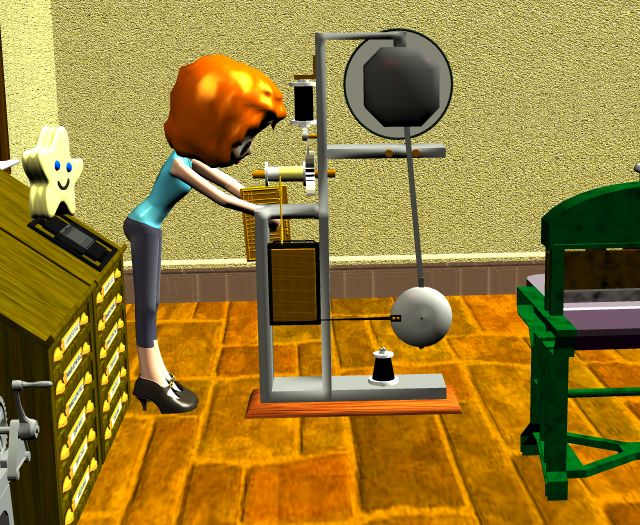 Let 'er rip!
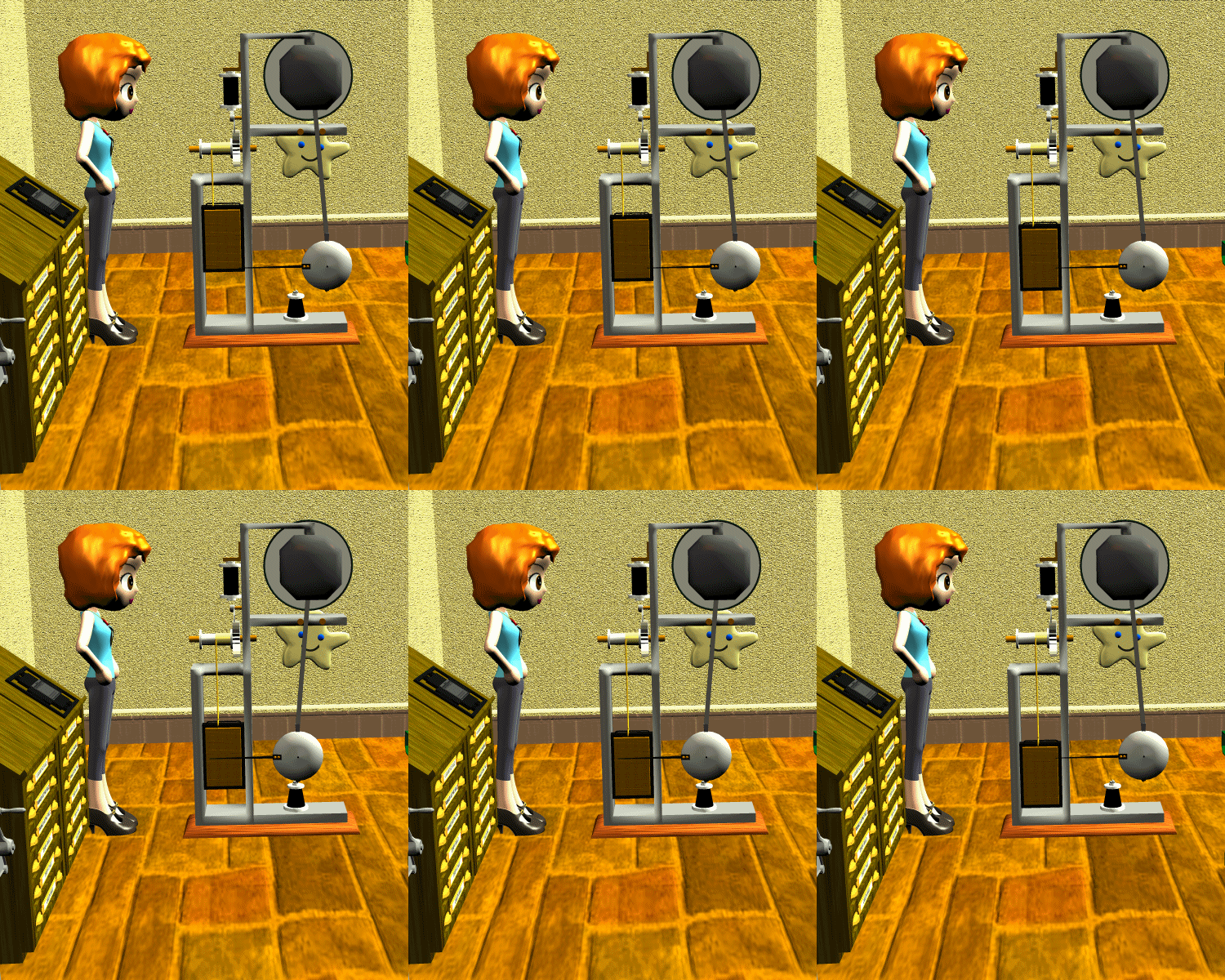 A clock movement (hands on other side) powers the heavy pendulum. The pointer is forced to stay parallel, and it scans across the mysterious box line by line. When the pendulum makes contact with the 'ticker' points (just above Happystar's eyes) it energizes an electromagnet that escapes the rope pulley, allowing the mysterious box to drop one line.
What's happening inside the mysterious box?
A clock movement (hands on other side) powers the heavy pendulum. The pointer is forced to stay parallel, and it scans across the mysterious box line by line. When the pendulum makes contact with the 'ticker' points (just above Happystar's eyes) it energizes an electromagnet that escapes the rope pulley, allowing the mysterious box to drop one line.
What's happening inside the mysterious box?
 A closeup view for orientation, with the pointer at the left end of the top line. The mysterious box contains a dense grid of wires running through an insulating mass like ceramic or hard wax. The top of the wires is just above the insulating surface, and the pointer gently brushes each wire as it scans. I'm showing three columns of (overly fat) wires for simplicity.
 Here's a partly transparent side view, with a slug of type touching the wires.
 The wires that are touching the protruding parts of the type or engraving are grounded. (Shown in gold here.) When the pointer hits those wires, it conducts a current through a relay, sending a pulse through the telegraph wires to the receiver.
Bain's system had one truly unique and elegant feature which hasn't been repeated in any sort of TV or scanner or printer since then. The sender and receiver were exactly the same machine. How did this work?
The wires that are touching the protruding parts of the type or engraving are grounded. (Shown in gold here.) When the pointer hits those wires, it conducts a current through a relay, sending a pulse through the telegraph wires to the receiver.
Bain's system had one truly unique and elegant feature which hasn't been repeated in any sort of TV or scanner or printer since then. The sender and receiver were exactly the same machine. How did this work?
 On the receiving end, the pointer was sending current toward ground at the moments in the scan when the sending pointer had encountered a 'high point' in the engraving. In the receiver, a chemically treated paper was inserted between the wire grid and ground. The wires that received current from the pointer would cause a reaction in the dye, darkening the paper at those points.
So the sender became a receiver by inserting paper instead of an engraving. No other changes needed. ELEGANT.
The magnet on the bottom leg was used for a separate purpose, which Bain intended to be included in the scanning process. It wouldn't have worked that way. The bottom magnet was a solenoid with a little latch bolt inside.
On the receiving end, the pointer was sending current toward ground at the moments in the scan when the sending pointer had encountered a 'high point' in the engraving. In the receiver, a chemically treated paper was inserted between the wire grid and ground. The wires that received current from the pointer would cause a reaction in the dye, darkening the paper at those points.
So the sender became a receiver by inserting paper instead of an engraving. No other changes needed. ELEGANT.
The magnet on the bottom leg was used for a separate purpose, which Bain intended to be included in the scanning process. It wouldn't have worked that way. The bottom magnet was a solenoid with a little latch bolt inside.
 When energized it would pop out the latch bolt and hold back the pendulum for one tick. Bain seemed to intend this as a synchronizer during the scan. This would have been messy, with some ticks used for inking and some for syncing. Heavy pendulums keep time pretty well, so it would have sufficed to run a sync session between scan sessions. Then the signals wouldn't have been confused.
Let 'er rip!
A clock movement (hands on other side) powers the heavy pendulum. The pointer is forced to stay parallel, and it scans across the mysterious box line by line. When the pendulum makes contact with the 'ticker' points (just above Happystar's eyes) it energizes an electromagnet that escapes the rope pulley, allowing the mysterious box to drop one line.
What's happening inside the mysterious box?
A closeup view for orientation, with the pointer at the left end of the top line. The mysterious box contains a dense grid of wires running through an insulating mass like ceramic or hard wax. The top of the wires is just above the insulating surface, and the pointer gently brushes each wire as it scans. I'm showing three columns of (overly fat) wires for simplicity.
Here's a partly transparent side view, with a slug of type touching the wires.
The wires that are touching the protruding parts of the type or engraving are grounded. (Shown in gold here.) When the pointer hits those wires, it conducts a current through a relay, sending a pulse through the telegraph wires to the receiver.
Bain's system had one truly unique and elegant feature which hasn't been repeated in any sort of TV or scanner or printer since then. The sender and receiver were exactly the same machine. How did this work?
On the receiving end, the pointer was sending current toward ground at the moments in the scan when the sending pointer had encountered a 'high point' in the engraving. In the receiver, a chemically treated paper was inserted between the wire grid and ground. The wires that received current from the pointer would cause a reaction in the dye, darkening the paper at those points.
So the sender became a receiver by inserting paper instead of an engraving. No other changes needed. ELEGANT.
The magnet on the bottom leg was used for a separate purpose, which Bain intended to be included in the scanning process. It wouldn't have worked that way. The bottom magnet was a solenoid with a little latch bolt inside.
When energized it would pop out the latch bolt and hold back the pendulum for one tick. Bain seemed to intend this as a synchronizer during the scan. This would have been messy, with some ticks used for inking and some for syncing. Heavy pendulums keep time pretty well, so it would have sufficed to run a sync session between scan sessions. Then the signals wouldn't have been confused.
Labels: defensible spaces, defensible times, Equipoise, Happy Ending, Morsenet of Things, Patient things
¶ 7:54 AM
Sunday, March 15, 2020
The astonishing Hammond
The Sholes & Glidden typewriter, perfected by Remington, was first produced in 1873, and was starting to spread in 1880. Other inventors and manufacturers were trying all sorts of variations.
Let's remember the technological context of 1880. Printing was old and universal. Telegraphs and railroads were mature and common. Indoor plumbing was common in cities and nonexistent elsewhere. Telephones had just been invented and were mostly unknown. Electric power was barely experimental and wouldn't be common until 1900. Most lighting in cities was by oil or gas.
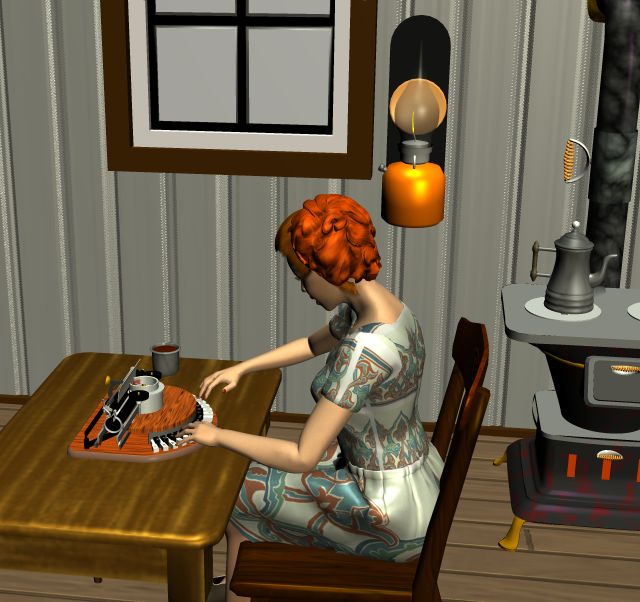 The Hammond was first patented in 1880. The single-wheel version I'm showing here was the second version in 1883. It was superior in EVERY way to the Remington, but as usual the Remington succeeded by commercial dominance, not by technical mastery.
How was the Hammond superior? Let me count the ways.
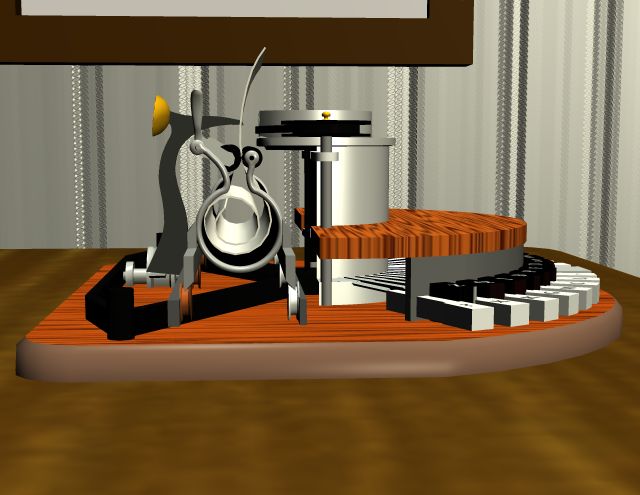
1. Long before electricity, the Hammond was power-assisted. Your fingers didn't have to power the hammers. The hammer came from behind with uniform speed and force, and pressed the paper up against the stable type. Where did the power come from? Clockwork springs driving a cam. Did you have to wind up the clockwork? No, because you rewound the spring every time you returned the carriage. Other typewriters were already using a mainspring on the carriage, to drive the stepwise spacing of the carriage itself. Hammond used the same spring to power the striking force, sparing your fingers. [Note for clarity: The curly thing below is not the mainspring. The paper came from a roll inside the cylinder, a common technique in early typewriters. Later versions used separate pieces of paper inserted separately.]
The Hammond was first patented in 1880. The single-wheel version I'm showing here was the second version in 1883. It was superior in EVERY way to the Remington, but as usual the Remington succeeded by commercial dominance, not by technical mastery.
How was the Hammond superior? Let me count the ways.
1. Long before electricity, the Hammond was power-assisted. Your fingers didn't have to power the hammers. The hammer came from behind with uniform speed and force, and pressed the paper up against the stable type. Where did the power come from? Clockwork springs driving a cam. Did you have to wind up the clockwork? No, because you rewound the spring every time you returned the carriage. Other typewriters were already using a mainspring on the carriage, to drive the stepwise spacing of the carriage itself. Hammond used the same spring to power the striking force, sparing your fingers. [Note for clarity: The curly thing below is not the mainspring. The paper came from a roll inside the cylinder, a common technique in early typewriters. Later versions used separate pieces of paper inserted separately.]
 2. Because the point of impression was flat, the typeface could vary in size. Other typewriters had a cylindrical platen, which limited the size.
3. You could change the font any time you needed. The typewheel was a single small arc, easily removed and replaced. With the Remington style you needed a whole new typewriter for each size or font.
4. The typewheel had three vertical levels instead of two, and the keyboard had a Figs shift and a Caps shift. This made it possible to carry more symbols on only 30 keys, compared to the usual 44 on basic Remingtons.
2. Because the point of impression was flat, the typeface could vary in size. Other typewriters had a cylindrical platen, which limited the size.
3. You could change the font any time you needed. The typewheel was a single small arc, easily removed and replaced. With the Remington style you needed a whole new typewriter for each size or font.
4. The typewheel had three vertical levels instead of two, and the keyboard had a Figs shift and a Caps shift. This made it possible to carry more symbols on only 30 keys, compared to the usual 44 on basic Remingtons.
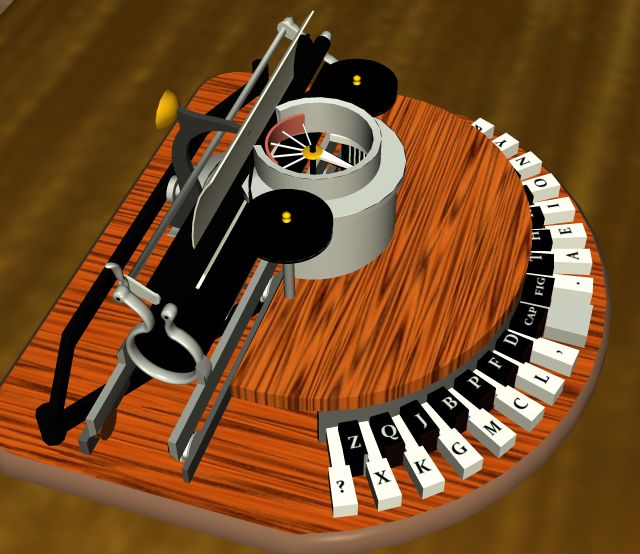 5. The keyboard was arranged appropriately for letter frequency, not QWERTY. Sholes and Glidden used QWERTY to avoid key collisions, but key collisions remained common on Remington-style machines. Key collisions were physically impossible on the Hammond, so there was no reason to sort the keys peculiarly. Your right fingers had the vowels and more common consonants, and your left fingers had the rest.
 6. The keyboard was also less stressful for wrist and arm alignment. This advantage isn't obvious because we're unaccustomed to the arc-like keys. Look at the typist's wrists and arms to see the answer.
= = = = =
Here's a slow animation of the action with part of the covers removed.
6. The keyboard was also less stressful for wrist and arm alignment. This advantage isn't obvious because we're unaccustomed to the arc-like keys. Look at the typist's wrists and arms to see the answer.
= = = = =
Here's a slow animation of the action with part of the covers removed.
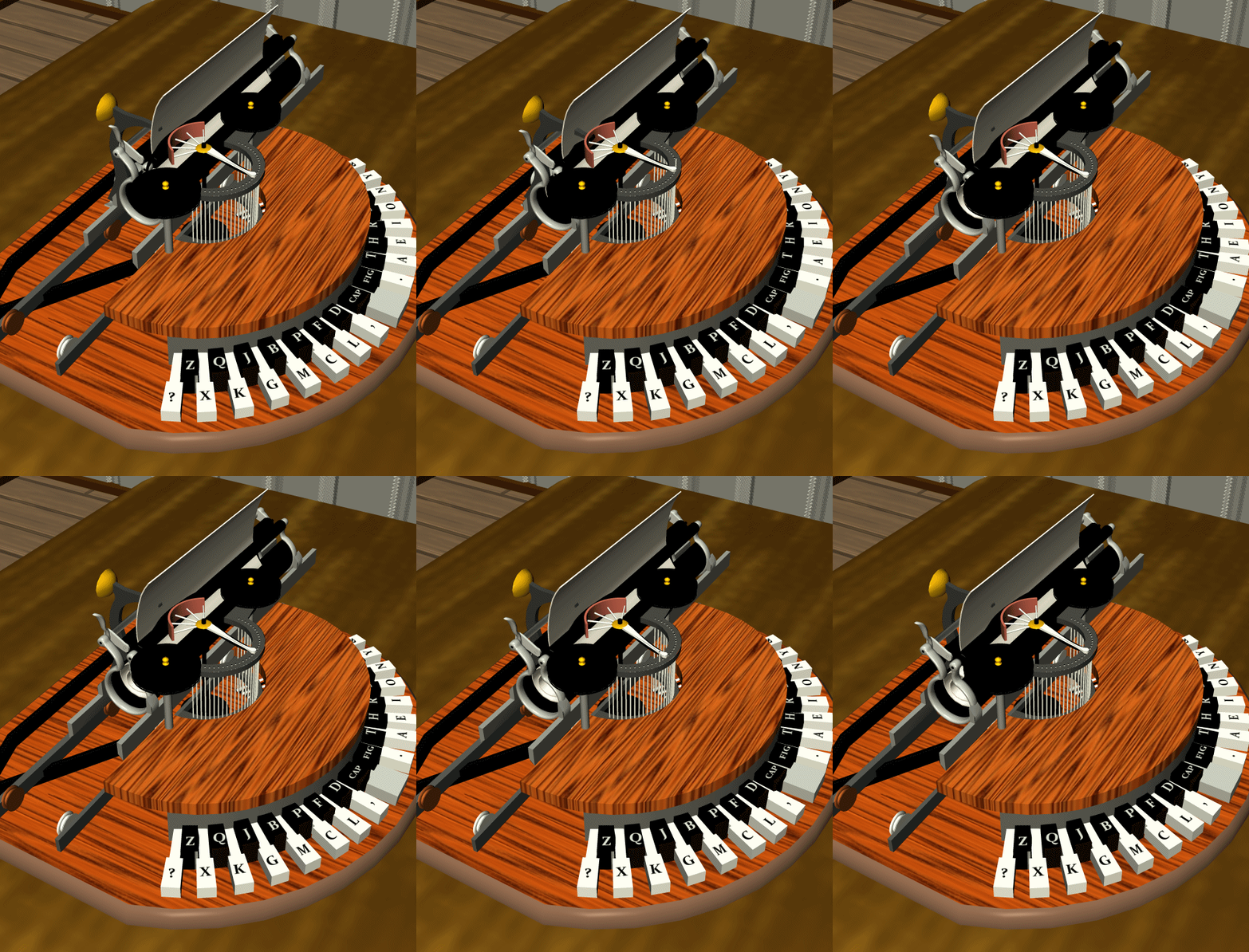 When you hit a key on the left range, the typewheel is released to turn clockwise until it hits the pin raised by the key. At that moment the hammer, also released by the key, comes forward to press the paper against the ribbon and the typewheel, hitting the chosen character squarely. When you hit a key on the right range, the typewheel is released CCW until it hits the raised pin, and the hammer does its job. [I've shown the hammer punching through the paper; not for any good educational reason; only because animating the paper would be way too hard.]
HAPPY ENDING: Like the mammals waiting for the dinosaurs to bash themselves into extinction, the Hammond found a niche and a refuge. It was renamed and repurposed as the VariTyper, and remained indispensable for offset printers and similar businesses. The VariTyper was later electrified, and the company switched over to digital until finally failing around 2007.
= = = = =
Fussy typographical footnote: The symbol on the right index key is unreadable on all the pictures I can find, from the original patent drawings to pix of antiques for sale. On the patent it looks something like a symbol I vaguely recall from typesetting:
When you hit a key on the left range, the typewheel is released to turn clockwise until it hits the pin raised by the key. At that moment the hammer, also released by the key, comes forward to press the paper against the ribbon and the typewheel, hitting the chosen character squarely. When you hit a key on the right range, the typewheel is released CCW until it hits the raised pin, and the hammer does its job. [I've shown the hammer punching through the paper; not for any good educational reason; only because animating the paper would be way too hard.]
HAPPY ENDING: Like the mammals waiting for the dinosaurs to bash themselves into extinction, the Hammond found a niche and a refuge. It was renamed and repurposed as the VariTyper, and remained indispensable for offset printers and similar businesses. The VariTyper was later electrified, and the company switched over to digital until finally failing around 2007.
= = = = =
Fussy typographical footnote: The symbol on the right index key is unreadable on all the pictures I can find, from the original patent drawings to pix of antiques for sale. On the patent it looks something like a symbol I vaguely recall from typesetting:
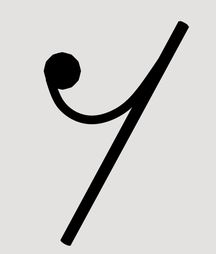 ... (rendered in 3d for precision) ... but Google is no help in trying to locate the symbol. Since there isn't a period elsewhere on the keyboard, I put a period there for symmetry with the comma on left index. The original may have been a period with some extra indication over it for clarity? Oh. Now that I've "drawn" the symbol, I recognize it immediately. It's an eighth rest in musical notation, which certainly wouldn't be in a prominent position on a typewriter! So the original is still mysterious, but a period is most likely by symmetry. Everything on the Hammond is organically symmetrical and differential.
Unsurprising: When the symbol was floating around in what remains of my brain, I couldn't place it. After running it through some muscles and senses, I could place it. Experiential education as always.
... (rendered in 3d for precision) ... but Google is no help in trying to locate the symbol. Since there isn't a period elsewhere on the keyboard, I put a period there for symmetry with the comma on left index. The original may have been a period with some extra indication over it for clarity? Oh. Now that I've "drawn" the symbol, I recognize it immediately. It's an eighth rest in musical notation, which certainly wouldn't be in a prominent position on a typewriter! So the original is still mysterious, but a period is most likely by symmetry. Everything on the Hammond is organically symmetrical and differential.
Unsurprising: When the symbol was floating around in what remains of my brain, I couldn't place it. After running it through some muscles and senses, I could place it. Experiential education as always.
The Hammond was first patented in 1880. The single-wheel version I'm showing here was the second version in 1883. It was superior in EVERY way to the Remington, but as usual the Remington succeeded by commercial dominance, not by technical mastery.
How was the Hammond superior? Let me count the ways.
1. Long before electricity, the Hammond was power-assisted. Your fingers didn't have to power the hammers. The hammer came from behind with uniform speed and force, and pressed the paper up against the stable type. Where did the power come from? Clockwork springs driving a cam. Did you have to wind up the clockwork? No, because you rewound the spring every time you returned the carriage. Other typewriters were already using a mainspring on the carriage, to drive the stepwise spacing of the carriage itself. Hammond used the same spring to power the striking force, sparing your fingers. [Note for clarity: The curly thing below is not the mainspring. The paper came from a roll inside the cylinder, a common technique in early typewriters. Later versions used separate pieces of paper inserted separately.]
2. Because the point of impression was flat, the typeface could vary in size. Other typewriters had a cylindrical platen, which limited the size.
3. You could change the font any time you needed. The typewheel was a single small arc, easily removed and replaced. With the Remington style you needed a whole new typewriter for each size or font.
4. The typewheel had three vertical levels instead of two, and the keyboard had a Figs shift and a Caps shift. This made it possible to carry more symbols on only 30 keys, compared to the usual 44 on basic Remingtons.
5. The keyboard was arranged appropriately for letter frequency, not QWERTY. Sholes and Glidden used QWERTY to avoid key collisions, but key collisions remained common on Remington-style machines. Key collisions were physically impossible on the Hammond, so there was no reason to sort the keys peculiarly. Your right fingers had the vowels and more common consonants, and your left fingers had the rest.
6. The keyboard was also less stressful for wrist and arm alignment. This advantage isn't obvious because we're unaccustomed to the arc-like keys. Look at the typist's wrists and arms to see the answer.
= = = = =
Here's a slow animation of the action with part of the covers removed.
When you hit a key on the left range, the typewheel is released to turn clockwise until it hits the pin raised by the key. At that moment the hammer, also released by the key, comes forward to press the paper against the ribbon and the typewheel, hitting the chosen character squarely. When you hit a key on the right range, the typewheel is released CCW until it hits the raised pin, and the hammer does its job. [I've shown the hammer punching through the paper; not for any good educational reason; only because animating the paper would be way too hard.]
HAPPY ENDING: Like the mammals waiting for the dinosaurs to bash themselves into extinction, the Hammond found a niche and a refuge. It was renamed and repurposed as the VariTyper, and remained indispensable for offset printers and similar businesses. The VariTyper was later electrified, and the company switched over to digital until finally failing around 2007.
= = = = =
Fussy typographical footnote: The symbol on the right index key is unreadable on all the pictures I can find, from the original patent drawings to pix of antiques for sale. On the patent it looks something like a symbol I vaguely recall from typesetting:
... (rendered in 3d for precision) ... but Google is no help in trying to locate the symbol. Since there isn't a period elsewhere on the keyboard, I put a period there for symmetry with the comma on left index. The original may have been a period with some extra indication over it for clarity? Oh. Now that I've "drawn" the symbol, I recognize it immediately. It's an eighth rest in musical notation, which certainly wouldn't be in a prominent position on a typewriter! So the original is still mysterious, but a period is most likely by symmetry. Everything on the Hammond is organically symmetrical and differential.
Unsurprising: When the symbol was floating around in what remains of my brain, I couldn't place it. After running it through some muscles and senses, I could place it. Experiential education as always.Labels: Happy Ending, Morsenet of Things, Patient things
¶ 2:42 PM
Wednesday, September 04, 2019
A message across the ages
The first organized (pre-electric) telegraph network was the 1793 Chappe system.
Short synopsis: The inventor, Claude Chappe, was a tragic figure, the classic introvert who let perfectionism kill him. Like most successful inventors, he had business-minded brothers who could carry the business side of the project.
Claude's first attempt was a clock-style telegraph. Each station had a synchronized continually rotating letter dial. The upper panel was white on one side and black on the other, and pivoted vertically. The sending station would give the panel a quick turn, switching the color, when the desired letter was on the clock; the receiver would see the flash and record the corresponding letter from his own clock.
 Revolutionary mobs disapproved of this invention and burned it.
 The family managed to get the attention of the ideologues, who saw the value of a nationwide system to carry military commands and propaganda. Claude's second invention was built quickly, with Chappe mechanisms mounted on every tall building and every available hill. After the revolution was replaced by the usual neocons, Napoleon expanded the network even more for military purposes.
From a beautifully written account at Parisian Fields blog:
The family managed to get the attention of the ideologues, who saw the value of a nationwide system to carry military commands and propaganda. Claude's second invention was built quickly, with Chappe mechanisms mounted on every tall building and every available hill. After the revolution was replaced by the usual neocons, Napoleon expanded the network even more for military purposes.
From a beautifully written account at Parisian Fields blog:
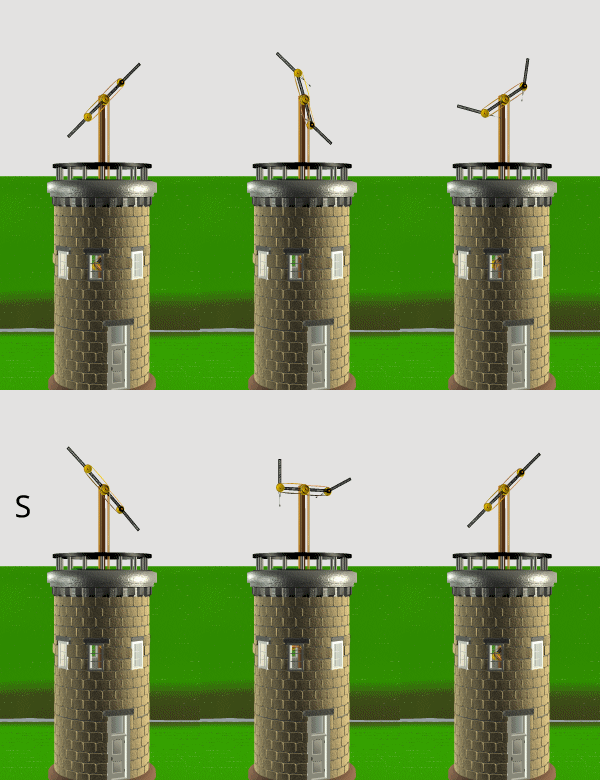 A closeup look at the controls. Existing pictures are vague, so I designed a setup that would work if implemented. The pictures show ropes between the pulleys, but chains would have been better.
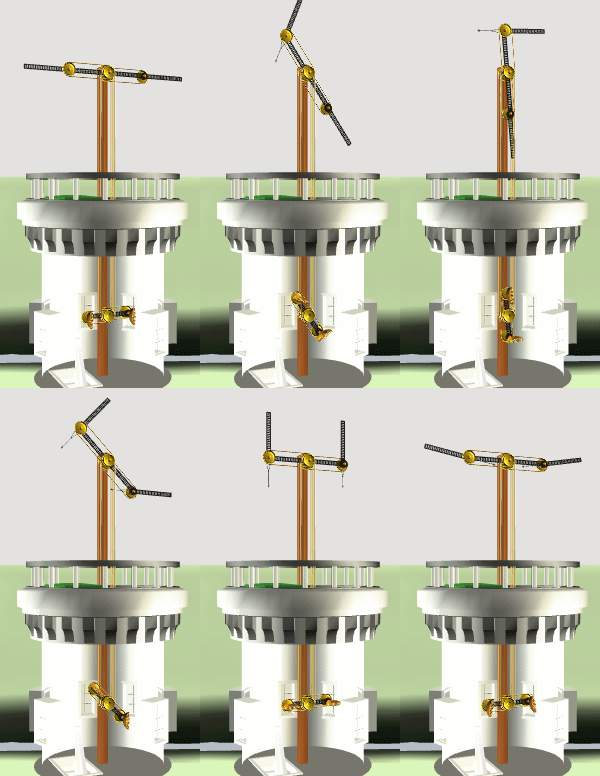 This system required considerable skill and brute strength. The stationnaires were expected to work 12/7/365 for 38 francs a month, roughly $150 now. They had to watch up and down the line for messages from other telegraphs, and then twist their wrists and bodies to resend the message. No wonder they were easy to bribe.
By contrast, the early dial telegraphs required no skill and no strength, and Morse requires considerable skill and no strength.
= = = = =
Here's a somewhat speculative model of the original clock-style. Happystar demonstrates the operation of the pivoted planche, which would be visible for about a mile in ideal conditions. This device would be especially suitable for night use. A single fixed torch could illuminate the planche; if the bright side was reflective metal, the signal could be visible for many miles.
This system required considerable skill and brute strength. The stationnaires were expected to work 12/7/365 for 38 francs a month, roughly $150 now. They had to watch up and down the line for messages from other telegraphs, and then twist their wrists and bodies to resend the message. No wonder they were easy to bribe.
By contrast, the early dial telegraphs required no skill and no strength, and Morse requires considerable skill and no strength.
= = = = =
Here's a somewhat speculative model of the original clock-style. Happystar demonstrates the operation of the pivoted planche, which would be visible for about a mile in ideal conditions. This device would be especially suitable for night use. A single fixed torch could illuminate the planche; if the bright side was reflective metal, the signal could be visible for many miles.
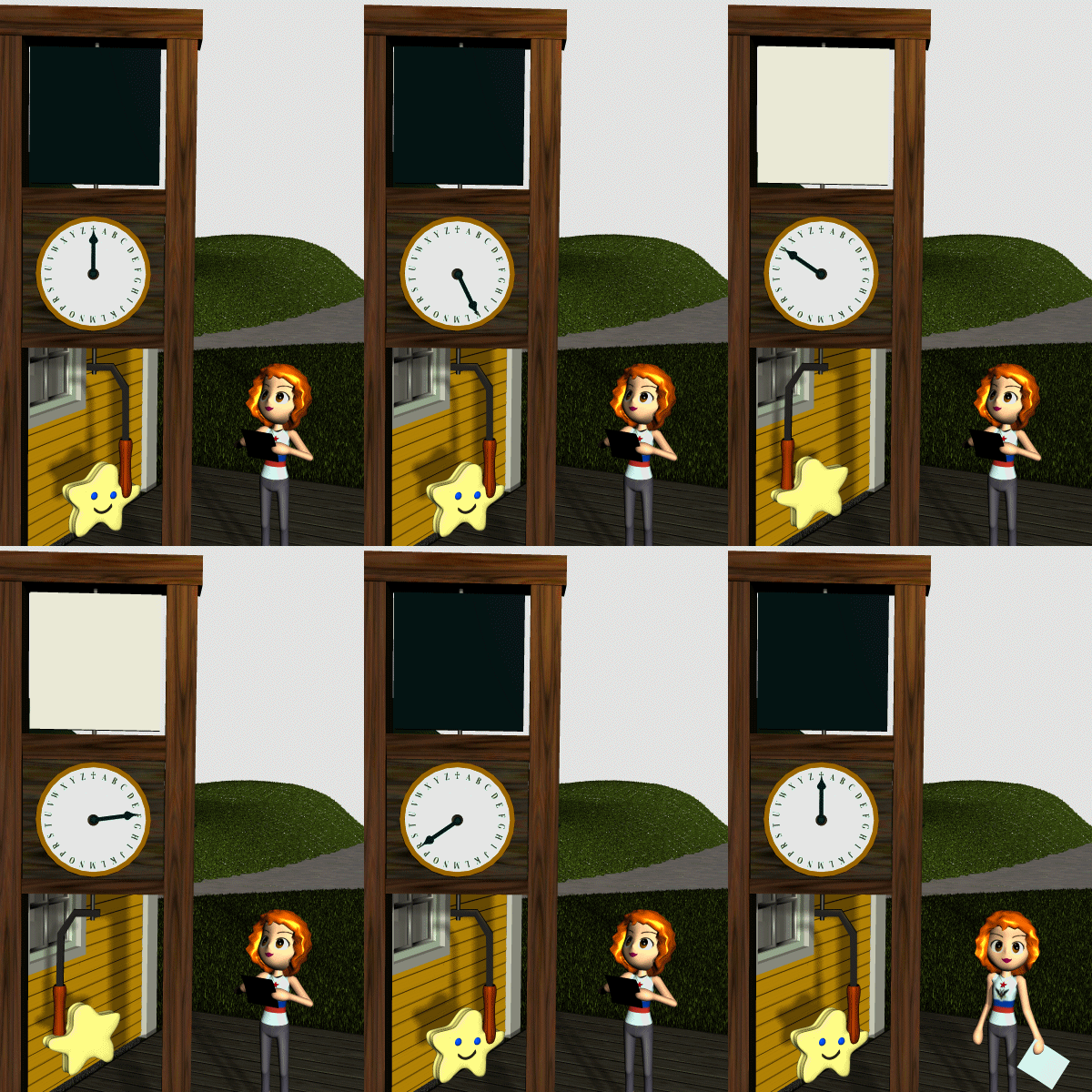 The clock-style would require two people to operate properly. Polistra would be reading the text and watching the clock. When the next letter was about to hit, she would give a vocal command to Happystar. No skill, some strength.
= = = = =
The Poser set will be released when I finish the House-Brett printing telegraph, another no skill no strength system that didn't get very far.
Raises an interesting question: Successful systems required either physical strength or mental skill. Telegraphs that anyone could operate didn't succeed.
= = = = =
Stupid footnote: I initially assuméd that the namé had to be Chappé. Like most Americans, I automatically think that Frenchay worday alway enday with é. Laysay lay bon ton roulaaaay! The name just doesn't look right as Chappe, but in fact it is Chappe. One syllable.
= = = = =
Not quite stupid footnote: It's odd that Chappe's code didn't include separate characters for the various diacritics. A business or military message could be ambiguous without them. He used the Latin tradition of i=j, but included k and w as separate letters. Both are odd choices for French, where i and j are fully distinct while k and w are foreign and rare. See the 'lesser Russian alphabet' for another odd set of choices. /// LATER: He did include the diacritics and a few digraphs. I was using an improper account of his code.
The clock-style would require two people to operate properly. Polistra would be reading the text and watching the clock. When the next letter was about to hit, she would give a vocal command to Happystar. No skill, some strength.
= = = = =
The Poser set will be released when I finish the House-Brett printing telegraph, another no skill no strength system that didn't get very far.
Raises an interesting question: Successful systems required either physical strength or mental skill. Telegraphs that anyone could operate didn't succeed.
= = = = =
Stupid footnote: I initially assuméd that the namé had to be Chappé. Like most Americans, I automatically think that Frenchay worday alway enday with é. Laysay lay bon ton roulaaaay! The name just doesn't look right as Chappe, but in fact it is Chappe. One syllable.
= = = = =
Not quite stupid footnote: It's odd that Chappe's code didn't include separate characters for the various diacritics. A business or military message could be ambiguous without them. He used the Latin tradition of i=j, but included k and w as separate letters. Both are odd choices for French, where i and j are fully distinct while k and w are foreign and rare. See the 'lesser Russian alphabet' for another odd set of choices. /// LATER: He did include the diacritics and a few digraphs. I was using an improper account of his code.
Revolutionary mobs disapproved of this invention and burned it.
The family managed to get the attention of the ideologues, who saw the value of a nationwide system to carry military commands and propaganda. Claude's second invention was built quickly, with Chappe mechanisms mounted on every tall building and every available hill. After the revolution was replaced by the usual neocons, Napoleon expanded the network even more for military purposes.
From a beautifully written account at Parisian Fields blog:
But it seemed that the more his idea spread, the more Claude Chappe was beset by rivals, claiming they had had the idea first, or that they had a better idea, or that the clockmaker Bréguet was the real genius behind the invention. In 1805, suffering from depression, he committed suicide by throwing himself into a well at the main Telegraph Administration.Perfectionism leads to the predictable all-or-nothing tragedy. The business-minded brothers continued running the system until 1845, when it was replaced by a direct electrical metaphor in order to retain the SKILLS and continue the employment of the operators. Claude missed the chance to participate in the long success. But maybe it's a good thing that he missed the later development. From Parisian Fields again:
Around that time, twin brothers in Bordeaux, François and Louis Blanc, came up with a plan to bribe telegraph operators between Paris and Bordeaux to introduce “typos” (the French use the delightful word coquilles) into messages sent across the system; the coquilles indicated the direction of the Paris stock market each day. This allowed the brothers to beat the Bordeaux market in government bonds. They were eventually caught, and even tried, but since they had not broken an existing law (laws generally lag behind new technology), they were not punished.More on the Blanc Brothers from an oddly translated Wikipedia article:
They grew up in a small town and were impressed every time circus came with a show - it seemed so interesting and simple so they followed the circus to learn all the tricks of the trade, boys were dreaming to become rich and successful and learnt so much and worked on different jobs. The brothers started to work in gambling business in Marseilles and earning some money brothers decided to develop their business and started to speculate on government pensions and got into real estate development. In that way they attracted attention to their business and were arrested, but not for a long time because law was not adopted yet for such cases. They were released and moved to Paris, but after King Louis Philippe passed new laws they had to move again - to Luxembourgh. They ran profitable business there but it was just the first little step to their success in Hesse-Homburg near Frankfurt, where brothers signed a contract with a monarch because of debts of the city and in order to develop tourism industry. It happened that the Prince of Monaco had recently legalized gambling, so "The Magician of Homburg" became that first person to establish a casino operation in Monaco.Government contracts + casinos = absolute corruption + absolute impunity. Text communication systems always make it easier for Satan's stocksters to steal from honest businesses and governments. True from Chappe to Morse to Compuserve to Twitter. = = = = = I've "built" a model of the Chappe system, using the Chappe code. The model is sending a Carverian message from an introvert who has (more or less) conquered perfectionism to the ghost of Chappe, and to other introverts who tragically allow perfection to delete future joy.
A closeup look at the controls. Existing pictures are vague, so I designed a setup that would work if implemented. The pictures show ropes between the pulleys, but chains would have been better.
This system required considerable skill and brute strength. The stationnaires were expected to work 12/7/365 for 38 francs a month, roughly $150 now. They had to watch up and down the line for messages from other telegraphs, and then twist their wrists and bodies to resend the message. No wonder they were easy to bribe.
By contrast, the early dial telegraphs required no skill and no strength, and Morse requires considerable skill and no strength.
= = = = =
Here's a somewhat speculative model of the original clock-style. Happystar demonstrates the operation of the pivoted planche, which would be visible for about a mile in ideal conditions. This device would be especially suitable for night use. A single fixed torch could illuminate the planche; if the bright side was reflective metal, the signal could be visible for many miles.
The clock-style would require two people to operate properly. Polistra would be reading the text and watching the clock. When the next letter was about to hit, she would give a vocal command to Happystar. No skill, some strength.
= = = = =
The Poser set will be released when I finish the House-Brett printing telegraph, another no skill no strength system that didn't get very far.
Raises an interesting question: Successful systems required either physical strength or mental skill. Telegraphs that anyone could operate didn't succeed.
= = = = =
Stupid footnote: I initially assuméd that the namé had to be Chappé. Like most Americans, I automatically think that Frenchay worday alway enday with é. Laysay lay bon ton roulaaaay! The name just doesn't look right as Chappe, but in fact it is Chappe. One syllable.
= = = = =
Not quite stupid footnote: It's odd that Chappe's code didn't include separate characters for the various diacritics. A business or military message could be ambiguous without them. He used the Latin tradition of i=j, but included k and w as separate letters. Both are odd choices for French, where i and j are fully distinct while k and w are foreign and rare. See the 'lesser Russian alphabet' for another odd set of choices. /// LATER: He did include the diacritics and a few digraphs. I was using an improper account of his code.Labels: #DeplorableLivesMatter, defensible times, Happy Ending, Morsenet of Things
¶ 9:03 AM

