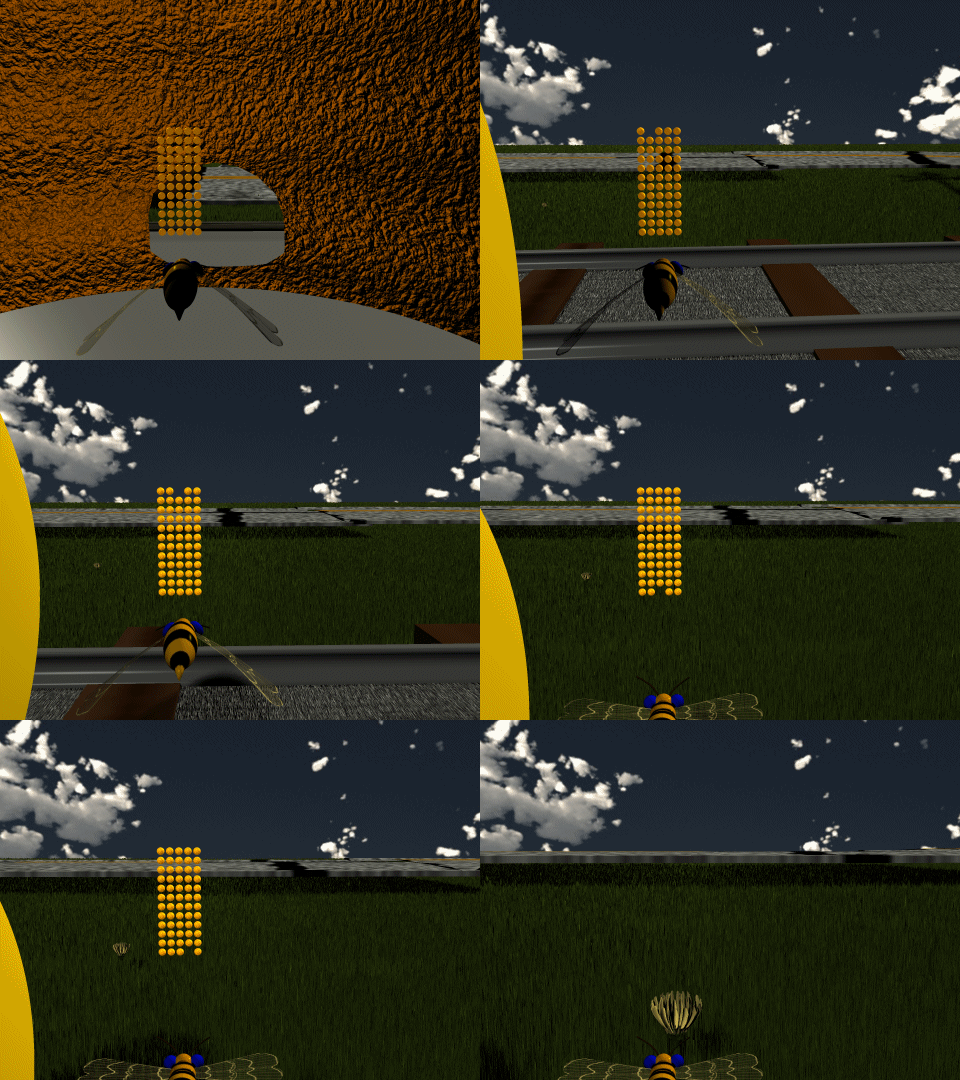
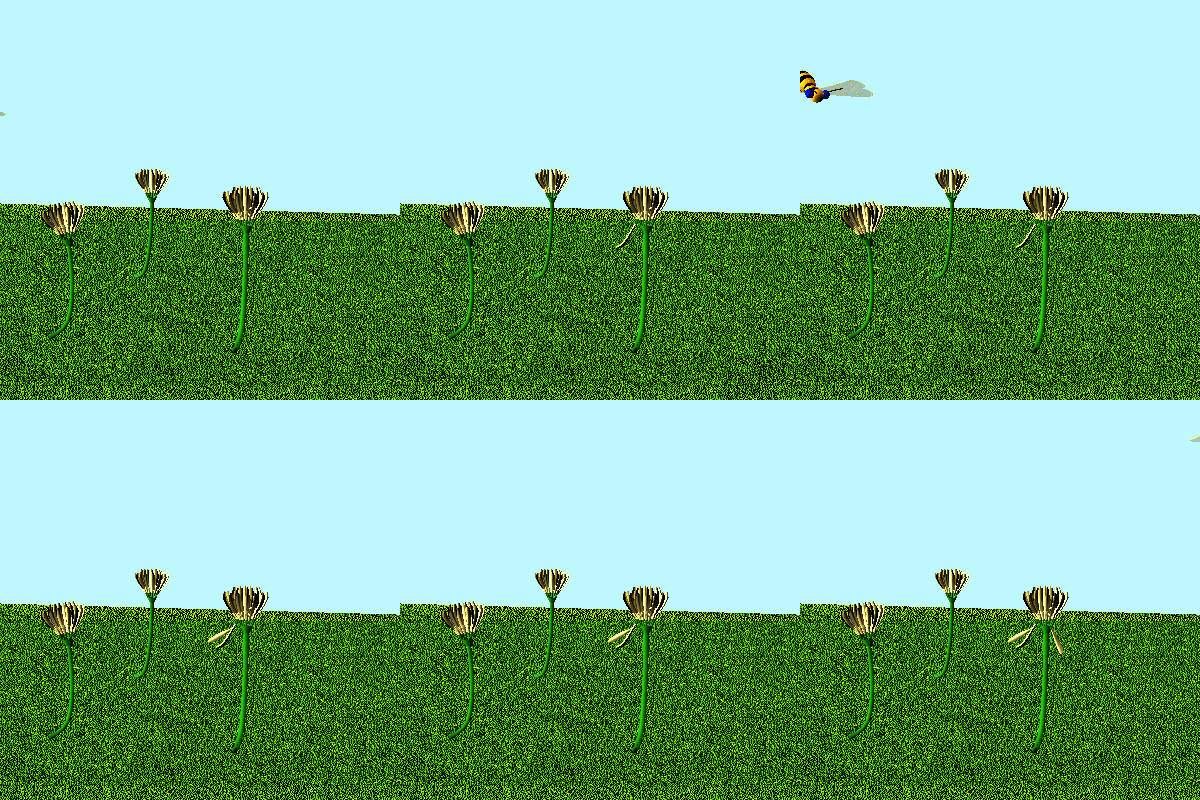
 Looking downward inside the hive we see one scout telling one forager about her find:
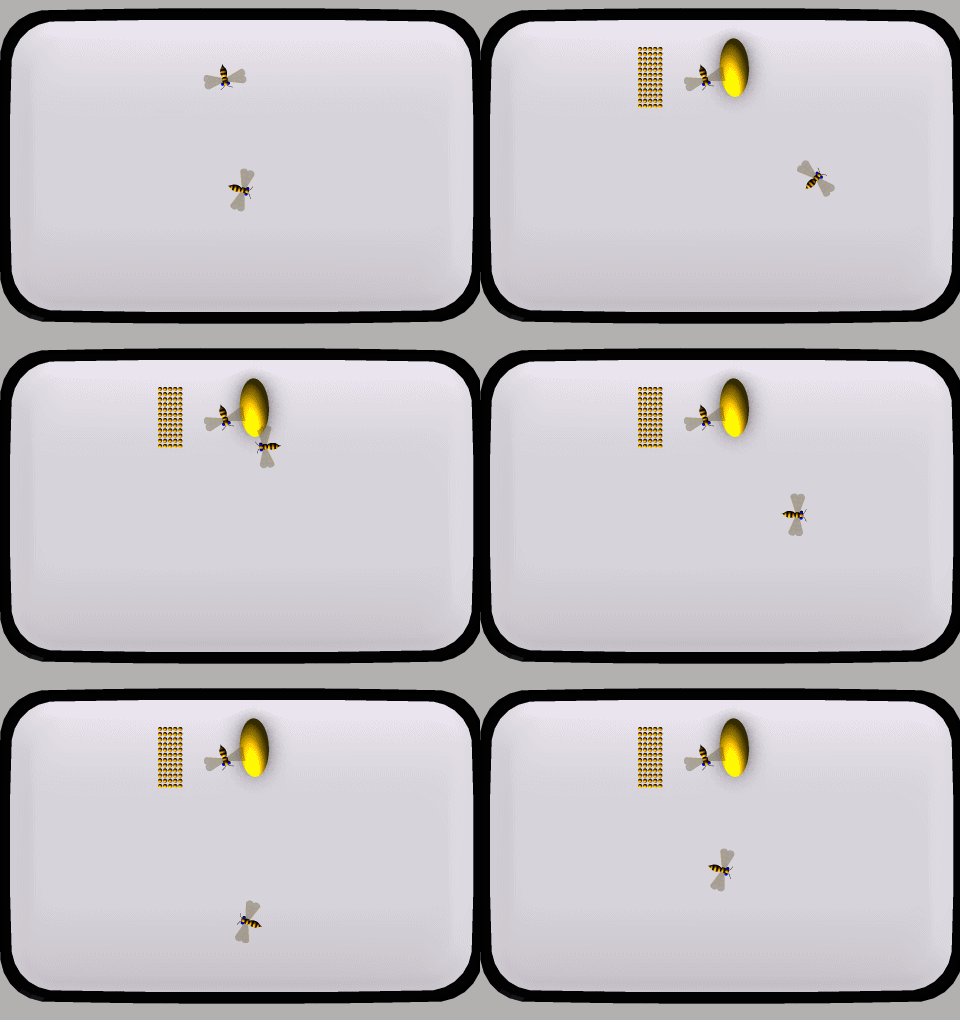 The forager observes the direction of the dance with respect to the hive, and forms a template for where the sun should be when she's flying.
Taking the important part in slow motion:
The forager observes the direction of the dance with respect to the hive, and forms a template for where the sun should be when she's flying.
Taking the important part in slow motion:
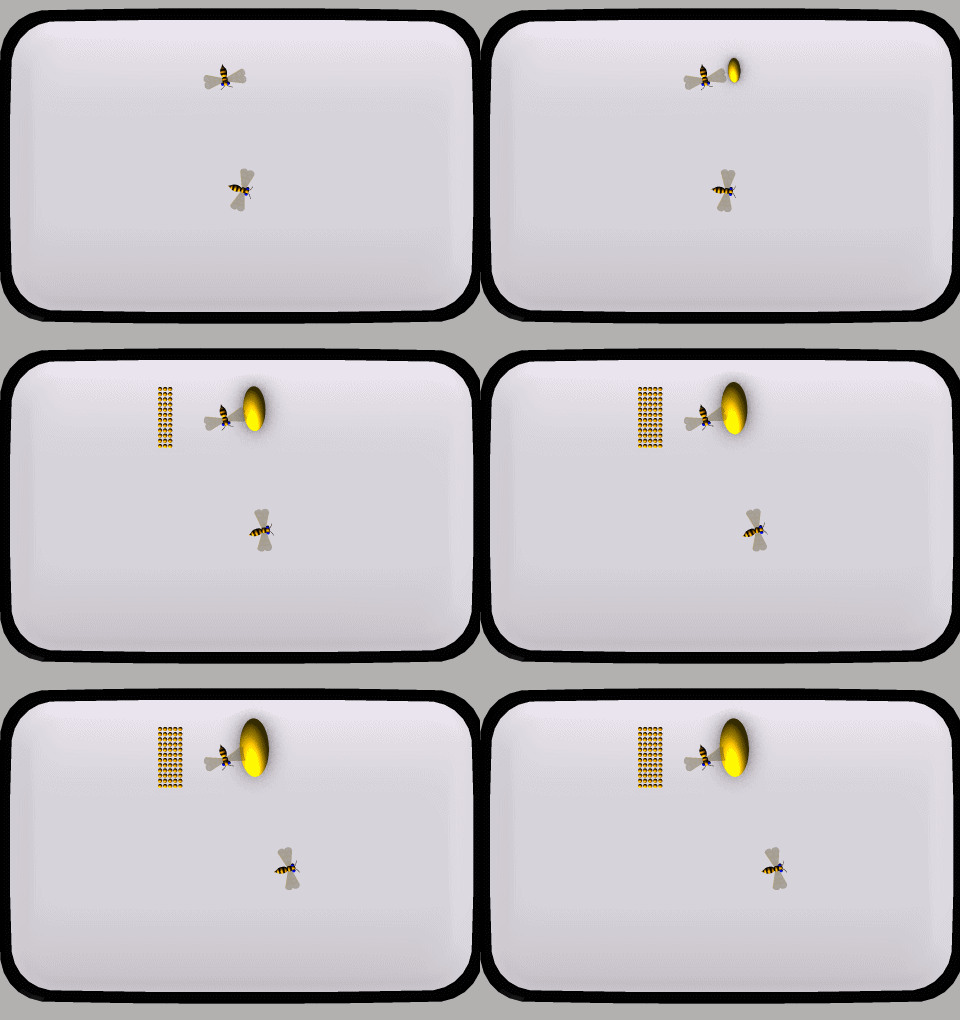 Each waggle ticks up the beads of her astrocyte abacus. For a simple animation we'll assume she's a Babylon Bee who counts in base 60. For each of these five waggles she brings in one 12-bead astrocyte. The total of all the counters tells her how many wingflaps she needs. (Obviously the real multiple of wingflaps per waggle would be far more than 12.)
She then launches out of the hive and turns until the actual sun matches the template position supplied by the dance. As she flies, each wingflap clicks down a bead. When the astrocytes have all reached threshold, she's there.
Each waggle ticks up the beads of her astrocyte abacus. For a simple animation we'll assume she's a Babylon Bee who counts in base 60. For each of these five waggles she brings in one 12-bead astrocyte. The total of all the counters tells her how many wingflaps she needs. (Obviously the real multiple of wingflaps per waggle would be far more than 12.)
She then launches out of the hive and turns until the actual sun matches the template position supplied by the dance. As she flies, each wingflap clicks down a bead. When the astrocytes have all reached threshold, she's there.
 = = = = =
Even better: The clover is also an abacus!
= = = = =
Even better: The clover is also an abacus!
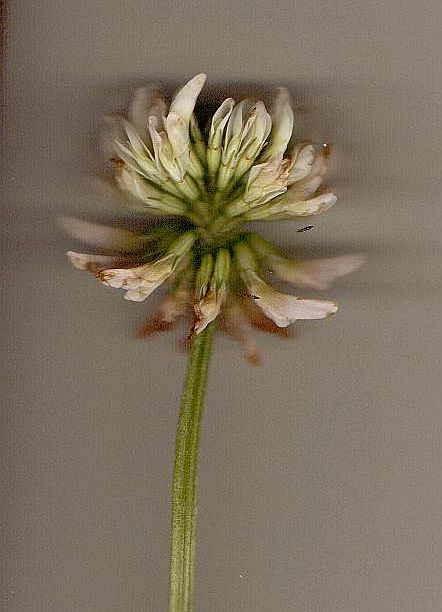 What looks like a blossom is actually a cluster (inflorescence) of a few dozen tiny florets. Each 'spike' is a complete little flower, with a green cup (calyx) containing a white crown (corolla).
Why are some pointing down? Those are the florets that have already been touched by a pollinating insect. The clover detects the touch and removes nutrition from that floret, allowing it to drop down and turn brown.
What looks like a blossom is actually a cluster (inflorescence) of a few dozen tiny florets. Each 'spike' is a complete little flower, with a green cup (calyx) containing a white crown (corolla).
Why are some pointing down? Those are the florets that have already been touched by a pollinating insect. The clover detects the touch and removes nutrition from that floret, allowing it to drop down and turn brown.
Labels: bee, Grand Blueprint, Smarty-plants
¶ 3:41 PM

Magnetic fields had previously been observed in other plants; algae in one study, bean plants in another. The previous magnetometers, called SQUIDs, are large and run at very cool temperatures, and the team needed something more convenient for their use. Different actions on or by a plant can elicit the fields—from being wounded to trying to snap at food within its reach, as was the case with the flytrap. The magnetic field doesn’t correspond with the act itself but the action potential that precipitates the plant’s next move.I've been puzzled by the missing square in the otherwise orthogonal pattern of inputs and outputs. = = = = = START REPRINT: Nature uses magnetic and static fields and ion currents ALMOST universally, but there are some exceptions. Why? Static fields are used for internal communication EVERYWHERE. Inside a cell, between cells, in the nervous system, inside muscles, EVERYWHERE. Static fields are used for external communication more narrowly, but one of the narrow uses is common. Plants communicate with pollinating insects by fields, telling the bugs which flowers are ready for pollination and which are used up. Mud-dwelling fish use static fields for radio communication, in FM Stereo. Static sensors are part of the communication systems in above paragraph, and more broadly used by just about everything to detect nearby objects. (Even dull humans use the hairs on our arms for this purpose!) Static fields are used directly for motion in two ways, one of which is nearly universal. Cells drive their flagella with a synchronous motor, using phased variation of static fields. Spiders alter their charge to move away from walls and toward plants when hanging from a silk fiber. = = = = = Ion currents are also EVERYWHERE for internal communication. The nervous system is all about ion currents. Bacteria use ion currents to communicate via miniature wires, and some plants send currents through fungal wires. Ion currents are sensory as part of the wire systems above. Ion currents are NOT used for motion as such. Currents are a vital part of muscle action, but the current isn't what moves the animal. = = = = = Magnetic fields are used by EVERYONE for sensing 3d position, but NOT used for the other purposes. It's possible that bees use magnetic motion for communication in their waggle dance, but this doesn't seem to be established. = = = = =
| Static field | Ion current | Magnetic field | |
| Internal communication | Yes | Yes | 0 |
| External communication | Yes | Yes | 0 |
| Sensory | Yes | Yes | Yes |
| Motor | Yes | 0 | 0 |
Labels: bee, Natural law = Sharia law, Natural law = Soviet law
¶ 12:35 AM
The decline of New England farming in the 20th century dramatically diminished the open acreage of what we ecologists call early successional habitat, which provided unique plants and cover for wildlife. Successional habitat is land like old pastures, fields and beaver meadows where grasses, small shrubs and trees grow. In New England, for example, they contribute to the persistence and resilience of many species such as spadefoot toads, box turtles, New England cottontails and birds like towhees.When you eliminate farms, forests recapture the land. Without farmers, who maintains open land suitable for bees?
Despite being separated at times by a mere 30 feet, forests and transmission line corridors differ tremendously. In a recent study, we found that the sunny, open corridors held nearly 10 times the number of bees and twice the number of bee species as compared to forested plots, where nectar becomes scarce by the end of May. The diversity of bees found along the corridor was eye-opening. More than 200 species of wild pollinators, half the known species for the entire New England region, were buzzing around the 27 survey plots.Power companies, that's who. In the West where the envirogenocidists have total murderous control, power companies must leave trees growing into their wires. The PRIMARY result of this idiocy is massive wildfires. Now this research shows a SECONDARY result: No bees. Carver: LOOK ABOUT YOU. TAKE HOLD OF THE THINGS THAT ARE HERE. TALK TO THEM. LET THEM TALK TO YOU. = = = = = Sidenote: Bees depend on sensing magnetic and static fields. There's a strong magnetic field around a powerline. Contrary to my guess, this clearly doesn't repel the bees ... maybe it's an advantage, a guide for navigation? And speaking of wildfires and envirogenocidists....
Labels: bee, Carbon Cult, Carver
¶ 12:31 AM
Labels: Asked and sort of answered, bee
¶ 3:32 AM
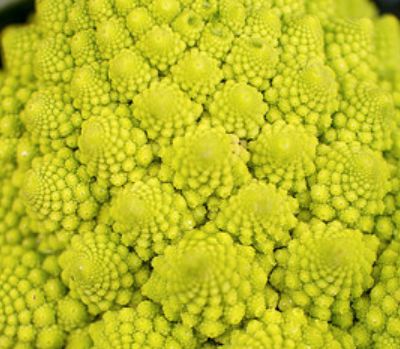
A possible plant organ that could relay the airborne acoustic signal into a response is the flower itself, especially in flowers with “bowl” shape. If this is the case, we expect that part of the flower (or the entire flower) would vibrate physically in response to the airborne sound of a potential pollinator. We further predict that nectar sugar concentration would increase in response to the sound.The researchers used all sorts of tricks to isolate the sensor and check the frequency response. The hypothesis was verified. A sound similar to the wingbeats of a plant's preferred pollinator causes a temporary sweetening of the nectar. The sweetening takes a few minutes to develop, so the first bee might not receive the signal. But the first bee is often a scout, so the sugar trap is fresh just in time for the mass of bees who respond to the scout. The next step in research is to find the mechanism. If the petals are the tympanic membrane, where is the cochlea? More likely the petals ARE the cochlea, directly transducing pressure change. I discussed this parallel in my earlier piece on Chamovitz, but at that time the basic question about airborne sound hadn't been answered. I was thinking in terms of acoustic response by roots and stems. Now that the petals are known to be the sensors, the parallel is blatantly clear. The cochlea is a logarithmic spiral because frequencies are sensed logarithmically.
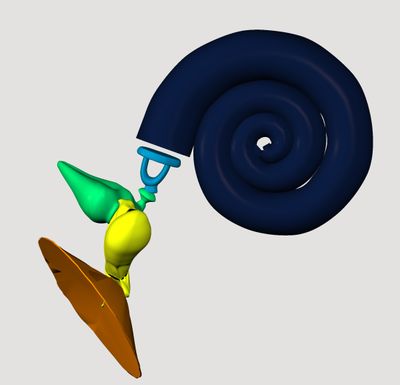 Many flowers are also log spirals.
 How about the opposite parallel? Do animals sweeten their pheromones on hearing the voice of the preferred mating type? A preferred sound certainly creates a whole-body pleasure via the vagus nerve and parasympathetic system. The vagus controls many secretions in the skin and gut, and also picks up olfactory signals from incoming pheromones.
So this is highly likely but not yet determined.
= = = = =
Later astonished thought: The delayed sweetness is truly remarkable. It shows that the plant's intelligence is ANTICIPATING a future event and STRATEGIZING to match the beehive's strategy. Other plant responses are much faster and simpler. The snapdragon bops the bee on the head to knock it down into the pollen, and the clover ticks each floret out of the way after it's been consumed.
How about the opposite parallel? Do animals sweeten their pheromones on hearing the voice of the preferred mating type? A preferred sound certainly creates a whole-body pleasure via the vagus nerve and parasympathetic system. The vagus controls many secretions in the skin and gut, and also picks up olfactory signals from incoming pheromones.
So this is highly likely but not yet determined.
= = = = =
Later astonished thought: The delayed sweetness is truly remarkable. It shows that the plant's intelligence is ANTICIPATING a future event and STRATEGIZING to match the beehive's strategy. Other plant responses are much faster and simpler. The snapdragon bops the bee on the head to knock it down into the pollen, and the clover ticks each floret out of the way after it's been consumed.Labels: bee, Carver, Grand Blueprint, Smarty-plants
¶ 2:25 AM
“Our country is, as they say, destined by the heavens to feed the whole planet. And we’ll try and do that,” Medvedev told journalists... Apart from being the country’s “destiny,” the foods plainly make “nice export goods,” the prime minister added. Russia’s agriculture has expanded greatly over the past few years, becoming a solid and profitable industry, unlike the way it was a couple decades ago.This video shows the new approach in action. The title mentions wheat, but the most significant innovation is year-round tomato production. Russia is breaking Graybill's Law massively. Every new US blockade and sanction lets Russia develop a new skill and a new industry to world-leading levels. Before the Switchover US was feeding the world. Now we're bombing the world and Russia is feeding the world. You couldn't ask for a sharper distinction between good and evil. Our bombing and Russia's feeding are both capitalist ventures aimed at profit. Bombing is profit for Satan, feeding is profit for God. = = = = = Later and more complex thought: Well, the constant part isn't really constant. Both ventures are capitalist, but the payment side is different. The people who eat Russia's food are paying Russia in plain old capitalist style. Product out, money in. The people who are dying from our bombs can't pay for the privilege of being dead, and we don't even bill their governments for the privilege of having a dead population and a ruined country. Instead, American taxpayers are forced to pay the Pentagon and defense contractors for our bombing. So we're more like a non-profit demonic charity financed by paycheck deductions. United Way for genocide.
Labels: bee, Constants and Variables, skill-estate, switchover, things worth doing
¶ 11:34 PM
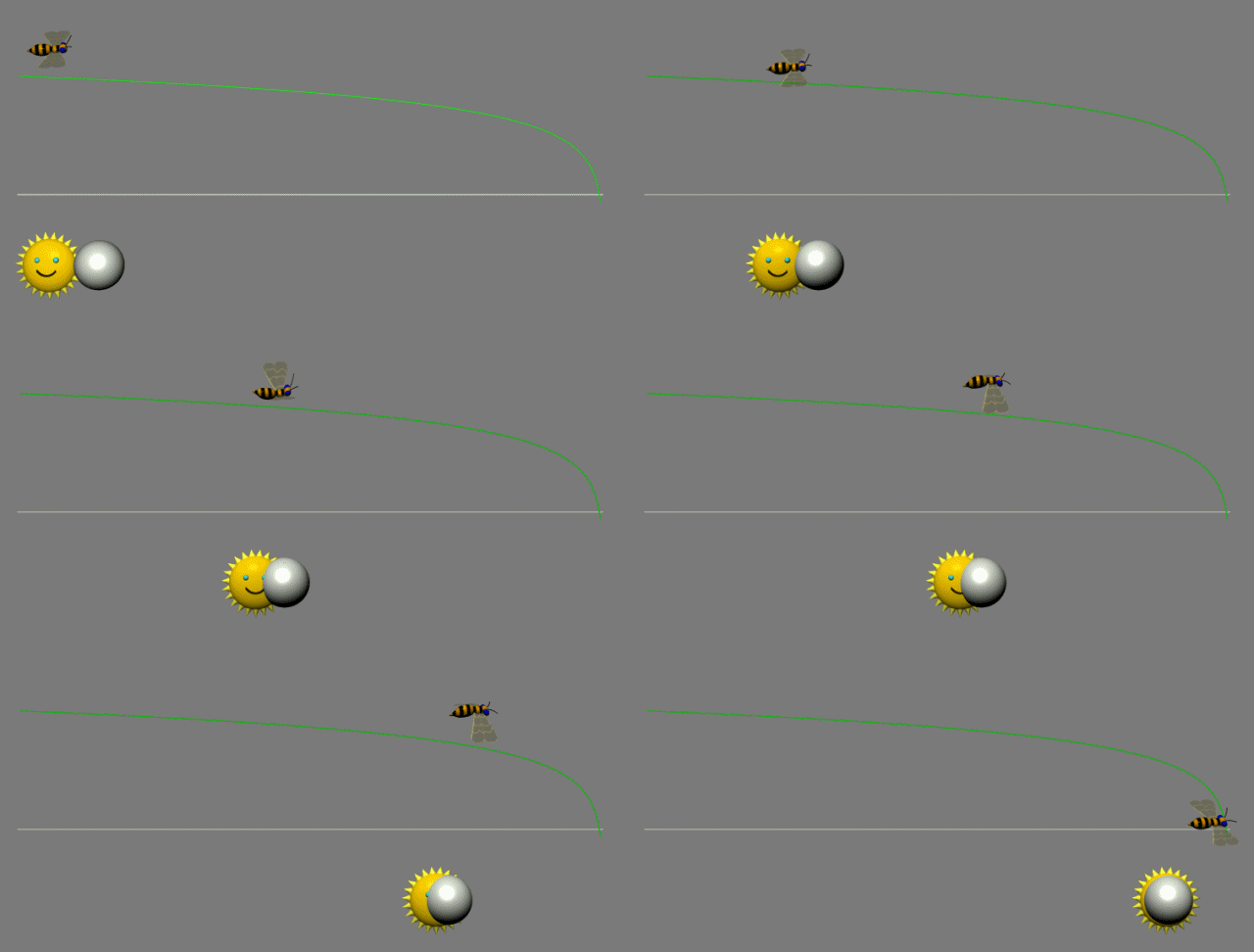
In an unprecedented study of a solar eclipse's influence on bee behavior, researchers at the University of Missouri organized a cadre of citizen scientists and elementary school classrooms in setting up acoustic monitoring stations to listen in on bees' buzzing -- or lack thereof -- as the 2017 eclipse passed over. The results... were clear and consistent at locations across the country: Bees stopped flying during the period of total solar eclipse. "We anticipated, based on the smattering of reports in the literature, that bee activity would drop as light dimmed during the eclipse and would reach a minimum at totality," says Candace Galen, Ph.D., professor of biological sciences at the University of Missouri and lead researcher on the study. "But, we had not expected that the change would be so abrupt, that bees would continue flying up until totality and only then stop, completely."Shouldn't be unexpected. Perception is logarithmic. As the intensity dropped linearly, the bee's sense of light stayed nearly constant for a while, then dropped off abruptly.
Labels: bee, Carver, Experiential education
¶ 1:57 AM
| Static field | Ion current | Magnetic field | |
| Internal communication | Yes | Yes | 0 |
| External communication | Yes | Yes | 0 |
| Sensory | Yes | Yes | Yes |
| Motor | Yes | 0 | 0 |
Labels: bee, Carver, Grand Blueprint
¶ 2:30 PM
The researchers trained the bees to associate a platform that had fewer shapes on it with the sweet reward, until they made the right choice 80 per cent of the time. The bees were put through further tests with differently shaped objects to confirm that they were responding to the number of shapes and not their appearance. Next, when given a choice between two or three shapes and “zero” shapes, bees picked zero most of the time.Good experiment. Not hugely surprising, despite the tiny brain. Intelligence is turning out to be independent of neuron count or brain volume. I'd argue that this isn't about Zero in the sense of roman vs arabic number systems. This is more about establishing a template and knowing when reality violates the template. Immediate example: My kitchen faucet has developed a leak at the rotator joint for the spout. Until I get around to ordering a new gasket, I'm trying to avoid the positions that leak the most. Last night when washing dishes I left the spout over the soap-holding pan instead of turning it to the right over the egg pan as I normally do after filling the soap-holding pan. When I finished the stuff in the soap-holding pan and dipped the washcloth into the egg pan to start scrubbing, ALARM ALARM ALARM SOMETHING IS WRONG! Oh. The water in the egg pan was room temperature instead of warm, because the faucet hadn't been over the egg pan for the previous three minutes as it usually is. Every minuscule detail of a well-developed habit is ALARM ALARM ALARM when any sensed measurement is off by more than a difference limen. When the bees have formed the habit of expecting some shape objects on the platform, the absence of shape objects is ALARM ALARM ALARM! Brain expects things on platform! No things on platform! Etymology of NOUGHT: Middle English noght, from Old English nōwiht, which in turn comes from ne-ā-wiht, which was a phrase used as an emphatic "no", meaning "not a thing". Zero in numeration is a more abstract concept, which developed separately from seeing and marking a NO-THING where things are expected. Few minutes later: Ordered the gasket. ALARM can be useful.
Labels: bee, Grand Blueprint, Real World Math
¶ 11:36 PM
Labels: bee, defensible spaces
¶ 6:36 AM
Labels: Asked and answered, bee
¶ 4:54 PM
MANAGEMENT PRIZE — Gennaro Bernile [ITALY, SINGAPORE, USA], Vineet Bhagwat [USA], and P. Raghavendra Rau [UK, INDIA, FRANCE, LUXEMBOURG, GERMANY, JAPAN], for discovering that many business leaders developed in childhood a fondness for risk-taking, when they experienced natural disasters (such as earthquakes, volcanic eruptions, tsunamis, and wildfires) that — for them — had no dire personal consequences.Reversed logic, like all "social" """""science"""". I'd guess that more than half of all adults have been in or near disasters without being killed or injured. The vast majority of survivors develop a sensible avoidance of risk after such events. Leader types are innately risk-loving, whether they had an experience of survival or not. Every experience makes a risk-lover love risk more, because he's a risk-lover who loves risk. The survival experience is the fucking CONSTANT and the innate risk preference is the fucking VARIABLE. If you call yourself a scientist you should FIRST OF ALL be able to distinguish constants from variables. And even morer firster of aller, you should understand that
 = = = = =
At the other end, this item....
= = = = =
At the other end, this item....
Michael L. Smith, for carefully arranging for honey bees to sting him repeatedly on 25 different locations on his body, to learn which locations are the least painful.....is simply GOOD SCIENCE, and is NOT trivial or silly. Variables and constants properly separated, useful information. I suppose he could have used a mechanical stinger instead of live bees, but bees are not known for individuality. It's reasonable to assume that the bee will always optimize her sting. ETHICS rules make it impossible to run such a study on anyone but yourself. Aside from ETHICS, pain is so subjective that the only way to get a reasonable scaling is to keep it on yourself anyway. Good science and serious science. Pain is not trivial. Shouldn't be an Ig.
Labels: Age of Stings, bee, Blinded by Stats, Ethics, Loughnerian Logic
¶ 2:34 AM
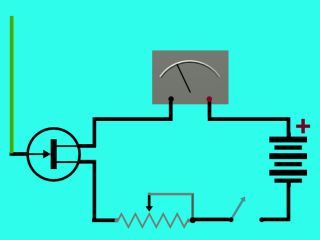 = = = = =
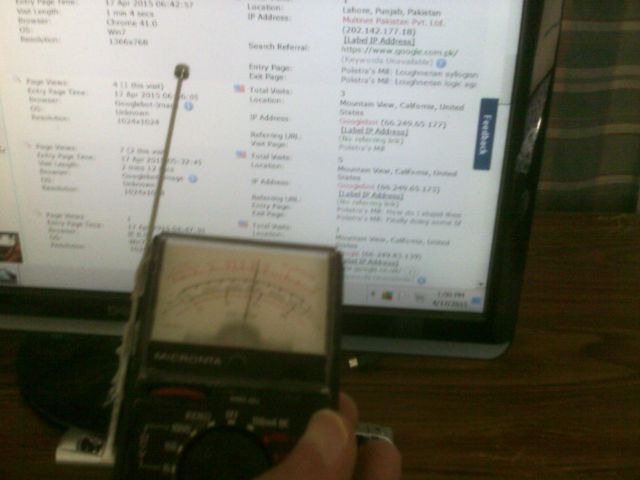
Some initial pictures:
Near the computer:
= = = = =
Some initial pictures:
Near the computer:
 A little farther from the computer:
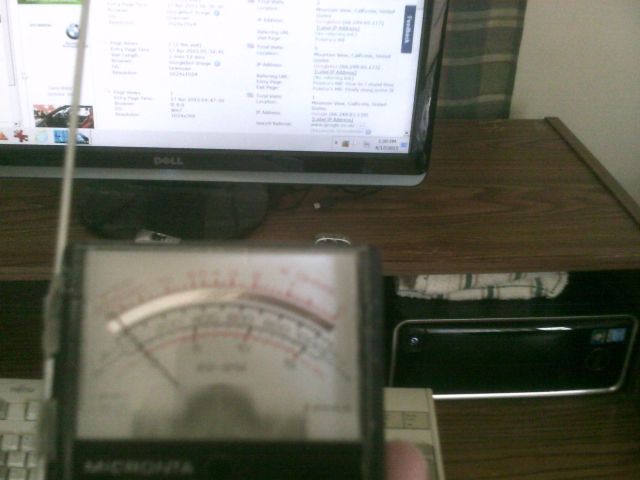 Left side of living room. This house is packed with 60 cycle hum, so this is probably more of a
signal-rectification effect than a static effect. The middle of the room seems to be 'colder' than the walls.
Left side of living room. This house is packed with 60 cycle hum, so this is probably more of a
signal-rectification effect than a static effect. The middle of the room seems to be 'colder' than the walls.
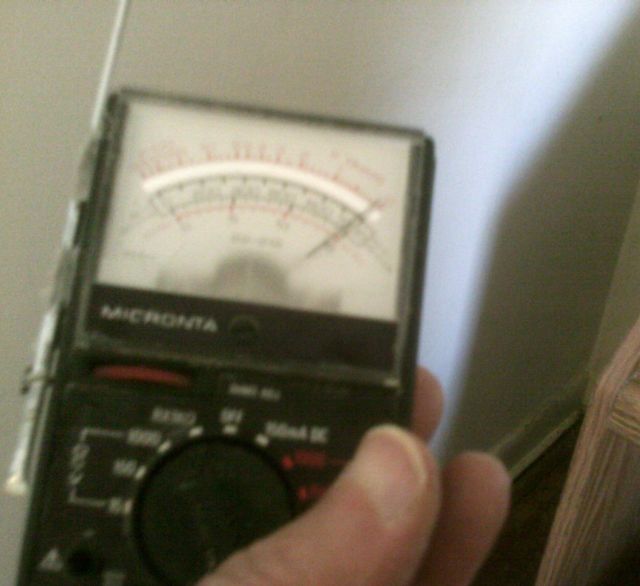 To prove that it's not solely picking up 60: About a foot from a pile of plastic trash bags:
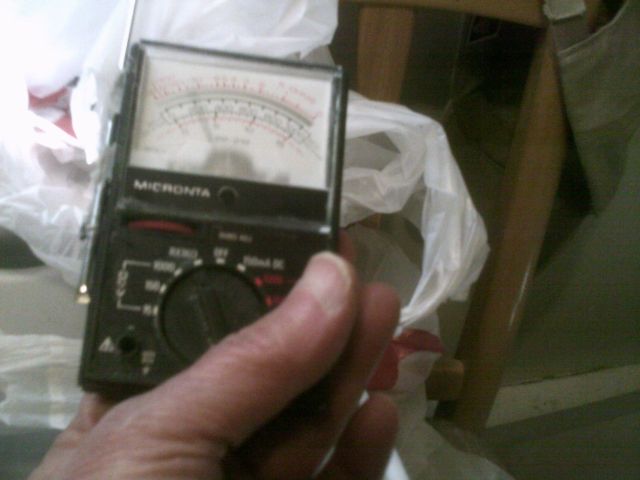 And then an inch from the bags:
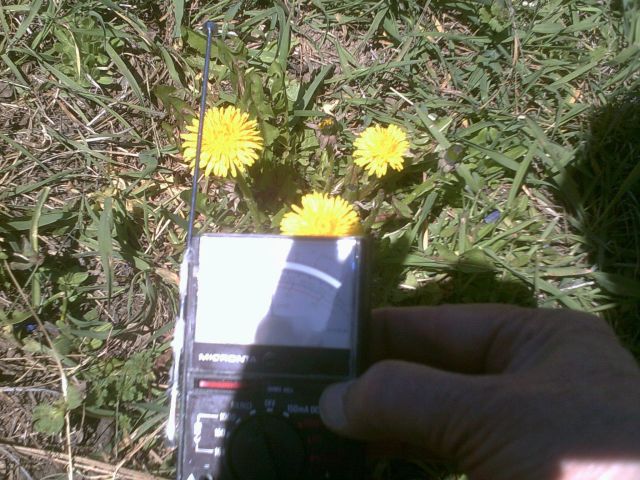
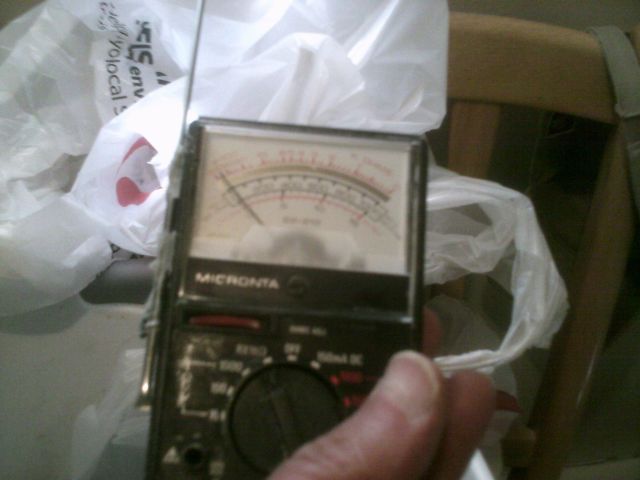 Okay, now let's get closer to Shepardson. Outside is less contaminated by 60, but it's also sunny, which means my crappy camera and non-existent camera skills get in the way. You can almost see where the needle is on the first two pics, and I accidentally got a usable picture on the third.
Far from a dandelion:
Okay, now let's get closer to Shepardson. Outside is less contaminated by 60, but it's also sunny, which means my crappy camera and non-existent camera skills get in the way. You can almost see where the needle is on the first two pics, and I accidentally got a usable picture on the third.
Far from a dandelion:
 About 6 inches from dandelion:
 Touching the dandelion:
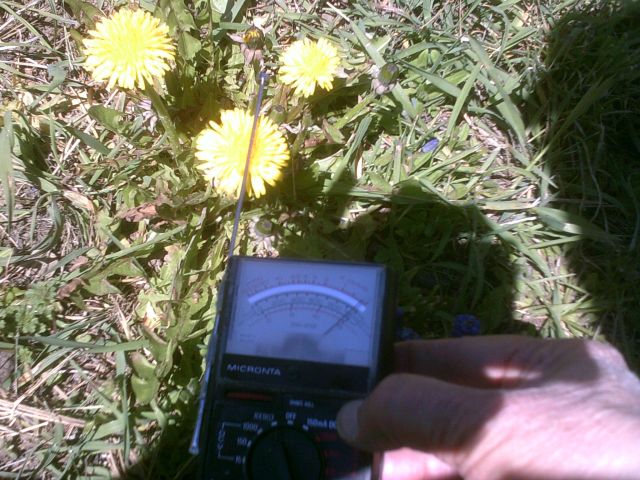 Yay! Science, sort of!
Note that I have NOT added the 'Metrology' tag to this entry, because this crude gadget is wildly uncalibrated.
More readings here.
Yay! Science, sort of!
Note that I have NOT added the 'Metrology' tag to this entry, because this crude gadget is wildly uncalibrated.
More readings here.Labels: bee, coot-proofing, Grand Blueprint, new toy
¶ 4:12 AM
Every child who goes to school spends his days partly in school, partly in playing or working, and partly at home. At home he eats, sleeps, perhaps plays with his brothers and sisters, and gets the clothes that keep him warm and dry. ... People are not the only dwellers in homes, however, for the small birds and the wild animals have homes, but they do not always live in the same home all year. Every country boy knows the homes of certain birds. He has probably watched them build the homes and seen the way they live and the way the old birds feed the young birds and teach them to fly. ... No matter where we go, we shall find people living in homes. So, if we can find out why we live in homes, and what we do there, we will be better able to understand other people who do many things that seem strange to us now, but who are busy earning a living in different ways. An old deserted farmhouse, such as one often sees in the country, is not a home. Neither is an empty city house or a vacant apartment a home. But they would become homes if somebody moved into them. People are, therefore, a necessary part of every home, and a house is only a place for a family to live in and to make into a home.Note the emphasis on human presence, and the calibration to human scale. The rest of the book has the same focus. All is defined by the connections and relations between you and the rest of the universe. All verbs, no nouns. All about how you respond to the world and influence the world, nothing about raw facts. We need to teach everything this way. = = = = = Wonder if bees feel the same longing, the same inward pull toward the nest, when they sense the bee equivalent of hearth and lamp? [Would those equivalents be Hexagon shapes and Larva smell?]
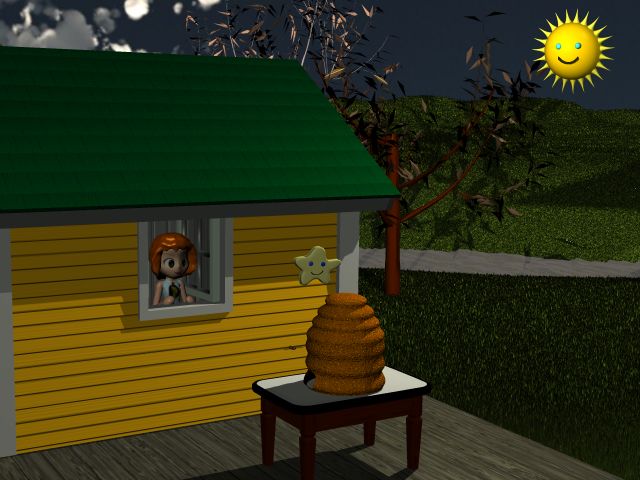
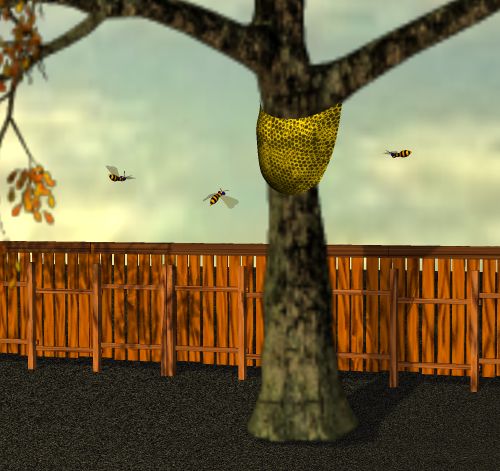 Artistic sidenote: I was going to use the iconic dome-shaped beehive in this picture, but a little googling convinced me that American and Euro bees don't build their hives in that form. Their hives are generally built into and around a hole in a tree. Using a realistic nest in the same image with toonish bees and toonish trees probably violates art rules... but I respect bees and want to give them a proper home in my picture.
= = = = =
[Posted last year, decided it deserves to be a regular Xmas item.]
Artistic sidenote: I was going to use the iconic dome-shaped beehive in this picture, but a little googling convinced me that American and Euro bees don't build their hives in that form. Their hives are generally built into and around a hole in a tree. Using a realistic nest in the same image with toonish bees and toonish trees probably violates art rules... but I respect bees and want to give them a proper home in my picture.
= = = = =
[Posted last year, decided it deserves to be a regular Xmas item.]Labels: 20th century Dark Age, bee, Heimatkunde
¶ 1:53 AM
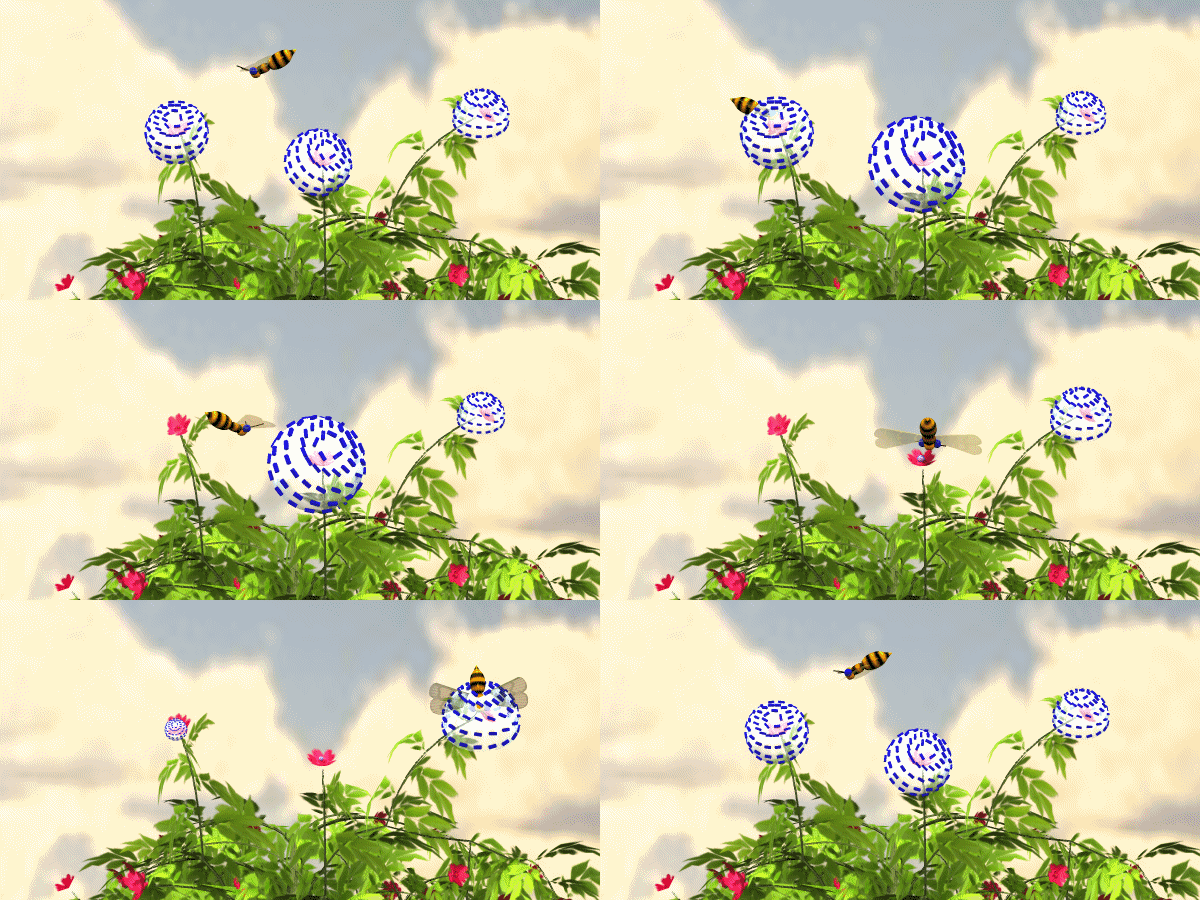 Shepardson's special theme was that pointy things act as centers for charge transfer. Pine needles have very little sunlight-absorbing area and excellent charge-absorbing qualities, so it's reasonable to assume that their main function is to gather electrons, not to gather sunlight. Similarly, bumblebees are hairy so they can sense the static signals from flowers.
= = = = =
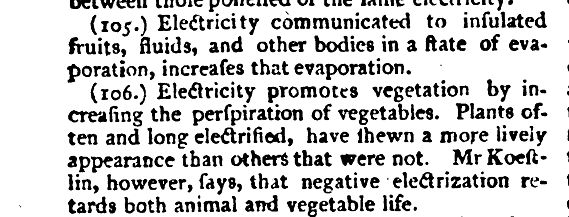
Ancient sidenote, from 1816 'Encyclopedia Perthensis'.
Shepardson's special theme was that pointy things act as centers for charge transfer. Pine needles have very little sunlight-absorbing area and excellent charge-absorbing qualities, so it's reasonable to assume that their main function is to gather electrons, not to gather sunlight. Similarly, bumblebees are hairy so they can sense the static signals from flowers.
= = = = =
Ancient sidenote, from 1816 'Encyclopedia Perthensis'.
Labels: 20th century Dark Age, bee, Grand Blueprint
¶ 8:07 AM
Every child who goes to school spends his days partly in school, partly in playing or working, and partly at home. At home he eats, sleeps, perhaps plays with his brothers and sisters, and gets the clothes that keep him warm and dry. ... People are not the only dwellers in homes, however, for the small birds and the wild animals have homes, but they do not always live in the same home all year. Every country boy knows the homes of certain birds. He has probably watched them build the homes and seen the way they live and the way the old birds feed the young birds and teach them to fly. ... No matter where we go, we shall find people living in homes. So, if we can find out why we live in homes, and what we do there, we will be better able to understand other people who do many things that seem strange to us now, but who are busy earning a living in different ways. An old deserted farmhouse, such as one often sees in the country, is not a home. Neither is an empty city house or a vacant apartment a home. But they would become homes if somebody moved into them. People are, therefore, a necessary part of every home, and a house is only a place for a family to live in and to make into a home.Note the emphasis on human presence, and the calibration to human scale. The rest of the book has the same focus. All is defined by the connections and relations between you and the rest of the universe. All verbs, no nouns. All about how you respond to the world and influence the world, nothing about raw facts. We need to teach everything this way. = = = = = Wonder if bees feel the same longing, the same inward pull toward the nest, when they sense the bee equivalent of hearth and lamp? [Would those equivalents be Hexagon shapes and Larva smell?]
Artistic sidenote: I was going to use the iconic dome-shaped beehive in this picture, but a little googling convinced me that American and Euro bees don't build their hives in that form. Their hives are generally built into and around a hole in a tree. Using a realistic nest in the same image with toonish bees and toonish trees probably violates art rules... but I respect bees and want to give them a proper home in my picture.
= = = = =
[Posted this a few weeks ago; decided it deserved to be a year-end or Xmas item, so moved it to this date.]Labels: bee
¶ 8:18 AM
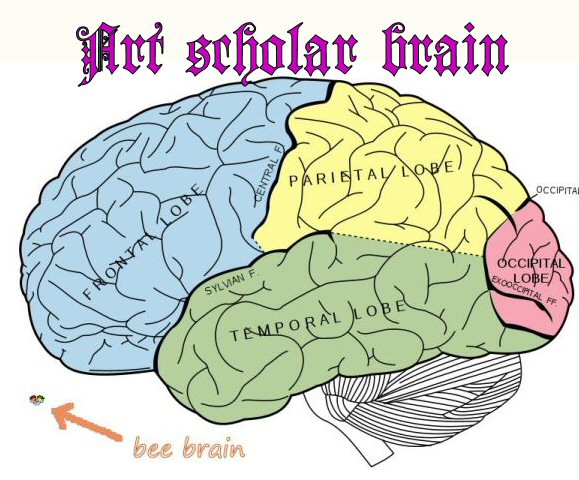
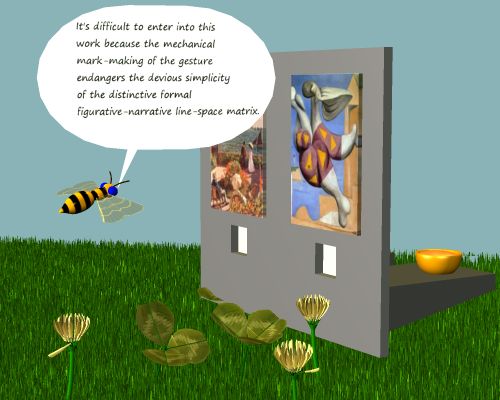 Not that way, of course... When trained in a Skinner-box setup with several samples of Picasso and Monet, bees continue to choose the 'sweet' painter when they see other paintings by Picasso and Monet.
This gives the lie to the art scholars who love to spew the nonsense that I put in the bee's mouth. Scholars claim that analyzing art is a high-level professional undertaking, requiring vast IQ and decades of training.
Nope. All it takes is an animal with eyes and a brain.
Not that way, of course... When trained in a Skinner-box setup with several samples of Picasso and Monet, bees continue to choose the 'sweet' painter when they see other paintings by Picasso and Monet.
This gives the lie to the art scholars who love to spew the nonsense that I put in the bee's mouth. Scholars claim that analyzing art is a high-level professional undertaking, requiring vast IQ and decades of training.
Nope. All it takes is an animal with eyes and a brain.
 The first part of Reinhard's study is completely unsurprising. Bees are unquestionably good at spotting and remembering patterns. When working clover, they can instantly find and hit the upward-pointing florets. (Upward means full, because the clover lowers the empty florets.) The same bee can recognize and hit the sweet spot on a rose or daffodil. Plenty of varied patterns there, not to mention their famous navigation abilities.
What's surprising is the generalization from an initially learned distinction based on a pattern that has nothing to do with flowers. This eliminates reductionist ideas that the bees are just smelling the sugar or recognizing the color or matching instinctive templates. Clearly high-level pattern recognition is part of the available genetic blueprint for all critters.
= = = = =
Aside from the fascinating subject, the Reinhard article is an outstanding example of scientific method and writing, and sets the absolute gold standard for scientific availability.
The researchers tried everything you could possibly imagine to insure that only the style was influencing the bees. Processed the paintings for equal overall luminosity, switched to black&white to eliminate color preference, checked the 2d Fourier transform for basic frequency information.
The full article is blessedly available online FREE. Includes excellent illustrations of the training box and the paintings. (Usually the full article is behind a paywall, and usually the full article contains nothing that wasn't in the press release.)
The first part of Reinhard's study is completely unsurprising. Bees are unquestionably good at spotting and remembering patterns. When working clover, they can instantly find and hit the upward-pointing florets. (Upward means full, because the clover lowers the empty florets.) The same bee can recognize and hit the sweet spot on a rose or daffodil. Plenty of varied patterns there, not to mention their famous navigation abilities.
What's surprising is the generalization from an initially learned distinction based on a pattern that has nothing to do with flowers. This eliminates reductionist ideas that the bees are just smelling the sugar or recognizing the color or matching instinctive templates. Clearly high-level pattern recognition is part of the available genetic blueprint for all critters.
= = = = =
Aside from the fascinating subject, the Reinhard article is an outstanding example of scientific method and writing, and sets the absolute gold standard for scientific availability.
The researchers tried everything you could possibly imagine to insure that only the style was influencing the bees. Processed the paintings for equal overall luminosity, switched to black&white to eliminate color preference, checked the 2d Fourier transform for basic frequency information.
The full article is blessedly available online FREE. Includes excellent illustrations of the training box and the paintings. (Usually the full article is behind a paywall, and usually the full article contains nothing that wasn't in the press release.)Labels: bee, Grand Blueprint
¶ 4:40 AM
Mark Hohn didn't pay much attention to the dead bees scattered outside his shop when he got home from vacation a few weeks ago. He just pulled out a leaf blower and blasted away the mess. It took him a few days to realize he had an invasion of the living dead on his hands. "I joke with my kids that the zombie apocalypse is starting at my house," said the novice beekeeper. The dead and dying honeybees from Hohn's 1.25-acre spread in Kent are the first in Washington confirmed to be infected by a parasitic fly that causes the bees to lurch around erratically before dropping dead. The discovery expands the range of the so-called "zombie bees" first discovered in California in 2008 by San Francisco State University biologist John Hafernik. Unlike healthy bees, which spend the night tucked up in their hive, infected bees fly after dark and tend to congregate at lights. Hohn noticed bees buzzing around the light in his shop, flying in jerky patterns and finally flopping on the floor. He remembered hearing about the zombie bees, so he collected several of the corpses and popped them into a Ziploc bag. "Curiosity got the better of me," he said. The fly's life cycle is gruesomely reminiscent of the movie "Alien" — though they don't pose a risk to people. Adult females, smaller than a fruit fly, land on the backs of foraging honeybees and use their needle-sharp ovipositors to inject eggs into the bee's abdomen. The eggs hatch into maggots. "They basically eat the insides out of the bee," Hafernik said.My first impulse was to do an animation ridiculing the San Francisco bees, showing them staggering around with fat joints in their mouths. After rereading the above, I just couldn't do it. I've gotten fairly 'close to the soil' in the last year or so, and learned enough about bees and pollination to gain considerable empathy for the industrious critters. I like to watch them working on my all-clover back yard. So my only thought now is: Jesus, what an awful way to die. Pushed to exhaustion in darkness by an internal demon.
Labels: bee
¶ 11:57 AM
A new government forecast says alfalfa hay production is up 15 percent in Kansas after a huge spike in harvested acres.
Kansas Agricultural Statistics Service reported Friday that Kansas growers are expected to harvest 2.25 million tons of alfalfa hay. The expected yield of 3 tons per acre is the same as a year ago, but it is coming off about 750,000 acres.
Kansas farmers planted 100,000 more acres of alfalfa hay this year in response to record hay prices last year.
Kansas always has droughts. Alfalfa doesn't seem to be bothered by this year's drought. Could we learn something from this? No, of course not. We're EXCEPTIONAL. We don't learn.
The current problem is a classic agricultural mistake: monoculture. Corn production is required by the Gaian national suicide laws, and corn production is subsidized by the Gaian national suicide laws. So farmers grow lots of corn, and ag research focuses on corn. Alfalfa fades into the background even though it's more adaptable, enriches the soil and encourages honeybees.
In terms of both government subsidies and the natural cycle, corn is 'taker', alfalfa is 'maker'.
But we keep growing more corn. All because the fucking Iowa caucus comes first on the calendar.
Labels: bee, Smarty-plants
¶ 2:40 AM

