Tuesday, November 10, 2020
Quickie on audions
I'm not doing justice to this subject but felt the need or duty to output SOMETHING with a bit of meaning, as counterforce to the wild destruction of logic and meaning. I might return later with a proper animation.
The first triode tube, DeForest's audion, looked a lot like the existing detectors for radio waves, and was used first as a detector plus incidental amplifier. Soon the audion's real use for amplification became clearer, and detection was separated from amplification.
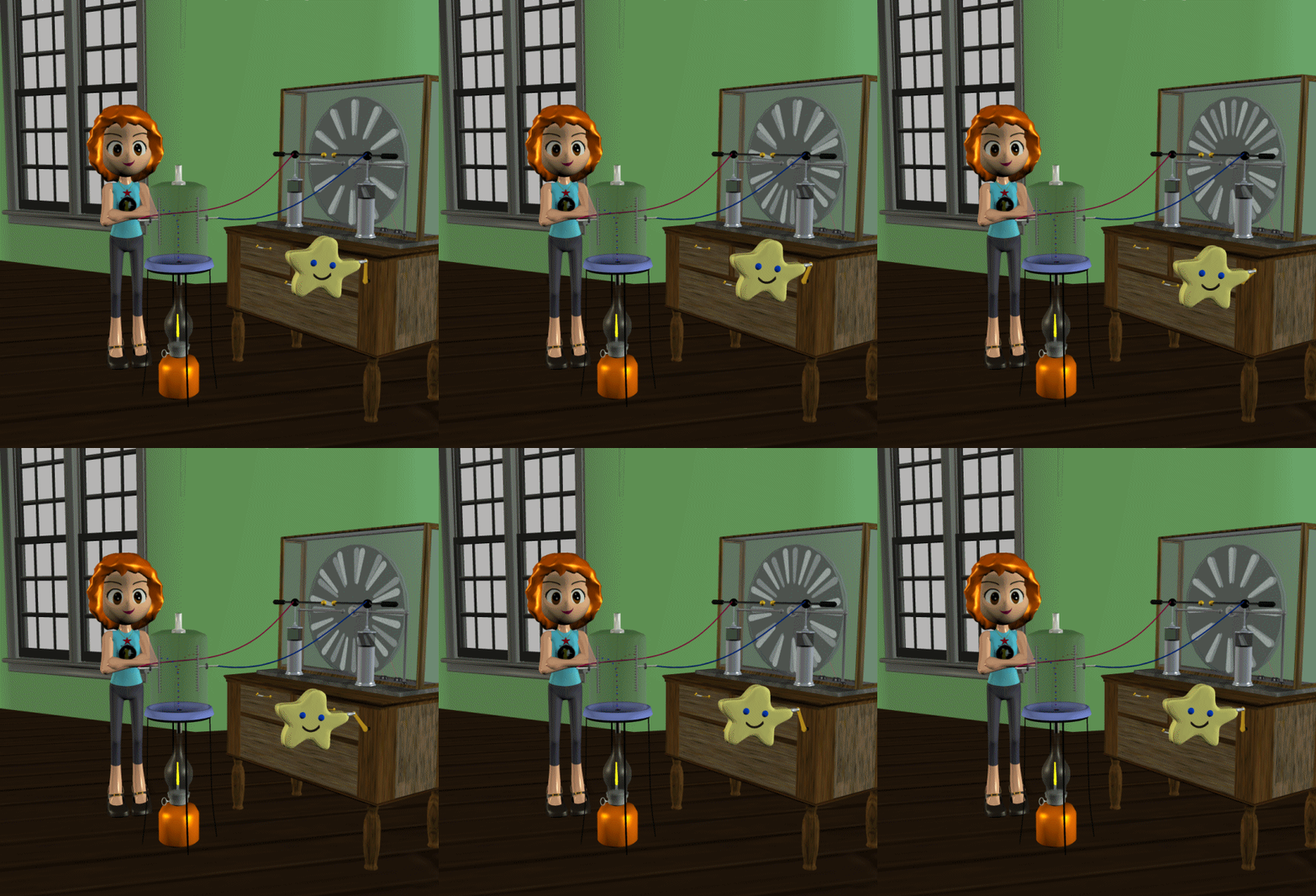
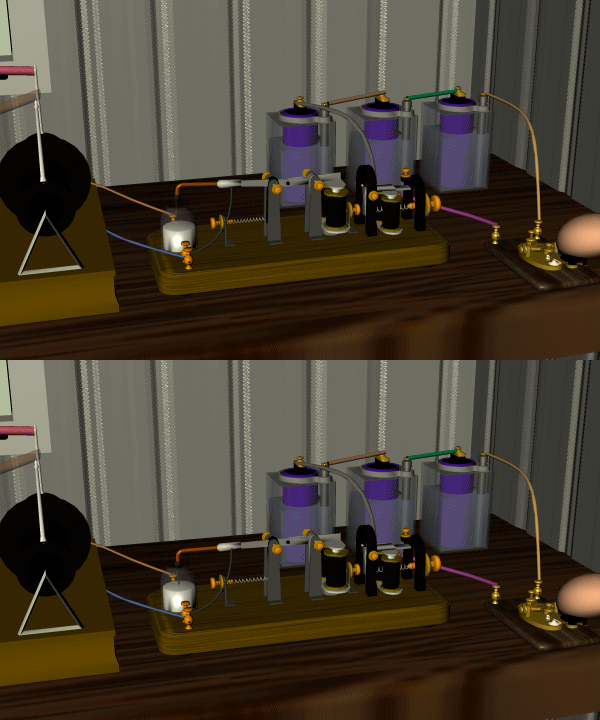
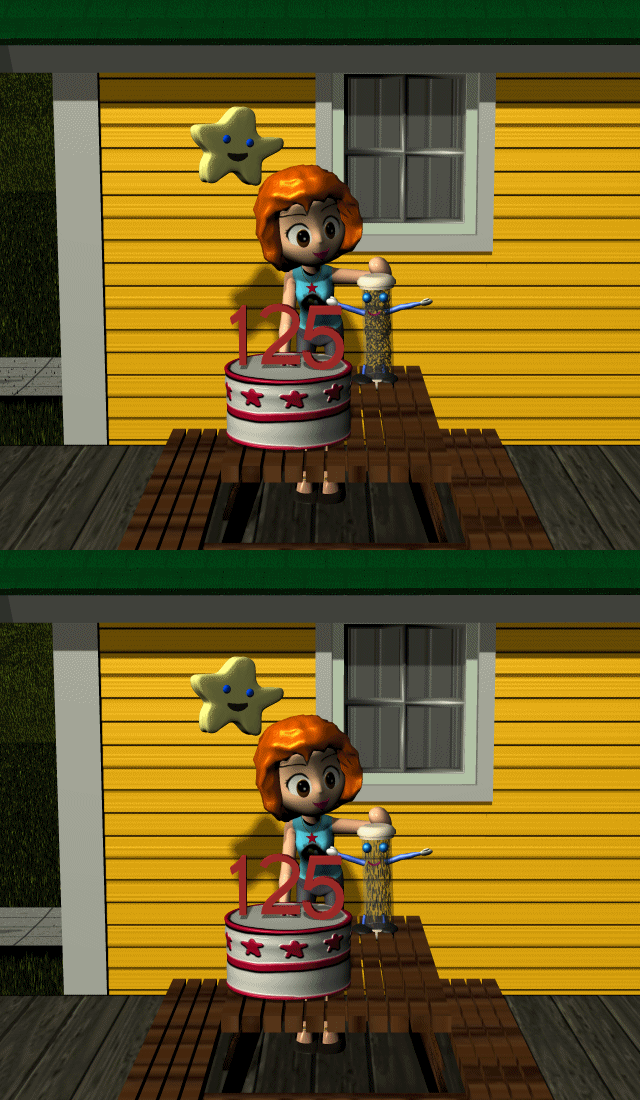
Here Polistra is receiving Morse with an audion. I've shown a parallel connection to an external coherer to illustrate the substitution, but there wouldn't have been a real reason to connect them.
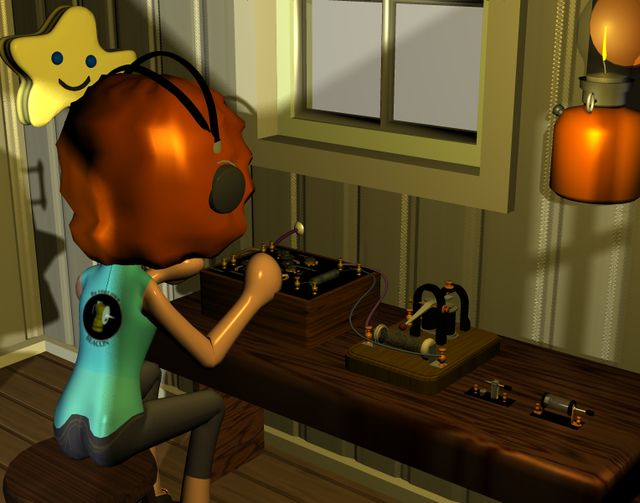 Coherers were uniquely suited to spark gap transmitters. When spark gaps were gradually replaced by high-frequency alternators, then by tube oscillators, coherers were replaced by rectifiers. I'm showing two typical crystal rectifiers next to the coherer; first the common vertical catwhisker, then the enclosed horizontal version often used in military receivers.
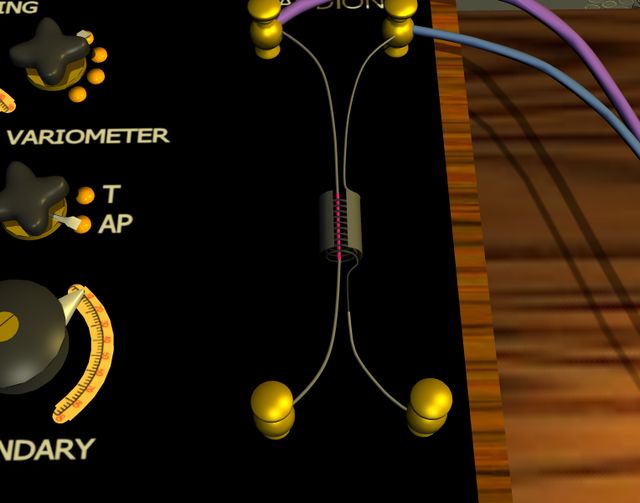
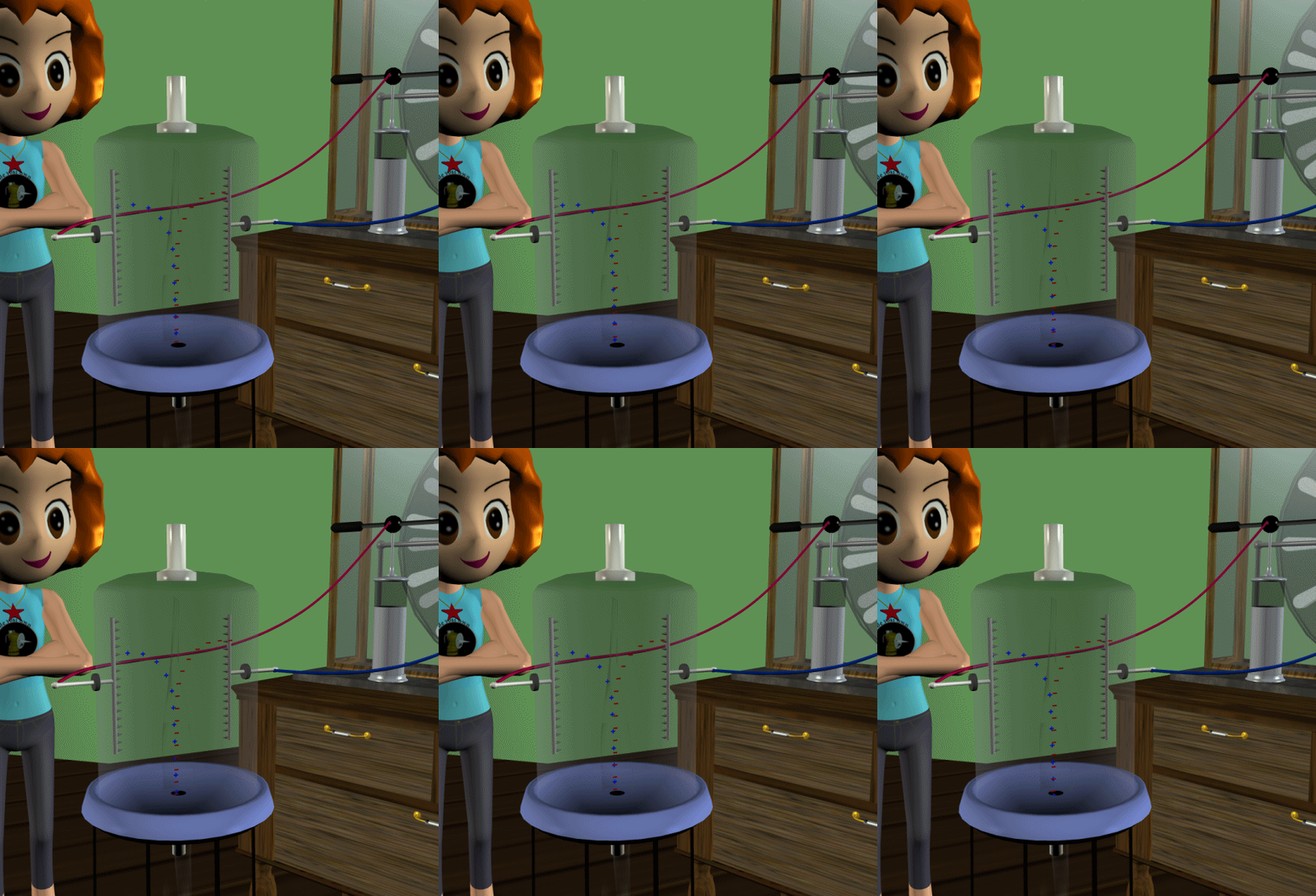
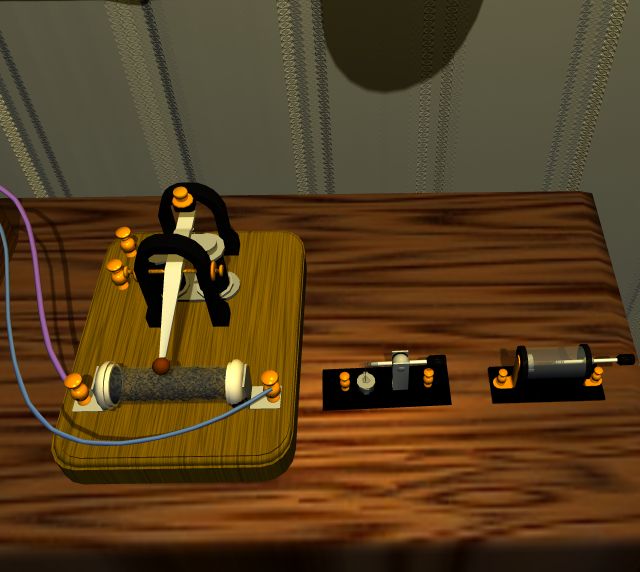 Closeup of the audion in action, connected to a receiver that tuned the incoming signal. The filament ran straight through from top to bottom; the grid was a sparse spiral around it; the plate surrounded the grid.
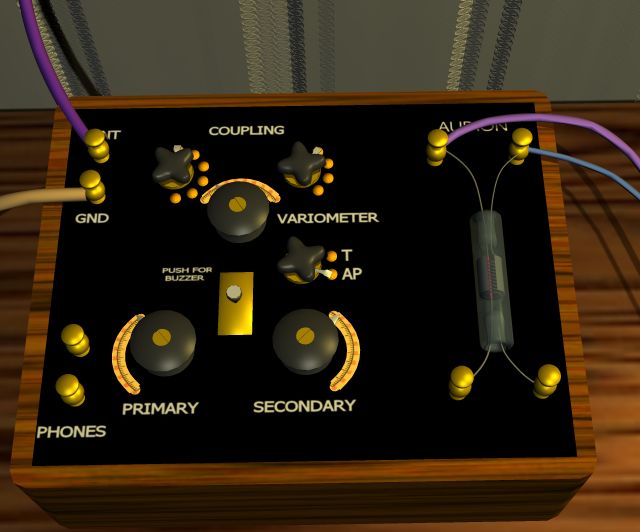 Inner view without the glass. The action was similar to Lodge's precipitator. The hot filament threw off electrons. If the grid was uncharged, the electrons passed through to the positively charged plate easily. If the grid had a negative charge, it repelled the negative electrons and they stayed around the filament. The ability of a charge (without current) to regulate the flow of a large current is the valving or amplifying effect. Because the grid only varied the current when the charge on it was negative, it also rectified the incoming signal, giving rise to the demodulating or detecting effect.
 These earliest audions typically used 12 to 20 volts on the plate. Later submini tubes returned to this range of voltage, but by that time transistors were already underway. As I discussed earlier, if tubes had continued on this scale, it would have made experimentation much easier and safer, and it also would have made rechargeable batteries more practical. Wet batteries are necessarily big, and a wet battery for the typical 90 volt B supply would occupy a major piece of furniture. Dry batteries are wasteful of materials and short-lived, but 90 volts could be packed into a cardboard case about 6 inches long.

Coherers were uniquely suited to spark gap transmitters. When spark gaps were gradually replaced by high-frequency alternators, then by tube oscillators, coherers were replaced by rectifiers. I'm showing two typical crystal rectifiers next to the coherer; first the common vertical catwhisker, then the enclosed horizontal version often used in military receivers.
Closeup of the audion in action, connected to a receiver that tuned the incoming signal. The filament ran straight through from top to bottom; the grid was a sparse spiral around it; the plate surrounded the grid.
Inner view without the glass. The action was similar to Lodge's precipitator. The hot filament threw off electrons. If the grid was uncharged, the electrons passed through to the positively charged plate easily. If the grid had a negative charge, it repelled the negative electrons and they stayed around the filament. The ability of a charge (without current) to regulate the flow of a large current is the valving or amplifying effect. Because the grid only varied the current when the charge on it was negative, it also rectified the incoming signal, giving rise to the demodulating or detecting effect.
These earliest audions typically used 12 to 20 volts on the plate. Later submini tubes returned to this range of voltage, but by that time transistors were already underway. As I discussed earlier, if tubes had continued on this scale, it would have made experimentation much easier and safer, and it also would have made rechargeable batteries more practical. Wet batteries are necessarily big, and a wet battery for the typical 90 volt B supply would occupy a major piece of furniture. Dry batteries are wasteful of materials and short-lived, but 90 volts could be packed into a cardboard case about 6 inches long.Labels: From rights to duties, Lodge
¶ 11:08 AM
Sunday, November 01, 2020
Lodge month
October was Lodge month 'in these columns'. I've added a tag to the related items.
I hadn't paid much attention to Lodge before, even though his name is well known in radio circles for his studies of propagation. That wasn't his central contribution.
His constant focus was on the boundaries and borders between electricity and matter. His coherer made use of a constantly moving and re-forming layer of liquid. The device wasn't practical, but it helped to form a better understanding of modulation and rectification, which then led to the changeover from Morse to music.
His precipitator also applied a static charge to flowing gas and smoke, ionizing and cleaning the flow. This device proved to be powerfully practical, and his sons commercialized it for profit. The precipitator, as improved by Cottrell, is still in use.
Lodge's philosophy was unfashionable in 1906, and even more unfashionable now. Around 1900 the cult of "science" was in its first flush of victory. Deconstructors were everywhere, from religion to biology to math to physics. Purpose was dethroned and replaced by Lord Random.
Lodge, with impeccable credentials as an experimenter AND theorist, discussed the boundary between static spiritual charge and the moving material world. He countered the purpose-killers and psychopaths who were starting to take over the world and now have completely conquered it.
The essence of mind is design and purpose. There are some who deny that there is any design or purpose in the universe at all: but how can that be maintained when humanity itself possesses these attributes? Is it not more reasonable to say that just as we are conscious of the power of guidance in ourselves, so guidance and intelligent control may be an element running through the universe, and may be incorporated even in material things? If we could grasp the entire scheme of things, so far from wishing to shatter it to bits and then remold it nearer to the heart's desire, we should hail it as better and more satisfying than any of our random imaginings. The universe is in no way limited to our conceptions: it has a reality apart from them; nevertheless they themselves constitute a part of it, and can only take a clear and consistent character insofar as they correspond with something true and real. Whatever we can clearly and consistently conceive, that is ipso facto already existent in the universe as a whole; and that, or something better, we shall find to be a dim foreshadowing of a higher reality. That is my creed, and, optimistic though it be, it seems to me the only rational creed for a man of science who, undeterred by any accusation of dualism, realizes strongly that our entire selves — our thoughts, conceptions, desires, as well as our perceptions and our acts — are all but parts of one stupendous whole.LIFE IS PURPOSE.
Labels: Lodge
¶ 10:06 PM
Thursday, October 29, 2020
More Lodge
Just completing the history of the Lodge precipitator. Previously I showed two experiments.
This is the later practical version produced by Cottrell. Variants on this form are still in common use. Practical versions have dozens or hundreds of coaxial pipes. I've placed it next to a factory-style building which might contain forges or smelters.
Before turning on the charge:
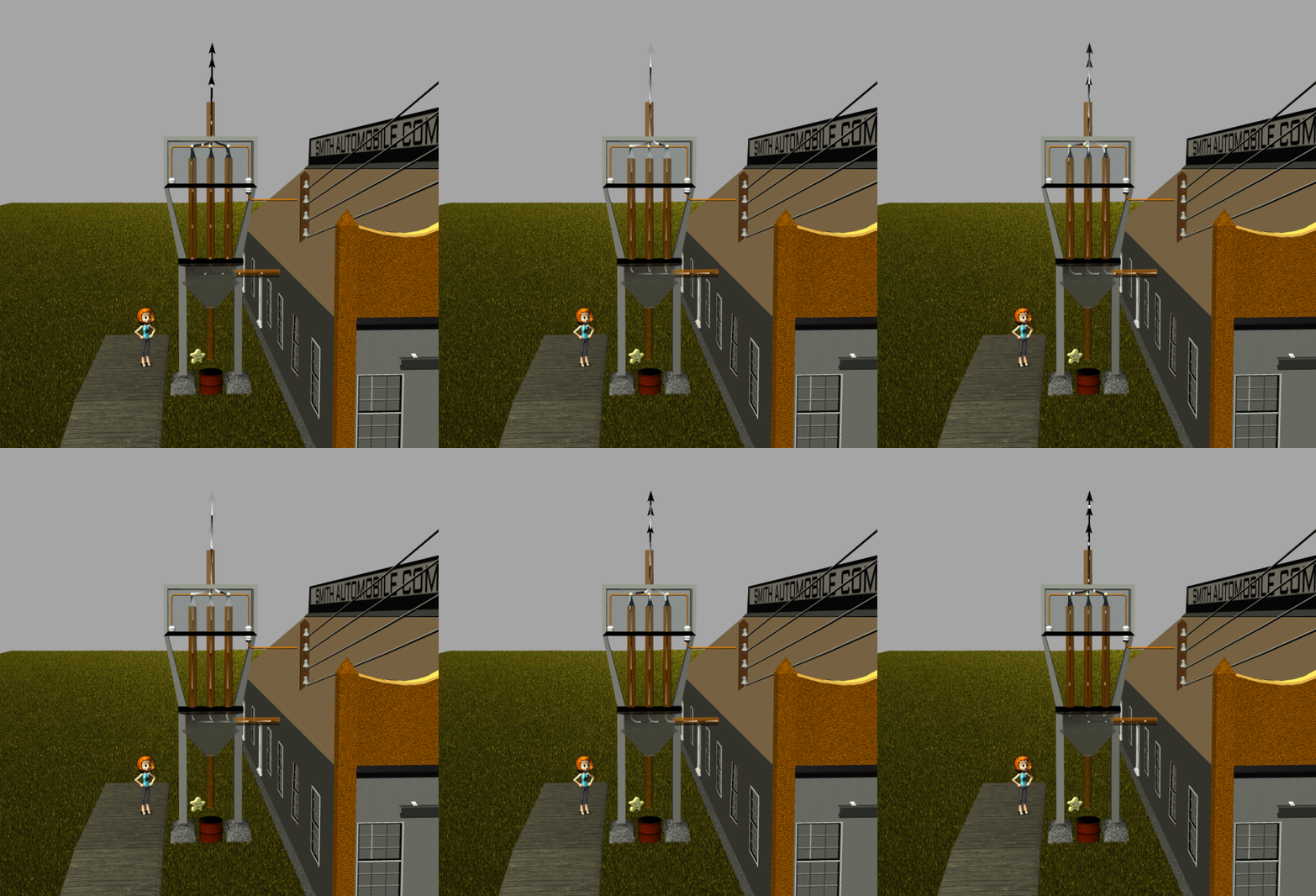 Air laden with dust and smoke simply passes through. Nothing falls into the hopper below.
= = = = =
After turning on the high voltage:
Air laden with dust and smoke simply passes through. Nothing falls into the hopper below.
= = = = =
After turning on the high voltage:
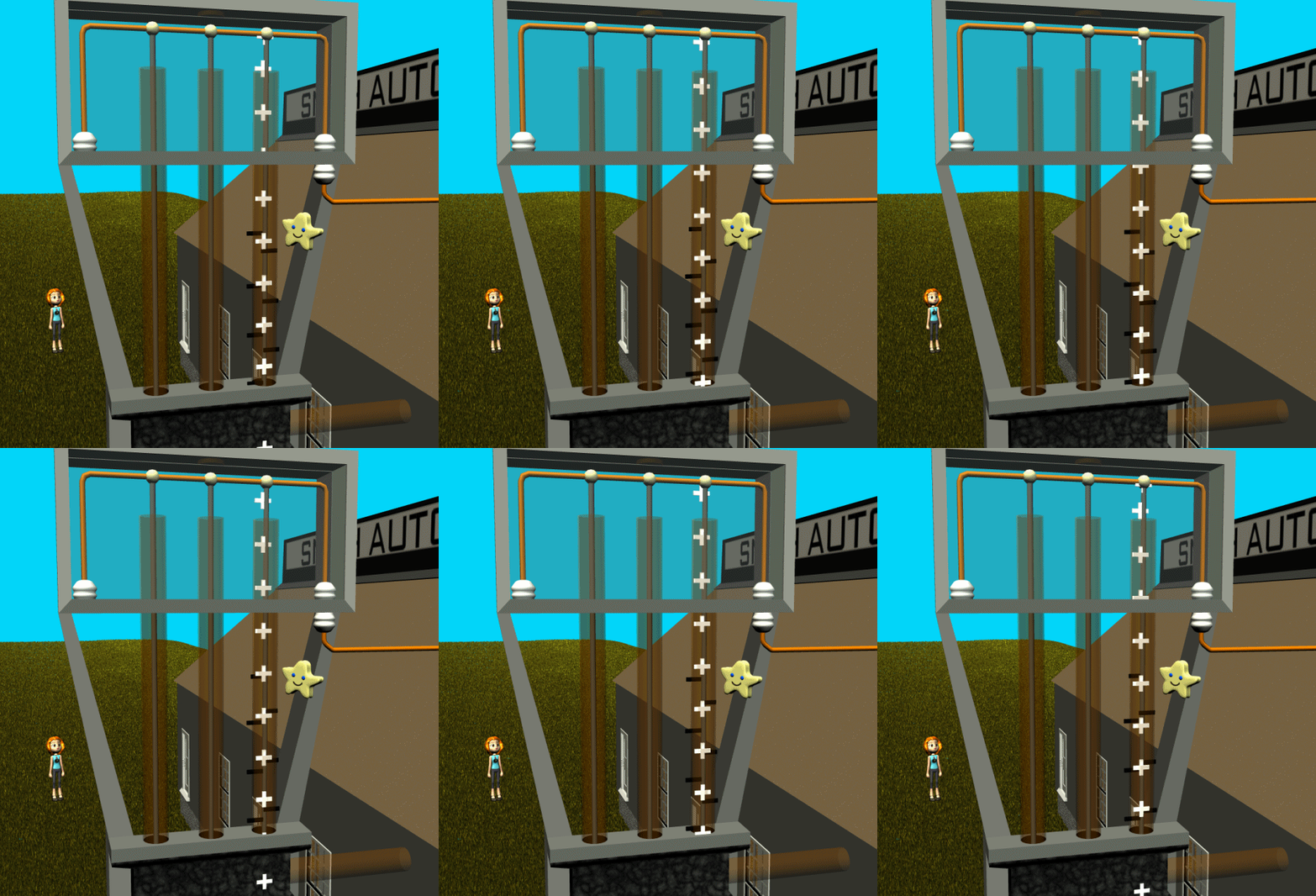 Particles are ionized and attracted to the inner rod electrode or the outer cylinder. They cling to the electrodes, and a tapping hammer (not shown) loosens the mass every few seconds so it can fall into the hopper. The air itself is also ionized into ozone, which the EPA describes as a "pollutant" because EPA's job is to ban all effective pollution control.
Self-calibration: This isn't a good animation because I didn't find this device especially interesting. I simply wanted to complete the history and move on to a more interesting subject.
Particles are ionized and attracted to the inner rod electrode or the outer cylinder. They cling to the electrodes, and a tapping hammer (not shown) loosens the mass every few seconds so it can fall into the hopper. The air itself is also ionized into ozone, which the EPA describes as a "pollutant" because EPA's job is to ban all effective pollution control.
Self-calibration: This isn't a good animation because I didn't find this device especially interesting. I simply wanted to complete the history and move on to a more interesting subject.
Air laden with dust and smoke simply passes through. Nothing falls into the hopper below.
= = = = =
After turning on the high voltage:
Particles are ionized and attracted to the inner rod electrode or the outer cylinder. They cling to the electrodes, and a tapping hammer (not shown) loosens the mass every few seconds so it can fall into the hopper. The air itself is also ionized into ozone, which the EPA describes as a "pollutant" because EPA's job is to ban all effective pollution control.
Self-calibration: This isn't a good animation because I didn't find this device especially interesting. I simply wanted to complete the history and move on to a more interesting subject.Labels: Lodge
¶ 11:42 PM
Tuesday, October 27, 2020
One answer to the previous question
Well, I 'asked' the plains tribes what to do when the leaves turn brown.
The Cherokee had a simple and obvious answer:
So all the people knew that Wahkoda had given this strange plant to the people. They knew of other plants they might eat. They knew there was a time when each plant was ripe. So they watched the strange plant; they guarded it and protected it. Then a flower appeared on the plant. Afterwards, at one of the joints, a new part of the plant pushed out. It had hair. At first the hair was green; then it was brown. Then the people thought, “ Perhaps this fruit is ripe. " But they did not dare touch it. They met together. They looked at the plant. Then a young man said, “My life has not been good. If any evil comes to me, it will not matter." So the people were willing, and the young man put his hand on the plant and then on its fruit. He grasped the fruit boldly. He said to the people, “It is solid. It is ripe.” Then he pulled apart the husks, and said, " It is red." He took a few of the grains and showed them to the people. He ate some. He did not die. So the people knew Wahkoda had sent this plant to them for food. Now in the fall, when the prairie grass turned brown, the leaves of this plant turned brown also. Then the fruit was plucked, and put away.There's a lot of objective science and human wisdom in that story, but the conclusion is simple: Leaves are an idiot light telling us when we can harvest corn. This isn't a reciprocal duty to the trees, so not quite an answer to the original question. [The Cherokee thought deciduous trees were cowards for letting Winter steal their leaves. Maybe they didn't feel duty-bound to the cowardly parts of Nature.] The Kansa didn't seem to have an answer, but they had an interesting intuition about stopping storms.
When there is a blizzard, the other Kansa beg the members of the Tcihaci clan to interpose, as they are the Wind People. They say, “Oh grandfather, I wish good weather. Please have one of your children decorated.” Then the youngest son of one of the Wind People, but one half grown, is selected. He is painted all over with red paint. Then he goes out into the storm and rolls over and over the snow, reddening it for some distance. This stops the storm.See vortices and hail cannons. Some pieces of leftover memory make you wonder if much older cultures had a hi-tech civilization that entirely vanished.
Labels: Alternate universe, Answered better than asked, Lodge
¶ 2:27 PM
Friday, October 23, 2020
Lodge meets Lodge
This item is really an extension of the Lodge precipitator. I'll repeat part of the earlier item and tack on the new.
= = = = = START PARTIAL REPRINT:
Electrostatic precipitators were under active development in 1886. Lodge and his associates built a practical precipitator, and tried it in a lead smelter. The precipitator reduced the dust and fumes "remarkably".
Lead is one of the few REAL pollutants. The EPA acted first to halt lead pollution, which is the ONLY good thing they did.
I've seen the effects of lead pollution. Several of my engineer uncles worked for American Metals, which had a smelter in Blackwell. We visited them occasionally, and the results of REAL pollution were dramatically obvious. The part of town downwind from the smelter was BARREN AND GRAY. Plants refused to grow there. Most adults had serious lung problems and died young. After EPA forced the plant to shut down, Blackwell was green again.
Big point: Pollution control for lead was AVAILABLE in 1886, and was developed and perfected over the years. Effective precipitators on smelters were common in 1920. American Metals didn't bother. Pinching pennies was more important than live workers. American Metals deserved to be shut down.
After 1975, EPA's real mission was finished, and EPA should have been shut down instead of switching to the "carbon" genocide. Unfortunately there's no meta-agency to shut down agencies that create problems instead of solving problems. Calling Trinity House, the permanent enemy of Parkinson!
= = = = =
Lodge and associates built several versions of the precipitator. The small version was meant mainly for demonstrations. Before turning on the charge, smoke from an oil lamp flowed freely through the chamber.
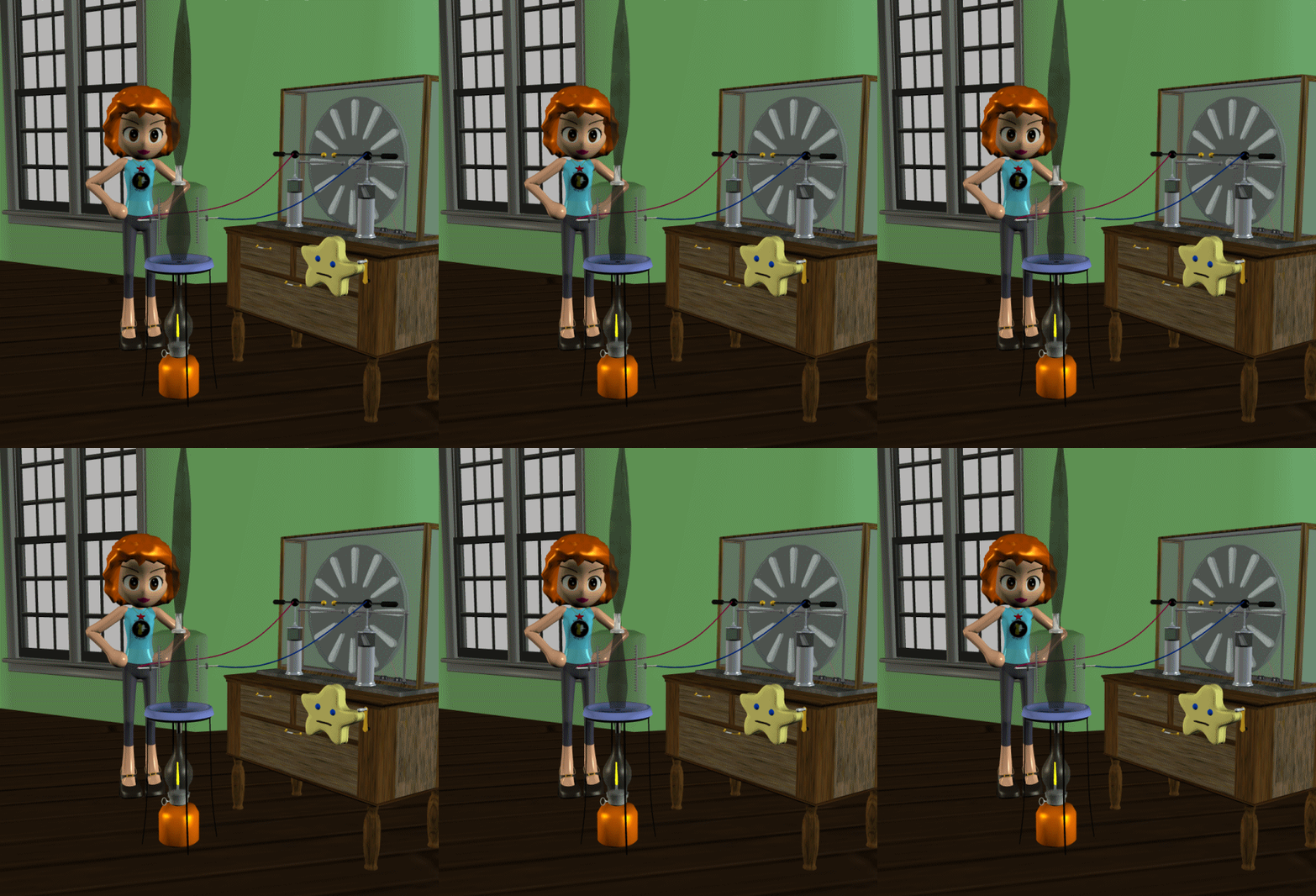 = = = = =
With charge applied from a static machine or induction coil, the smoke was ionized and precipitated.
= = = = =
With charge applied from a static machine or induction coil, the smoke was ionized and precipitated.
 Positive ions deposited on the negatively charged comb, and negative ions deposited on the positive comb.
 = = = = = END PARTIAL REPRINT.
= = = = = Extension:
Lodge's sons, who ran the Lodge Fume Deposit Company profitably for many years, also tried to control weather with static charge. This miniature experiment was successful, but they quickly gave up attempts to apply the same technique to parts of a city. One 'active lightning rod' on a building managed to clear out a few cubic feet around it. There was no way to multiply the effect enough to clear a house, let alone a neighborhood.
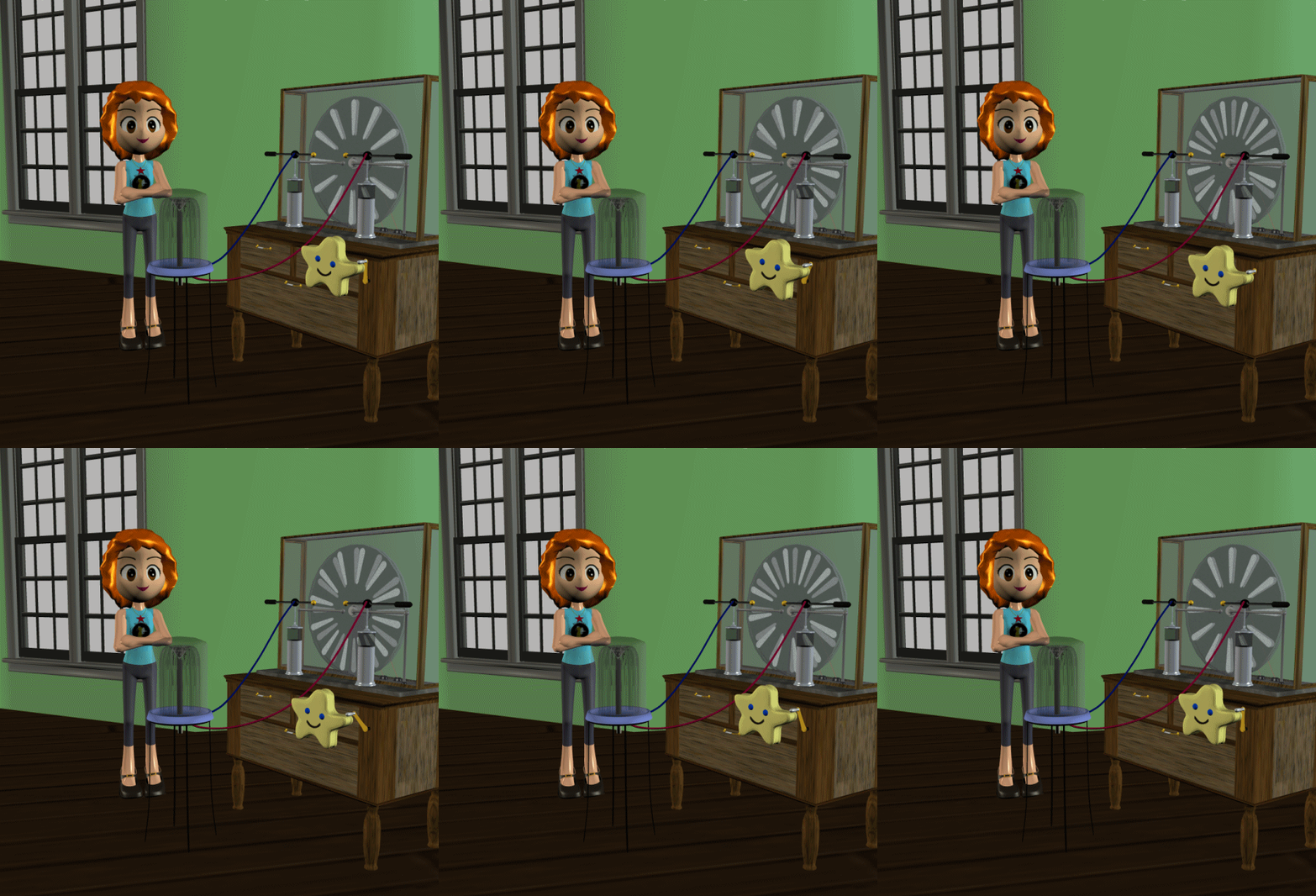
This bell jar was similar to the one above, except that the positive charge is a single point in the middle and negative charge is on the metal base. The bell jar contained water vapor similar to a London fog.
= = = = = END PARTIAL REPRINT.
= = = = = Extension:
Lodge's sons, who ran the Lodge Fume Deposit Company profitably for many years, also tried to control weather with static charge. This miniature experiment was successful, but they quickly gave up attempts to apply the same technique to parts of a city. One 'active lightning rod' on a building managed to clear out a few cubic feet around it. There was no way to multiply the effect enough to clear a house, let alone a neighborhood.
This bell jar was similar to the one above, except that the positive charge is a single point in the middle and negative charge is on the metal base. The bell jar contained water vapor similar to a London fog.
 When charge was applied, the water vapor COHERED in radial patterns, following the electrostatic lines of force.
 The real thing:
 This coherer-like behavior was the interesting part. Coherers are a basic and general type of device, with a range of uses that have only been partly explored.
Effective weather control tends to work by reactance, not resistance or blunt counterforce. Trees break wind into vortices. Hail cannons shoot vortices into the cloud mass to induce larger vortices that suck in the energy. If a coherer-like effect could create charged 'nuclei' for pollution, it could possibly agglomerate and precipitate large masses of smoke and smog.
This coherer-like behavior was the interesting part. Coherers are a basic and general type of device, with a range of uses that have only been partly explored.
Effective weather control tends to work by reactance, not resistance or blunt counterforce. Trees break wind into vortices. Hail cannons shoot vortices into the cloud mass to induce larger vortices that suck in the energy. If a coherer-like effect could create charged 'nuclei' for pollution, it could possibly agglomerate and precipitate large masses of smoke and smog.
= = = = =
With charge applied from a static machine or induction coil, the smoke was ionized and precipitated.
Positive ions deposited on the negatively charged comb, and negative ions deposited on the positive comb.
= = = = = END PARTIAL REPRINT.
= = = = = Extension:
Lodge's sons, who ran the Lodge Fume Deposit Company profitably for many years, also tried to control weather with static charge. This miniature experiment was successful, but they quickly gave up attempts to apply the same technique to parts of a city. One 'active lightning rod' on a building managed to clear out a few cubic feet around it. There was no way to multiply the effect enough to clear a house, let alone a neighborhood.
This bell jar was similar to the one above, except that the positive charge is a single point in the middle and negative charge is on the metal base. The bell jar contained water vapor similar to a London fog.
When charge was applied, the water vapor COHERED in radial patterns, following the electrostatic lines of force.
The real thing:
This coherer-like behavior was the interesting part. Coherers are a basic and general type of device, with a range of uses that have only been partly explored.
Effective weather control tends to work by reactance, not resistance or blunt counterforce. Trees break wind into vortices. Hail cannons shoot vortices into the cloud mass to induce larger vortices that suck in the energy. If a coherer-like effect could create charged 'nuclei' for pollution, it could possibly agglomerate and precipitate large masses of smoke and smog.Labels: Carbon Cult, Lodge, Parkinson, Trinity House
¶ 2:02 PM
Wednesday, October 21, 2020
Y no lead dress?
In reading about early experiments from the era of Marconi and Lodge, I'm constantly struck by the outright sloppiness of the rigs. There's no regard for lead dress or preventing trips and falls. Wires wiggle and coil randomly in hopeless tangles.
These weren't homebrew tinkerers. These were well-funded and well-organized scientists. They had teams with division of labor. They could afford to cut proper lengths and tie things together. Nylon zipties hadn't been invented, but string was available, and the telegraph industry had developed a wide variety of tying and lacing methods.
Here's an especially egregious example:
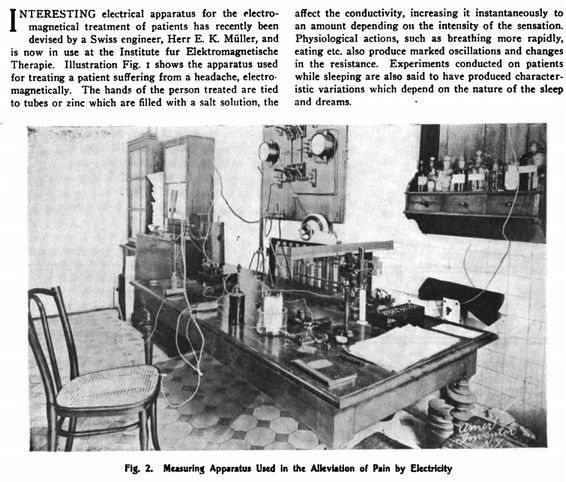 Magnetic therapy for headaches and pain, in a SWISS sanitarium. The Swiss are fanatics about neatness and order. Why didn't the obsession apply here?
Compare with the lead dress in the target device:
Magnetic therapy for headaches and pain, in a SWISS sanitarium. The Swiss are fanatics about neatness and order. Why didn't the obsession apply here?
Compare with the lead dress in the target device:
 Nothing tangled, nothing out of place. Everything bundled neatly in coaxial cables and conduits.
Lead dress is especially important with high voltages and high currents, and in situations like this where you want to know how the magnetic field is formed and resonating.
Nothing tangled, nothing out of place. Everything bundled neatly in coaxial cables and conduits.
Lead dress is especially important with high voltages and high currents, and in situations like this where you want to know how the magnetic field is formed and resonating.
Magnetic therapy for headaches and pain, in a SWISS sanitarium. The Swiss are fanatics about neatness and order. Why didn't the obsession apply here?
Compare with the lead dress in the target device:
Nothing tangled, nothing out of place. Everything bundled neatly in coaxial cables and conduits.
Lead dress is especially important with high voltages and high currents, and in situations like this where you want to know how the magnetic field is formed and resonating.Labels: Bemusement, Lodge
¶ 3:35 PM
Friday, October 09, 2020
Lodge vs Darwin
Lodge again. From Literary Digest, 1905, p247 of the PDF. Writing in response to Haeckel and Darwin, and prematurely but perfectly in response to the Quantumites.
Sir Oliver proceeds to analyze what he regards as the two main propositions of Haeckel's philosophy, namely: (1) the theory of the inorganic origin of life, will, and consciousness; and (2) the theory of persistence as a test of real existence. The first is declared to be "quite unsupported by the facts of science as at present known," and the second rests on doctrines which are "very far from being axiomatic." "It is singular," adds Sir Oliver, "that even during Haeckel's lifetime the atom shows signs of breaking up into stuff which is not ordinary matter; and it is quite likely that before long fresh atoms of matter may be brought into being in a laboratory." He goes on to say: "I admit, however, that a certain speculative hypothesis, really underlying Haeckel's contention, tho not explicitly formulated by him, deserves consideration. It is not a scientific theory, but it is a plausible assumption. There is a sense in which the guess is plausible that real existence is a permanent thing; that anything which really and fundamentally exists, in a serious and untrivial and non-accidental fashion, can be trusted not suddenly to go out of existence and leave no trace behind. Arbitrary collocations may and must be temporary, but there may be in each a fundamental substratum which if it can be reached will be found to be eternal." There is a sense, continues Sir Oliver, in which matter and mind may be "different aspects of some fundamental unity." A lofty kind of monism can be true, he thinks, just as a lofty kind of pantheism can be true; but "the miserable degraded monism and lower pantheism which limits the term 'god' to that part of existence of which we are now aware — sometimes indeed to a fraction only of that — which limits the term 'mind' to that of which we are ourselves conscious, and the term 'matter' to the dust of the earth and the other visible bodies, is a system of thought appropriate perhaps to a fertile and energetic portion of the nineteenth century, but not likely to survive as a system of perennial truth." He says, in conclusion: "The essence of mind is design and purpose. There are some who deny that there is any design or purpose in the universe at all: but how can that be maintained when humanity itself possesses these attributes? Is it not more reasonable to say that just as we are conscious of the power of guidance in ourselves, so guidance and intelligent control may be an element running through the universe, and may be incorporated even in material things? If we could grasp the entire scheme of things, so far from wishing to shatter it to bits and then remold it nearer to the heart's desire, we should hail it as better and more satisfying than any of our random imaginings. The universe is in no way limited to our conceptions: it has a reality apart from them; nevertheless they themselves constitute a part of it, and can only take a clear and consistent character insofar as they correspond with something true and real. Whatever we can clearly and consistently conceive, that is ipso facto already existent in the universe as a whole; and that, or something better, we shall find to be a dim foreshadowing of a higher reality. "That is my creed, and, optimistic tho it be, it seems to me the only rational creed for a man of science who, undeterred by any accusation of dualism, realizes strongly that our entire selves — our thoughts, conceptions, desires, as well as our perceptions and our acts — are all but parts of one stupendous whole."Shatter it to bits and then remold it nearer to the heart's desire also sounds familiar.
Labels: Grand Blueprint, Lodge
¶ 10:15 AM
Tuesday, October 06, 2020
Lodge vs lead
Still more from the 1886 Canadian Patent Register.
This ties in with my previous coverage of the Lodge-Muirhead wireless system, and the destructive EPA approach to wildfire pollution.
Electrostatic precipitators were under active development in 1886. Lodge and his associates built a practical precipitator, and tried it in a lead smelter. The precipitator reduced the dust and fumes "remarkably".
Lead is one of the few REAL pollutants. The EPA acted first to halt lead pollution, which is the ONLY good thing they did.
I've seen the effects of lead pollution. Several of my engineer uncles worked for American Metals, which had a smelter in Blackwell. We visited them occasionally, and the results of REAL pollution were dramatically obvious. The part of town downwind from the smelter was BARREN AND GRAY. Plants refused to grow there. Most adults had serious lung problems and died young. After EPA forced the plant to shut down, Blackwell was green again.
Big point: Pollution control for lead was AVAILABLE in 1886, and was developed and perfected over the years. Effective precipitators on smelters were common in 1920. American Metals didn't bother. Pinching pennies was more important than live workers. American Metals deserved to be shut down.
After 1975, EPA's real mission was finished, and EPA should have been shut down instead of switching to the "carbon" genocide. Unfortunately there's no meta-agency to shut down agencies that create problems instead of solving problems. Calling Trinity House, the permanent enemy of Parkinson!
= = = = =
Lodge and associates built several versions of the precipitator. The small version was meant mainly for demonstrations. Before turning on the charge, smoke from an oil lamp flowed freely through the chamber.
= = = = =
With charge applied from a static machine or induction coil, the smoke was ionized and precipitated.
Positive ions deposited on the negatively charged comb, and negative ions deposited on the positive comb.
= = = = =
Lodge also built a large two-stage device, which I haven't animated because the description wasn't clear. Apparently the smoke entered the right chamber for partial precip, then an updraft sucked it into the left chamber for more thorough cleaning.
 Lodge's sons commercialized his invention, running the wonderfully named Lodge Fume Deposit Company in Birmingham for many years. Why does the name tickle my fancy? Probably because it's more verb than noun. It tells you what the product does. It's like Frito-Lay Salty Taste Enjoyment Company or Tesla Neck-Snapping Acceleration Company.
Continued with an alternate use of the precipitator.
Lodge's sons commercialized his invention, running the wonderfully named Lodge Fume Deposit Company in Birmingham for many years. Why does the name tickle my fancy? Probably because it's more verb than noun. It tells you what the product does. It's like Frito-Lay Salty Taste Enjoyment Company or Tesla Neck-Snapping Acceleration Company.
Continued with an alternate use of the precipitator.
= = = = =
With charge applied from a static machine or induction coil, the smoke was ionized and precipitated.
Positive ions deposited on the negatively charged comb, and negative ions deposited on the positive comb.
= = = = =
Lodge also built a large two-stage device, which I haven't animated because the description wasn't clear. Apparently the smoke entered the right chamber for partial precip, then an updraft sucked it into the left chamber for more thorough cleaning.
Lodge's sons commercialized his invention, running the wonderfully named Lodge Fume Deposit Company in Birmingham for many years. Why does the name tickle my fancy? Probably because it's more verb than noun. It tells you what the product does. It's like Frito-Lay Salty Taste Enjoyment Company or Tesla Neck-Snapping Acceleration Company.
Continued with an alternate use of the precipitator.Labels: Carbon Cult, Lodge, Parkinson, Trinity House
¶ 2:51 PM
Friday, September 25, 2020
Tubes were an unnecessary and destructive sidetrack
Random afterthought to real coherers.
Thinking again about those submini tubes while using the breadboard for experimentation led to a historical oddity.
Tubes were probably an unnecessary sidetrack in the overall development of electronics, making experimentation unnecessarily hard for a few decades.
If the path of coherers and catwhiskers had been extended, it would have led quickly to transistors. The Lodge liquid coherer was a solid-state diode. Some early experimenters with catwhisker-style detectors developed the triode transistor but didn't pursue it.
Tubes made experimentation hard because they needed high plate voltage, which in turn required special precautions. When you're fiddling with 1.5 to 18 Volts, you can plug and unplug stuff and screw around to your heart's content, without stopping your heart or starting a fire. When you're working with 250 Volts, extreme caution is needed.
The HV could have been avoided if the original Audion had led directly to those submini tubes. Subminis easily live in the same breadboard world as transistors and ICs, with 1.5 V filament and 18 V plate. DeForest's original Audion operated in this range.
The Brits had subminis in the '30s, but America stuck with the big HV tubes until '48. By that time the transistor was already underway and the tube era was fading.
Plain old size is another factor in experimentation, but it's more of a balanced factor. The components in 1920 were much larger than now, requiring bigger workbenches and more woodworking and metalworking tools. If I had been working with those components, I couldn't keep my electronics stuff inside one desk. I'd need a separate workroom or an outside ham shack. But larger components are easier to handle and repair, and easier to see, so there are advantages both ways. Safety is a purely one-way variable.
Continued here.
Labels: Alternate universe, Lodge, Morsenet of Things
¶ 12:08 AM
Saturday, August 22, 2020
National Coherer Day
August 20 was National Radio Day, arbitrarily created in the '70s to celebrate WWJ in Detroit. This year is the centennial of WWJ's first broadcast, which wasn't exactly the first commercial broadcast but close.
I'll arbitrarily call today National Coherer Day because I feel like it.
Coherers were an odd sidetrack in the history of radio. They were developed by experiment and accident, not by theory. Coherers flourished in a very specific environment, and helped to maintain the environment. Spark gap transmitters favored coherer receivers, and coherer receivers favored spark gap transmitters.
Most of all, coherers were strictly for Morse, and strictly for driving a tape-writer or plotter. They didn't belong in a system that relied on human hearing, whether via Morse sounder or earphones. Printers were part of the early transatlantic cable systems, and printers were mature and reliable at the time when wireless experimentation started. Marconi saw wireless as a replacement for the transatlantic cable, with essentially one sender and one receiver; so his system was surrounded and constrained by the analogy and the existing equipment.
= = = = =
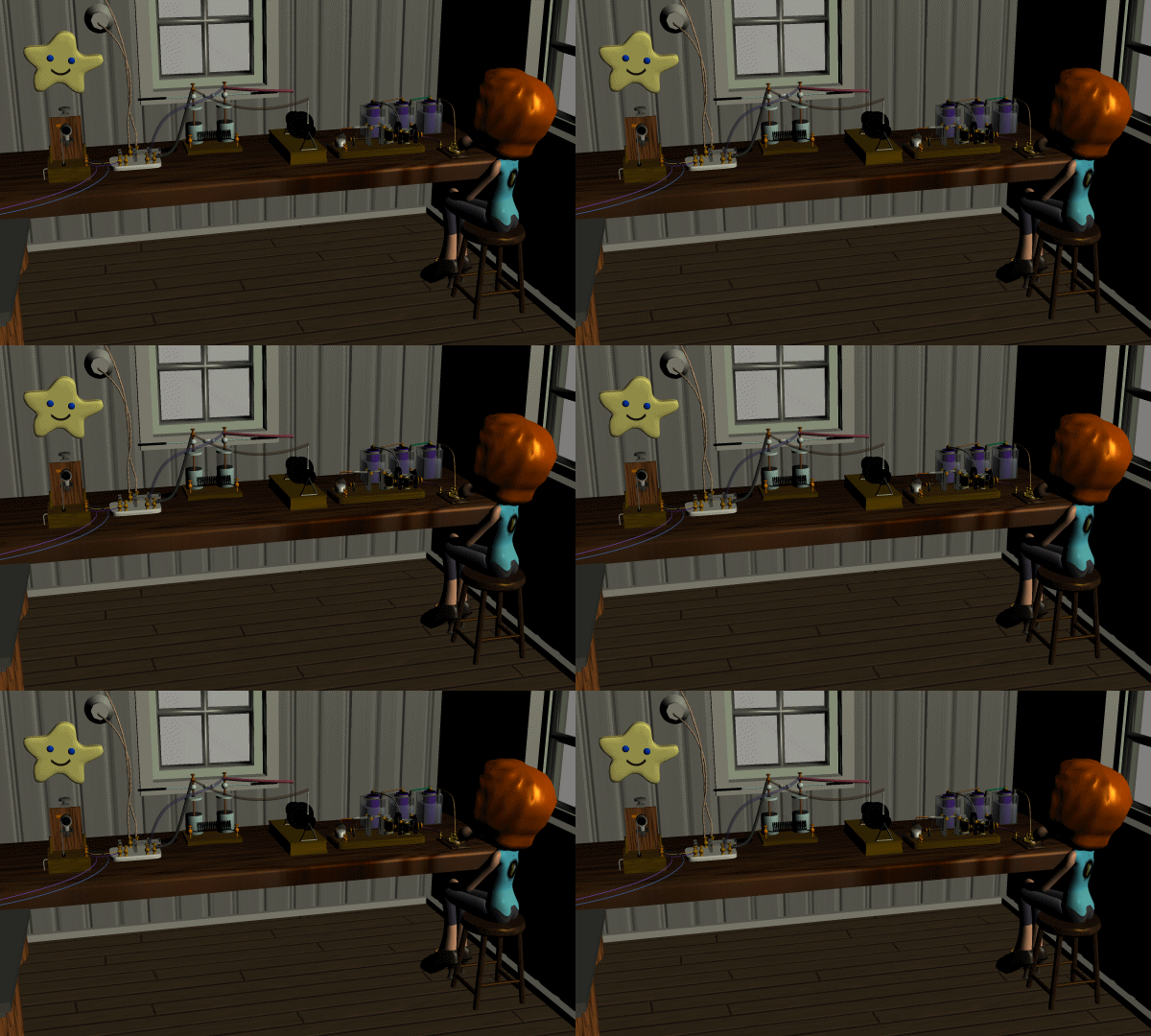
Let's start with a complete Lodge-Muirhead station, operated by Polistra with the help of Happystar.
Lodge designed a resonant antenna, with two conical capacitive elements tied by an inductive element.
 The station included, from right to left, the Morse key (hidden by Polistra); the Lodge Buzzer; an induction coil; a spark gap tuned by Leyden jar capacitors and an inductor; the transmit-receive switch leading out to the antenna; a Lodge Coherer; and finally a printer or tape-writer.
 The Lodge Buzzer was an overly complex way of providing AC to the primary of the induction coil. Most systems used a simple hammerbreak. The Buzzer was a three-stage relay, allowing the Morse key to handle low voltage and current. The fast switching of high current for the primary was done by a mercury dip.
 Now we see the whole thing ticking and tapping away, while Polistra sends a meaningful message through the antenna.
 Early telegraph rigs were extremely clocky, with all sorts of mechanical pendulums and escapements, and electrically switched pendulums.
Before looking at the Lodge Disc Coherer, we'll show the most common coherer.
Early telegraph rigs were extremely clocky, with all sorts of mechanical pendulums and escapements, and electrically switched pendulums.
Before looking at the Lodge Disc Coherer, we'll show the most common coherer.
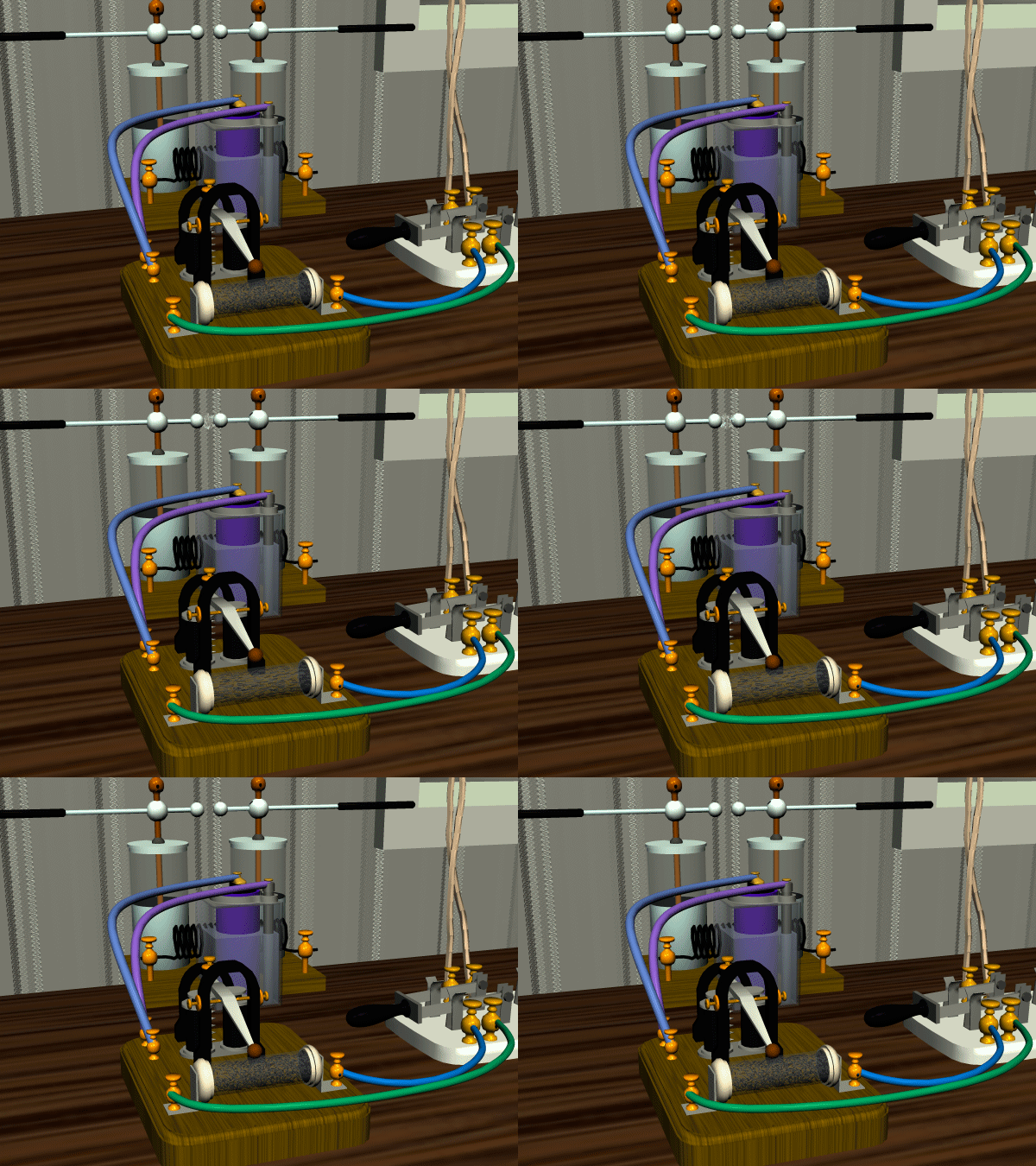 A glass tube with loose metal powder or filings inside. The tube was placed in series with a battery and the printer or tape-writer. Normally the filings had a high resistance, essentially non-conducting. When an RF signal came through the ether near the coherer, or a high-frequency signal was imposed on the DC, the filings lined up and cohered, closing the circuit and effectively acting like a relay. The filings wanted to remain lined up, so a mechanical tapper was needed to break them apart between dots and dashes. This tapper is run by a buzzer, but it could also be pure mechanical clockwork.
The Lodge Disc was entirely different.
A glass tube with loose metal powder or filings inside. The tube was placed in series with a battery and the printer or tape-writer. Normally the filings had a high resistance, essentially non-conducting. When an RF signal came through the ether near the coherer, or a high-frequency signal was imposed on the DC, the filings lined up and cohered, closing the circuit and effectively acting like a relay. The filings wanted to remain lined up, so a mechanical tapper was needed to break them apart between dots and dashes. This tapper is run by a buzzer, but it could also be pure mechanical clockwork.
The Lodge Disc was entirely different.
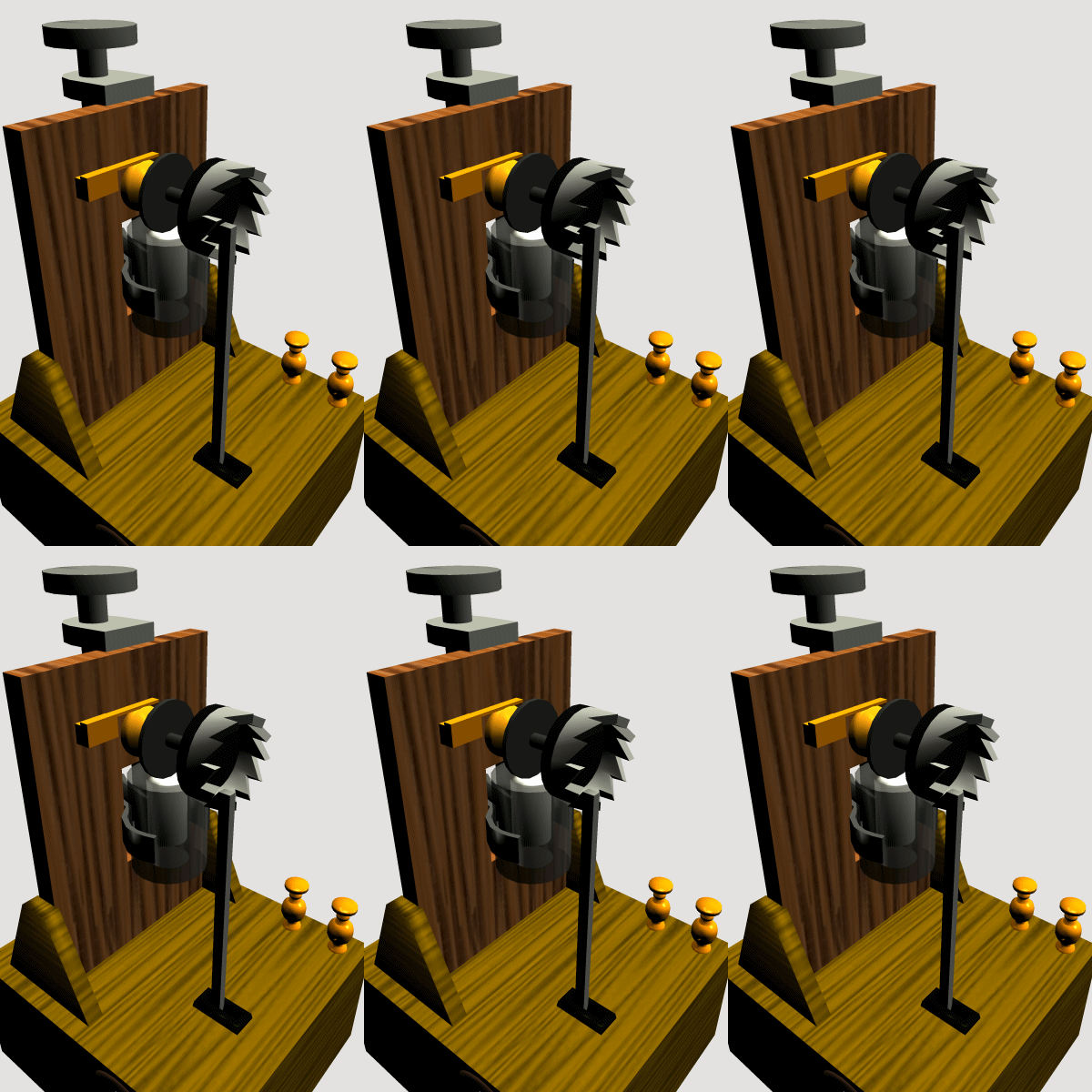 Here's a description of its action:
This is done by causing a small steel disc to revolve continuously in contact with a column of mercury, between which is interposed a thin film of oil. In action the coherer operates as follows: When the impinging waves set up oscillations in the resonator circuit the potential difference due to their cumulative effect disrupts the film of oil and at that instant cohesion takes place between the molecules of the solid and the fluid metals, only to be instantly restored by a partial revolution of the disc.
The thin layer of oil between dissimilar metals was probably acting like a semiconductor, similar to a catwhisker or even a bijunction transistor. "Cumulative" implies that some degree of rectifying was going on.
Marconi tried another variation on the constantly moving surface:
Here's a description of its action:
This is done by causing a small steel disc to revolve continuously in contact with a column of mercury, between which is interposed a thin film of oil. In action the coherer operates as follows: When the impinging waves set up oscillations in the resonator circuit the potential difference due to their cumulative effect disrupts the film of oil and at that instant cohesion takes place between the molecules of the solid and the fluid metals, only to be instantly restored by a partial revolution of the disc.
The thin layer of oil between dissimilar metals was probably acting like a semiconductor, similar to a catwhisker or even a bijunction transistor. "Cumulative" implies that some degree of rectifying was going on.
Marconi tried another variation on the constantly moving surface:
 Looks like a tape recorder or wire recorder. The large-diameter coil around the moving wire carried the DC, and the antenna was connected to the small-diameter coil inside it. When RF was present, the magnetic particles in the wire cohered, strengthening the core effect, raising the inductance of the large coil momentarily, and thus providing a pulse of added current in the larger coil. The moving loop gave this section of wire a chance to relax its coherence before it was used again.
Another inventor went full biological, reverting to Galvani.
Looks like a tape recorder or wire recorder. The large-diameter coil around the moving wire carried the DC, and the antenna was connected to the small-diameter coil inside it. When RF was present, the magnetic particles in the wire cohered, strengthening the core effect, raising the inductance of the large coil momentarily, and thus providing a pulse of added current in the larger coil. The moving loop gave this section of wire a chance to relax its coherence before it was used again.
Another inventor went full biological, reverting to Galvani.
 A frog leg carried a pen in its foot, and the RF was enough to trigger muscular contractions.
= = = = =
An early realization of the need for tuning came close to understanding the principle of rectifiers:
To excite the coherer under the conditions presumed to be necessary for
long distances, the impulses due to these waves must syntonize with the natural period of oscillation of the receiving circuit, and therefore these successive waves must pass by that circuit (wherever it may be), with the second following in the same phase as the first, or nearly so, otherwise the tendency of the second one will be to weaken or annul the effect of the first one.
Again emphasizing the cumulative effect. Almost got the point of rectifying, but not quite. Fleming finally realized that it was necessary to eliminate or invert the negative side of the sine wave. A symmetrical wave adds and subtracts equally, so the sum is zero. Removing one side made it possible to accumulate the RF power, which could then be filtered to sort out the modulation. But the realization was hard to grasp while the sparks and coherers were working together nicely.
= = = = =
Earlier I mentioned an attempt to see coherer-like activity in the brain. The experiments were interesting, and I noted that the connection was actually better than the 1906 researcher could see.
There's a separate coherer-like response in nearly all neurons, which didn't occur to me at that point. A spark-gap signal received by a coherer, complete with the buzzing and tapping and ticking at both ends, was a pulse train of varying length. A longer series of pulses for a dash, shorter series for a dot. This is how MOST neurons communicate and accumulate their signals. Pulse trains of varying lengths.
= = = = =
Happy ending:
Surprisingly, coherers are enjoying a second life in the new digital world.
A frog leg carried a pen in its foot, and the RF was enough to trigger muscular contractions.
= = = = =
An early realization of the need for tuning came close to understanding the principle of rectifiers:
To excite the coherer under the conditions presumed to be necessary for
long distances, the impulses due to these waves must syntonize with the natural period of oscillation of the receiving circuit, and therefore these successive waves must pass by that circuit (wherever it may be), with the second following in the same phase as the first, or nearly so, otherwise the tendency of the second one will be to weaken or annul the effect of the first one.
Again emphasizing the cumulative effect. Almost got the point of rectifying, but not quite. Fleming finally realized that it was necessary to eliminate or invert the negative side of the sine wave. A symmetrical wave adds and subtracts equally, so the sum is zero. Removing one side made it possible to accumulate the RF power, which could then be filtered to sort out the modulation. But the realization was hard to grasp while the sparks and coherers were working together nicely.
= = = = =
Earlier I mentioned an attempt to see coherer-like activity in the brain. The experiments were interesting, and I noted that the connection was actually better than the 1906 researcher could see.
There's a separate coherer-like response in nearly all neurons, which didn't occur to me at that point. A spark-gap signal received by a coherer, complete with the buzzing and tapping and ticking at both ends, was a pulse train of varying length. A longer series of pulses for a dash, shorter series for a dot. This is how MOST neurons communicate and accumulate their signals. Pulse trains of varying lengths.
= = = = =
Happy ending:
Surprisingly, coherers are enjoying a second life in the new digital world.
 In the '50s, US and Soviet researchers were using coherers as computer memory elements, taking advantage of the natural hold time to create a 'short-term' memory.
Several recent Japanese patents use old-style powder coherers for the original purpose, giving a sensitive relay-like response to small added AC. The patents use coherers in touch-sensitive pens, or to detect nearby lightning.
Convective question: Wouldn't it be nice if our wetware memory had a tapper to break up unwanted coherences? Instant answer: We do have a tapper. Walking. Also, some biofeedbackish therapy techniques use finger tapping for this exact purpose.
= = = = =
Here's the set for Poser at ShareCG.
Followup, a real experiment with a real coherer!
In the '50s, US and Soviet researchers were using coherers as computer memory elements, taking advantage of the natural hold time to create a 'short-term' memory.
Several recent Japanese patents use old-style powder coherers for the original purpose, giving a sensitive relay-like response to small added AC. The patents use coherers in touch-sensitive pens, or to detect nearby lightning.
Convective question: Wouldn't it be nice if our wetware memory had a tapper to break up unwanted coherences? Instant answer: We do have a tapper. Walking. Also, some biofeedbackish therapy techniques use finger tapping for this exact purpose.
= = = = =
Here's the set for Poser at ShareCG.
Followup, a real experiment with a real coherer!
The station included, from right to left, the Morse key (hidden by Polistra); the Lodge Buzzer; an induction coil; a spark gap tuned by Leyden jar capacitors and an inductor; the transmit-receive switch leading out to the antenna; a Lodge Coherer; and finally a printer or tape-writer.
The Lodge Buzzer was an overly complex way of providing AC to the primary of the induction coil. Most systems used a simple hammerbreak. The Buzzer was a three-stage relay, allowing the Morse key to handle low voltage and current. The fast switching of high current for the primary was done by a mercury dip.
Now we see the whole thing ticking and tapping away, while Polistra sends a meaningful message through the antenna.
Early telegraph rigs were extremely clocky, with all sorts of mechanical pendulums and escapements, and electrically switched pendulums.
Before looking at the Lodge Disc Coherer, we'll show the most common coherer.
A glass tube with loose metal powder or filings inside. The tube was placed in series with a battery and the printer or tape-writer. Normally the filings had a high resistance, essentially non-conducting. When an RF signal came through the ether near the coherer, or a high-frequency signal was imposed on the DC, the filings lined up and cohered, closing the circuit and effectively acting like a relay. The filings wanted to remain lined up, so a mechanical tapper was needed to break them apart between dots and dashes. This tapper is run by a buzzer, but it could also be pure mechanical clockwork.
The Lodge Disc was entirely different.
Here's a description of its action:
This is done by causing a small steel disc to revolve continuously in contact with a column of mercury, between which is interposed a thin film of oil. In action the coherer operates as follows: When the impinging waves set up oscillations in the resonator circuit the potential difference due to their cumulative effect disrupts the film of oil and at that instant cohesion takes place between the molecules of the solid and the fluid metals, only to be instantly restored by a partial revolution of the disc.
The thin layer of oil between dissimilar metals was probably acting like a semiconductor, similar to a catwhisker or even a bijunction transistor. "Cumulative" implies that some degree of rectifying was going on.
Marconi tried another variation on the constantly moving surface:
Looks like a tape recorder or wire recorder. The large-diameter coil around the moving wire carried the DC, and the antenna was connected to the small-diameter coil inside it. When RF was present, the magnetic particles in the wire cohered, strengthening the core effect, raising the inductance of the large coil momentarily, and thus providing a pulse of added current in the larger coil. The moving loop gave this section of wire a chance to relax its coherence before it was used again.
Another inventor went full biological, reverting to Galvani.
A frog leg carried a pen in its foot, and the RF was enough to trigger muscular contractions.
= = = = =
An early realization of the need for tuning came close to understanding the principle of rectifiers:
To excite the coherer under the conditions presumed to be necessary for
long distances, the impulses due to these waves must syntonize with the natural period of oscillation of the receiving circuit, and therefore these successive waves must pass by that circuit (wherever it may be), with the second following in the same phase as the first, or nearly so, otherwise the tendency of the second one will be to weaken or annul the effect of the first one.
Again emphasizing the cumulative effect. Almost got the point of rectifying, but not quite. Fleming finally realized that it was necessary to eliminate or invert the negative side of the sine wave. A symmetrical wave adds and subtracts equally, so the sum is zero. Removing one side made it possible to accumulate the RF power, which could then be filtered to sort out the modulation. But the realization was hard to grasp while the sparks and coherers were working together nicely.
= = = = =
Earlier I mentioned an attempt to see coherer-like activity in the brain. The experiments were interesting, and I noted that the connection was actually better than the 1906 researcher could see.
There's a separate coherer-like response in nearly all neurons, which didn't occur to me at that point. A spark-gap signal received by a coherer, complete with the buzzing and tapping and ticking at both ends, was a pulse train of varying length. A longer series of pulses for a dash, shorter series for a dot. This is how MOST neurons communicate and accumulate their signals. Pulse trains of varying lengths.
= = = = =
Happy ending:
Surprisingly, coherers are enjoying a second life in the new digital world.
In the '50s, US and Soviet researchers were using coherers as computer memory elements, taking advantage of the natural hold time to create a 'short-term' memory.
Several recent Japanese patents use old-style powder coherers for the original purpose, giving a sensitive relay-like response to small added AC. The patents use coherers in touch-sensitive pens, or to detect nearby lightning.
Convective question: Wouldn't it be nice if our wetware memory had a tapper to break up unwanted coherences? Instant answer: We do have a tapper. Walking. Also, some biofeedbackish therapy techniques use finger tapping for this exact purpose.
= = = = =
Here's the set for Poser at ShareCG.
Followup, a real experiment with a real coherer!
Labels: Equipoise, Happy Ending, Lodge, Morsenet of Things, Trinity House
¶ 2:55 PM

