
Friday, April 02, 2021
Rediscovering as usual
This bit of research is part of the "rediscovery" of electrotherapeutics. Researchers found that:
In compulsive “addicted” rats, low (30 Hz) but not high (130 Hz), deep brain stimulation (DBS) of the STN efficiently reduces pathological cocaine seeking.
I was curious to see if this correlation was known by the original electrotherapists. I couldn't find a direct connection to cocaine because cocaine and opium were just ordinary medications at that time, not forbidden fruits. In the 1880s no substance was considered to be witchy.
I did find one use of frequencies in the same range to get rid of a persistent muscle spasm, which is on the same end of the spectrum as cocaine.
From Journal of Electrotherapeutics:


Aroloring and Chantre have made some interesting studies into the contractions of the sphincter ani. The form and duration of the muscular shock are modified, and the muscle shows a greater aptitude to become tetanized in comparison to other muscles . The contraction is slower in starting and disappearing and in graphic tracings the summit is less acute and the duration of the contractions longer than in an ordinary muscle. Fewer excitations are necessary to tetanize it. Under the influence of excitations induced at the rate of 3 per second , the contractors of the sphincter become confused and cease to be visible when the excitations are increased to 22 or 24 per second. The primary effect of an excitation is to produce a brief diminution of the tonicity of the muscle.In other words, 24 cps 'confuses' the contracting muscle and breaks up its spasm.
Labels: 1901
¶ 1:11 AM
Friday, September 11, 2020
Grandinifughi
Last week I ran across these strange devices while looking for something else, as usual.
 On further reading, it turns out that hail cannons were a big business for about 20 years. French and Italian farmers were convinced that the cannons made a difference. Like cloud seeding, they didn't halt the weather every time, but they dissipated hail often enough to save massive amounts of money and trouble. Unlike cloud seeding, there was no downside. Seeding is a zero-sum procedure, depriving one location of rain to favor another location. Deicing the hail doesn't move the precip, it just avoids the damage.
Major agricultural implement companies made hail cannons along with plows and seeders and cream separators. Genuine scientific conferences were held annually, showing off the latest experiments and inventions.
The French called them canons contre grèle or grelifuges, and the Italians called them Grandinifughi. A word you can chew on!
Here's part of a wonderfully lyrical account from a 1901 cultural magazine (p 662 of the PDF):
On further reading, it turns out that hail cannons were a big business for about 20 years. French and Italian farmers were convinced that the cannons made a difference. Like cloud seeding, they didn't halt the weather every time, but they dissipated hail often enough to save massive amounts of money and trouble. Unlike cloud seeding, there was no downside. Seeding is a zero-sum procedure, depriving one location of rain to favor another location. Deicing the hail doesn't move the precip, it just avoids the damage.
Major agricultural implement companies made hail cannons along with plows and seeders and cream separators. Genuine scientific conferences were held annually, showing off the latest experiments and inventions.
The French called them canons contre grèle or grelifuges, and the Italians called them Grandinifughi. A word you can chew on!
Here's part of a wonderfully lyrical account from a 1901 cultural magazine (p 662 of the PDF):
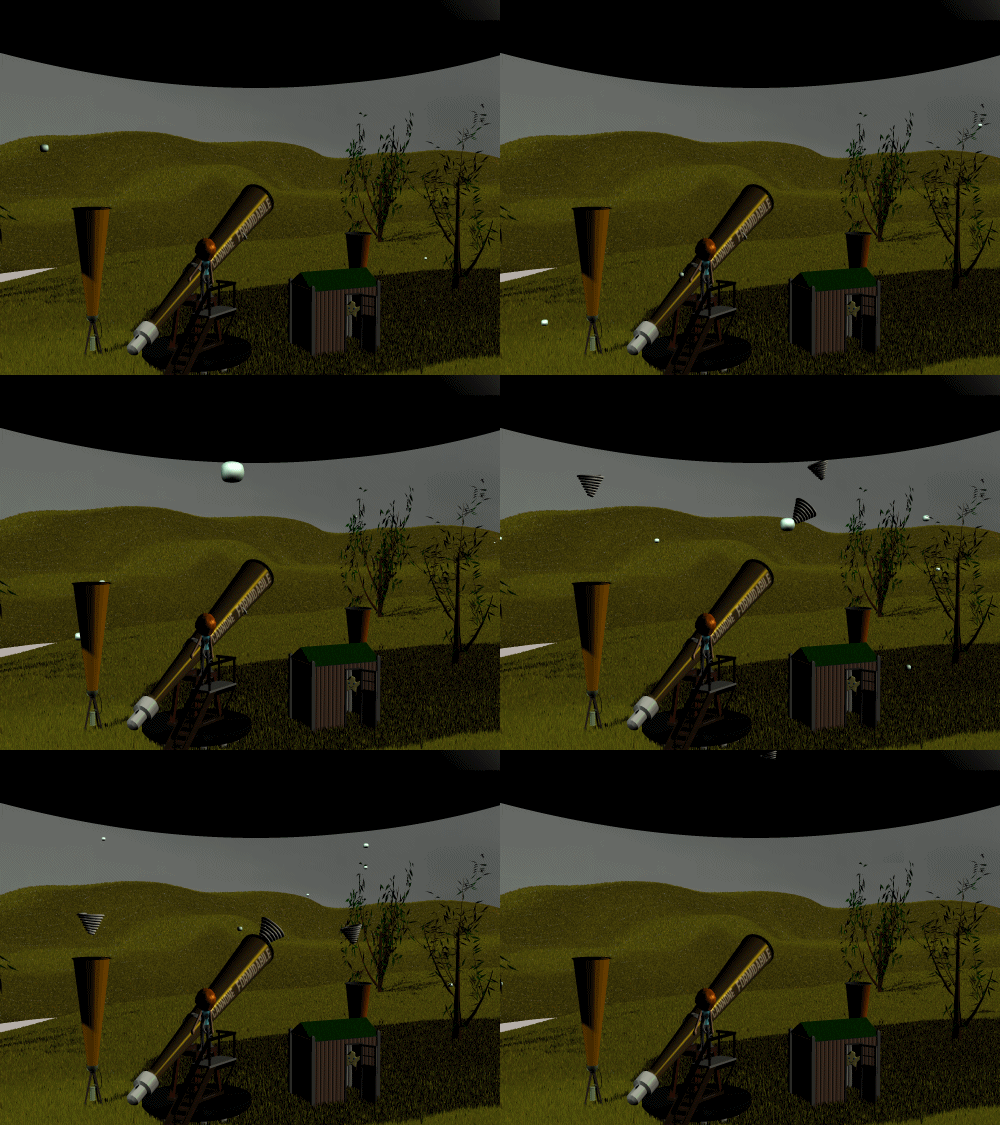 Polistra is at the controls of CANNONE FORMIDABILE, a full-fledged artillery piece with azimuth and altitude adjustments:
 Happystar is supervising a cannon built into its own cozy shed, with a separate inner room where the tireur could sit and wait for the storm while sipping the products of the vineyard he was protecting.
 An automatic acetylene cannon is in the background, developed by Maghiora and Blanchi.
 Did the cannons make sense? We know from wind-tunnel studies of streamlining that a vortex breaks up smooth airflow. The purpose of streamlining is twofold: First avoid flat surfaces directly pushing the air; second, avoid vortices. You want the air to split smoothly around the car or plane, and rejoin smoothly afterward.
The end of the Grandinifughi era isn't clear. Did the farmers decide that the Grandinifughi weren't worth the effort? Or did insurance companies make damage more profitable than prevention? Flood insurance works that way.
= = = = =
Happy ending! Grelifuges are STILL USED in France and Italy, and STILL MADE in Spain, and they look about the same as the 1902 versions! The new cannons use acetylene, continuing the tech invented by Maghiora and Blanchi. Video of a modern grelifuge. Live action with a visible and audible whirlwind-ring at 4:14. The old description wasn't lyrical, it was accurate!
= = = = =
Etymological footnote: The French and Italian words for hail are opposite. Grèle comes from Latin gracilis, and means slim or small when used as an adjective. Grandini comes from a root meaning 'coarse-grained', thus by extension grinding and grain and grand and things that grind, including hail. My initial impression of 'chewiness' was spot on.
Did the cannons make sense? We know from wind-tunnel studies of streamlining that a vortex breaks up smooth airflow. The purpose of streamlining is twofold: First avoid flat surfaces directly pushing the air; second, avoid vortices. You want the air to split smoothly around the car or plane, and rejoin smoothly afterward.
The end of the Grandinifughi era isn't clear. Did the farmers decide that the Grandinifughi weren't worth the effort? Or did insurance companies make damage more profitable than prevention? Flood insurance works that way.
= = = = =
Happy ending! Grelifuges are STILL USED in France and Italy, and STILL MADE in Spain, and they look about the same as the 1902 versions! The new cannons use acetylene, continuing the tech invented by Maghiora and Blanchi. Video of a modern grelifuge. Live action with a visible and audible whirlwind-ring at 4:14. The old description wasn't lyrical, it was accurate!
= = = = =
Etymological footnote: The French and Italian words for hail are opposite. Grèle comes from Latin gracilis, and means slim or small when used as an adjective. Grandini comes from a root meaning 'coarse-grained', thus by extension grinding and grain and grand and things that grind, including hail. My initial impression of 'chewiness' was spot on.
On further reading, it turns out that hail cannons were a big business for about 20 years. French and Italian farmers were convinced that the cannons made a difference. Like cloud seeding, they didn't halt the weather every time, but they dissipated hail often enough to save massive amounts of money and trouble. Unlike cloud seeding, there was no downside. Seeding is a zero-sum procedure, depriving one location of rain to favor another location. Deicing the hail doesn't move the precip, it just avoids the damage.
Major agricultural implement companies made hail cannons along with plows and seeders and cream separators. Genuine scientific conferences were held annually, showing off the latest experiments and inventions.
The French called them canons contre grèle or grelifuges, and the Italians called them Grandinifughi. A word you can chew on!
Here's part of a wonderfully lyrical account from a 1901 cultural magazine (p 662 of the PDF):
The terror of hail is as old as Adam's first planting season, and the hysterical efforts of man to do away with it date from that same springtime. It is just another phase of man's striving to climb back into Eden, where it does not hail. So he rang bells and made other noises, at first in religious appeal, and then with a vague notion of turning the storm by deafening detonations. Neither is the more scientific idea of shooting against clouds a new one. In 1760 the Chevalier de Jancourt, a physicist, noted that it never hailed on besieged towns, and urged wise men to get to work against what he called the most costly form of divine wrath. But the wise men were not wise enough, and the peasants rang their bells as before, and then declared that it would have hailed harder if they had not rung them.The author visited actual farms and watched the Grelifuges in action. He talked to the farmers and grape-growers and scientists. Conclusion:
Cannons have been fired against hailstorms, and hail did not fall. You might say that hail would not have fallen anyhow. But it did fall anyhow - that is, all around except on the spot covered by cannon. Again there remains the other possible coincidence: namely, that the hail had no designs against that particular exempted spot in the first place. But there is still an answering fact; for when the shooting ceased, the rain changed to hail, and when the shooting recommenced the hail as quickly changed back to rain. This is not an isolated instance, but the general case. ....... A veteran artilleur who had lost a leg in the service demonstrated how simply and safely this particular gun can be handled. He first produced one of the empty cartridges. This was of specially forged steel, about eight inches long. He adjusted a percussion cap, rammed in eighty grammes of mining powder, and ended with a wad of soft wood... The artilleryman advised us to watch for the whirlwind-ring, and then he pulled the string. The explosion sounded like the heavy boom of rock-blasting. You knew vaguely that the tripod was hidden in smoke, and that a white cloud had puffed from the mouth of the funnel. Then, as though growing out of the shock of the explosion, there came the sound of a long, shrill whistling. It was like the fierce metallic singing of some monster tuning-fork, mounting to a more angry pitch as it hurled higher in air. There, away up in the sky, was a gauzy ring as of smoke, still ascending and still buzzing on that shrill crescendo note. The ring was outlined against the deep blue like a soft, silky wreath, in the rays of the sun it was brilliant and changing, and then again shaded. One second later, and it had vanished in space. That, briefly, is the tore, or whirlwind-ring, which bursts from the cannon.And what happened after the vortex penetrated the cloud?
But even as the spectator on the hill was losing hope for the much-vaunted cannon, he looked up again. There was a disturbance going on in the darkest cloud, just over the vineyards. It looked like billows of rolling, tossing smoke up there. Then all at once the cloud opened, and through the rift was the glorious gold of the afternoon sun. At last, here was a breach in the enemy's flank. A gunner below shouted involuntarily, and all of them worked faster and faster yet. Each cannon was counting two, three, shots to the minute. Other breaks showed in the clouds. There was a moment of wavering, and then panic. The dark-browed invader broke and fled. He scattered towards the hills, and in his retreat he sent down a discouraged volley of raindrops.Or in more prosaic form, the cannons broke the updrafts that encouraged hail, and left a heavy rain. Here's my attempt to capture the scene.
Polistra is at the controls of CANNONE FORMIDABILE, a full-fledged artillery piece with azimuth and altitude adjustments:
Happystar is supervising a cannon built into its own cozy shed, with a separate inner room where the tireur could sit and wait for the storm while sipping the products of the vineyard he was protecting.
An automatic acetylene cannon is in the background, developed by Maghiora and Blanchi.
Did the cannons make sense? We know from wind-tunnel studies of streamlining that a vortex breaks up smooth airflow. The purpose of streamlining is twofold: First avoid flat surfaces directly pushing the air; second, avoid vortices. You want the air to split smoothly around the car or plane, and rejoin smoothly afterward.
The end of the Grandinifughi era isn't clear. Did the farmers decide that the Grandinifughi weren't worth the effort? Or did insurance companies make damage more profitable than prevention? Flood insurance works that way.
= = = = =
Happy ending! Grelifuges are STILL USED in France and Italy, and STILL MADE in Spain, and they look about the same as the 1902 versions! The new cannons use acetylene, continuing the tech invented by Maghiora and Blanchi. Video of a modern grelifuge. Live action with a visible and audible whirlwind-ring at 4:14. The old description wasn't lyrical, it was accurate!
= = = = =
Etymological footnote: The French and Italian words for hail are opposite. Grèle comes from Latin gracilis, and means slim or small when used as an adjective. Grandini comes from a root meaning 'coarse-grained', thus by extension grinding and grain and grand and things that grind, including hail. My initial impression of 'chewiness' was spot on.
Labels: 1901, Asked and partly answered, Happy Ending, Morsenet of Things
¶ 5:11 PM
Saturday, September 05, 2020
Was Hollerith famous?
An article in a 1902 SciAm basically translates an earlier article in the French La Nature.
This was the French answer to Hollerith, and the French author considered it superior to Hollerith.
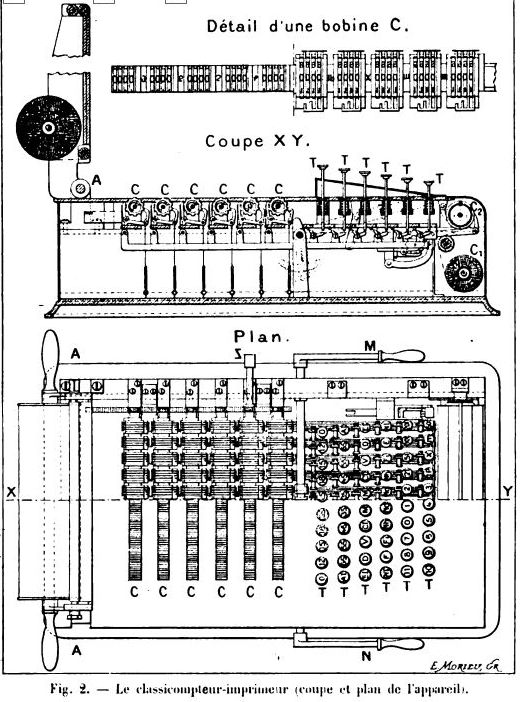
 When SciAm translated the article, they didn't even bother to correct the spelling of 'Hollrith', and didn't try to defend his reputation.
The neat little shed wasn't a shelter for le tireur de grèle; it housed the acetylene generator and trigger mechanism for the cannon. Le tireur was meant to stay in his farmhouse and control the system remotely.
When SciAm translated the article, they didn't even bother to correct the spelling of 'Hollrith', and didn't try to defend his reputation.
The neat little shed wasn't a shelter for le tireur de grèle; it housed the acetylene generator and trigger mechanism for the cannon. Le tireur was meant to stay in his farmhouse and control the system remotely.
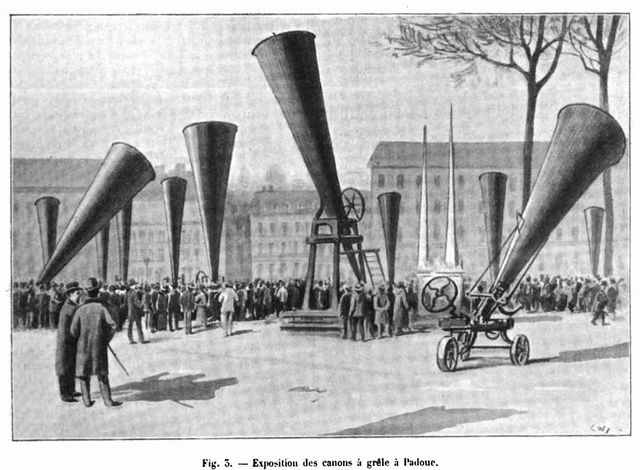 Reminds me of this.
When SciAm translated the article, they didn't even bother to correct the spelling of 'Hollrith', and didn't try to defend his reputation.
M. MARCH, chief of the Bureau of Statistics, who had charge of the operations connected with the taking of the last census in France, has devised an apparatus that permits of registering in their entire extent the manifold answers figuring on the census cards to be abstracted. This machine, which is called a "classicompteur-imprimeur" (printing classification counter) comprises simple mechanical combinations only. M. March's apparatus possesses manifold advantages over all similar ones invented up to the present time, in that (1) it permits of the direct abstracting or epitomizing of the census cards without a preliminary transcription upon special cards, as is necessary with the Hollrith machine; (2) it gives definite results with the first manipulation of the cards; (3) since the control of the registering apparatus is mechanical, there is no fear of errors in reading or transcription; (4) after the abstracting of each series of cards, all the counters having been brought to zero, the operations are greatly simplified, since differences never have to be established between the consecutive numbers registered; (5) it is easily manipulated.Hollerith's machine was in rapid commercial development at that time, and had already served in two censuses. Was he obscure enough that SciAm didn't notice the misspelling? = = = = = Another item in the same 1901 La Nature was more intrinsically interesting. This hail cannon, invented in Italy, was claimed to protect 50 acres of farmland or vineyard from hail. It used electrically triggered acetylene explosions, sending shock waves up into the clouds to break the circulation. Would it also prevent tornados? (The artist suggests this with an incipient funnel cloud.)
The neat little shed wasn't a shelter for le tireur de grèle; it housed the acetylene generator and trigger mechanism for the cannon. Le tireur was meant to stay in his farmhouse and control the system remotely.
Reminds me of this.Labels: 1901
¶ 2:03 PM
Saturday, February 22, 2020
Better proof
I was playing with my Great Smith set, and noticed a bit of logic or evidence that I hadn't taken into account before.
 In the first decade of autos, American cars continued our French-influenced habit of driving on the right side of the street, and the steering wheel was also on the right. The Ford T started the transition to left steering, but the transition was slow. Some expensive cars were still right-wheeled in 1920.
Earlier I had tried to think about our road chirality, but missed this point.
= = = = = START PARTIAL REPRINT:
[The cited article] quotes a Wikipedia explanation for America's right-hand driving habit. The explanation seems to have appeared first in Popular Science in 1925.
In the first decade of autos, American cars continued our French-influenced habit of driving on the right side of the street, and the steering wheel was also on the right. The Ford T started the transition to left steering, but the transition was slow. Some expensive cars were still right-wheeled in 1920.
Earlier I had tried to think about our road chirality, but missed this point.
= = = = = START PARTIAL REPRINT:
[The cited article] quotes a Wikipedia explanation for America's right-hand driving habit. The explanation seems to have appeared first in Popular Science in 1925.
In the first decade of autos, American cars continued our French-influenced habit of driving on the right side of the street, and the steering wheel was also on the right. The Ford T started the transition to left steering, but the transition was slow. Some expensive cars were still right-wheeled in 1920.
Earlier I had tried to think about our road chirality, but missed this point.
= = = = = START PARTIAL REPRINT:
[The cited article] quotes a Wikipedia explanation for America's right-hand driving habit. The explanation seems to have appeared first in Popular Science in 1925.
Then the balance of power shifted. In the United States, wagons were increasingly common on the roads. Drawn by up to 20 animals, they were a popular way of transporting goods over long distances – and the men helming these vehicles liked to drive on the right. They’d sit on the rear leftmost horse, so it was easier to make sure oncoming traffic didn’t get too close if it was also on the left. There wasn’t any arguing with the momentum of 20 1,000-pound (453kg) horses. Other road traffic quickly got used to driving on the right and the rule stuck. Hundreds of years on, right-side driving is irreversibly embedded in US street design.Supposedly some drivers of Conestoga wagons formed a national habit. I can't prove this one wrong, but a tendency among some long-distance freighters seems unlikely to set a habit for city streets. More likely:
In France, traditionally foot traffic had kept right, while carriage traffic kept left. Following the French Revolution, all traffic kept right. The first keep-right law for driving in the United States was passed in 1792 and applied to the Philadelphia and Lancaster Turnpike. New York formalized RHT in 1804, New Jersey in 1813 and Massachusetts in 1821.Note the dates. We were consciously following French trends and erasing British tendencies after the Revolution. = = = = = END PARTIAL REPRINT I was using the pre-existing French habit to disprove the Popular Science logic. Our first automobiles were a much more decisive disproof. If we had formed our habits from the left-horse drivers of Conestogas, we would have placed the steering wheel on the left horse immediately and consistently. But we didn't. We began with the driver on the right horse, and gradually changed to the left horse over 20 years. More broadly, the driving position doesn't seem to matter much. There are advantages both ways, and the outside position has more advantages. Driving near the centerline makes it easier to pull out for a pass. Driving on the outside makes it easier to see pedestrians and parked cars, and easier to see the edge of the road. We think of driving on the outside as strange, but we do it all the time in the left lane of one-way streets and divided highways.
Labels: 1901, Answered better than asked
¶ 1:52 AM
Sunday, February 09, 2020
Acetylene world 7, patience rewarded
Polistra and Happystar are puttering through the countryside in their Great Smith runabout.
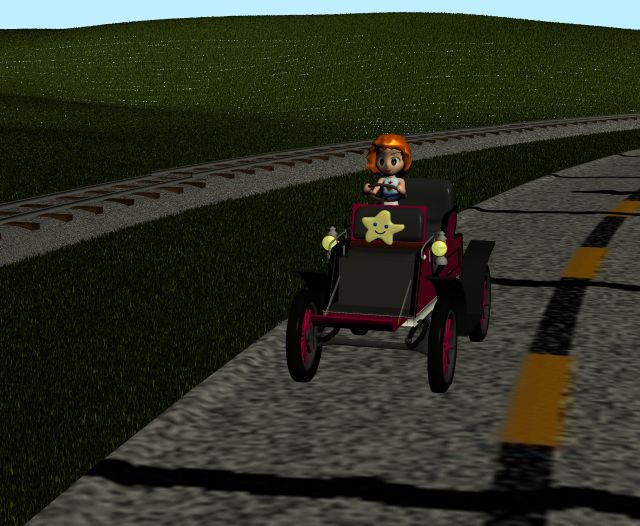 Puttering turns to sputtering, and the car is out of gas.
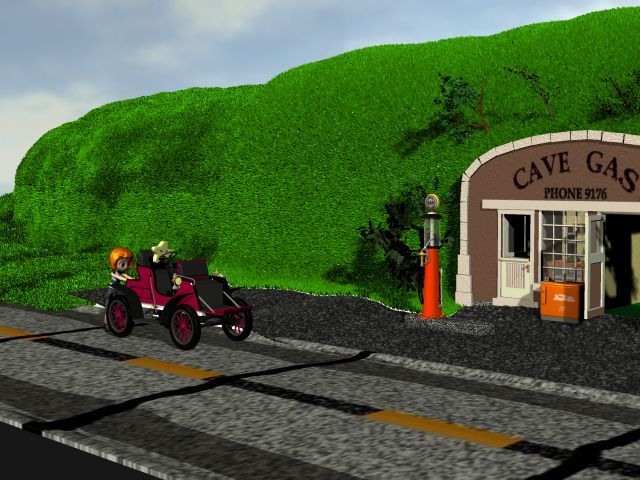 This place might have gas. It says gas.
 Oops, it's closed, and seems to have been closed for a long time. Might as well explore since nobody is around.
 Was this a fallout shelter many years ago? What's behind the door?
 Cave! Well, the sign says Cave Gas. It's dark. Here's a table with more stuff on it. Mostly powdered stuff.
 Instant everything, just add water. Good shelter supplies. Well, what we need here is light. Let's try the Instant Light....
 Aha! A lamp! Polistra knows how things work, so she tries to light the lamp.
A carbide lamp has upper and lower compartments. The upper section holds a tablespoon of water, and the lower section holds a similar volume of carbide rocks.
Aha! A lamp! Polistra knows how things work, so she tries to light the lamp.
A carbide lamp has upper and lower compartments. The upper section holds a tablespoon of water, and the lower section holds a similar volume of carbide rocks.
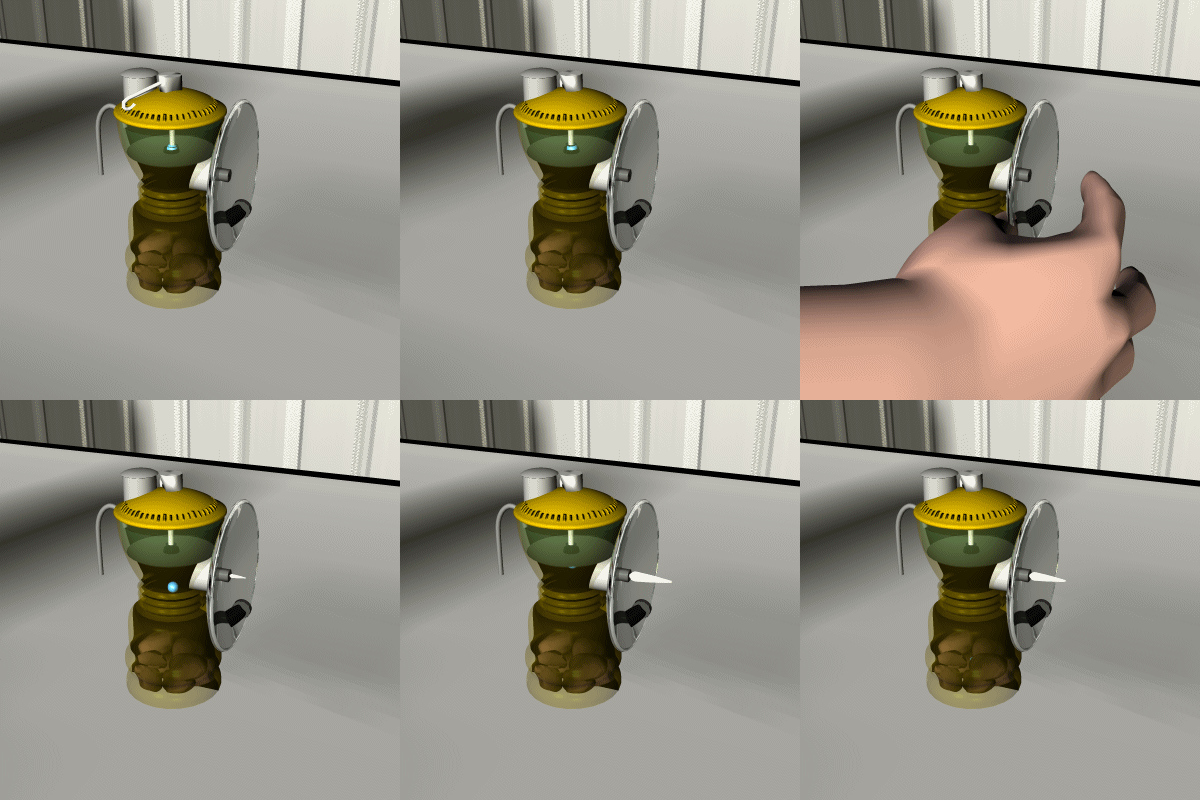 The control lever is threaded. When you turn it leftward, the valve lifts slightly and lets water drip onto the carbide. Acetylene gas forms immediately. When you hear the nozzle hissing, you flick the flint and presto! Bright steady light.
Now that we've got light, let's look at the book.
It's a guide to acetylene by Lewes. It has a good description of using a carbide lamp. The numbers are expressed in a natural way:
The control lever is threaded. When you turn it leftward, the valve lifts slightly and lets water drip onto the carbide. Acetylene gas forms immediately. When you hear the nozzle hissing, you flick the flint and presto! Bright steady light.
Now that we've got light, let's look at the book.
It's a guide to acetylene by Lewes. It has a good description of using a carbide lamp. The numbers are expressed in a natural way:
 What else is in the book? A description of Baldwin's carbide lamp, which was a bit fancier than this basic lamp. Baldwin used the same feedback principle as Willson's buoy. The water itself formed the 'fulcrum' of the differential balance.
 Baldwin's description resonates beautifully with Polistra's line of thought:
 Polistra is happy.
= = = = =
Later note: This was written just a week before "CLIMATE" EMERGENCY shifted smoothly to the vastly more holocaustal "VIRUS" EMERGENCY. The same comparison and the same graph apply to the new Top Gear of the holocaust machine, because it's the same monstrosity created and operated by the same monsters. Only the names have changed to slaughter the innocent.
Polistra is happy.
= = = = =
Later note: This was written just a week before "CLIMATE" EMERGENCY shifted smoothly to the vastly more holocaustal "VIRUS" EMERGENCY. The same comparison and the same graph apply to the new Top Gear of the holocaust machine, because it's the same monstrosity created and operated by the same monsters. Only the names have changed to slaughter the innocent.
Puttering turns to sputtering, and the car is out of gas.
This place might have gas. It says gas.
Oops, it's closed, and seems to have been closed for a long time. Might as well explore since nobody is around.
Was this a fallout shelter many years ago? What's behind the door?
Cave! Well, the sign says Cave Gas. It's dark. Here's a table with more stuff on it. Mostly powdered stuff.
Instant everything, just add water. Good shelter supplies. Well, what we need here is light. Let's try the Instant Light....
Aha! A lamp! Polistra knows how things work, so she tries to light the lamp.
A carbide lamp has upper and lower compartments. The upper section holds a tablespoon of water, and the lower section holds a similar volume of carbide rocks.
The control lever is threaded. When you turn it leftward, the valve lifts slightly and lets water drip onto the carbide. Acetylene gas forms immediately. When you hear the nozzle hissing, you flick the flint and presto! Bright steady light.
Now that we've got light, let's look at the book.
It's a guide to acetylene by Lewes. It has a good description of using a carbide lamp. The numbers are expressed in a natural way:
When acetylene gas burns in air the gases given off by the flame consist of carbon dioxide (CO2), and water (H2O) in the form of steam, neither of which can be seen. In burning 1 cubic foot of acetylene, 2 cubic feet of oxygen is required; the products are 2 cubic feet of carbon dioxide and 1 cubic foot of steam. The ordinary types of miners' carbide cap lamps use 1/2 ounce of carbide in an hour, and make 0.1 cubic foot of acetylene gas. In burning 0.1 cubic foot of this gas, 0.36 cubic foot of oxygen, or 1.8 cubic feet of air, is required, and there is given off by the flame 0.3 cubic foot of carbon dioxide. In one hour the lamp in a confined space measuring 3 by 5 by 10 feet, or 150 cubic feet, would take from the air 0.36 cubic foot of oxygen, and add 0.288 cubic foot of CO2, which, added to the 0.006 cubic foot (or 0.04 of 1 per cent) of CO2 in 150 cubic feet of ordinary mine air, would total 0.294 cubic foot, or 0.196 of 1 per cent of CO2.There's an interesting number from 1900. Ordinary air had .04 of 1 percent CO2, or 4/10000 of the total quantity. How does this compare with 2020 CLIMATE EMERGENCY? As we know from Michael Mann and Greta, our air is now MORE THAN 100000000000% CO2, which causes WEATHER to happen. There was no weather in 1900. Let's check with Wikipedia, which is definitely not TRUMPKKKTRUMPHITLER. By volume, dry air contains 78.09% nitrogen, 20.95% oxygen, 0.93% argon, 0.04% carbon dioxide, and small amounts of other gases. See? Toldja so. EMERGENCY!!! Now we'll graphically compare the normal .04 of 1 percent in 1900 with the GRAVE EMERGENCY .04 of 1 percent in 2020. We can see from the chart that MORE THAN ALL of our atmosphere is now CO2!!!!!
What else is in the book? A description of Baldwin's carbide lamp, which was a bit fancier than this basic lamp. Baldwin used the same feedback principle as Willson's buoy. The water itself formed the 'fulcrum' of the differential balance.
Baldwin's description resonates beautifully with Polistra's line of thought:
The Automatic feed of the Baldwin cannot make a mistake, for it is based on a natural law. It must be and is more reliable than the steam engine governor which is built according to mechanical laws and is a mechanical device. One is based on mechanical law, the other a natural law. A valve regulated lamp operates under mechanical law and needs help. Lamps operated under a natural law do not. A valve regulated lamp therefore, lacks that automatic feature which is essential in a practical and satisfactory miner's lamp. In the Baldwin, the moment there is an excess of gas this excess cuts off the water and the carbide deprived of the water cannot further generate gas.Patience rewarded with a wonderfully patient mechanism and NATURAL LAW.
Polistra is happy.
= = = = =
Later note: This was written just a week before "CLIMATE" EMERGENCY shifted smoothly to the vastly more holocaustal "VIRUS" EMERGENCY. The same comparison and the same graph apply to the new Top Gear of the holocaust machine, because it's the same monstrosity created and operated by the same monsters. Only the names have changed to slaughter the innocent.
Labels: 1901, Carbon Cult, Patient things
¶ 10:27 AM
Monday, February 03, 2020
Acetylene world 5: patient automation
Continuing the acetylene theme.
Automatic warning buoys were powered by acetylene for a long time. Canada used them best, and the best inventor was Canadian.
Thomas Willson spent his life inventing and improving lights. He succeeded and got rich. Later he tried to diversify and failed:
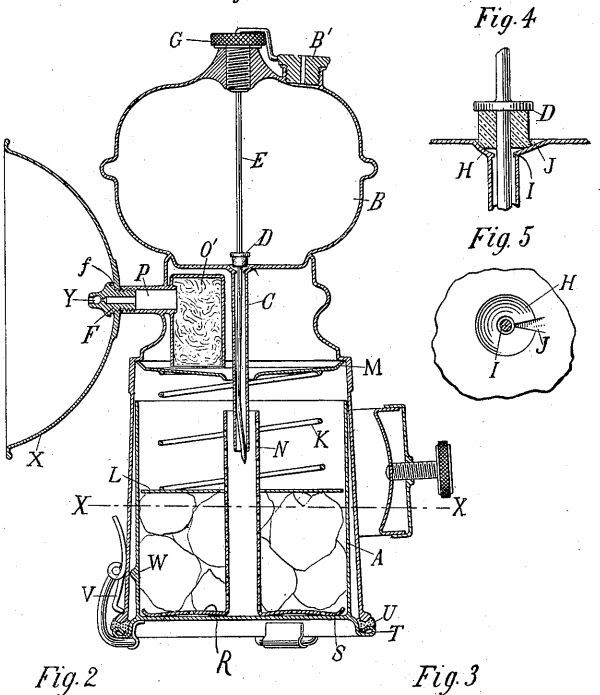
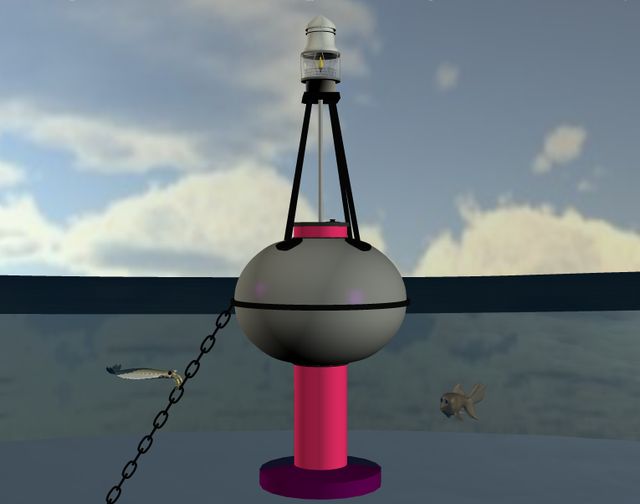 It has an air-filled float in the middle, anchored to the seabed. The long cylindrical chamber containing carbide passes through the float, with a counterweight or ballast at the bottom. A hole in the ballast admits water from below. Acetylene gas produced by the carbide reaction flows through a pipe to the lamp on top. (The lamp is standard, not inventive).
The basic problem: You can't let water surge in and soak all the carbide. You'll get a huge explosive reaction and use up the material fast. You need to expose just enough of the carbide to feed the lamp.
Willson's just enough solution starts with this screen or sieve near the bottom of the chamber:
It has an air-filled float in the middle, anchored to the seabed. The long cylindrical chamber containing carbide passes through the float, with a counterweight or ballast at the bottom. A hole in the ballast admits water from below. Acetylene gas produced by the carbide reaction flows through a pipe to the lamp on top. (The lamp is standard, not inventive).
The basic problem: You can't let water surge in and soak all the carbide. You'll get a huge explosive reaction and use up the material fast. You need to expose just enough of the carbide to feed the lamp.
Willson's just enough solution starts with this screen or sieve near the bottom of the chamber:
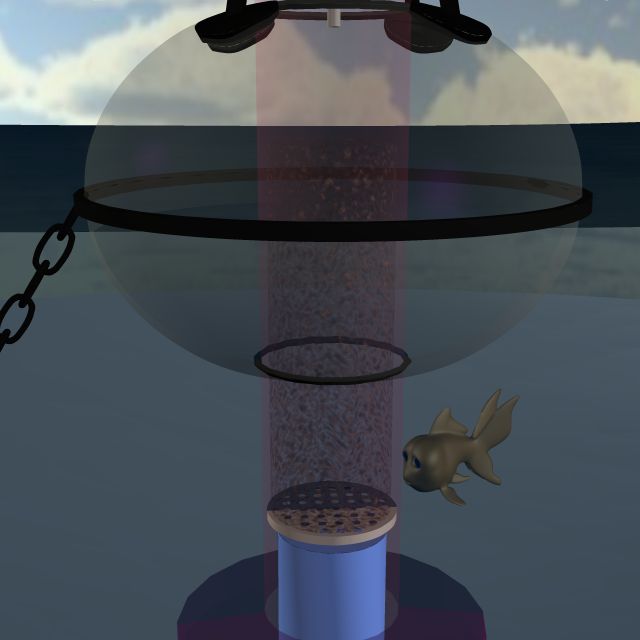 Raw carbide rocks can't drop through the screen, but water can pass freely.
Looking at the action in two stages: Before considering the feedback, here's the input variable. Tides and waves move up and down relative to the buoy because the buoy is anchored. The water inside rises with the input motion by hydrostatic pressure:
Raw carbide rocks can't drop through the screen, but water can pass freely.
Looking at the action in two stages: Before considering the feedback, here's the input variable. Tides and waves move up and down relative to the buoy because the buoy is anchored. The water inside rises with the input motion by hydrostatic pressure:
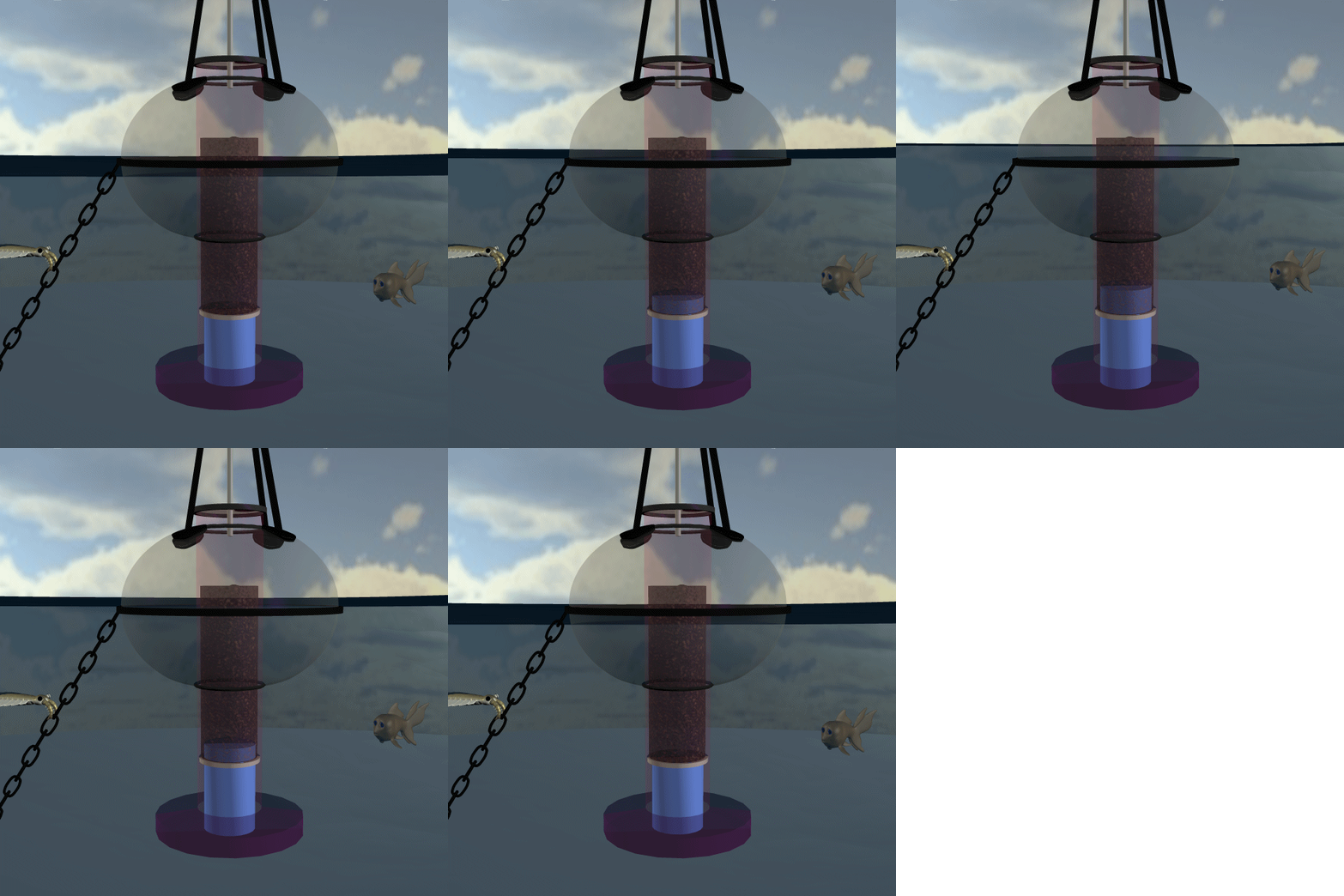 Now we add the feedback. When the water rises, more carbide rocks are bathed by water, so they start reacting and producing acetylene. The gas pressure above the water increases, pushing the water back down. Result: The water stays low, contacting only the rocks that are 'fresh' and ready for reaction. (I'm exaggerating for visibility. Negative feedback tends to keep the controlled variable steady, so in reality you wouldn't see much movement.)
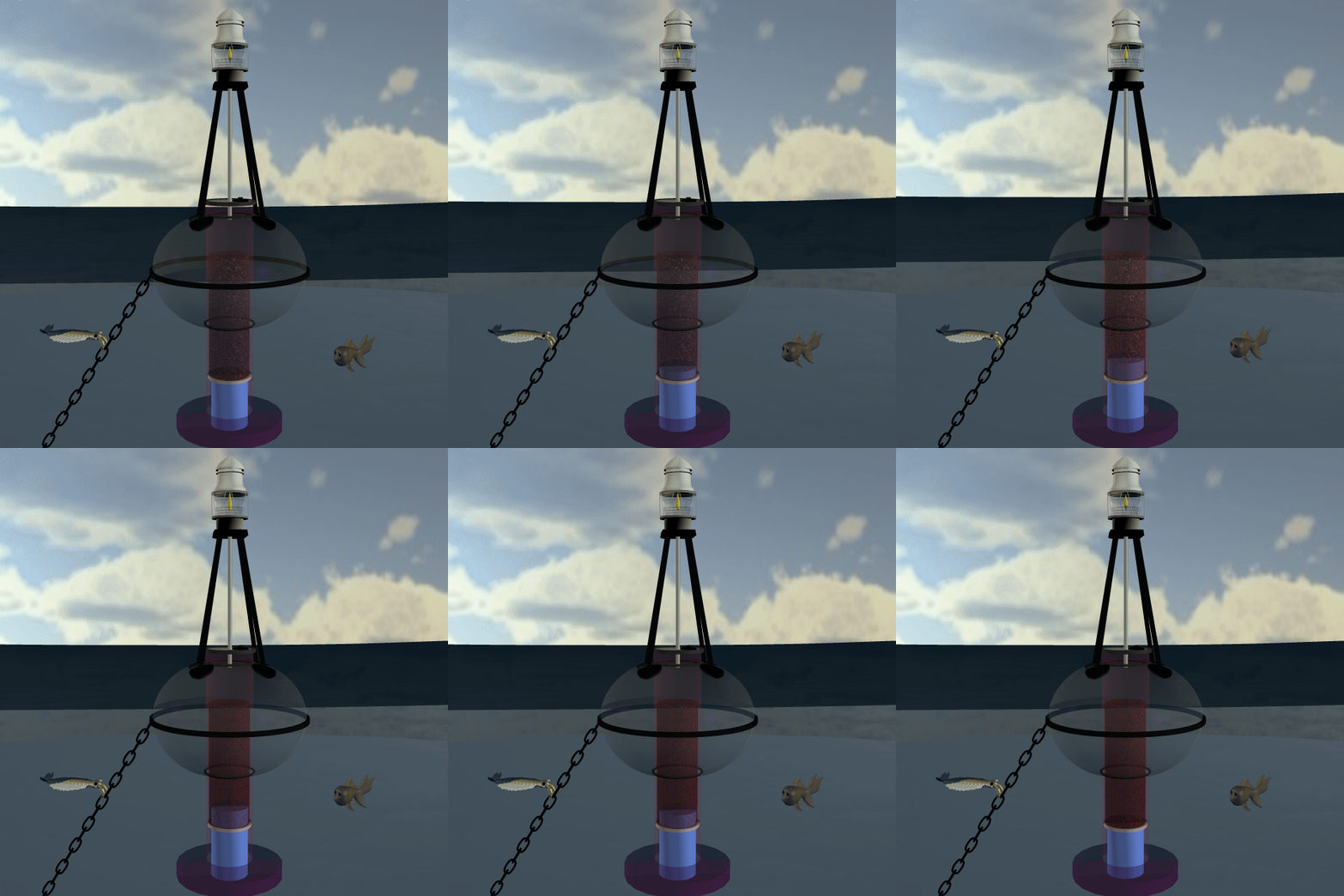 Best feedback of all: The slaked lime after reacting is slushy, not solid, and gradually washes off and falls down through the sieve, so the lower part of the solid rockpile is always fresh. No need for human intervention to clean the 'ashes'.
The Willson system worked splendidly and efficiently. The Canadian government found that they could visit each buoy to reload once a year.
Best feedback of all: The slaked lime after reacting is slushy, not solid, and gradually washes off and falls down through the sieve, so the lower part of the solid rockpile is always fresh. No need for human intervention to clean the 'ashes'.
The Willson system worked splendidly and efficiently. The Canadian government found that they could visit each buoy to reload once a year.
In 1911, he began experimenting with the condensation of phosphoric acid in the manufacture of fertilizers at a mill on Meech Creek within the park. Due to this venture and running out of capital, he lost nearly all of his estate to his creditor, American tobacco king J.B. "Buck" Duke. In 1915, he died of a heart attack in New York City while trying to raise funds for a hydroelectric project in Labrador. His dream was finally realized in 1974 as the Churchill Falls project.Should have stuck with acetylene. NYC is lethal. = = = = = His automatic buoy was a beautifully patient mechanism, with no gears or software or wires or moving parts. The sea water itself was the only moving part, and the elegant feedback resulted from the nature of the carbide reaction. Here's the buoy as seen from outside:
It has an air-filled float in the middle, anchored to the seabed. The long cylindrical chamber containing carbide passes through the float, with a counterweight or ballast at the bottom. A hole in the ballast admits water from below. Acetylene gas produced by the carbide reaction flows through a pipe to the lamp on top. (The lamp is standard, not inventive).
The basic problem: You can't let water surge in and soak all the carbide. You'll get a huge explosive reaction and use up the material fast. You need to expose just enough of the carbide to feed the lamp.
Willson's just enough solution starts with this screen or sieve near the bottom of the chamber:
Raw carbide rocks can't drop through the screen, but water can pass freely.
Looking at the action in two stages: Before considering the feedback, here's the input variable. Tides and waves move up and down relative to the buoy because the buoy is anchored. The water inside rises with the input motion by hydrostatic pressure:
Now we add the feedback. When the water rises, more carbide rocks are bathed by water, so they start reacting and producing acetylene. The gas pressure above the water increases, pushing the water back down. Result: The water stays low, contacting only the rocks that are 'fresh' and ready for reaction. (I'm exaggerating for visibility. Negative feedback tends to keep the controlled variable steady, so in reality you wouldn't see much movement.)
Best feedback of all: The slaked lime after reacting is slushy, not solid, and gradually washes off and falls down through the sieve, so the lower part of the solid rockpile is always fresh. No need for human intervention to clean the 'ashes'.
The Willson system worked splendidly and efficiently. The Canadian government found that they could visit each buoy to reload once a year.Labels: 1901, Patient things
¶ 3:15 PM
Monday, January 27, 2020
Good advice
I noted before that acetylene couldn't compete with electricity in urban or automotive uses, but it should have done better in off-grid and emergency situations.
An ad from 1912 Acetylene Journal tries to sell acetylene to farmers.
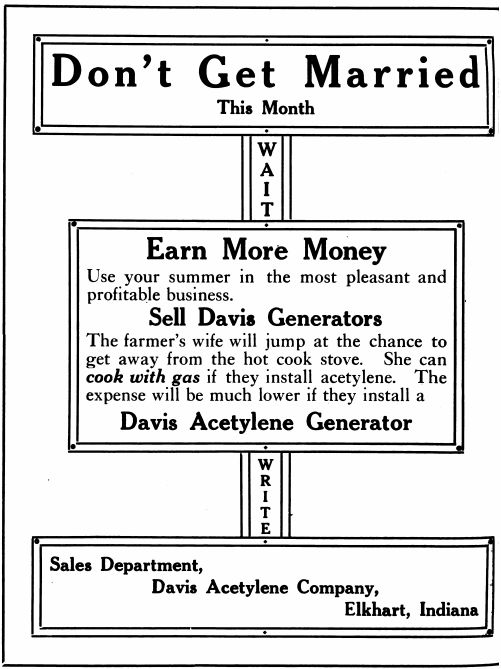 [An interesting piece of typesetting art, using slugs and rules and blocks to pull your eyes in two directions. You could turn it into a dynamic neon sign.]
The ad was good advice to the young salesman, and he would be offering good advice to the farm wife.
Electricity didn't arrive at most farms until after WW2, so the choices were coal, wood, kerosene or acetylene. Among those four, acetylene was the safest and cleanest and coolest. A wood or coal range is always hot and always consuming fuel. Kerosene is smelly and greasy and dangerous. Acetylene is inert until you turn the valve to let water drip on the carbide. Then you can open the burner valve and light the burner.
The generator took some maintenance, filling the carbide in the morning and emptying out the limestone after it was done, but the process was no worse than coal or wood ashes. The leftover material is slaked lime or hydrated lime, usable as aggregate in concrete, and a good fertilizer.
[An interesting piece of typesetting art, using slugs and rules and blocks to pull your eyes in two directions. You could turn it into a dynamic neon sign.]
The ad was good advice to the young salesman, and he would be offering good advice to the farm wife.
Electricity didn't arrive at most farms until after WW2, so the choices were coal, wood, kerosene or acetylene. Among those four, acetylene was the safest and cleanest and coolest. A wood or coal range is always hot and always consuming fuel. Kerosene is smelly and greasy and dangerous. Acetylene is inert until you turn the valve to let water drip on the carbide. Then you can open the burner valve and light the burner.
The generator took some maintenance, filling the carbide in the morning and emptying out the limestone after it was done, but the process was no worse than coal or wood ashes. The leftover material is slaked lime or hydrated lime, usable as aggregate in concrete, and a good fertilizer.
 Why did acetylene fail in this application? Still mysterious. Maybe the young salesman married the farmer's daughter.
[An interesting piece of typesetting art, using slugs and rules and blocks to pull your eyes in two directions. You could turn it into a dynamic neon sign.]
The ad was good advice to the young salesman, and he would be offering good advice to the farm wife.
Electricity didn't arrive at most farms until after WW2, so the choices were coal, wood, kerosene or acetylene. Among those four, acetylene was the safest and cleanest and coolest. A wood or coal range is always hot and always consuming fuel. Kerosene is smelly and greasy and dangerous. Acetylene is inert until you turn the valve to let water drip on the carbide. Then you can open the burner valve and light the burner.
The generator took some maintenance, filling the carbide in the morning and emptying out the limestone after it was done, but the process was no worse than coal or wood ashes. The leftover material is slaked lime or hydrated lime, usable as aggregate in concrete, and a good fertilizer.
Why did acetylene fail in this application? Still mysterious. Maybe the young salesman married the farmer's daughter.Labels: 1901, Patient things
¶ 1:53 PM
Tuesday, January 21, 2020
Rolls before Royce
Bumped into this while looking for more acetylene gadgets to "build"....
 From the article:
From the article:
The delights of winter touring by motor-car can only be enjoyed when accompanied with good fellowship, and when the keenness of cold winds is mitigated by great depths of fur and appropriate raiment. Provided with both essentials, the trio of motor-enthusiasts recognisable in the photograph recently participated in a tour from France to Wales, which was thoroughly enjoyed, and should add another demonstration to the attractiveness of the new means of locomotion for winter touring as well as for summer trips. The vehicle was an 8-h.p. Panhard car, and with it the party left Paris a few days before Christmas. Members of the Automobile Club will readily identify the three travellers, while those who are not within that organisation will be interested in the features of Mr. Roger Wallace, Q.C., the presidont of the club, who is to the left of the Hon. C. S. Rolls, to whom the ear belonged. Though the upturned collar prevents a full view of the latter's face, it gives some idea of the way in which the party were prepared for any climatic conditions. Seated behind is Mr. Frank H. Buller, treasurer of the Automobile Club.Rolls was a car dealer for a while before he joined up with Royce to build cars. Another picture shows Rolls piloting a Peugeot. There were plenty of English autos available at that time, but Rolls obviously preferred the French.
Labels: 1901
¶ 12:30 AM
Monday, January 20, 2020
A point long forgotten
From 1899:
A Springfield, Mass., contemporary. discussing the advance of the motor-vehicles in the United States, advances the opinion that it will "take the U.S.A. half a century of progressive road building and improved paving before any but the few largest cities in the United States could utilise motor-waggons for the ordinary purposes of traffic." Our contemporary continues :— "The recent tremendous snow-falls remind us that conditions are likely from time to time to arise in all northern cities under which the motorwaggons would be as helpless as a bicycle on a sandy road. It was more than 24 hours after the recent nine-inch snowfall in New York before even the main avenues of travel in the business section of the metropolis were cleared of snow, and it was several days later before the rest of the city proper was cleared, to say nothing of the other boroughs of Greater New York. The spectacle must have given Mr. Croker and the other would-be revolutionists of the trucking and passenger carrying business in New York a very bad half hour's reflections. If their plan had been effected and motorcarriages and waggons had entirely supplanted horse-drawn vehicles in this city, there could not have been a pound of freight or a single carriage passenger moved in the city for many hours, and the blockade of traffic and delay of business would have been perfectly intolerable."Needless to say, it still takes a long time to clear the snow from streets in a city. Our motor waggons have improved, but a good snowfall still stops all traffic for a day or two. Snow doesn't stop horses. = = = = = Looking up Mr Croker: He was the leader of Tammany Hall at that time.
Croker was in the newspapers in 1899 after a disagreement with Jay Gould's son, George Gould, president of the Manhattan Elevated Railroad Company, when Gould refused Croker's attempt to attach compressed-air pipes to the Elevated company's structures. Croker owned many shares of the New York Auto-Truck Company, a company which would have benefited from the arrangement. In response to the refusal, Croker used Tammany influence to create new city laws requiring drip pans under structures in Manhattan at every street crossing and the requirement that the railroad run trains every five minutes with a $100 violation for every instance.In other words, he wasn't really a prophetic lover of autos, he was a normal NYC businessman using blackmail to raise his Share Value.
Labels: 1901
¶ 12:01 AM
Saturday, January 18, 2020
Tired of winter
I really like the Great Smith Runabout that I added to the Smith set.
 I'd been wanting to make this type of vehicle for a long time, and it came out better than expected. Also, it's not common among existing old car models and may be unique. A quick scan of the DMI models and Renderosity and Daz finds coupes and roadsters and sedans, but no open-front runabouts.
Using it here as a graphic 'prayer' to the weather gods. Enough already. Let winter steam away and clear the crossing. Give us a break. Let it melt for a while.
Graphic sidenote: In most cases the judgment of an audience disagrees with the self-evaluation of the author or artist or teacher. Usually the creator is proudest of the products that the audience disdains, and the audience loves items that were produced hastily or incidentally. This inversion doesn't happen at ShareCG. Pretty consistently the best ratings go with the items I'm proud of, the items I continue using for pictures and animations. The items that I don't especially like, and don't use after making, get lower ratings.
I'd been wanting to make this type of vehicle for a long time, and it came out better than expected. Also, it's not common among existing old car models and may be unique. A quick scan of the DMI models and Renderosity and Daz finds coupes and roadsters and sedans, but no open-front runabouts.
Using it here as a graphic 'prayer' to the weather gods. Enough already. Let winter steam away and clear the crossing. Give us a break. Let it melt for a while.
Graphic sidenote: In most cases the judgment of an audience disagrees with the self-evaluation of the author or artist or teacher. Usually the creator is proudest of the products that the audience disdains, and the audience loves items that were produced hastily or incidentally. This inversion doesn't happen at ShareCG. Pretty consistently the best ratings go with the items I'm proud of, the items I continue using for pictures and animations. The items that I don't especially like, and don't use after making, get lower ratings.
I'd been wanting to make this type of vehicle for a long time, and it came out better than expected. Also, it's not common among existing old car models and may be unique. A quick scan of the DMI models and Renderosity and Daz finds coupes and roadsters and sedans, but no open-front runabouts.
Using it here as a graphic 'prayer' to the weather gods. Enough already. Let winter steam away and clear the crossing. Give us a break. Let it melt for a while.
Graphic sidenote: In most cases the judgment of an audience disagrees with the self-evaluation of the author or artist or teacher. Usually the creator is proudest of the products that the audience disdains, and the audience loves items that were produced hastily or incidentally. This inversion doesn't happen at ShareCG. Pretty consistently the best ratings go with the items I'm proud of, the items I continue using for pictures and animations. The items that I don't especially like, and don't use after making, get lower ratings.Labels: 1901
¶ 2:46 PM
Tuesday, January 14, 2020
Closing the Memory Hole
Exploring old tech journals helps to close the Memory Hole, helps to destroy the lies of Innovative Disruption. We have standard Shared Lies about every invention. Elon is taking the art to new heights. Every invention by Elon is NEW NEW NEW and NOBODY EVER THOUGHT OF IT BEFORE.
Four examples from just two months in 1914, from The Automobile.
1. On p 360 of the PDF, the Ruetschi full synchromesh gearbox. As I've noted with Smith, GM claimed to have the first sync in 1929. Smith had it in 1906, Ruetschi in 1914. In fact the Big Three didn't get FULL sync until 1963. Smith and Ruetschi had sync on all gears.
2. On p 443, an adaptive air suspension that automatically responds to load conditions.
3. On p 791, the Zeitler full automatic, with a selector knob that looks a lot like the HydraMatic selector. I've noted the earlier 1905 Sturtevant full automatic. Both well before the Innovative Disruptive 1940 HydraMatic.
4. Less important but still well before the Shared Lie. On p 358, this Duryea convertible had a fully concealed top and spare tires in the trunk. We normally believe that the '34 Airflow started the hidden spare trend, and the first concealed soft top was the '55 Tbird. The Duryea has nice graceful lines. Too bad they didn't slant the windshield.
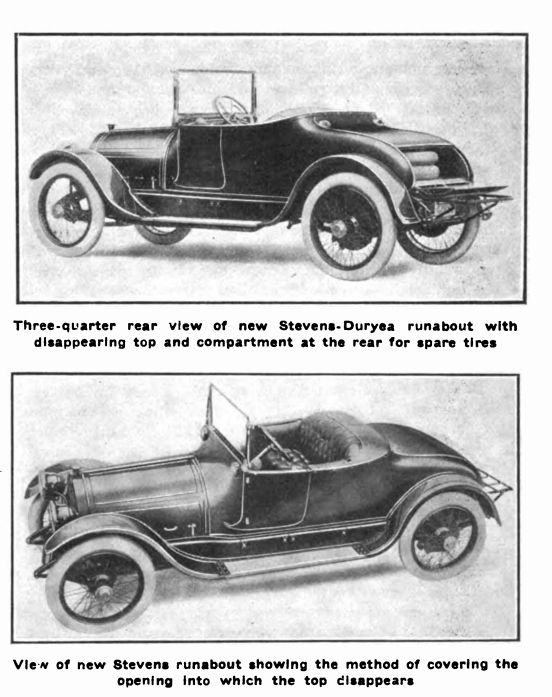 General observation: Most 1915 cars were trending toward smoothness and streamlining. The trend reversed after WW1, and most cars in the '20s were rigidly square and essentially identical. The trend toward smoothness and real variety restarted in '33 when the Depression forced automakers to think outside the rigidly square box.
General observation: Most 1915 cars were trending toward smoothness and streamlining. The trend reversed after WW1, and most cars in the '20s were rigidly square and essentially identical. The trend toward smoothness and real variety restarted in '33 when the Depression forced automakers to think outside the rigidly square box.
Labels: 1901, Shared Lie
¶ 3:10 PM
Sunday, January 12, 2020
More Great Smith after all
I decided that the Great Smith set wasn't done after all. There was another version I hadn't "built" yet.
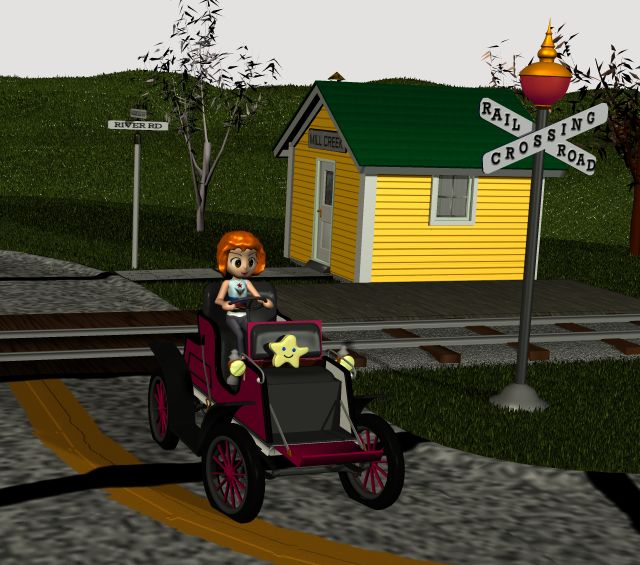 The runabout with openable front compartment is a type that wouldn't be practical now, but in the days when cars averaged 15 mph it would have been fun to drive and ride.
The runabout with openable front compartment is a type that wouldn't be practical now, but in the days when cars averaged 15 mph it would have been fun to drive and ride.Labels: 1901
¶ 12:00 PM
Acetylene world 2
Following on the prevalence and advantages of acetylene...
A picture from one of Floyd Clymer's books on the T.
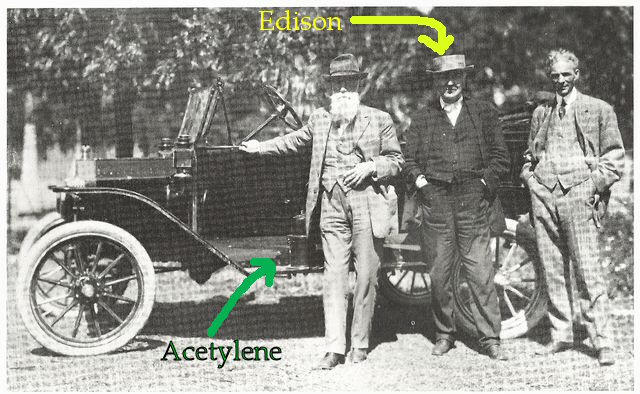 Henry with two of his friends, outdoorsman John Burroughs and Thomas Edison.
We know Edison as Mister Electric Light. We don't know anyone as Mister Acetylene.
Union Carbide is the counterpart to GE as systematizer and provider of material and machines, but Union Carbide didn't have any notable inventor/founder figures.
= = = = =
I hadn't heard of John Burroughs, so I sampled his writings. I'm not impressed. He was a good observer of Nature, but he constantly deleted his own clear and crisp observations and replaced them with Darwinist crap.
He marveled at a hemlock tree that had germinated on a partly floating log. The hemlock had formed roots that clasped the log, and sent out one 6-foot-long horizontal root into the soil on shore. Was this intelligence? If he had simply BELIEVED HIS OWN SENSES he would have said Yes. Instead, he CANCELED AND ERASED his own senses:
Henry with two of his friends, outdoorsman John Burroughs and Thomas Edison.
We know Edison as Mister Electric Light. We don't know anyone as Mister Acetylene.
Union Carbide is the counterpart to GE as systematizer and provider of material and machines, but Union Carbide didn't have any notable inventor/founder figures.
= = = = =
I hadn't heard of John Burroughs, so I sampled his writings. I'm not impressed. He was a good observer of Nature, but he constantly deleted his own clear and crisp observations and replaced them with Darwinist crap.
He marveled at a hemlock tree that had germinated on a partly floating log. The hemlock had formed roots that clasped the log, and sent out one 6-foot-long horizontal root into the soil on shore. Was this intelligence? If he had simply BELIEVED HIS OWN SENSES he would have said Yes. Instead, he CANCELED AND ERASED his own senses:
Henry with two of his friends, outdoorsman John Burroughs and Thomas Edison.
We know Edison as Mister Electric Light. We don't know anyone as Mister Acetylene.
Union Carbide is the counterpart to GE as systematizer and provider of material and machines, but Union Carbide didn't have any notable inventor/founder figures.
= = = = =
I hadn't heard of John Burroughs, so I sampled his writings. I'm not impressed. He was a good observer of Nature, but he constantly deleted his own clear and crisp observations and replaced them with Darwinist crap.
He marveled at a hemlock tree that had germinated on a partly floating log. The hemlock had formed roots that clasped the log, and sent out one 6-foot-long horizontal root into the soil on shore. Was this intelligence? If he had simply BELIEVED HIS OWN SENSES he would have said Yes. Instead, he CANCELED AND ERASED his own senses:
In the case of the little hemlock upon the partly submerged log, roots were probably thrown out equally in all directions; on all sides but one they reached the water and stopped growing; but on the land side, the root on top of the log, not meeting with any obstacle, kept growing. It was a case of survival, not of the fittest, but of that which the situation favored.Darwin himself wasn't blinded by Darwin's theories, and made clear observations and clever experiments in plant senses and plant intelligence. Biologists are just now starting to take off the theory goggles, starting to repeat Darwin's own experiments without DarwinIST distortions. = = = = = Sidenote: Though Edison's workshop never dealt with acetylene, there is a family connection. Edison's chief mechanic and model builder was John Kruesi. Edison sketched ideas and Kruesi turned them into practical patentable devices. Kruesi's son Paul ended up as head of American Lava, a major manufacturer of acetylene equipment.
Labels: 1901, Patient things, Smarty-plants
¶ 2:06 AM
Friday, January 10, 2020
Another Kansas car
Unlike the Great Smith, this one may have been a speculation that never produced anything. Still, it was an interesting car made in an unusual place.
The Great Smith was made in Topeka, which had some Detroit-style advantages thanks to the Santa Fe. Plenty of machine shops and foundries and industrial workers. Hiawatha is in the NE corner of the state but not close to St Joe or Atchison.
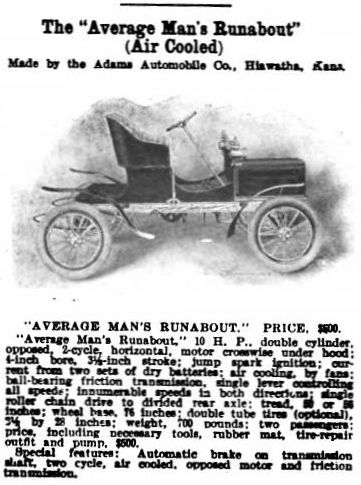 The Average Man's Runabout. Later marketers realized that Everyman's car is a used car, and also figured out that nobody wants to be Average. But both assumptions were forgivable in 1905.
About the same size as a Jeep or Nash Metropolitan, and VERY light at 700 pounds. Two-cylinder two-stroke aircooled transverse engine, with CVT and chain drive. It would have been easy to drive if it existed, and the price would have been comparatively easy at $500. (The Great Smith was a more realistic $2500.)
The Average Man's Runabout. Later marketers realized that Everyman's car is a used car, and also figured out that nobody wants to be Average. But both assumptions were forgivable in 1905.
About the same size as a Jeep or Nash Metropolitan, and VERY light at 700 pounds. Two-cylinder two-stroke aircooled transverse engine, with CVT and chain drive. It would have been easy to drive if it existed, and the price would have been comparatively easy at $500. (The Great Smith was a more realistic $2500.)
The Average Man's Runabout. Later marketers realized that Everyman's car is a used car, and also figured out that nobody wants to be Average. But both assumptions were forgivable in 1905.
About the same size as a Jeep or Nash Metropolitan, and VERY light at 700 pounds. Two-cylinder two-stroke aircooled transverse engine, with CVT and chain drive. It would have been easy to drive if it existed, and the price would have been comparatively easy at $500. (The Great Smith was a more realistic $2500.)Labels: 1901
¶ 2:35 PM
Wednesday, January 08, 2020
One difference
Random "thought", triggered by previous item about Y2K + 20.
The transition from Boomers to Millennials is a lot like the transition from the 1900 generation to the 1920 generation. The latter is usually called Greatest; the former doesn't have a common name.
In both cases the older generation stayed in control of business and government well after retirement, shutting out the younger generation from the expected succession of leadership.
When I started work in 1970, many small businesses were still owned and operated by the 1900 crowd, who were in their 70s. The Greatest folks were itching to take control, and by normal standards should have already been on top.
There's one difference.
After WW2 the 1900 folks recognized that the 1920 crowd had done most of the fighting in the war, and organized the government and economy to make life easy for the fighters. The 1920 folks were able to get free education and easy mortgages, and their jobs were well-paid and secure if not top-level.
Boomers are NOT doing the same favor for Millennials. Our TARP and offshoring knocked the Millennials out of the competition, while many of us are secure in management positions (eg corporate chairmen, Presidents, Senators and Blackrobes) with no fixed retirement age.
Labels: 1901
¶ 12:45 AM
Sunday, January 05, 2020
Great Smith: the factory
Continuing with the Great Smith project...
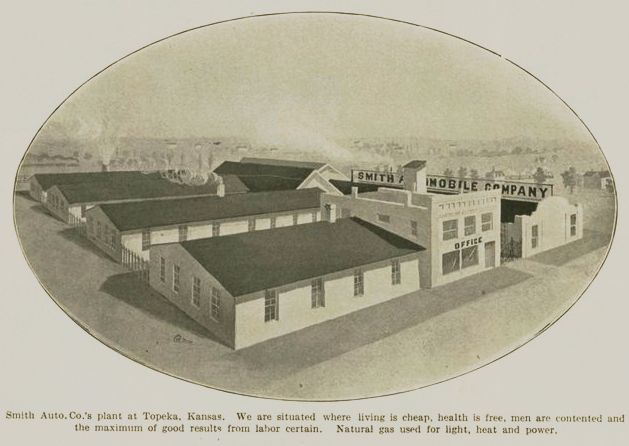
Here's the original artist's conception of the Smith factory in Topeka:
 And here's my version:
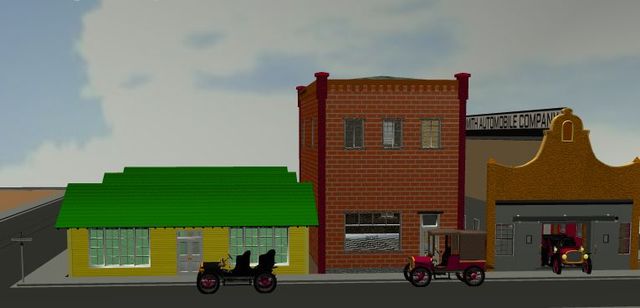 Based on verbal descriptions and partial photos, I think the original drawing was somewhat overblown but not pure fantasy. We don't have complete photos of the real factory, so I'm going with the conception.
Later, added a terrain and a train. Now the view agrees fully with the original, and shows the 'loop' and tracks and creek in their real-life positions.
Based on verbal descriptions and partial photos, I think the original drawing was somewhat overblown but not pure fantasy. We don't have complete photos of the real factory, so I'm going with the conception.
Later, added a terrain and a train. Now the view agrees fully with the original, and shows the 'loop' and tracks and creek in their real-life positions.
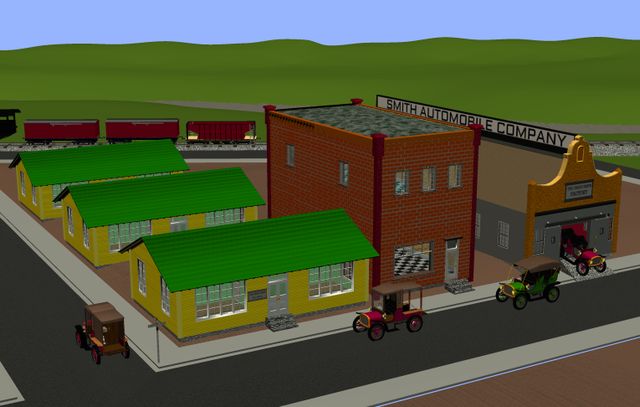 = = = = =
Links so far:
Noticed the item at KSHS, started studying.
Finished the touring car.
Finished the truck.
Sidebar on the truck's real use.
Sidebar on acetylene.
Finished the factory.
Added runabout.
And finally the released product at ShareCG.
This was a quick project. 16 days from conception to completion. Nowhere near as much detail as the Box Depots or Semaphores, but pretty decent authenticity.
= = = = =
Links so far:
Noticed the item at KSHS, started studying.
Finished the touring car.
Finished the truck.
Sidebar on the truck's real use.
Sidebar on acetylene.
Finished the factory.
Added runabout.
And finally the released product at ShareCG.
This was a quick project. 16 days from conception to completion. Nowhere near as much detail as the Box Depots or Semaphores, but pretty decent authenticity.
And here's my version:
Based on verbal descriptions and partial photos, I think the original drawing was somewhat overblown but not pure fantasy. We don't have complete photos of the real factory, so I'm going with the conception.
Later, added a terrain and a train. Now the view agrees fully with the original, and shows the 'loop' and tracks and creek in their real-life positions.
= = = = =
Links so far:
Noticed the item at KSHS, started studying.
Finished the touring car.
Finished the truck.
Sidebar on the truck's real use.
Sidebar on acetylene.
Finished the factory.
Added runabout.
And finally the released product at ShareCG.
This was a quick project. 16 days from conception to completion. Nowhere near as much detail as the Box Depots or Semaphores, but pretty decent authenticity.Labels: 1901, defensible times, Patient things
¶ 9:11 AM
Saturday, January 04, 2020
Acetylene world
After showing the Great Smith truck in food vending mode, I decided to make a proper accessory with shelves and hotplate.
The heat source would logically be acetylene, because the Great Smith already had an acetylene generator on board for its headlights.
Looking through Googlebooks, I found the Acetylene Journal from 1912. An alternate universe opened up.
We tend to think of acetylene as a welding gas, supplied in high-pressure cylinders, dangerous and hard to handle. This is a more recent way of using the gas. In 1906, acetylene was supplied on demand by generators using calcium carbide granules or rocks. Carbide is neutral and safe until you put water on it, and acetylene gas is non-toxic. (Plants love it.)
CaC2 + 2H2O → Ca(OH)2 + C2H2
On contact with water the carbide turns to limestone, and the acetylene gas is burned IMMEDIATELY, turning into CO2 and water, releasing heat and light. In these generators there's no storage of gas, no pressurized tanks.
I remember using a miniature acetylene generator in the 'hatlight' I bought for spelunking. The process was easy to control. A few drops of water gave enough acetylene for an hour of light. When not in contact with liquid water the carbide was just inert like rock salt. (This video shows the same lamp in use. These lamps are EXPENSIVE now! Wish I'd kept it.)
Big generators for town usage were available:
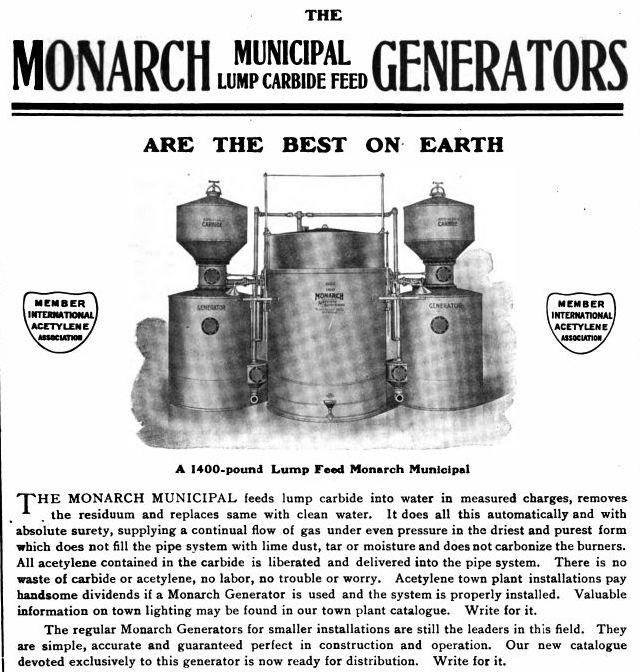 and smaller generators for cars:
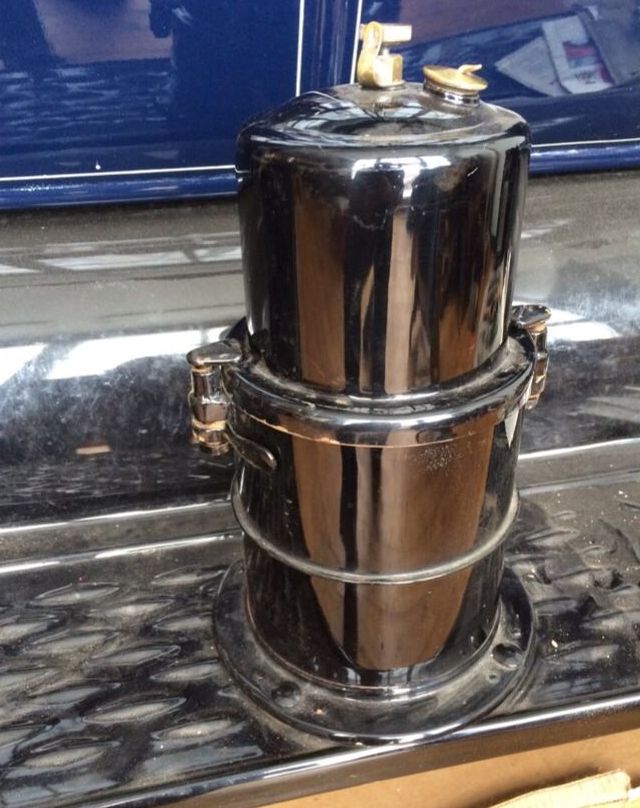 and free-standing lamps:
 and this thing:
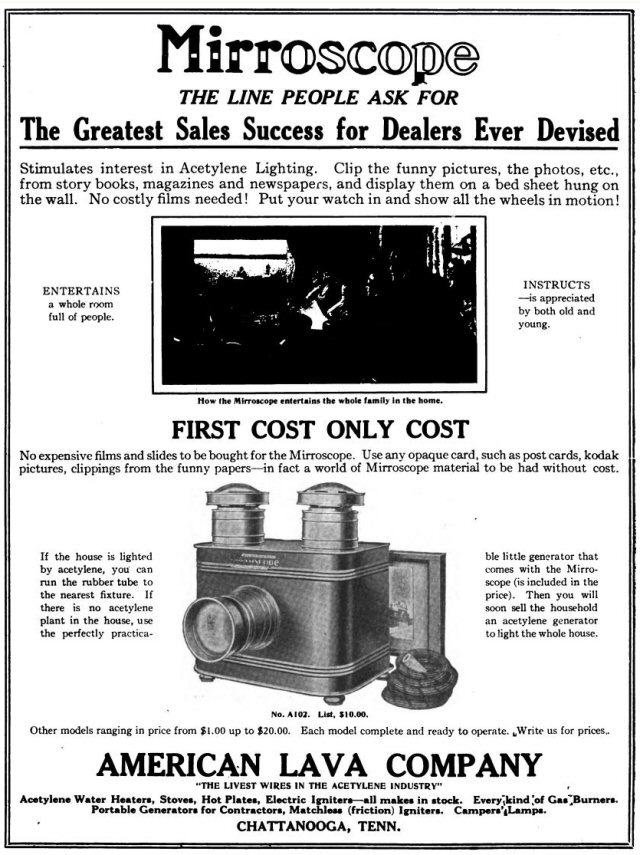 Why did low-pressure acetylene disappear? Most of the answer is wildly obvious. Nothing can compete with electricity for flexibility and ease of use. Cars and houses switched to electricity and never looked back. That's not the puzzle. The puzzling comparison is acetylene versus propane for emergency and off-grid heat and light. Propane won despite being far more dangerous and toxic.
and smaller generators for cars:
and free-standing lamps:
and this thing:
Why did low-pressure acetylene disappear? Most of the answer is wildly obvious. Nothing can compete with electricity for flexibility and ease of use. Cars and houses switched to electricity and never looked back. That's not the puzzle. The puzzling comparison is acetylene versus propane for emergency and off-grid heat and light. Propane won despite being far more dangerous and toxic.Labels: 1901, Patient things, storage
¶ 7:42 AM
Friday, January 03, 2020
Fast food first
A lively article on fast food by Addison Del Mastro tied in nicely with my Great Smith screen-side truck.
Del Mastro misses a big part of the timeline for fast food. He seems to think that fast food developed mainly as a result of American car culture, spurred by the Interstates.
Fast food and slow food developed together. If we're talking about food as a money-making business, fast food came first. Subsistence farms and feudal plantations have been around forever, but those weren't businesses. They worked on family and tribal loyalty.
Restaurants began as roadside stands serving refreshing drinks and hand-carried food for weary travelers. Restaurant = refresher.
Every culture has its own version of hand-carried food for workers and travelers: Pasties, pies, piroshki, papadzules, pemmican, Pop-tarts. (Most seem to begin with lip-smacking bilabial sounds!) The sandwich is a late and rather crude version of these self-contained edible packages.
Stand-up cafes were common near big factories and workplaces. In the vehicle era fast food vendors were often the drivers, not the drive-up window. Even now in big cities, lunch pushcarts do a good business.
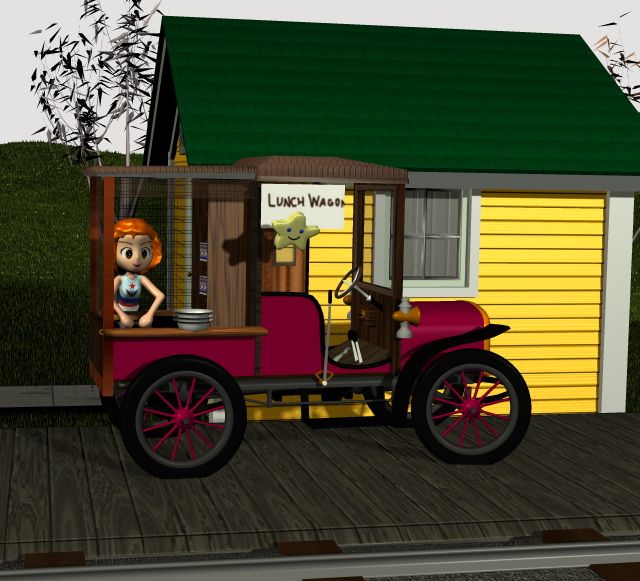
So here's the screenside Smith Truck in proper usage...
Labels: 1901
¶ 2:56 PM
Thursday, January 02, 2020
More Great Smith
Continuing to form up the advanced vehicles from the Smith Auto Co in Topeka.
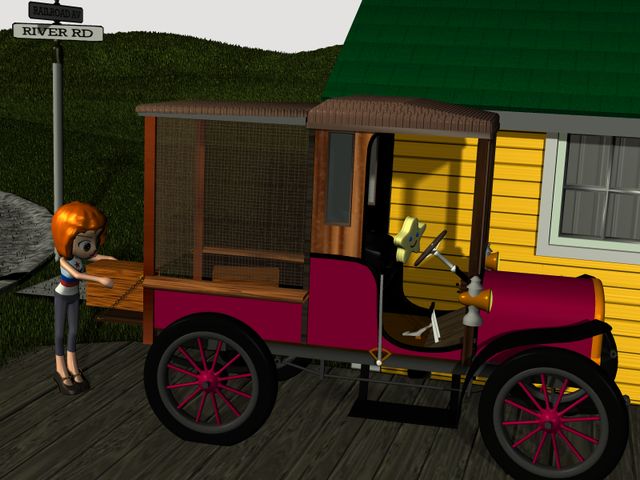 This is the truck version, typical of 'screen side' trucks in that era. These were meant to be mobile fast-food stores. Note the side shelves, serving as counters for the standup customers.
I've got all the details in now, including the unique rocker-style throttle and the synchromesh shift lever.
This is the truck version, typical of 'screen side' trucks in that era. These were meant to be mobile fast-food stores. Note the side shelves, serving as counters for the standup customers.
I've got all the details in now, including the unique rocker-style throttle and the synchromesh shift lever.
This is the truck version, typical of 'screen side' trucks in that era. These were meant to be mobile fast-food stores. Note the side shelves, serving as counters for the standup customers.
I've got all the details in now, including the unique rocker-style throttle and the synchromesh shift lever.Labels: 1901
¶ 3:26 PM
Sunday, December 29, 2019
Great Smith again
Following up on the item about the Great Smith, a surprisingly advanced car invented and made in Topeka.
Needless to say, I had to "build" one. This is far from finished; plenty of details and textures are missing or wrong; but Polistra wanted to try it out.
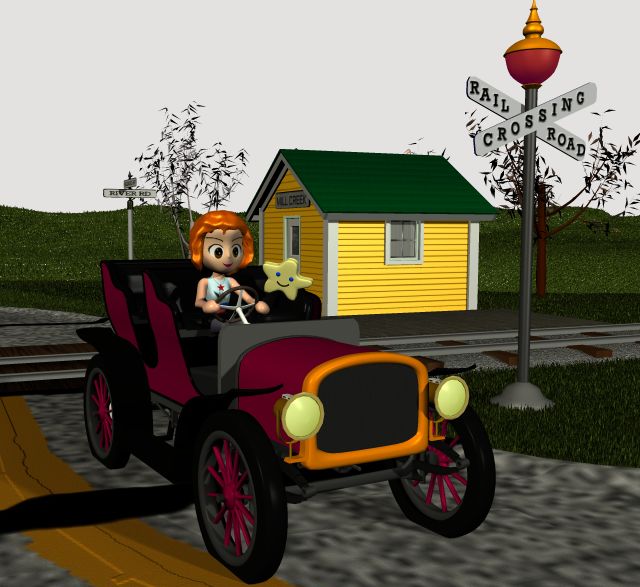 [Also, by tradition, I needed to take Polistra out of the predicament I depicted yesterday.]
Next up is the truck version, then the factory scene.
= = = = =
Tech sidenote: Forming up the engine focused my attention on a distinction that I had sort of noticed before. Before WW1 most cars had LOW hoods. After 1915, most cars had HIGH hoods and TALL radiators, giving the impression of a locomotive. The extra height wasn't needed for the engine, it was needed for the downdraft carburetor. The upper half of the engine compartment was empty except for the tall stack of carb and air cleaner.
[Also, by tradition, I needed to take Polistra out of the predicament I depicted yesterday.]
Next up is the truck version, then the factory scene.
= = = = =
Tech sidenote: Forming up the engine focused my attention on a distinction that I had sort of noticed before. Before WW1 most cars had LOW hoods. After 1915, most cars had HIGH hoods and TALL radiators, giving the impression of a locomotive. The extra height wasn't needed for the engine, it was needed for the downdraft carburetor. The upper half of the engine compartment was empty except for the tall stack of carb and air cleaner.
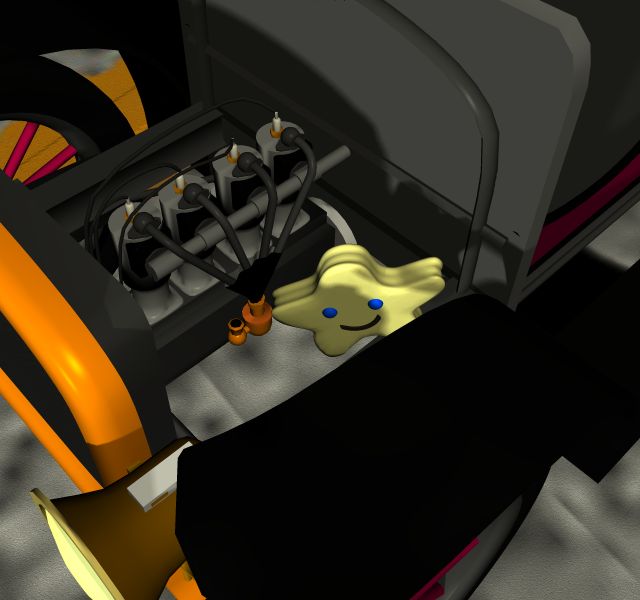 The Great Smith, built in 1906, had a little sidedraft carb way down below the intake valves. The cylinders were separate, and each cylinder had its own manifold pipe. When the intake valve opened, the cylinder had to suck the mixture upward on its own. This was probably inefficient but OK at the low revs of these long-stroke engines.
[Also, by tradition, I needed to take Polistra out of the predicament I depicted yesterday.]
Next up is the truck version, then the factory scene.
= = = = =
Tech sidenote: Forming up the engine focused my attention on a distinction that I had sort of noticed before. Before WW1 most cars had LOW hoods. After 1915, most cars had HIGH hoods and TALL radiators, giving the impression of a locomotive. The extra height wasn't needed for the engine, it was needed for the downdraft carburetor. The upper half of the engine compartment was empty except for the tall stack of carb and air cleaner.
The Great Smith, built in 1906, had a little sidedraft carb way down below the intake valves. The cylinders were separate, and each cylinder had its own manifold pipe. When the intake valve opened, the cylinder had to suck the mixture upward on its own. This was probably inefficient but OK at the low revs of these long-stroke engines.Labels: 1901
¶ 3:26 PM

